In my last post, Trump’s Misogyny – A Case for the Contempt-Oriented Personality, I wrote about disgust, claiming that media diagnosticians failed to identify disgust- contempt as part of Donald Trump’s psychological profile. At the end of the piece, I said that the statement “Make America Great Again” was misogynistic. I maintain this claim but now want to consider disgust a little more closely – particularly when it constitutes self-disgust underlying or complicit in misogyny. Confronting and ameliorating self-disgust provides an entrance into combating misogyny.
Self-disgust interferes with self-love. As a result, self-disgust impedes connection and empathy in human relationships. Self-disgust also attenuates intimacy –self and other directed. Self- disgust manifests in multiple ways – in withdrawal, refusal to engage, self and other directed violence, addictions (including those to negative affect), etc.: the list is a long one. Self-disgust which manifests as hubris motivates the projection of disgust onto others, so that the other becomes the source of disgust; the abject unwanted object present in the self – rejected and discarded –becomes transported, launched to rest on the back of another.
The simple way to describe this mechanism emerges in self-help literature that suggests that the thing that one dislikes most in others is that which one cannot tolerate in oneself. This negatively perceived part of self can also be conceptualized in terms of Carl Jung’s notion of the shadow – the unknown dark side of the personality which we all carry but whose integration into conscious life defines its denseness, or the weight of its impact. The more conscious we are of our shadow, the more we are able to identify that what we recognize as a deficiency in another is actually what we understand as a personal inferiority. Continue reading “Encountering and Countering Self-Disgust by Stephanie N. Arel”
Last week, I listened to an episode of Krista Tippett’s series On Being that featured an interview with poet Marilyn Nelson. I am not very knowledgeable about the world of modern poetry, but I am familiar with Nelson’s work. A couple years ago, I wrote about Fortune’s Bones: The Manumission Requiem, Nelson’s poetic composition about Fortune, an enslaved man whose owner rendered his body into a skeleton for medical training. Fortune’s identity and history had been erased across centuries as his remains were displayed. Community concerns eventually led to a multi-disciplinary academic, artistic, and community effort to honor the man and, in 2013, put his bones to rest. Isaye M. Barnwell, a musician formerly of Sweet Honey in the Rock, developed a cantata and choral work for Fortune’s Bones. These developed into a series of artistic performances and community events that demonstrate the power of art to speak through and for those who are marginalized—even in death. Disparate communities joined together to ponder Fortune’s life, and it was powerful.
In the On Being interview, Nelson spoke about “communal pondering,” and I’ve been repeating this phrase to myself since then. It identifies a form of creative activity and a spiritual way of being that I am deeply committed to, and have not been able to name. Communal pondering occurs when a group of people are listening together and are opening up new paths for discourse and action by the engaged reflection that takes place within that listening.
breathe me
compel my flesh to stir.
will new landscapes through
your pores.
dine upon my potent supplication.
peel the lonely longing from
your swelling desire.
partake of flaming majesty, while
speaking: yes, over and over and
over again, rising and falling in
love’s newly remembered caress.
breathe me in.
breathe me out. Continue reading “Agape: Inspiration and Word Made Flesh by Margot Van Sluytman”
During another week of killings, war, protests, and debates about whether Black Lives Matter or Blue Lives Matter, I’m concerned about the toll it takes on those who are witnessing the violence and fighting for justice.
I’m not on the front lines of these battles, but I can feel my energy draining, nonetheless. Over the past few days, while I’ve stayed informed about the latest tragedies and conflicts, I’ve intentionally limited my exposure to most news and social media outlets. I’ve begun preparing for a contemplative retreat with other women who also care about justice. For me to continue to participate in any effort of transforming society, culture, or the church, I must nurture my mind, spirit, and body.
Audre Lorde put it like this:
“Caring for myself Is not self-indulgence. It is self-preservation, and that is an act of political warfare.”
Self-care is a radical practice of self-love. It is absolutely necessary when engaged in conflict against those who do not show love to you, or worse, those who seek to destroy you. Your survival and your flourishing are defiantly brave. Self-care honors the God who created you, the One who loves you, and the Spirit who sustains you. Continue reading “What My Mothers and Mentors Taught Me about Self-Care by Elise M. Edwards”
‘Someone needs to gather the stories, to keep the cauldron,’ said the late Goddess feminist artist Lydia Ruyle during one of the last times we spoke, at the 2014 Glastonbury Goddess Conference. I had hinted at my concerns around conducting doctoral research in the presence of ongoing conflict within the Glastonbury Goddess community (especially when my broadly-stated site of interest is ‘politics’), and in reply she had stressed the need to ‘hold space’ for the different voices and perspectives in the UK Goddess movement, and that conflict would be inevitable. ‘There needs to be a weaver,’ she said.
The following day I recorded an interview with Lydia and some of her friends at Café Galatea on the High Street, which she had been keen to ensure since the previous summer—with poignant foresight, given her death in March 2016. I’m not sure if she was expecting that I should fully take on the role of this ‘weaver’—there are more stories than one PhD thesis can claim to encompass—but the theme is present in my writing. Her words lead me to reflect on the weaving together of politics with memory and storytelling, and on the need to honour the plural histories of the British Goddess movement. Continue reading “Goddess Politics and the Cauldron of Memory by Kavita Maya”
I’m currently developing a book that considers how theological and ethical considerations in architectural design can define good architecture. My book discusses five virtues related to the architectural design process that promote human participation in bringing out God’s intention of flourishing for humanity and creation. Those five virtues (or values) are: empathy, creativity, discernment, beauty, and sustainability. In the book, I’ll explain how these virtues orient design tasks to the social and ethical aims of architecture.
In this virtual space, I want to have a discussion about what these virtues mean from a feminist standpoint. In my writing, I draw from theological ethics, architectural theory, and feminist theory to emphasize community discernment and participation. It’s fitting, then, to claim opportunities in my work to acknowledge the feminists who have influenced me while also opening up the dialogue to the feminists in this community who continue to inspire and guide me to do my best work. Continue reading “What Dorothee Soelle Taught Me about Creativity by Elise M. Edwards”
The pieces of my dissertation are beginning to float to the surface, piece by piece, released into the world as smaller parts of the whole. At some point this all may become a book, but for now, I have enjoyed the opportunity to share some of the learning from my dissertation research in book chapters, articles, and blog posts, which I’d like to share with you all so that you can see some of what I’ve been up to these days.
The most recent piece that has come to be is an article on The Listening Guide, the particular method of narrative analysis I used to analyze the transcriptions of the interviews I conducted with participants of Emerging Church congregations. I’m particularly excited about this piece because I think it could be a useful tool to many of us in our respective fields of study and work. And although my particular context is theological and, even more specifically, Christian, as a tool and method, The Listening Guide can be used for reflection and be of great value in a variety of contexts. Continue reading “Updates on Listening by Xochitl Alvizo”
If you ever eavesdrop on a conversation between my husband and me around the clamor of our four children’s voices, you will probably hear me making a tired lament: “All I want is a broad swath of uninterrupted time.” In listening to Elizabeth Gilbert’s newest book, Big Magic, on audio book I was interested by her mention that many creative people lament not having long stretches of uninterrupted time available in which to work. She quotes a letter from Herman Melville to Nathaniel Hawthorne, lamenting his lack of time and how he is always pulled “hither and thither by circumstances.” Melville said that he longed for a wide-open stretch of time in which to write. She says he called it, “the calm, the coolness, the silent grass-growing mood in which a man ought always to compose.”
…I do not know of any artist (successful or unsuccessful, amateur or pro) who does not long for that kind of time. I do not know of any creative soul who does not dream of calm, cool, grass-growing days in which to work with- out interruption. Somehow, though, nobody ever seems to achieve it. Or if they do achieve it (through a grant, for in- stance, or a friend’s generosity, or an artist’s residency), that idyll is just temporary—and then life will inevitably rush back in. Even the most successful creative people I know complain that they never seem to get all the hours they need in order to engage in dreamy, pressure-free, creative exploration. Reality’s demands are constantly pounding on the door and disturbing them. On some other planet, in some other lifetime, perhaps that sort of peaceful Edenic work environment does exist, but it rarely exists here on earth. Melville never got that kind of environment, for instance. But he still somehow managed to write Moby-Dick, anyhow.
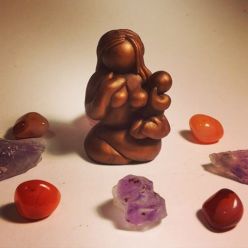
When I create a new sculpture, I am most often creating something that I need to remember or want to learn. The original figures for my Centered Mama sculpture and my Meditation Goddess sculpture were both created while at a friend’s house for a weekend work exchange as my baby toddled around. While I love making figures of mothers and babies, I was feeling a strong urge to make a goddess representation complete unto herself. It felt like a reclaiming of my non-maternal identity and a declaration of self-sovereignty. She turned out a little bigger than some of my other figures, strong and secure and independent. Then, the baby crawled over and knocked off one of her breasts, knocked her over on the tray, smashing the side of her head. I came close to crying. I felt annoyed with my husband who’d “let” him come over and destroy my work rather than noticing him doing it and stopping him. I was frustrated, dismayed, and my feelings felt hurt in a sense. First I felt like, Argh! This is a metaphor for life! And, then I realized it was not just a metaphor for life, it is my actual life! I pouted a bit and said I was just going to smash her and give up and I made some bitter faces at my husband and some long-suffering huffs and signs, but then the baby fell asleep in the Ergo, held close against my chest. I kissed his soft hair and I took my clay and started again. I reclaimed her from the smashed parts and she sat stronger and taller than ever.
She reminds me not to give up and that beautiful work can come from struggle, but also of interdependence (not just the independence I was going for!), co-creation, and tenacity. When the finished version of her, cast from the original sculpt, sits by my bed at night or overlooks my dinner preparations, she reminds me that I am strong and that persistence is worthwhile. She also tries to remind me to be calm and steady, centered and Zen, even though I more often feel like a whirlwind.
That same Saturday at my friend’s house, as my baby tentatively toddled around the kitchen, chewed on a piece of watermelon, and snoozed on my chest, I felt moved to begin creating a new Centered Mama sculpture. I had been going through an emotional rough patch, feeling buffeted by variable emotions and erratic and unpredictable in my enthusiasm and confidence. I was also feeling impatient, snappy, and irritable.
“I will be gentle with myself. I will be tender with my heart. I will hold my heart like a newborn baby child.”
This song by Karen Drucker replayed in my mind as I sculpted. The baby woke, the watermelon got dragged along the floor collecting dust, and it was time for our collaborative dinner, so I had to put her away unfinished. When we got back to our own home, I was compelled to finish her, working feverishly as the baby pulled on my legs and I said, “just a few more minutes!” to the older kids who were trying to play with him to let me work. Again and again I re-rolled the clay baby’s head, trying to make it “perfect,” and worked to lay down the strands of her hair, against of the backdrop of this often-chaotic, noisy, home-based life we’ve consciously and intentionally created together. She was created to represent holding my own center in the midst of motherhood. I will be tender with my heart. I don’t create sculptures like this because I AM so “Zen” and have life all figured out, I make them to remind me what is possible if I listen to my soul.
As I do extensive rearranging, construction, and reconstruction on my slowly ongoing dissertation project, I typed out a quote from the book Priestess: Woman as Sacred Celebrant by Pamela Eakins about her past life memories of making clay goddess figures as a temple priestess:
…to me it brought a continuation of the energy of the sacred objects of the grandmothers. I contained this energy in a new form in the dolls that would be placed upon the altars and in the graves of the daughters living now and the daughters to come…
I felt this process made my own clay stronger, too. Some of the pieces cracked in the fire because of the added ‘impurities’…but, in this case, I felt the impurities were the purest of pure and I worshipped each crack knowing the crack contained the wisdom of the priestesses who had occupied the doll-making table for more moons than I could even imagine. It contained too, the devotional energy of every grandmother who had held it in her hands or placed it on her altar. Sometimes ‘impurities’ sanctify further that which is holy to begin with.
While I tend to have a knee-jerk skepticism about past-life memories, there is something in Eakins’ words that I know at a bone-deep level as I do my own work with goddesscraft:
…Each goddess was imprinted with the sound of sacred life coursing through the Universe. I changed with the priestesses as the figures came through my hands. Each doll received the sacred vibration of life…For seventy-seven moons I made the dolls at the long table with the young Sisters of Nun. My hands were so fast. I made thousands of figures: beautiful little faces, etched collars of gold plates, pubic hair swirled into tiny rows of connecting spirals. They were so precious. At the end of the day, my baked clay shelves were covered with little women.
The clay goddesses healed…
This is how I apprenticed. I learned, in this manner, the art of healing. I learned that to heal means to make whole, and that becoming whole involves learning many levels of purification, balance, and reformation” (p. 32-33).
In Anne Key’s marvelous priestess memoir, Desert Priestess, she makes this important point: “It is of course no small wonder why graven images are so tightly controlled by religious traditions.” (p. 52) Sometimes I feel like this is what I’m tapping into when I make my own goddess sculptures—a resistance to tight control over graven images and over personalization of divinity as male.
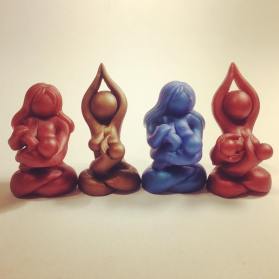
I occasionally get requests to make bigger goddesses–-people ask about figures that are large altar pieces 12-18 inches tall or taller. The goddesses I make are all about three inches tall and there’s a reason for that: they fit in the palm of my hand. When I create them, I feel as if I’m part of an unbroken lineage stretching back 30,000 years to the person who carved the Goddess of Willendorf. I feel connected to the priestesses of the Mesopotamian temples who sculpted hundreds upon hundreds of tiny clay goddesses. Someone commented on my sculptures once saying, “echoes of Mesopotamia.” And, I said, “exactly.” I feel the connection between the clay in my hand and the clay in their hands, running through the ripples and eddies of time.
I’ve been inspired recently to re-read Starhawk’s The Spiral Dance, finding new bits of wisdom from it that speak to something different in me than they did the first time I read it. She writes of the attempts to discredit Goddess religion by invalidating the historical narratives or archaeological evidence: “The idea seems to be that if they can disprove our origin story, they can invalidate our spirituality…Is Buddhism invalid if we cannot find archaeological evidence of Buddha’s existence? Are Christ’s teachings unimportant if we cannot find his birth certificate or death warrant?…the truth of our experience is valid whether it has roots thousands of years old or thirty minutes old…a mythic truth whose proof is shown not through references and footnotes but in the way it engages strong emotions, mobilizes deep life energies, and gives us a sense of history, purpose, and place in the world. What gives the Goddess tradition validity is how it works for us now, in the moment, not whether or not someone else worshipped this particular image in the past” (p. 4).
The ancestry of my goddess sculptures may not be the same energy that raised temples and built monuments (or walls), it is the energy that carried a baby on one hip and a basket of supplies on the other and needed a goddess just the right size to tuck down the front of a shirt…
Sometimes I describe my life in the woods as being held in the hand of the goddess. And, I make goddesses that I hold in my hand. Am I in the palm of her hand or is she in the palm of mine? The answer is both.
(One of my all-time favorite fan photos–a rainy day traveling goddess picture, taken by my friend/SIL (this one is only an inch tall, but look how she calls in the waters of the world!)
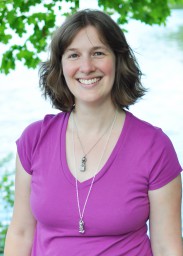
Molly has been “gathering the women” to circle, sing, celebrate, and share since 2008. She plans and facilitates women’s circles, seasonal retreats and rituals, mother-daughter circles, family ceremonies, and red tent circles in rural Missouri. She is an priestess who holds MSW and M.Div degrees and she is finishing her dissertation about contemporary priestessing in the U.S. Molly’s roots are in birth work and in domestic violence activism. She has worked with groups of women since 1996 and teaches college courses in group dynamics and human services. Molly is the author of Womanrunes: a guide to their use and interpretation, Earthprayer, Birthprayer, Lifeprayer, Womanprayer, and The Red Tent Resource Kit, as well as three social service oriented booklets and a miscarriage memoir. She has maintained her Talk Birth blog since 2007 and writes about thealogy, nature, practical priestessing, and the goddess at her Woodspriestess blog. Molly and her husband Mark co-create original birth art, goddess sculptures, ceremony kits, and pendants at Brigid’s Grove.
I have called it, The Terrible Transition Year, this year of finishing dissertation, uprooting from home, moving cross-country, and starting a new full-time teaching job. Last year at this time I was in LA for a 7-8 week stay, away from home – which at the time was in Boston – writing dissertation nonstop. I spent the holidays apart from my family and shared in none of my traditional holiday celebrations as I intensely pushed forward to complete the dissertation. After (seemingly) endless edits back and forth with my advisor and second reader, I finished the dissertation just in time to successfully defended it in May.
During most of this dissertation-writing time, I never had the sense that there would be a successful end to it all. I wrote and submitted each chapter-draft always with the underlying fear that I would be told my work was unworthy, my logic lacking, and my thesis unsubstantiated. So I vividly remember the moment (I can actually still feel it) when I got definitive affirmation that my dissertation would reach a successful end. I remember the shock, the relief, and the physiological rush that coursed through my body as I read the words of approval that came in response to my last chapter. I remember my body shooting up off the chair and saying, “No!” as I read the email. It was a “No” of disbelief, as in “Can this really be?!” And it was. And only at that point did I believe my dissertation would be successful. Continue reading “My Terrible Transition Year and the Return of my Humanity by Xochitl Alvizo”
“I was born in a strange little country town that may be like all other country towns, but I do not know. It was the world I was born to. The world is such a place that you need special things to understand it. I do not think I am a fool, but I do not understand life. It is like I am always standing in the dark somewhere. It could be on the edge of a cliff by a deep ravine… Or on a flat piece of all the land in the world… and I would not know. I would not know whether to step stand still. Either one could be a danger… When I am alone. Some lives are like that. Depending on the kindness of everybody.”
-from “Feeling for Life “ in Some Soul to Keep by J. California Cooper
In my previous post, I wrote about the truths we learn from black women’s literary tradition and from listening to the stories of those we too often ignore. Continuing that reflection over the next few months, I’d like to share some of the lessons from J. California Cooper’s short stories. The quote above is taken from the opening paragraph of one of her works.



 ‘Someone needs to gather the stories, to keep the cauldron,’ said the late Goddess feminist artist
  The pieces of my dissertation are beginning to float to the surface, piece by piece, released into the world as smaller parts of the whole. At some point this all may become a book, but for now, I have enjoyed the opportunity to share some of the learning from my dissertation research in book chapters, articles, and blog posts, which I’d like to share with you all so that you can see some of what I’ve been up to these days.
 “If there is one chant in the universe it is to create.”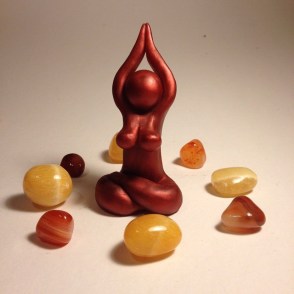
 inches tall or taller. The goddesses I make are all about three inches tall and there’s a reason for that: they fit in the palm of my hand. When I create them, I feel as if I’m part of an unbroken lineage stretching back 30,000 years to the person who carved the Goddess of Willendorf. I feel connected to the priestesses of the Mesopotamian temples who sculpted hundreds upon hundreds of tiny clay goddesses. Someone commented on my sculptures once saying, “
 I have called it, The Terrible Transition Year, this year of finishing dissertation, uprooting from home, moving cross-country, and starting a new full-time teaching job. Last year at this time I was in LA for a 7-8 week stay, away from home – which at the time was in Boston – writing dissertation nonstop. I spent the holidays apart from my family and shared in none of my traditional holiday celebrations as I intensely pushed forward to complete the dissertation. After (seemingly) endless edits back and forth with my advisor and second reader, I finished the dissertation just in time to successfully defended it in May.
 Feminism and Religion