The Roman authorities executed Jesus for sedition because he posed a threat to their hegemony: their wealth and their oppressive, imperial domination system of exploiting others for profit. Jesus spoke out against their injustice, and his message resonated with the 99%. People were beginning to listen; momentum was growing. So the Empire snuffed out that “Rebel Scum” in their most excruciating, punishing, degrading form of execution. According to the logic of imperial domination, Jesus’ death should have been a humiliating, final defeat.
Instead, his movement lived on and on, grew and grew. The symbol of Imperial execution — the cross — should have symbolized the wrongness, the lack of Divine sanction, the complete Divine rejection of Jesus’ ideas, according to Empire. Instead, the Jesus Movement reclaimed the cross from an Imperial symbol of shame and turned it into a symbol of victory. Paul, the feminist liberationist prophet most responsible for the survival and spread of the Jesus Movement, repeatedly wrote that the Jesus Movement follows Christ Crucified. Paul’s message seemed scandalous and confusing— lifting up a symbol of horror, death, and defeat as proof of victory? Why? How?
A few days ago, a Greek friend told me she was going to bring holy water from a church so that we could bless my house. Ever since I moved to my new apartment in Heraklion, I have intended to do a house blessing, following rituals I learned from Z Budapest. But with unpacking and settling in interrupted by illness, I never got around to it. I did burn frankincense early on to clear out vibes left by the previous inhabitants of my space, but nothing more. I have slowly made the house a home, but I have been waiting for the renovations to be finished before doing a final blessing. As I still anticipate remodeling the kitchen island, I did not proceed.
Before my friend arrived, I incensed the house again, musing that now that I have finished my chemotherapy and am on the road to recovery, it is high time to clear out all the lingering feelings and memories of the time I was very ill. When my friend arrived bearing a small plastic bag filled with water from a church spring, she asked if she could water the plants on my balcony. I had watered them the day before, but I didn’t mention that.
Announcing that she loved to play with water, she doused the plants, then hosed the balcony tiles and sprayed the windows which were covered with dust following a recent dirty rain. As there are balconies surrounding all of my rooms, that completed the cleansing. Watering the plants signaled the renewal of life.
Even though I was a late-comer to the Netflix series The Crown, when I did watch it, I was riveted. Lots of thoughts ran through my mind at this picture of royalty. The concept of royalty in human history is vast and multi-faceted, however in this blogpost I am only pulling on a few threads that tugged at me as I watched this show.
I laughed as people greeted the Queen and said, “your highness.” Does that make the rest of us lownesses? And where did all this pomp come from anyway? And why is the British monarch the head of the Church of England which is a bible-based Christian religion?
Monarchy, religion and war have always seemed so connected in our culture. Indeed, during the coronation of Queen Elizabeth, she was handed “the sword of state” as if she would actually be using it. (I looked it up, true to the ceremony). Continue reading “Musings on The Crown by Janet MaiKa’i Rudolph”
This morning, I walked around the field and discovered three soft white breast feathers of an unknown bird, two earthstar mushrooms, sinking quietly back into the soil, one tiny snail shell, curled in spiral perfection, and the fire of my own spirit burning in my belly, rekindled by elemental magic of the everyday kind, the small and precious gifts of an ordinary day.
Every January, we rent a house on Dauphin Island and spend the month at the beach with our kids. Usually, we pack our business along with us and work from the rental house, though this year my sister kept it running from our home studio in Missouri instead. My husband describes this month away as the “weekend of the year,” and this is, in fact, how it feels, except for unlike most normal weekends, we walk five miles by 8:30 a.m. each morning. We joke that this is one of the best ways to know we’re on “vacation.” During one month of walking, we will log more than 300,000 steps together, this time away from home allowing us to pare back the layers of to-dos that build up each year, to re-prioritize our goals, to re-sync ourselves with what we most value, and to breathe deeply back into ourselves again—our hearts, our hopes, our dreams—after the hectic holiday season. Since we are self-employed, we never wake to an alarm clock at home, but while on our sojourn away, always motivated by the prospect of finding good shells, we set the alarm for 5:00 a.m., rising to the voice of Kellianna singing “I Walk with the Goddess” as we set off in the darkness to the uninhabited beach down the road. This year, due to hurricane damage and the resultant road work and beach restoration work in progress, the only way to reach our favorite walking spot is to rise before the road crews do and get out and back before the access road is closed to traffic for the work day.
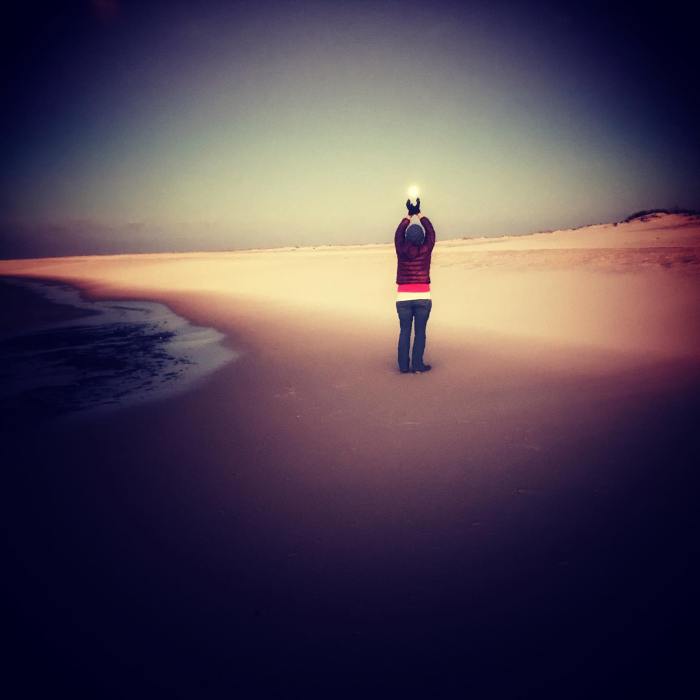
We walk before dawn, our faces glimmering palely beneath a full moon. Our shell finding has been slender on this trip, the beach often swept clean by waves, but on this day, lit only by full moonlight, I finally catch sight of a big brown moon snail shell, half-buried in the sand. My favorite type of shell and, discovered on a full moon, no less! My husband’s foot comes down upon it as I grab his arm to stop him, but then I seize it with glee, undamaged and smooth in my hand. Though I have previously written that I expect no reward for devotion, sometimes it is, in fact, delightful to receive a reward anyway, especially on a dark beach with only moonlight as my guide. We spot two glowing eyes a few feet away and a fox keeps pace with us, pausing to sit and watch as we make our steady way along the shore. The sky lightens to rainbow stripes as the first flares of dawn begin to glow with eastern fire. I stand with my arms extended, the fingertips of one hand reaching for the moon while the other hand reaches for the sun, the waves lapping at the shore, the wind at my back. I feel held, suspended in eternity, small and rapturous, balanced at a centerpoint of time, inhabiting the liminal, poised within a living strip of space between land and sea, earth and sky, wind and sand, dawn and dusk, motion and stillness. Behind me, the fox moves swiftly away across the sand under a rainbow sky.
I reflect as I continue to walk, murmuring the Charge of the Goddess below the moon, that these are my favorite kinds of rituals, the most powerful kinds of ceremonies, the truest expression of magic in my life and days.
On the winter solstice this past year, I carried a blanket out to the field in front of our house. I brought along my Womanrunes cards so I could do an annual oracle card layout for the year. I carried my journals and my planner and some of our small goddess figurines. Rather than sit on the blanket and dream about the year to come, busily scribbling notes and ideas in my planners as I had envisioned, instead I lie flat on my back on gazing at the sky. I became aware as I was lying there, breath slow in my belly, that I could see the moon on my right hand side and I could see the sun getting closer to setting on my left hand side. Then, I became aware that the birds were at my feet at our bird feeder by the studio building. Next, I became I aware of the cedar trees above my head, at the far side of the field. Lying there, feeling the earth beneath me, the sensation struck: I’m surrounded by the elements. I’m surrounded by all these aspects of magic, right now, no elaborate solstice ritual required. Though I made sun bread with my children and we held our traditional candle lit winter solstice ceremony and spiral walk, these moments lying on my back in the field were my ritual, my ceremony, the fullest expression of a living spirituality for me. Magic need not need to be fancier or more elaborate or more planned out than this, I think. It can mean lying on your back in a field and feeling the presence of the living elements around you, carrying you, holding you, supporting, nourishing, restoring, revitalizing, and, in a way, rebirthing you into awareness.
When I rose from my blanket to work on my plans, I noticed the way the rapidly setting sun was peeking through the trees and I decided to take a picture of one of my goddesses there with the last rays of the solstice sun shining behind her. As I squatted down to take the picture, I saw that one of the sunrays was extending through the trees in such a way that it was literally pointing exactly at my blanket, right at my little pile of books and my little plans, an affirmation of sorts: this is where you need to be, this is what you need to be doing. Since it was the Winter Solstice, of course this ray of light reminded me of light coming through Stonehenge and striking the exact right point, and it thrilled me to know that if I hadn’t decided to be outside exactly at this exact moment with the sun at this position, I never would have seen the ray of light illuminating my blanket. I’m not suggesting that the sun did that for me, it was rather that I allowed myself to witness what was already there, as if the ceremony was in place, it was unfolding, it was taking place, whether I was going to step into it or not, whether I was going to notice it or not, whether I was even aware of it or not. While this may not sound like a ceremony or a ritual in the way that many people describe ceremony and ritual, for me, it was one of the most powerful rituals I experienced that year.
Ceremonies of earth and being are unfolding around us all the time and we can either be present for them or not.
I could not have planned or designed that solstice or the full moon, fox-accompanied beach walk. I could not have planned or designed these rituals of living. I stepped out into the world instead and saw what ceremony was already underway, and then took part in it. Perhaps this sounds too simple or too small. There are many books with plans and outlines, ceremonies and correspondences, the right colors of candle and the right invocations to choose. And, those things are all wonderful too. I love setting up a fulfilling ritual space and creating a ritual atmosphere for people. I love candles and singing and choosing just the right words. I write today to remind us that there are many rituals of the everyday, there are many ceremonies of everyday magic, natural magic, that are already unfolding around you. I invite you to consider stepping into them and receiving them as a gift rather than trying to harness the elements or shape the setting to your own will. I encourage you to savor and see the unplanned, small magics of living unfold as they will. These elements of the holy, these sacred sites, can be alive, within you, beneath your feet, and around you every day, waiting (or not waiting) for you to notice that they’re here, carrying you along.
May you celebrate, savor, and sink into the magic of your life right where you are.
Sometimes, the world creates ceremonies for us and we just have to show up for them.
Here’s a simple spiritual practice that I’ve been doing for longer than I can remember. During the regime of the Orange T. Rex, I started doing it at bedtime to calm my mind so I could go to sleep. We’re hopefully living in a more optimistic and peaceable time now, but that’s no reason not to add a new spiritual practice to our lives. I hope you’ll like this one and will try it for yourself.
We’re accustomed to seeing people praying with rosaries or reciting mantras and counting repetitions with strings of beads. We can do that, too. But how about using a simpler “tool” to keep track of our mantras and affirmations—our own hands?
How to use your hand? Make a fist and extend each finger as you say its affirmation. If you’re seated, lay your hand on the arm of the chair or in your lap and tap one finger at a time. Or just find your own way to keep track.
In the next paragraphs, I interpret what the affirmations in the illustration mean to me.
Thumb: All seems well. Yes, this is ambiguous, but consider what we’ve been living through since 2016, especially in 2020 with the pandemic and the election. Perhaps things have improved now. Perhaps some things do seem well. This ambiguity is the baseline upon which the rest of the handy practice is built.
Pointer finger: All things shall be well. This and the next finger are my paraphrases of the writing of Dame Julian of Norwich (ca. 1314-1416), a medieval English anchorite. Dame Julian lived through the Black Death and the Peasants Revolt and was the author of Revelations of Divine Love,https://en.wikipedia.org/wiki/Revelations_of_Divine_Love which is the first surviving book in the English language written by a woman. An interesting note about the conjugation of English verbs: the declarative (everyday) mood is I/we shall, you will, he/she/it/they will. Note that when the “shall” and the “will” are reversed—I/we will, you shall, he/she/it/they shall—we get the imperative mood. It’s emphatic. “All things shall be well” means that’s how it’s gonna be. When you say this affirmation (aloud or silently), say it emphatically.
Long finger: All manner of things shall be well. Again, my paraphrase. (What she really wrote is what she heard Jesus say in a vision: “All shall be well, and all shall be well, and all manner of thing shall be well.”) Let’s look more closely at my version. “All manner of things”: not just a few things, but many things. What do you see as “all manner of things”? Your own welfare? The welfare of your family and friends? What’s happening in your neighborhood, city, state, nation? Think as personally or as generally as you want to when you say this. (You can of course change what things shall be well every time you repeat this affirmation.) Emphasize “all manner” as you think about what you want to be well. Then also emphasize “shall be well.” We’re not giving orders to the universe, of course, but we can shout if we want to.
Ring finger: All can only be well. A typical metaphysical affirmation. As you repeat it, see it as a universal goal. Try saying it five times, stressing each word in turn. ALL can only…. All CAN only…. All can ONLY…. Et cetera.
Pinkie finger: Om tare tuttare ture soha. Because I took refuge with Green Tara during a weekend workshop taught by Dagmola Jamyang Sakya many years ago, I use the Tara mantra. Translation: “I prostrate to the Liberator, Mother of all the Victorious Ones.” (Well, I don’t do the proper Tibetan prostrations. It takes me forever to get up off the floor.) Another goddess mantra is Vishwa Shakti Avaham. Translation: “Universal energy of the Divine Mother [Shakti], be present in my life.”
You can of course make other choices for your pinkie finger affirmation. Here are half a dozen ideas. Use them and/or make up new ones. Let your littlest finger be strong enough to hold a big intention.
Deena Metzger’s Goddess Chant: “Isis Astarte Diana Hecate Demeter Kali Inanna.” You’re invoking seven powerful goddesses into your life.
“We are the flow, we are the ebb. We are the weavers, we are the web.” (Probably composed by Shekinah Mountainwater.) We are active parts of the benevolent universe.
A Beatitude. Here’s one I like: “Blessed are the merciful, for they shall obtain mercy.” I have long believed that if Christians paid more attention to the Sermon on the Mount there would be less conflict in religious discussions.
The opening line of a Psalm. Here’s Psalm 19 (AV): “The heavens declare the glory of God; and the firmament sheweth his handywork.” Open your own Bible and select the Psalm that speaks to your heart.
These lines spoken by the exiled Duke in the Forest of Arden in Shakespeare’s As You Like It: “And this our life…/ Finds tongues in trees, books in the running brooks,/ Sermons in stones, and good in everything./ I would not change it” (II, 1, 562-65). As we’ve seen in many posts by the FAR community, we can find much good in and learn much from Mother Nature.
The first line of this Jerry Herman song from La Cage aux Folles: “The best of times is now.” Here’s the whole song from the 2010 Tony awards broadcast https://www.youtube.com/watch?v=PBZLCnF4KC0 as sung by Douglas Hodge (who won the Tony that year) and the whole cast. It’s enormous fun to watch. (Those are the Cagelles dancing in the aisles.) For a cheery and inspiring conclusion to your handy spiritual practice, learn and sing the whole song.
[Note: Many thanks to Jennifer Ardinger for turning my sketch of the hand into real art. Many thanks to Meloney Hudson for teaching me the Shakti mantra.]
Barbara Ardinger, Ph.D. (www.barbaraardinger.com), is a published author and freelance editor. Her newest book is Secret Lives, a novel about grandmothers who do magic. Her earlier nonfiction books include the daybook Pagan Every Day, Finding New Goddesses (a pun-filled parody of goddess encyclopedias), and Goddess Meditations. When she can get away from the computer, she goes to the theater as often as possible—she loves musical theater and movies in which people sing and dance. She is also an active CERT (Community Emergency Rescue Team) volunteer and a member (and occasional secretary pro-tem) of a neighborhood organization that focuses on code enforcement and safety for citizens. She has been an AIDS emotional support volunteer and a literacy volunteer. She is an active member of the Neopagan community and is well known for the rituals she creates and leads.
The Clean Tent ritual[1] is done among the Samoyed peoples of northern Siberia. It is a group ritual invoking blessing and protection for each of the participants, traditionally all the inhabitants of a camp or village. You may choose for whom this work will be done.
This is best done outside but can be modified for indoors. Needed in your circle:
Fire – it can be in a cauldron
A mound of dirt
5 – 2″ strips of ribbon and a 3″ red cord
Rocks to create a circle
2 large rocks for gate in the South
Pitcher of milk and ladle
Your drum if you wish
Any vows you wish to make
This ceremony is normally be done during what is called the White Moon. This is the lunar cycle closest to the time of Imbolc. It also coincides with the Chinese New Year. It is called the Clean Tent Ceremony because traditionally a special tent is erected for the ritual. In some cases, this ritual is performed outside using a stone circle to enclose the ritual space in lieu of the tent, which is what you will do. Continue reading “Clean Tent Ceremony for Imbolc by Deanne Quarrie”
The original Night Chant involved four teams who danced twelve times each with half-hour intervals in between-a total of ten hours. The dance movements involve two lines facing each other. Each of the six male dancers takes his female partner, dances with her to the end of the line, drops her there, and moves back to his own side. The chant itself is performed without variation and has a hypnotic effect on the listeners. The only relief is provided by the rainmaker-clown named Tonenili, who sprinkles water around and engages in other playful antics.
The medicine men who supervise the Night Chant insist that everything-each dot and line in every sand painting, each verse in every song, each feather on each mask-be arranged in exactly the same way each time the curing ceremony is performed or it will not bring about the desired result. There are probably as many active Night Chant medicine men today as at any time in Navajo history, due to the general increase in the Navajo population, the popularity of the ceremony, and the central role it plays in Navajo life and health. Continue reading “Navajo Night Chant – Part 2 by Sara Wright”
With the Winter Moon waxing on nights when stars are falling from the sky and the winter solstice passage, I am much aware of the healing and dwelling place that I inhabit that also characterizes these dark months of the year.
Unfortunately, even those who acknowledge our seasonal turnings rarely honor the dark as sacred. At the winter solstice the emphasis is still on light.
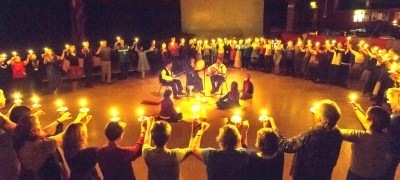
Armenian Candle Dance with Laura Shannon, Findhorn 2015 (photo: Hugo Klip)
When I first began researching traditional circle dances in the mid-1980s, I was amazed to find that the peoples who have suffered the worst of human experience – oppression, exile, genocide, war – also produce the most vibrant and joyful music and dance. Armenian, Jewish, Kurdish, and Romani (Gypsy) dances, in particular, were passionate affirmations of life, despite the horrors these peoples have gone through in their history. The dances seemed to hold clues to the mystery of moving on with life after trauma.
This was something I was desperate to learn how to do. Barely 20 at the time, I was struggling to keep my dignity and optimism while growing up female in a woman-hating world. The trauma of a violent rape on my 18th birthday had robbed me of my joy for life – but I could experience joy again in those dances.
Early on in my research and teaching, therefore, alongside the women’s dances which were always my main interest, I began to focus on the traditional dances of persecuted peoples, which I called Dances of Exile and Homecoming. These songs and dances seemed to have an inherently therapeutic potential, profoundly moving for people from any background and any culture.
My ancestors built great circles of stones that represented their perception of real time and space, and enabled them to tell time: the stone circles were cosmic calendars. They went to great lengths and detail to get it right. It was obviously very important to them to have the stones of a particular kind, in the right positions according to position of the Sun at different times of the year, and then to celebrate ceremony within it.
I have for decades had a much smaller circle of stones assembled, representing the ‘Wheel of the Year’, as the annual cycle of Earth around Sun is commonly named in Pagan traditions. I have regarded this small circle of stones as a medicine wheel. It is a portable collection, that I can spread out in my living space, or let sit in a small circle on an altar, with a candle/candles in the middle. Each stone (or objects, as some are) represents a particular Seasonal Moment, and is placed in the corresponding direction. I have found this assembled circle to have been an important presence. It makes the year, my everyday sacred journey of Earth around Sun, tangible and visible as a circle, and has been a method of changing my mind, as I am placed in real space and time. My stone wheel has been a method of bringing me home to my indigenous sense of being.Continue reading “Her Magic in the Stone Circle by Glenys Livingstone”



 A few days ago, a Greek friend told me she was going to bring holy water from a church so that we could bless my house. Ever since I moved to my new apartment in Heraklion, I have intended to do a house blessing, following rituals I learned from Z Budapest. But with unpacking and settling in interrupted by illness, I never got around to it. I did burn frankincense early on to clear out vibes left by the previous inhabitants of my space, but nothing more. I have slowly made the house a home, but I have been waiting for the renovations to be finished before doing a final blessing. As I still anticipate remodeling the kitchen island, I did not proceed.


 Barbara Ardinger, Ph.D. (
 My ancestors built great circles of stones that represented their perception of real time and space, and enabled them to tell time: the
