Va’etchanan (Deuteronomy 3:23-7:11) gives us pause for thought in its contradictions. First, the parshah (Torah portion) contains the aseret hadibrot (Ten Commandments), among which is: you shouldn’t murder (5:17). Then, pasukim (verses) 6:4-5 contain the shema (Hear O Israel! The L-rd is Our G-d. The L-rd is One!) followed by the admonishment to: “love the L-rd, your G-d, with all your heart and with all your soul, and with all your might,” (Deut. 6:4-5). Finally, pasuk 7:2 instructs the Isrealites, upon entry into the Promised Land, to kill and “utterly destroy” the various groups of people living there.
Sitting around the tree watching the kids open presents. Attempting to enjoy a holiday meal with extended and immediate family that you may or may not have traveled thousands of miles to see. Trying with every fiber of your being to not talk about the elephant, or red hat, in the room.
We’ve all been there.
Sitting around the tree watching the kids open presents. Attempting to enjoy a holiday meal with extended and immediate family that you may or may not have traveled thousands of miles to see. Trying with every fiber of your being to not talk about the elephant, or redhat, in the room.
I get it. It is hard to not go home for the holidays. It’s also hard to sit at home and watch every one of your friends post online about their dinners, get-togethers, and other joyous events while you sit at home. I also understand that many of us, as a result of our sexual and/or gender identity, or maybe our political preference, don’t feel comfortable going home or, can’t go home. This is not ok and that is why it is so important that we all have our chosen families to be with during these times of communal gathering or more importantly, ways to cope while we are at home in these uncomfortable situations to make sure we take care of ourselves and make it out the other end.
Because this blog comes out on Christmas Day, I wanted to give you a few tips that I do to self-care in these situations. Remember, there is no right or wrong thing to do. I encourage you all to make your own list. The only thing that matters is you take care of yourself!
John’s Top 5 Tips for Dealing with “Those” People
Your car is your friend – Seriously, I cannot count the # of times that I have found myself driving around for that extra 5 minutes to just collect my thoughts or calm myself down. If you need to, jump out to your car and sit back and relax for a second or drive to a gas station (Kwik Trip in Wisconsin is my go-to) and pick up a soda to drink.
Drink (if you can) – look, I know not everyone drinks (or is from Wisconsin) but sometimes you just need to make yourself a cocktail (responsibly). However, if you are going to drink, remember that old adage: loose lips sink ships. If you get too loose, you may say something you regret (or didn’t plan on saying; I’ve been there).
Bathroom Sanctuary – Sometimes you may not need to use the restroom but you need a place to go and just lock the door, check Facebook, call a friend, or simply breath. The bathroom is the perfect place to do that. Find it. Use it (even if you don’t have to).
Dinner Conversation – Before I go anywhere, I always brush up on a few facts. How are the Packers doing? How about the Milwaukee Bucks? Can you believe they STILL haven’t finished that construction? No matter if you’re traveling somewhere near or far, if you think you need to make sure you can participate in dinner conversation without bringing up the two forbidden topics (Politics and Religion), then do so!
Push Back – Ok, sometimes it is ok to engage. I mean, how are we ever going to get out of this great divide if we don’t talk to each other. Now, that doesn’t mean it will go over or there will be some type of magical aha moment but it is ok to say something, especially when your crazy Aunt/Uncle/Cousin/Second Cousin/Random Friend of Cousin who no one invited starts spouting off some nonsense (like Mexico paying for Trump’s wall because that just isn’t going to happen). If you feel safe enough to push back and say something, especially when someone if being completely and totally rude and inappropriate, always make sure you have an exit strategy. That is either a friend you can call, a room you can go to, or a nap you suddenly want to take. No matter what, if you do choose to engage always remember to a.) Speak calmly and slowly at all times (Republicans are triggered when you yell and provide them with too many facts too fast); b.) Make direct eye contact; c.) Make sure you always have something to take a long sip from afterward to prove you made your point.
I have to admit, I am quite lucky. I know I have written a lot on this site about what has happened to my family since the election of the Fascist-in-Chief. Luckily for me, I surround myself during these times with people who openly love me, my views (for the most part), and allow me to be myself, or simply, we just don’t talk about “it” because they clearly know now that we were right about Trump and his cronies. I don’t have to use these tips because the people they apply to, don’t really come around our holiday gatherings.
However, if there is one thing that I learned, it is that this election has cost us each something. Whether that was a friend, family member, or a part of yourself that you never think you’ll be able to get back, we need to respect these losses and the pain that comes with them. I promise you that it will get better (heck, better starts on January 3, 2019). We have a long way to go until 2020 (I mean, a LONG way to go) but I know we will all get there together, one way or another because there are better Christmas and holidays to come where we won’t have to use these tips and tricks to survive anymore.
So, from my family to yours, Merry Christmas and Happy Holidays! I’m thankful for each and every one of you this holiday season (unless you voted for Trump).
John Erickson is a Ph.D. Candidate in American Religious History and holds two MA’s from Claremont Graduate University. John serves as a commissioner on the California Commission on the Status of Women. He is President of the Hollywood Chapter for the National Organization for Women, a boardmember for the City of West Hollywood’s Lesbian and Gay Advisory Board, a board member for the ACLU of Southern California, the Legislative Action Chair for Stonewall Democratic Club, and a board member for the National Organization for Women.
When the dust settled after November 9, 2016, many were looking for a better 2017. Alas, 2017 was one of the roughest, heaviest, and revelatory years in the last twenty years. 2017 shook many to their cores. Every morning seemed to bring new horrors, new mountains to climb, and more piles of ridiculousness to shift through. And it didn’t seem to relent. Every moment, every hour was met with baited breath. Is this the moment that our world falls apart? Is this the moment we wake up from this nightmare?
The church occasioned one of my first conscious experiences with inequality — Sunday school to be exact. I was nine and bedecked in black platform shoes and a bright pink polyester suit. It was the 70s, a moment in fashion history never to be revisited. My Sunday school teacher, a spiritually angelic woman, was explaining the demise of the Woman Caught in Adultery. According to the story, the leaders of law and religion wanted to stone the woman to death for having intercourse with a man that was not her husband. Although she was vulnerable to the death penalty, the man was not exposed to any punishment. This lopsided sanctioning plagued my young mind. Little did I know, I would spend my legal career, as a federal sex trafficking prosecutor and as a legal scholar, trying to vindicate the Woman Caught in Adultery.
My brother is, in this own words, an “old school street, squatter, gutter punk.” Indeed, he lives outside the system. He is an anarchist atheist and has lived many nights of his life on the streets – by choice. He has a quick and easy smile and makes friends effortlessly. Recently, while stuck in Seattle during an extended layover on his way back to Europe, where he’s been living the last few years, he passed the time making new friends and exploring the immediate area –
I watched this short video on facebook about Sisa, an Egyptian woman who spent forty years a man in order provide for her family. There is a longer version on YouTube. Sisa, a widow, decided to work to feed her children, and consequently grandchildren. In Egypt, a woman can only do unpaid jobs within a home. So Sisa had to pretend to be a man by wearing male clothing and head wear. She takes casual jobs, such as shoe shining or brick laying.
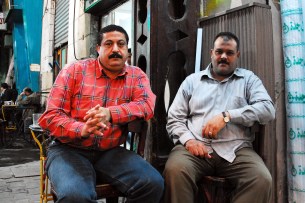
Then Sisa made the news and was honoured by governmental officials. There is footage in the report of Egyptian men watching that footage. Apparently, the men were impressed by Sisa’s efforts and they developed respect for her. One man, who knows Sisa personally, says for camera: “I treat her like a man, because she works like a man”.
The implication being, I assume, that Sisa is only worthy of respect because she acts like a man is expected to act. And another implication is that Sisa is an exception. He only prepared to treat her differently, as all the rest of the women in Egypt apparently cannot work as men.
Last weekend was a special one for me. After many years of study and dedication I graduated with my Ph.D. and am now, officially, Dr. Katie Deaver. The weekend was filled with celebrations to mark the completion of a milestone that I have spent years working toward. The amazing outpourings of love, support, and care that I have experienced throughout the last few days is quite humbling. The happiness and pure joy of my family, friends, professors, mentors, and multiple church communities have left me in awe. As I reflect on this love and support it helps to heal the wounds and scars that have accumulated throughout the process of earning this degree.
The undertaking of a Ph.D. program is significantly more difficult than anyone tells you. This difficultly lies not necessarily in the course work or the dedication to constant reading, writing, and learning but rather in the personal growth and vocational affirmation that takes place within the process. My dissertation explored the primary understandings of the doctrine of atonement and addressed how this doctrine can, and has, been used in ways that perpetuate, and in some cases even encourage, domestic violence.
My own fascination with the topic of atonement and its links to domestic violence was brought about at the suggestion of one of my undergraduate professors at Luther College, Dr. Jim Martin-Schramm. From the moment that Dr. Martin-Schramm explained the links between theologies of the cross and domestic violence I knew that I had found my new passion. Writing a dissertation on the topics of domestic violence, theology and women of faith was an extremely personal, and intimate experience for me. This topic forced me to accept my own lived experience. To claim myself… out loud… as a survivor of domestic violence. As a result the writing of my dissertation was particularly personal, and painful, as well as extremely life giving.
On August 4th, I visited Auschwitz. In the beginning, the reality of the experience did not match my surrealist expectations of it. I expected to walk onto the grounds and get hit over the head with the heaviness of what happened there, to feel a sense of deep connection to the land covered in the ashes of my people, to have the opportunity to mourn the loss of the members of my family I never met and to be utterly speechless as to the twisted systematization and industrialization of murder that took place there. That blow never came. Why?
The day of my visit was out-of-this-world hot. My guided tour, in Czech, started at 2pm. I was early so I wandered among the crowd outside of the site. There were families lounging on the lawns eating ice creams and drinking cokes. There were tourists taking selfies. There were lots of conversations and lots of laughter. I was pretty convinced that I was the only Jew around.
Upon entering the grounds, I was stunned by how green and lush it was. There were many old brick buildings, seemingly orderly, with lanterns and building signs hanging outside the entrances. Among it all, upwards of 500 people clustered in groups walked from place to place.
The tour began with a basic history of the events of the Holocaust with “exhibits” contained within 3 or 4 different buildings. The guide seemed to me to have memorized a script in which we went from one building to another looking at the “exhibits,” most of which consisted of nothing more than one or two oversized pictures and maps. Outwardly, I sensed no sentiment in the guide and no spirit in the exhibitions either. Her voice was monotone, pronouncing the Czech in such a syllable-by-syllable fashion that it was nearly incomprehensible. Most exhibition rooms were sparse, if they had any objects at all other than the black and white pictures and maps. The tour and exhibitions portrayed such a distance from the events it was almost as if they didn’t happen there, in that place.
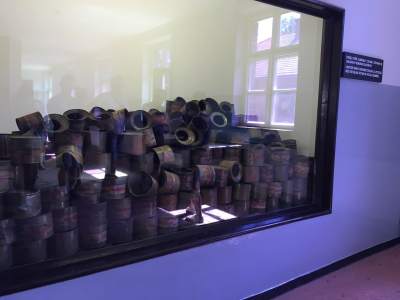
Zyklon B
There were a few buildings with objects all hermetically sealed behind glass once again keeping us at a distance. One room housed a display of used Zyklon B canisters and had an artist’s small scale all-white model of the “process of extermination,” meaning the “changing rooms,” “showers” and crematoriums – with tiny people crammed into the areas and bodies piled on the floors next to the ovens. Two other buildings contained large displays, again behind glass and removed from their context, of what the exhibition called “evidence of the destruction:” piles of hair loosened from the burlaps sacks they had been founded in when the camp was liberated; shoes of the victims and a large (two-story) container filled with the pots and pans the victims had packed and brought with them but never used.
After we finished our tour of Auschwitz 1, we were given a 15 minute break and were instructed to reassemble by the bus that would take us to Auschwitz-Birkenau. Once there, we rushed through the camp at such a pace that we were done in about 45 minutes. In spite of the rush, I did manage to leave two stones on the pillars, which marked where the ashes of the victims were scattered (buried?). We glanced at the memorial at the back of the camp as well as what was left of the bombed-out crematoriums. Returning to the front of the camp, we ducked into a reconstructed dormitory and a reconstructed bathroom building. The guide asked if we had any questions. Silence. The tour was done.
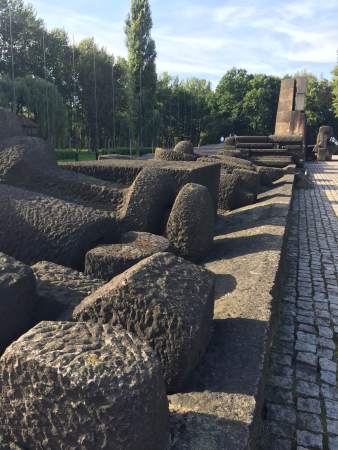
I stood there debating what to do. Do I leave? Do I stay? I was pretty confident that it didn’t feel right to just go. So, I headed back to the memorial. The tour guide had said that each of the smaller stones creating the steps and floor commemorated one of the 1.1 million Jews killed in Auschwitz. Yet, it was unclear as to the meaning of the large stones. After circling the large stones and a futile attempt to make some meaning out of them, I went and sat on the stairs of the memorial and just looked out over the place and the people there.
Still puzzled but needing to catch the train, I made my way to the entrance. In front of me was a group of Israeli Jews wrapped in Israeli flags, looking the Superhero part. Something changed. Maybe I didn’t need the sad, mournful, pit-of-the-stomach experience. Maybe I’ve had it enough, learned about it enough, taught it enough and lived with it enough. Maybe my pilgrimage there as a witness to the horrors was enough.
It was those Israeli Jews that I needed. Walking into Auschwitz was one thing, but they were proud Jews walking out. I followed them. We, Jews, were the lucky ones who got to leave. Isn’t that something!
Ivy Helman, Ph.D. is feminist scholar and faculty member at Charles University and Anglo-American University in Prague, Czech Republic where she teaches a variety of Jewish Studies and Ecofeminist courses. She is an Associate of Merrimack College‘s Center for the Study of Jewish-Christian-Muslim Relations and spent many years there as an Adjunct Lecturer in the Religious and Theological Studies Department.
During another week of killings, war, protests, and debates about whether Black Lives Matter or Blue Lives Matter, I’m concerned about the toll it takes on those who are witnessing the violence and fighting for justice.
I’m not on the front lines of these battles, but I can feel my energy draining, nonetheless. Over the past few days, while I’ve stayed informed about the latest tragedies and conflicts, I’ve intentionally limited my exposure to most news and social media outlets. I’ve begun preparing for a contemplative retreat with other women who also care about justice. For me to continue to participate in any effort of transforming society, culture, or the church, I must nurture my mind, spirit, and body.
Audre Lorde put it like this:
“Caring for myself Is not self-indulgence. It is self-preservation, and that is an act of political warfare.”
Self-care is a radical practice of self-love. It is absolutely necessary when engaged in conflict against those who do not show love to you, or worse, those who seek to destroy you. Your survival and your flourishing are defiantly brave. Self-care honors the God who created you, the One who loves you, and the Spirit who sustains you. Continue reading “What My Mothers and Mentors Taught Me about Self-Care by Elise M. Edwards”
Never before has a simple question packed such a punch. Five little words strike fear into my heart as I remember I have a countless number of things to do before I get that title after my name: Ph.D.
There are so many reasons I feel like I’m failing at my dissertation and school, which I used to love. The first reason is I never have any time to write. Continue reading “I’m Failing by John Erickson”


 Va’etchanan (Deuteronomy 3:23-7:11) gives us pause for thought in its contradictions. First, the parshah (Torah portion) contains the aseret hadibrot (Ten Commandments), among which is: you shouldn’t murder (5:17). Then, pasukim (verses) 6:4-5 contain the shema (Hear O Israel! The L-rd is Our G-d. The L-rd is One!) followed by the admonishment to: “love the L-rd, your G-d, with all your heart and with all your soul, and with all your might,” (Deut. 6:4-5). Finally, pasuk 7:2 instructs the Isrealites, upon entry into the Promised Land, to kill and “utterly destroy” the various groups of people living there.
 paying for Trump’s wall because that just isn’t going to happen). If you feel safe enough to push back and say something, especially when someone if being completely and totally rude and inappropriate, always make sure you have an exit strategy. That is either a friend you can call, a room you can go to, or a nap you suddenly want to take. No matter what, if you do choose to engage always remember to a.) Speak calmly and slowly at all times (Republicans are triggered when you yell and provide them with too many facts too fast); b.) Make direct eye contact; c.) Make sure you always have something to take a long sip from afterward to prove you made your point.
 John Erickson is a Ph.D. Candidate in American Religious History and holds two MA’s from Claremont Graduate University. John serves as a commissioner on the California Commission on the Status of Women. He is President of the Hollywood Chapter for the National Organization for Women, a boardmember for the City of West Hollywood’s Lesbian and Gay Advisory Board, a board member for the ACLU of Southern California, the Legislative Action Chair for Stonewall Democratic Club, and a board member for the National Organization for Women.
 When the dust settled after November 9, 2016, many were looking for a better 2017. Alas, 2017 was one of the roughest, heaviest, and revelatory years in the last twenty years. 2017 shook many to their cores. Every morning seemed to bring new horrors, new mountains to climb, and more piles of ridiculousness to shift through. And it didn’t seem to relent. Every moment, every hour was met with baited breath. Is this the moment that our world falls apart? Is this the moment we wake up from this nightmare?

 I watched this short video on facebook about
  Then Sisa made the news and was honoured by governmental officials. There is footage in the report of Egyptian men watching that footage. Apparently, the men were impressed by Sisa’s efforts and they developed respect for her. One man, who knows Sisa personally, says for camera: “I treat her like a man, because she works like a man”.




 Feminism and Religion