On Bechukotai and the Valuing of Females

Bechukotai, Leviticus 26:3-27:34, was read in synagogues around the world on May 24, 2025.  As I have mentioned in past blogs, my timing is somewhat off in my attempt to finish my (eco)feminist commentary on all 54 of the parshot.  Bechukotai discusses the consequences of both following and ignoring the commandments.  For those of you who have been following along with these commentaries, you could probably already tell me how this parshah is going to go.  If you have guessed follow the rules and live and eat well in the land or don’t and be exiled, sick, starving, and so on, then you have guessed correctly.  As this is the case, this thinking betrays a certain logic, common to the ancient world and its understanding of flourishing or lack thereof.  I have written about this numerous times on this site (see here for what is perhaps my most thorough explanation).  Yet, Bechutokai also makes some rather interesting comments about women, and that will be my focus for today’s post.

Continue reading “On Bechukotai and the Valuing of Females”

Did We Ask for a King? by Esther Nelson

Northrop Frye (1912-1991), a Canadian literary critic, is probably best known for his book THE GREAT CODE: THE BIBLE AND LITERATURE (1983). In it, he demonstrates how the Bible is foundational for our understanding of Western literature, a body of work replete with Biblical allusions. 

Today, most of us are not familiar enough with the Bible to appreciate where many literary themes take root. We fail to see how its stories—gathered over centuries—relate to us. Not only does Western literature mine from Biblical text, our lives as we experience them mirror much of Biblical story and narrative.   

I was raised on the Protestant Bible. To this day, I experience the world through Biblical story. There is nothing sacrosanct (to me) about the familiar text. The Bible is not unique. 

Continue reading “Did We Ask for a King? by Esther Nelson”

Bo: On Passing Over.

On August 12, 2018, I announced that I would begin my feminist reflections on Torah portions. I have seven left, but the timing of them are all in the beginning months of the year. This means, that the following seven posts about the parshot will not be aligned with the actual calendar dates in which they are read, especially since I only post once a month. But, in each post, I will note when they will be read next (in 2025). I hope that is not too much of a bother for the reader as I complete this project.

The parshah for Feburary 1, 2025 is Bo. It covers the final three plagues (locusts, darkness, and death of the firstborn males), the instructions for Pesach (Passover), and the beginning of the flight out of Egypt. The parshah makes two mentions of women. First, Moses includes the daughters of Israel among those who will leave Egypt (10:19). This mention comes in a list of opposites: young and old, sons and daughters, and (what I assume to have been considered opposites at the time) flocks and cattle. To me, this stylistic set-up signals that the entirety of the Israelite community would leave Egypt – a combination of seeming opposites thus represent the whole (that would be an interesting post for another time!). The second mention of women is in verse 11:2; men and women will ‘borrow’ gold and silver items from their (Egyptian) friends. This borrowing allows them to later leave Egypt with the items and thus rob Egypt of its riches (13:35). I do not find this necessarily all that interesting except to note that it helps to tell the story of how an oppressed, enslaved people had enough gold to build a golden calf (Ki Tisa), Exodus 32:2-3. 

Continue reading “Bo: On Passing Over.”

Miriam Speaks by Janet Maika’i Rudolph

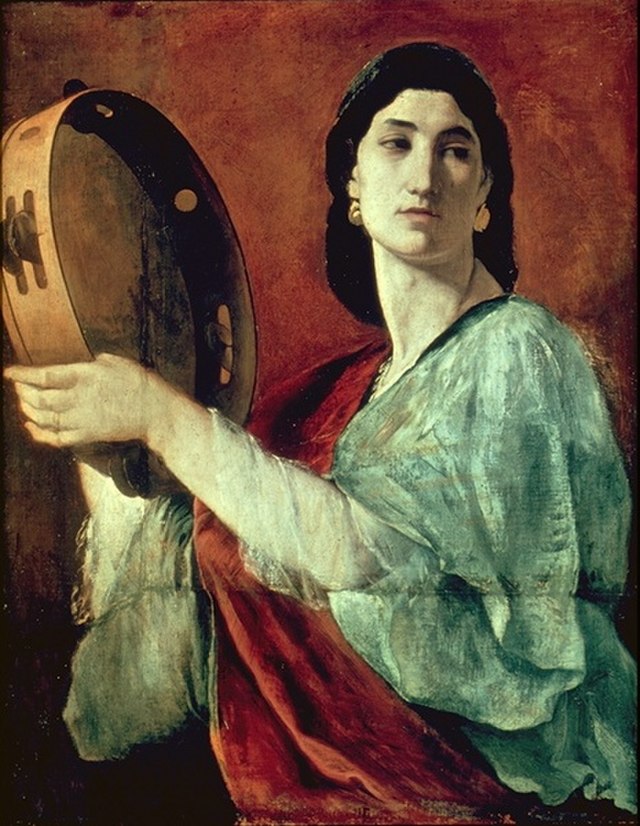
Wikimedia Commons: Anselm Feuerbach

Intro:  I have been working on a project inspired by Charlene Spretnak and her book Lost Goddesses of Early Greece. I am writing biblical stories through the eyes and words of the women. The scribes who wrote down the tales of the bible, wrote mostly from men’s point of view. And they had their own which was to destroy evidence of the Goddesses. I tell Noah’s story through Naamah, his wife. Abram and Sarai’s journey to Egypt through the eyes of Sarah. Exodus in Miriam’s voice. In my telling, Miriam went to Midian with Moses and, while there, experienced the Burning Bush and worked with Moses’ wife Zipporah to protect knowledge of the Goddesses. Below is an abridged version of this section of Miriam’s tale.  

I look around at your world today. You, yes you, are my descendants. My beloveds. I mourn for what you’ve lost. No, I am angry, how could things have gotten this bad? I dare you, I dare any of you to challenge my work. We did everything we could. It should not have taken this long to find our clues. But then I see the job the scribes did. It was better and more thorough than even we, who saw so much, could have imagined. I look around at this precious earth we bequeathed to you and see how damaged it is.

Continue reading “Miriam Speaks by Janet Maika’i Rudolph”

Sh’mini: An Egalitarian Argument for Women and Girls

The parshah for April 6, 2024 is Sh’mini (Shemini), Leviticus 9:1-11:47 and since it is also Shabbat Hachodesh, we read Exodus 12:1-20 in addition to Sh’mini.  Sh’mini contains commandments regarding animal sacrifice, the death of two of Aaron’s sons, lists of which animals are kosher and which are not, and distinctions between clean/unclean and holy/profane.  The excerpt from Exodus, read as the maftir, describes the last plague before the Jews were freed from slavery in Egypt, the establishment of Pesach, and the eating of unleavened bread or cakes.  In today’s commentary, I’m focusing on the only mention of femaleness in Sh’mini and by doing so I hope to find more room for women and girls within contemporary Judaism.

Continue reading “Sh’mini: An Egalitarian Argument for Women and Girls”

From the Archives: “Breathing Life into the Women of Chayei Sarah.”

One of the basic tenants of feminist methodology in religion is the recovery of women’s history.   There are many ways to approach such a task.  In religions with sacred writings, one avenue for recovery may be reinterpreting them.  This could come in the form of a critique.  For example, traditional interpretations may overlook or undervalue women, who appear in the text, reaffirm sexist, patronizing, and/or misogynist viewpoints already found in the text, or develop new ones.  In order to recover women’s history, feminists working with their sacred texts would then call out these interpretations for their sexism.  They would correct phrasing, understanding, and even translations, when necessary.   

In addition to critiquing, feminist interpretations of scripture could also be constructive.  Religious feminists may highlight values, teachings, and images that affirm women’s lives.   They may incorporate documented history into their interpretations as proof of expanded roles for women.  That would then contextualize or negate later traditions that deny women such roles.  

Continue reading “From the Archives: “Breathing Life into the Women of Chayei Sarah.””

Biblical Poetry – Trees by Janet Maika’i Rudolph

Image from an Egyptian tomb ca. 1314-1200 BCE. Isis is giving nourishment in the form of fruit and drink,

In many cultures of the world, including our own, trees are considered the ancestors of humanity – own our ancestors.

Trees are connected with great goddesses throughout antiquity. We see this in the bible where, as I’ve noted before, the Tree of Life is Eve’s tree for the word Eve means life. It is, in essence, the Tree of Eve. Goddesses in trees feeding humans were common themes in ancient Middle Eastern art. The tree was Hers to give freely of as she wished.  

Anthropologist and religious scholar, Mircea Eliade writes extensively about the associations of trees ancestral connection to humans. He calls them both mystical and mythical.[1] His examples include the Miao groups of Southern China and Southeast Asia who “worship the bamboo as their ancestor.” He also notes Australian tribes who view the mimosa as their progenitor. And there is a tribe from Madagascar, called Antaivandrika which means “people of the tree,” who considered themselves descended from the banana tree.

Continue reading “Biblical Poetry – Trees by Janet Maika’i Rudolph”

Of an Anniversary, a Methodology and the Parshah Yitro by Ivy Helman.

This month’s blog post marks my 10-year anniversary writing for feminismandreligion.com (FAR) and my 122nd post.  I would just like to take a moment to acknowledge this milestone and thank the community for both its dialogue with me and support over these years.  I look forward to writing for FAR for years to come.

Speaking of dialogue and support, this post is structured in the form of an answer to Barbara Ardinger’s question on my last post.  She asked in what language I read Torah.  I found that intriguing.  To me, what I do is obvious.  Yet, for the reader, I have never explicitly walked through the steps of how I create these Torah commentaries.  In this walk-through, the reader is getting a rather unedited look into my process.

Continue reading “Of an Anniversary, a Methodology and the Parshah Yitro by Ivy Helman.”

Vayechi’s Take on Fertility, Women and Theodicy by Ivy Helman.

This week’s Torah portion is Vayechi, or Genesis 47:28-50:26.  It is the last part of the Joseph saga (For my thoughts on two other parshot relating to Joseph, see Mikeitz and Vayigash).  While there is much that could be said, there are three aspects of the parshah which I would like to concentrate on for this post: blessings being associated with fertility; verses 50:19-20’s troubling theodicy; and its women.

Let us begin with the last topic: women.  Women are mentioned four times in Vayechi.  Jacob recalls the burial of Rachel in verse 48:7.  Joseph’s beauty is such that women often look at him (49:22). The blessing that Jacob gives to Joseph includes the blessings of both mother and father (49:25-26).  At present, I will focus my commentary on Jacob’s request for burial, the fourth mention of women in this parshah.

Continue reading “Vayechi’s Take on Fertility, Women and Theodicy by Ivy Helman.”

Heart Vibration: Biblical Poetry by Janet MaiKa’i Rudolph

My inspiration for biblical verses this month comes from the lovely and soulful translations of Rabbi Yael Levy in her book Journey through the Wilderness (subtitled: A Mindfulness Approach to the Ancient Jewish Practice of Counting the Omer). She has given me permission to quote her translations (thank you!). I use 2 of her verses in this blogpost.

One of her translations aspects I found most fascinating is that of YHVH (LORD in the bible). She uses Mystery. I have used Mother/Father Creator, and more lately, Vibration.Being. I love her usage. It taps into the magic that YHVH is the ultimate Mystery of all creation. These beautiful translations are meaningful, differing, yet connected aspects of the holy name. These prism-like views come together to make an even more exquisite truth.  

For today’s blogpost my main focus is on several verses from Psalm 119. It is poetry which talks about the heart and chesed, or in English, lovingkindness.

Continue reading “Heart Vibration: Biblical Poetry by Janet MaiKa’i Rudolph”