Sisterhood, Service, Sovereignty: The Living Spirit of Avalon by Elizabeth Cunningham

Like so many women, I read Marion Zimmer Bradley’s The Mists of Avalon and got caught up in her vision of the Holy Isle and the priestesses who knew how to navigate those mists and travel between the worlds. Like so many women, I wished Avalon existed still.

In fact, Avalon does exist, because Jhenah Telyndru did more than wish. In 1995 she founded The Sisterhood of Avalon. Twenty-two years later, the Sisterhood is going strong and growing, attracting members from all over the world. I urge you to explore their website where the Sisters speak eloquently about their vision, structure, and purpose.

Continue reading “Sisterhood, Service, Sovereignty: The Living Spirit of Avalon by Elizabeth Cunningham”

Empowering Toys and the Problem of Class Divisions by Katie M. Deaver

I recently noticed that I’ve been spending a lot of time thinking about financial security, the way class systems work in the United States context, and how these types of realities inform my feminism.  Part of this is no doubt due to the fact that for the first time in my life I am not a student with multiple part time jobs, but rather am a “real” adult working full time at a job that offers retirement and medical benefits.

As I’ve written about before, I grew up in a poor family in rural Wisconsin and as a result I am often hyper vigilant about my finances.  While I likely go a bit overboard when organizing my budgeting, balancing, saving, and spending this type of organizing is something I can control.  The simple act of paying a bill, or determining how much I can spend on groceries this week gives me a profound sense of safety because for the first time there really is enough coming in to support my basic needs.

Continue reading “Empowering Toys and the Problem of Class Divisions by Katie M. Deaver”

What I Believe (Post-2016) by John Erickson

Ever since the election of You-Know-Who, I have been doing a lot of creative writing.

Ever since the election of You-Know-Who, I have been doing a lot of creative writing. Unlike academic publications, policy reports, or my dissertation, creative writing, much like my mentor Dr. Marie Cartier has written about, provided me with a needed escape from a world that seems to grow darker with each passing day.  In college, I served as Poetry Editor for the Wisconsin Review, the oldest literary journal in Wisconsin. Continue reading “What I Believe (Post-2016) by John Erickson”

Fostering Conversation and Connection in Community by Katie M. Deaver

I recently began a new job as the Associate Director of Admissions for the Lutheran School of Theology at Chicago, one of the seminaries of the Evangelical Lutheran Church in America.   This week was orientation for our new and returning students and much of the time has been focused on getting to know one another as well as getting to know the corner of Chicago in which we are located.  There have been so many life giving conversations as well as so many questions!

Our mornings featured speakers who helped us to engage one another in conversation as well as to start thinking about the unique reality of our place within not only the LSTC community but also within the rest of the Chicago community and the larger world.  Throughout these presentations  and getting to know you activities my thoughts continued to be pulled back to the question of how to have life-giving conversations in a time when so many of us feel emotionally and spiritually drained by the world around us.

Continue reading “Fostering Conversation and Connection in Community by Katie M. Deaver”

Family, Interdependence, and Mutual Support by Chris Ash

Christy CroftOver the past few months, a precious person has come closer into my family’s life in such a way that their presence in my home, among my loved ones, has come to feel natural and easy. This is someone I love, someone who adores my children and appreciates my partner of 18 years and whose sweet spirit and vibrant laughter have added joy and mirth to our family home.
Yesterday, they rode with me to drop my freshly-mohawked teenager off at a farm to help with preparations for an upcoming arts camp. I introduced them by name to the camp assistant and walked over to chat with the camp director for a bit. Later, as we got back into the car to head to lunch, I asked what they thought of the farm.

“It was nice,” they said. “I’m glad your children have a place like that. Also, while I was chatting with the camp assistant, she asked if I was family.”

“What did you say?”

“I said yes.”

They weren’t wrong.

The meaning the word “family” holds for me is something I’ve given much consideration over the years. For generations, many of us have been expected to turn a blind eye to the ways patriarchal domination of women’s and children’s bodies perpetuates abuse in our own family systems. My inability to sweep these abuses under the carpet, to keep silence and pretend all is well, has led to my estrangement from one entire side of my family. It’s an estrangement I feel will be permanent, and while I grieve the loss of an ideal I never had, I welcome the opportunity to live authentically and boldly, confident in my dedication to my ideals, which include honesty, justice, and the unconditional protection of children and vulnerable populations.

For a while, I sat with the gap this estrangement created in my life, unwilling to fill it with harmful relationships with those to whom I am blood-related, yet hesitant to broadly redefine it in a way that negates the importance of those who have chosen to love and raise up a child, however imperfectly. Continue reading “Family, Interdependence, and Mutual Support by Chris Ash”

Mulling over Movies: Moana, Pt. 2 by Elise M. Edwards

elise-edwardsEvery summer in the US, movie theatres show their newest big budget films, hoping to draw in large audiences. While I appreciate an air-conditioned theatre on a hot day, I love the opportunity to go to an outdoor movie screening.  These screenings are usually community-oriented opportunities for social gathering.  In my previous post, I talked about Moana, a Disney film I saw at an outdoor screening earlier this summer.  I enjoyed watching this movie with my friends and their families and I was delighted by the story itself.  It has several religious and spiritual themes and strong female characters. Previously, I spoke of the significance of myths in this movie.  Today, I’m focused on depictions of nature in Moana and their remarkable beauty.

Many feminist and womanist theologians and religion scholars have raised concerns about the interrelated dominations of women and nature, as well as the disproportionate hardships women and children are exposed to with increasing climate change and environmental degradation.  Our changing environment affects all life on the planet, but it is the people who are most vulnerable (physically, economically, politically) who at most at risk.  Obviously, animals and plants are endangered, too. Ethicists like me are interested in finding ways to address these concerns because we are committed the preservation of life.  As feminists, there’s more to it, though.  We recognize the way nature itself is often feminized (“Mother Nature”), which makes it even more troubling when it is cultivated without respect for the wellbeing of existing ecosystems and the life forces dependent upon them.

Continue reading “Mulling over Movies: Moana, Pt. 2 by Elise M. Edwards”

What If…She’s Stronger than She Knows…by Molly Remer

“When I dare to be powerful–to use my strength in the service of my vision–then it becomes less and less important whether I am afraid.”

Audre Lorde

“The purpose of life is not to maintain personal comfort; it’s to grow the soul.”

–Christina Baldwin

When teaching childbirth classes, I would speak to my clients about shifting the common fear-based “what if” cultural dialog of birth to “positive” anticipation rather than fears, encouraging them to ask themselves questions like: “what if I give birth and it is one of the most powerful, thrilling moments of my life?” While I stand by this practice, I also think about the what ifs that crawl out of our dark places and lodge in our hearts. The what ifs that snake around the edges of our consciousness in the early hours of the morning. The what ifs we try to push down, down, down and away. The what ifs that stalk us. The what ifs so very awful that we fear in giving voice to them, we might give life to them as well.

We may feel guilty, ashamed, negative, and apologetic about our deepest “what ifs.” We worry that if we speak of them, they might come true. We worry that in voicing them, we might make ourselves, our families, our communities, our work, or philosophies, our faiths, or whatever look bad. We want to be positive. We want to be blissfully empowered, confident, and courageous. And, guess what? We are. Sometimes that courage comes from looking the “what ifs” right in the eye. Sometimes it comes from living through them. My most powerful gift from my pregnancy with my daughter, my pregnancy-after-loss baby, was to watch myself feel the fear and do it anyway. I was brave. And, it changed me to learn that.

What if we can learn more from our shadows than we ever thought possible? There is power in thinking what if I can’t do this and then discovering that you CAN.

Continue reading “What If…She’s Stronger than She Knows…by Molly Remer”

Mulling over Movies: Moana, Pt. 1 by Elise M. Edwards

elise-edwardsI love going to outdoor movie screenings.  Sitting outdoors on a summer evening with good company brings me joy.  Last week, I went to an screening of Moana, the Disney movie about a teenager who goes on a quest through the Pacific Ocean with the demi-god Maui.  Moana goes on this journey to help her people.  The movie came out last year, but I didn’t see it.  I have to admit that I wasn’t even interested in it until Simone Biles performed a dance to one of Moana’s songs on Dancing with the Stars. It was then that I realized that the movie has an empowering message.  I asked my friend Natalie, who is also a feminist religion scholar, about Moana.  She has three young daughters, so I trusted her to be more current than I am.  Her enthusiastic response sold me, as did her remark, “There’s not even a love story in it!”

Ah, Disney princesses and their love stories!  I’m old enough that I didn’t grow up with the Disney culture that children in the past few decades have, but I haven’t been immune to the Disney princess phenomenon.  I childhood pre-dated DVDs and digital downloads, but I still knew and cherished the Disney characterizations of Snow White, Cinderella, and Sleeping Beauty. These young women were kind and virtuous and beautiful (according to Eurocentric standards), but their stories culminate with marriage to a charming prince.  It’s also problematic that so often, the villains in these movies were older women—wicked stepmothers or evil witches—who were motivated by jealousy and hate.

Continue reading “Mulling over Movies: Moana, Pt. 1 by Elise M. Edwards”

Miriam the Prophetess as Guardian and Healer by Jill Hammer

jill hammer cropped

The biblical traditions of Miriam the prophetess have captured the imaginations of Bible-readers throughout the ages.  Miriam, Moses’ sister, watches over Moses in his cradle (Exodus 2), and leads the Hebrew women in dance at the shore of the Sea of Reeds to celebrate redemption  (Exodus 15).  Rabbinic lore identifies Miriam with Puah, the midwife who saved Hebrew babies from Pharaoh, and depicts her as the herald of Moses’ birth (Exodus Rabbah 1:13; Babylonian Talmud, Sotah 12a). Contemporary Jewish feminists have established traditions of singing to Miriam the prophetess on Saturday night, parallel to the tradition of singing to Elijah the prophet at that time.   It has also become popular among some feminist/egalitarian Jews to place a cup of Miriam on the seder table at the time of Passover.  This cup is usually filled with water in order to recall the ancient legend that a well of water followed Miriam through the wilderness, quenching the thirst of the wandering people (cf: Babylonian Talmud, Taanit 9a).  It was even said that healing herbs grew near this well, so that Miriam’s prophetic power became a source of healing.

The veneration of Miriam is especially deep in Sephardic Jewish traditions—those Jewish traditions stemming from the Spanish Jewish diaspora, which may be found everywhere from North Africa to Holland to Greece and Bulgaria.  Sephardic women used incantations along with various rituals involving salt, herbs, and other substances, as healing for various ailments and troubles; women skilled in these practices were called precanteras or precantadoras.  Some of their healing incantations invoke Miriam as the ancestress of all women healers, as in the following prayer:

Continue reading “Miriam the Prophetess as Guardian and Healer by Jill Hammer”

Women Made of Fire by Vanessa Rivera de la Fuente

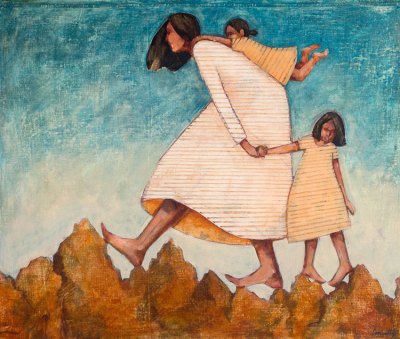
 climbing-mountains-with-children_webThis was going to be a post about my new life in South Africa; to say what it means for me the return to this country full of wonderful things to do, after an intense and grievous experience in 2015 that pushed me towards a totally introspective period in my life; I was willing to tell you how I managed to put myself together, come back, go out there to face my fears, gather the courage to speak my truth, look for clearance and healing in the same place and with the same people where I was wounded.

But that will be in the next post. Let me talk about my country.

I come from Chile, a country in the southern south of the world, poor in resources and rich in poets. I am Chilean by birth, and I took my first steps on shaking ground. I have survived 3 earthquakes, countless floods, a tsunami and a dictatorship.

I survived to be stronger, more faithful, more free and unbeatably resilient.

During the past 12 days, I have seen, as a distant and impotent witness, my country burning, overwhelmed by fire, in the greatest catastrophe of its kind in the history of the nation.

The fire has advanced more than 700 kilometers away from the first point of ignition, swallowing whole villages, with their houses, public buildings, animals and agricultural land.

I’ve spent these days with tight lips and enclosed in my thoughts, reading news on the Internet, thinking about my family, receiving audios that my sister records for me. My brother was injured protecting his house from the fire, my family is in the area of greatest catastrophe, currently declared “Area Zero.” My concern is huge because the fire is advancing over the city and the assistance seems to go three steps back … I believe in the power of prayer, but I also know the ferocity of nature because as a Chilean I am always expecting to deal with it. Continue reading “Women Made of Fire by Vanessa Rivera de la Fuente”