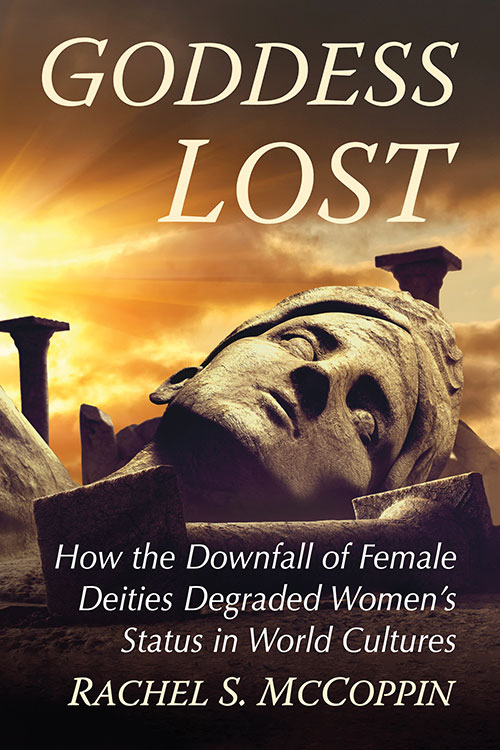
From the moment I saw the title, Goddess Lost: How the Downfall of Female Deities Degraded Women’s Status in World Cultures, by Rachel S. McCoppin, I knew I would have to read it. When it arrived in my mailbox and I saw the cover, I was imbued with inspiration. Then I read two sentences in the Preface, which articulate what for me, and for many, is one of the most vital, powerful, and, as yet, under-addressed, facts.
This blog was originally posted on October 20, 2013. You can read the comments here.
At least since the days of the Desert Mothers in the 4th and 5th centuries CE, there have been women in the Christian tradition (and doubtless other traditions) who have lived lives in religious solitude, whether by choice or circumstance. In Medieval Europe many churches had anchorholds, small enclosures inhabited by men or women dedicated to a life of solitude and prayer. The word anchorhold implies that the presence of the anchoress or anchorite grounded the church community, but the word derives from the ancient Greek verb (pronounced anachōreō) for to retire or withdraw. Anchoress Julian of Norwich is still revered as the author Revelations of Divine Love, possibly the earliest surviving book written by a woman in the English language. Six centuries after her death, her vision of Jesus our Mother continues to challenge, comfort, and inspire.
Moderator’s note: This marvelous FAR site has been running for 10 years and has had more than 3,600 posts in that time. There are so many treasures that have been posted in this decade that they tend to get lost in the archives. We are beginning this column so that we can all revisit some of these gems. Today’s blogpost was originally posted June 19, 2012. You can visit it to see the original comments here.
I have a beautiful picture of vagina hanging on my wall. However, for the longest time it was in the back of my closet, with a plastic bag covering it. I wasn’t ashamed of it but my ex-boyfriend, like most gay men, refused to have it on the wall where he could see it. He is now long gone; the vagina is now out and proud.
I bid on the picture one fall during a showing of the Vagina Monologues at Claremont School of Theology. One of my best friends was in the show and I had always loved its powerful message. I walked out of the theatre, waiting for my friend, and there it was: the picture of the vagina. I found myself caught up in its beauty. Its gaze had mesmerized me. The outlying layers of red, the contours of its shape, they all began to mold into a figure before my eyes. While I have never thought of myself as a religious person, I realized that at that moment I was no longer looking the old photo but rather I was staring at the outline of the Virgin Mary. At that moment, I realized that I had to have the picture.
Isabella Ides’ White Monkey Chronicles is my lectio divina, the wisdom, humor, and wonder of her story savored daily. (For an overview, see BJ Austin’s review.) Although the titular white monkey is at the heart of the chronicles, and his charge, foundling/avatar Conrad Eppler, is a boy, I have never encountered a more vivid evocation of goddess—multi-dimensional, earthy, transcendent, fierce, compassionate. No one knows Godma better than the Sisters of the Joyous Mysteries, an order of rogue nuns, the focus of this interview with the author.
Give us a thumbnail sketch of the three remaining members of the order, Sister Mary Subordinary, Sister Merry Berry, and Mother Mary Extraordinary.
Mother Mary Extraordinary is ancient, icy white, her soul as scuffed as an old shoe. Extraordinary’s veil hides long white hair that reaches to her ankles. Sister Merry Berry is youthful, dark as an espresso truffle, her hair a disarray of dreadlocks. She ditches her veil, crochets a Rastafarian beret, and adopts a pair of florescent orange running shoes. Nun on the run. The orderly Sister Mary Subordinary is almost without physical detail. She is selfless, a giver, a maker of bread and soup. She is porous. Sometimes her soul escapes her. Mary Subordinary has visitations; the monkey god, for one, slips in. Subordinary herself can enter other minds, although she tries not to snoop.
Have you encountered rogue nuns in your own life?
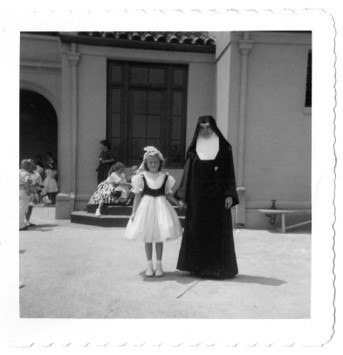
Author with Sr. Mary Agnus, Blessed Sacrament School
I spent my first-communion year at a Catholic school in Hollywood, on Sunset Boulevard. One day on the playground, Sister Mary Agnus asked if I wanted to see the bones of a saint. Yes, I did! She reached into her deep pocket and fetched out a small gold case with red velvet lining and a glass portal. Forget Mary Poppins. I was enthralled. Yet in my secret life, I did not believe in her god. I was a seven-year-old redactor, appalled by the vision of an ocean of children drowning as the ark of animals sails on.
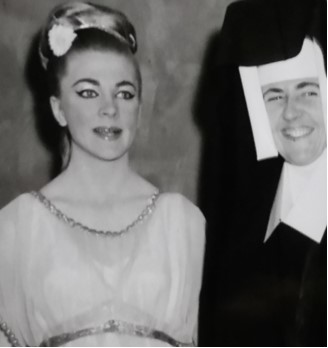
Then years of public school in the suburbs drained the world of mystery. I jumped at the chance to enroll in an all-girls Catholic high school. My notions about nuns changed irrevocably the day I wore a faux zebra coat over my school uniform. Sister Mary Malua asked to try it on. Her Sister friends giggled like girls. And with a shock, I was made aware that they were girls. Like me. These young Sisters, fresh off the boat. Irish – they spoke Gaelic when ruffled — upper-class girls, smart, some of them brilliant, but not very pretty, and not necessarily traditionally gendered.
And none of them as rogue as my creations. Indignant on their behalf, I stepped into the role of fairy Godmother to the Sister Cinderellas — working for no pay, made to obey their priest confessors, denied agency, denied priesthood, doomed to be brides of an indifferent god. Waving my writer’s wand, I de-colonized their minds, redressed them, and sent them invitations to a spiritual ball, the likes of which they had never known.
Toni Morrison said that she wrote the novels she wanted to read. I wrote the world I wanted for my beloveds.
Their mysterious foundling, Conrad Eppler, is home-schooled by the sisters who have widely and wildly varied approaches to his education. Give us a brief description of their curricula.
Author costumed as Shakespeare’s Helena with Sr. Mary Joseph, Louisville High School
Paraphrasing Marx, from each according to her gifts. Sister Subordinary, mindful of Conrad’s origins, reads to him from the Ramayana, stories of the monkey god, Lord Hanuman, and the story of Guha, her idea of a perfect devotee. Guha’s practice is to faithfully kick the statue of Shiva that the Brahman priests have brought to his forest. She passes to Conrad the spiritual gifts of discernment and doubt.
Merry Berry gives Conrad the childhood that she never had. This is one of the fascinations of motherhood and mentorhood, how the child/student changes the teacher. Motherhood is actually one of the deep themes of the Chronicles, that and redemption. How we transform and are transformed by what we create, what we give birth to in the world.
Mothering a child, a planet, a poem, a prayer, a god.
Mother Mary Extraordinary teaches Conrad astral travel. She is a visionary, come to grief over dead and dying dreams. She is cranky, reluctant to crank up further investments in the material world that betrayed her. Her most potent gift comes late in the novel. She is the difficult parent. The dark side of the moon.
The sisters have a highly original approach to prayer, which lands them in mortal trouble with the Great Church. Tell us a little about the flowering of the heretical practices.
The Great Church cast out its rebel brides for ordaining sister priests. Unbound, all holy mayhem broke loose at the convent. New sacraments were invented, Sisters married each other, created scrumptious communion breads, and each sister wrote a personal mass, worshiping the gods as she imagined them. Then disaster. The prayer eaters came and licked the pages of the prayer books clean. When a Sister’s prayer book went blank, death soon followed. And then there were three. Mary Extraordinary. Mary Subordinary. Merry Berry.
When the sky-blue baby deity is delivered to the convent, the three survivors crack open one of the old prayer books to enter his name in the litany of infants. Theirs is a radical hospitality. All gods are welcome. Well. Almost. This hospitality doesn’t quite extend to those gods who deny that they have mothers, or that claim one-and-only status, or label their progeny the only begotten. In the Sisters’ theology every child is a coming, and a godsend.
We’ll close with an excerpt from one of the sisters’ prayers:
Litany of the Infants
The infants come
on fresh beds of hay
on sterile hospital sheets
down dark Calcutta streets
on the back seats of taxi-cabs
on the beds of Mack trucks
they come
in woodshed and chateau
in barn and bordello
on the snow belt
and bible belt
on the green veldt
and parched plains of Africa
they huddle
in refugee camps
in quarantined villages
they set sail in Moses-baskets
afloat on the Nile
launched
from Bodrum
from the shores of Vietnam
from the banks of the Rio Grande
let them come
with halo hair
and soft eyes shining
Divine Mother, Sweet Protectoress
shelter each foundling
in the house of your infinite kindness
in the womb of your joyous mystery
Holy of Holies, Mary Mother of God
teach us thy trade.
Isabella Ides was born under the Hollywood sign and attended a Catholic School on Sunset Boulevard. Her father ran search lights for movie openings. Thus she was bent towards stage lights and spirit lights from the get go. A poet and playwright, she considers her debut novel, White Monkey Chronicles, the mother lode. Everything leads to it. And away.
Elizabeth Cunningham is best known as the author of The Maeve Chronicles, a series of award winning novels featuring a feisty Celtic Magdalen. Her novels The Wild Mother and The Return of the Goddess have both been released in 25th anniversary editions. She is also the author of Murder at the Rummage Sale. The sequel, All the Perils of this Night, will be published in 2020. Tell Me the Story Again, her fourth collection of poems, is now in print. An interfaith minister, Cunningham is in private practice as a counselor. She is also a fellow emeritus of Black Earth Institute.
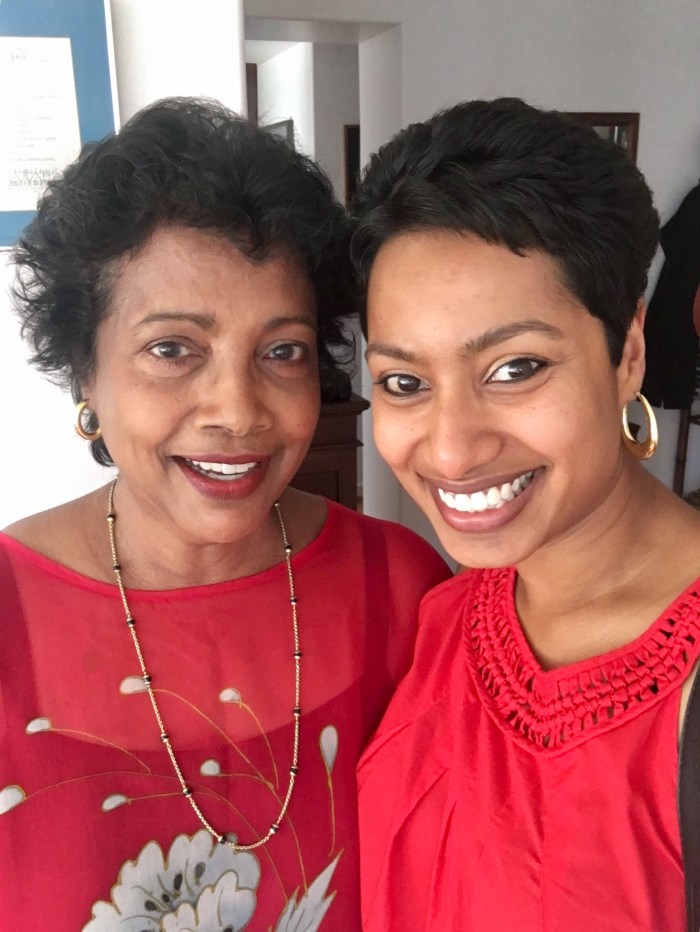
Author and daughter, Dr. Sheela Jane Menon, Assistant Professor at Dickinson College, PA
The country desperately needs to see the Nuns on the Bus on the road again. I just watched Radical Grace,nearly three years after my daughter and son-in-law gave it to me as a Christmas gift. My tardiness made me feel guilty, but despite the passage of time, the film still feels very timely. Three years after the cancer that is 45 entered the White House; three years after the corruption and cruelty he unleashed has metastasized into key branches of government; three years after Catholics have witnessed the heart of the Gospels ripped out the way children have been ripped from the arms of their parents at the southern border, this documentary about how a few nuns risked their place in the church to fight for justice tells me we need the leadership of the nuns more than ever.
This is a moment to drive the merchants of hate out of the Temple, as Jesus did. But will the United States Conference of Catholic Bishops (USCCB) bear prophetic witness? Do they have it in them to proclaim the Gospel?
I am a Catholic from Malaysia who has lived in the United States for nearly two decades. I became an American citizen two years ago. Every day I look for two of the Big Ideas –Catholicism and American democracy—to which I am forever tethered, to be rearticulated by new, principled leaders. And they are: not by those who command the pulpit or political power but by those who live the Gospel through their faith-inspired service to the community. People like Sister Erica Jordan who asked House Speaker, the conspicuously Catholic Paul Ryan to explain how he translates Church teaching into health care and tax policy. He could not.
She studies, and disputes, and teaches,
and thus she serves her Faith;
for how could God, who gave her reason, want her ignorant?
—Sor Juana Inés de la Cruz, Villancico, or, “Carol”, in celebration of St. Catherine of Alexandria (1692)
The reason for this blog, and for writing it on this day, is to celebrate and remember the life and legacy of Sor Juana Inés de la Cruz.
In 1994, I was exposed, by chance, to the life and writings of 17th century Novohispana feminist Sor Juana Inés de la Cruz. I am the product of twelve years of Catholic education, eight years of which were in an all-women setting. Again, by chance, I learned about Sor Juana in a liberation theology class while studying feminist theology at Harvard Divinity School. In this class, I learned about Sor Juana’s bold advocacy of the right of women to be educated. This spurred me to learn more about this Catholic Latina theologian whom I would later discover was the last great author of El Siglo de Oro (Spain’s Golden Age), recognized in her era as an esteemed poet, mathematician, astronomer, and more. This was the beginning of my life-long passion to reclaim the legacy of Sor Juana and her-story within the Christian, non-Christian Western tradition, and in Spanish and Mexican history. Continue reading “Remembering Sor Juana Inés de la Cruz’s Life and Legacy: Champion of Universal, and Non-Human Rights November 12, 1648/51 – April 17, 1695 by Theresa A. Yugar”
Viśākhā is often called the greatest female lay follower of the Buddha. She prompted the Buddha to give numerous teachings. She also donated generously to the Sangha (monastic order). Her crowning contribution was building a monastery called Migāramātupāsāda.
Visakha Directing the Construction of the Eastern Monastery in Savatthi, at the Nava Jetavana, Shravasti
She is said to either die as a “stream-enterer” (a person who will definitely become enlightened, no matter how many life times it will take). Another account about her afterlife says that she would live for eons in happiness in one of the divine realms before achieving the final Liberation there and then.
Viśākhā appears in numerous Suttas of Theravadin Canon. From the modern feminist point of view, the content of these discourses reinforces patriarchal gender stereotypes. In particular, Viśākhā is portrayed as a caring Mother for her relatives, Bhikkhus (Buddhist monks and nuns), and other people.
There is no shortage of men in power. No shortage of men who are ready to issue warnings and threaten punishment for straying from the party line. No shortage of men ready to hold forth in front of cameras. And yet, and yet….It took a woman with a lot of guts, a lawyer, and a person of faith to champion healthcare for all. It took a woman to criss-cross the country, standing in solidarity with those in need, ministering to those with “broken hearts” who stand on the margins.
There was no shortage of men with institutional power and access to the pulpit, but it took a woman to speak publicly about supporting the President as he worked in the face of Republican obstructionism to make the Affordable Healthcare Act a reality for millions who had no coverage. And once again in this the craziest of elections, it has taken a woman to stand with other faith leaders to call for a Moral Agenda. Continue reading “A Woman Leads: Church and Politics 2016 by Dawn Morais Webster”
In my class yesterday (a survey of Christian thought and practices), I was lecturing about monastic life in the Middle Ages. Among other points, I mentioned that medieval religious orders provided settings where women could be educated and assume leadership roles (primarily among other women), thinking of Hildegard of Bingen (1098-1179) who was the Abbess of a monastic community in Rupertsberg. Other women medieval writers who developed influential writings, like Mechtild of Magdeburg (ca. 1210-1282) and Catherine of Siena (1347-80), belonged to tertiaries or third orders, which were monastic community for laypersons. This part of the lesson emphasized that monastic reforms around the 12th century opened religious orders more extensively to women and laity.
Still speaking of medieval reforms, I displayed a picture of Francis of Assisi on the screen at the front of the room. I mentioned that Francis was concerned about the poor and the animals and that he has inspired some contemporary Christians, including the current pope who took Francis as his name. We talked about how both St. Francis and Pope Francis are seen as reformers.
Because earlier in my lesson I’d made a point of speaking of women’s experience, when I spoke about the Pope’s name as a possible sign of renewal or reform, Gina Messina-Dysert’s question “What about the women?” came to mind. In her recent post, she responded to the Pope’s exclusion of many issues that concern women in his address to the US Catholic Bishops. Like Gina, I applaud many of the Pope’s reforms but I am confused about how rarely he is criticized for maintaining the long-held Catholic view that disallows women to be ordained as priests.
Let me provide an example: During the Pope’s visit to the US, one of my students described Pope Francis as “very liberal.” When I interjected that he has not supported the ordination of women, the student laughed and said the pope would be accused of heresy for supporting that! While that may be true, my more immediate concern was that in a classroom of students who are mostly supportive of women in ministry, the Catholic restrictions on the priesthood were seen as a part of the tradition not worth challenging. Why is it that preserving male leadership is excused as a part of the tradition while preserving exclusive marriage practices is something to be challenged? They are interrelated.
As we know from blogs and social media sites, many people who support LGBTQ rights were upset over news stories about the Pope meeting with Kim Davis, the county clerk who was jailed for refusing to issue marriage licenses to same-sex couples. Certainly such a meeting is disturbing to same-sex marriage advocates. But is it surprising? At least one womanist ethicist I know, Eboni Marshall Turman, pointed out in a Facebook discussion that the church has long since been public in its support of male privilege and heteronormativity. My intent is not to single out Catholicism for sexist practices. When recently asked about women’s ordination and leadership in Baptist churches in my own town of Waco Texas, I had to admit that even though ordination of women is permissible and practiced in many of the churches, the number of churches that have called women to the position of senior pastor is shockingly few.
My point is this: When we find teachings in particular religious traditions that justify the exclusion of one group, we should expect to find justifications for excluding other groups, too. In the same discussion I referenced above, Eboni Marshall Turman said, ”Oppressions are compounded and intersectional. If they come for me, it is just a matter of time before they come for you. This is basic theological ethics.”
The experiences of varied groups are not the same; our oppressions and marginalizations also differ. But practices of exclusion are constructed on the same logic that values some persons (the in-group) more than others (the outsiders). Therefore, feminists have a responsibility to advance the well-being and interests of other groups (besides women) who are being marginalized.
Another reason for this advocacy is that many women are included in other marginalized groups. To ignore the intersectionality of oppression is to deny its pervasiveness and the realities of women’s lives. This is why feminists of color are often critical of white feminism. (The recent debate over the photo shoot for the movie Suffragette is a new instance of a persistent critique of white or mainstream feminism. See Rebecca Carroll’s piece on “Suffragette’s Publicity Campaign and the Politics of Erasure”).
To counter the limitations of our own experiences and be consistent in our pursuit of equality, feminists should intentionally cultivate practices of solidarity and coalition-building in our work. I, like everyone else, am often unable to see the inconsistencies in my own practices and teachings without others’ experiences to expand my view. This is one reason I value this Feminism and Religion community. Thank you for the wisdom and practices you offer from your own religious traditions and your own experiences of marginalization. You make me a better feminist through your writings and comments.
Perhaps working together, we can bring about religious reforms that our descendants will recognize in the centuries to come.
Elise M. Edwards, PhD is a Lecturer in Christian Ethics at Baylor University and a graduate of Claremont Graduate University. She is also a registered architect in the State of Florida. Her interdisciplinary work examines issues of civic engagement and how beliefs and commitments are expressed publicly. As a black feminist, she primarily focuses on cultural expressions by, for, and about women and marginalized communities. Follow her on twitter, google+ or academia.edu.


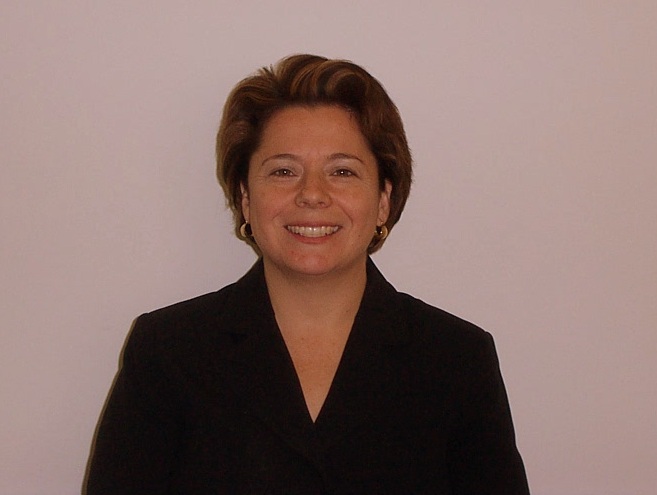 The reason for this blog, and for writing it on this day, is to celebrate and remember the life and legacy of Sor Juana Inés de la Cruz.
 Viśākhā is often called the greatest female lay follower of the Buddha. She prompted the Buddha to give numerous teachings. She also donated generously to the Sangha (monastic order). Her crowning contribution was building a monastery called Migāramātupāsāda.
 Feminism and Religion