Awakening to the Mystery of Absolute Beginnings by Carolyn Lee Boyd

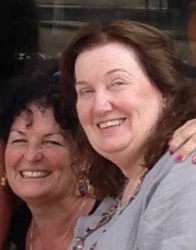
carolyn portrait

As I rise at 5:30 each morning, my spirit reawakens in a between-the-worlds realm of absolute beginnings. For those few minutes of quiet and slowly revealing dawn light, I revel in mystical newness, endless possibility, a horizon that is only the future.  By 7 am, when I can hear cars on the road and see television screens through windows as I walk to work, normal, plodding space-time has taken over, leaving just a shimmer to linger in my memory.

I remember living all day with this feeling of being at the very beginning of my world when I was a young child and everything that I did and thought was for the first time. I believed this sense was lost forever when I was later taught by society, as so many of us are, that I was only the tiniest, most ordinary mite in a world already built many eons ago by people with a much brighter genius than me.  Continue reading “Awakening to the Mystery of Absolute Beginnings by Carolyn Lee Boyd”

Brigit and Patricia: Comrade-Women by Elizabeth Cunningham

Brigit is my comrade-woman
Brigit is my maker of song
Brigit is my helping-woman
My choicest of women, my guide

Brigit, celebrated by pagans and Christians alike on February 1, is a goddess who knows how to incarnate. When Christianity came to Ireland, she became a saint without missing a beat and without giving up any of her reputation for healing, poetry, or smith crafting, for being the keeper of the sacred flames and wells. The verse above is one of my favorites from “The Blessing of Brigit,” several versions of which are recorded in Alexander Carmichael’s Carmina Gadelica, Hymns and Incantations Collected in the Highlands and Islands of Scotland in the Last Century (which is to say the nineteenth!)

I adapted the verse and sang it in memory of author, educator, priestess, and visionary activist Patricia Monaghan who died November 11, 2012. Dawn Work-Makinne offered a beautiful tribute to Patricia’s life and work. Today I want to reflect on Patricia in relation to Brigit, a goddess Patricia researched and celebrated (look for the forthcoming anthology she edited with her husband, Michael McDermott  Brigit: Sun of Womanhood)—and whose spirit she embodied as vigorously as the legendary Saint Brigit of Kildare. Continue reading “Brigit and Patricia: Comrade-Women by Elizabeth Cunningham”

Patterns for the New Year by Sara Frykenberg

Sara FrykenbergLife last year continually pushed me to figure out how I should care for those close to me while also caring for myself.  I have been pushed to see the difference between myself and other people: their choices and my own.  This is perhaps, the most difficult challenge I faced in the first year of the Age of Aquarius… and life has been an unrelenting teacher. 

Happy 2013!  Or a statement more accurate to my feelings: Happy end of 2012!  Last year around this time, I wrote a post entitled: Celebrating the Beginning of the Aquarian Age.  The push to evolve was and is very exciting to me.  This shifting astrological paradigm challenges us to break away from those habits and patterns that no longer serve us.  But excited as I am, I have to admit that the first year of the Age of Aquarius really kicked my butt.

Did last year feel exceptionally difficult for anyone else out there?  I really felt like I couldn’t catch a break for the entirety of 2012.  This is not to say that my year was simply filled with loss and grief, though I am dealing with loss and a great deal of grief.  But some really great things happened last year too, which I celebrated, but also found extremely difficult to manage.  Many of my roles and relationships radically changed in ways that were more difficult than I expected or wanted.  Riding the Aquarian tides, I felt tossed about and was often confused.  I kept telling myself: just hang on.  Just hang on, because you are not alone riding these cosmic waves.  Hang on, because you will learn how to swim in these new waters.

Therefore, in honor of the New Year, I would like to take this opportunity to evaluate and strategize for my how.

I am not usually one for making new years’ resolutions.  The cultural rhetoric surrounding resolutions either presupposes failure or relates success to the amount of money you spend to achieve a goal.  Yet today I find myself considering how I approached last years’ challenges, successfully and unsuccessfully.  I have concluded that I need to create more life giving patterns and habits in 2013.  Many things I am doing now, my coping mechanisms and my defenses, can no longer meet my needs.  So, I guess I am making resolutions.  I, however, prefer to say that I am actively hope-ing to evolve my praxis of living. ;) Thus, I set the following intentions for 2013: Continue reading “Patterns for the New Year by Sara Frykenberg”

Inspiration by Jassy Watson

Jassy_Agora1-150x150This “Mountain Mother” painting is an ode to women’s earth wisdom and is my prayer for reclaiming of that wisdom to heal the earth and all her beings.

When I am inspired to paint I can think of nothing else, the desire to put brush to canvas takes over every ounce of my being, and it is difficult to be present in everyday life. There are other times where I’ve wanted to create but inspiration was lacking: I would start a painting and have no desire to finish it. I would often get quite frustrated at myself.  It’s only recently that I’ve had the realisation that down time is just as significant as the up time. Rather than get anxious about not creating a masterpiece, I have learnt to go with the flow, take pleasure in the time of rest, because I know it’s all part of the cycle.  My inspiration always returns with abundance. Presently I am bursting at the seams with creativity, and I can’t find enough hours in the day to let all this inspired energy out. I am overcome with a sense of urgency I can’t explain. I am committed to paint and write with the intention that my personal message becomes part of the global message for change as our sacred feminine wisdom is being called forth. I am determined and full of courage to be part of the movement that brings about a shift in all aspects of life.

My present state of inspiration can be attributed to my recent Goddess pilgrimage to Crete with Carol Christ. I am sure that anybody who has attended such pilgrimages will attest that these experiences are life-changing. Travel alone is profound, but to share the experience in a circle of twenty amazing women is even more so. We sang, danced, trekked through the Cretan countryside, delved deep into caves; the womb of our great mother, climbed mountains and cleansed in the sea. We prayed and communed with the goddess daily, participating in rituals that were meaningful, un-contrived and safe. While I have always known that the goddess is everywhere, within and without–encountering her ancient past in a present day context is a feeling I’m not sure I can adequately describe with words, hence my desire to express some of these feelings through my art.

 “Mountain Mother” Jassy Watson
“Mountain Mother” Jassy Watson

Continue reading “Inspiration by Jassy Watson”

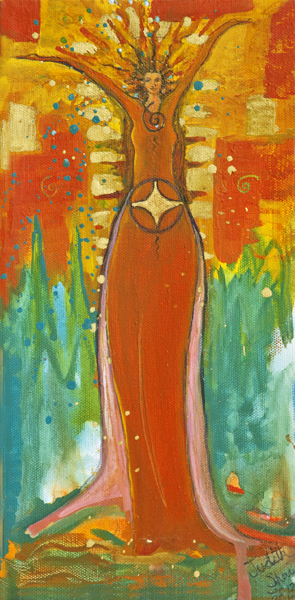
Why are We Drawn to the Black Madonna? by Judith Shaw

judith Shaw photoOnce the opportunity came my way to spend two weeks with my sister in Paris, I knew I had to visit the Black Madonnas at Chartres.  I had been to Chartres many years ago,  before I knew about the Black Madonnas scattered throughout Europe.  I felt the power of the site at that time, but had little understanding of where that power came from.

History of the Black Madonna 

Isis

The indigenous goddess worship of Europe, was influenced by Phoenician traders who introduced statues of dark skinned African and Middle Eastern goddesses such as Isis, Inanna, and others to the European continent from 1550BC to about 300BCE.  The worship of these goddesses continued  with The Roman invasion of Gaul (France) and other parts of Europe.

Once Christianity took hold in Europe, churches were built on top of sacred pagan sites. But old ways die hard; many of these dark skinned goddesses were incorporated into the newly built Christian churches.  Today there are more than 500 known Black Madonna statues and paintings throughout the world, the majority in France. Continue reading “Why are We Drawn to the Black Madonna? by Judith Shaw”

Maeve (aka the Celtic Mary Magdalen) on Elections, transcribed by Elizabeth Cunningham

You are a poet and a seer. Say you are a V.I.P (very important poet; in the first century CE when I lived such a thing was possible). Because of your poetic prowess, your ability to go between the worlds and see into the heart of the matter, it has fallen upon you to seek a vision. Who will be the new leader of the tribe?  Here is no simple matter of primogeniture. Here no ballots to be counted or stolen. No one has had to endure televised political conventions or candidate debates. It goes hardest for the sacrificial bull, who has been slaughtered and must be consumed—by you, sometimes raw, sometimes cooked, depending on local tradition. In either case, you consume the flesh and blood of the sacred bull. Then you are wrapped in its still-bloody hide. You fall into a trance, you dream….

My name is Maeve (rhymes with brave). I came to be known as Mary Magdalen. (How that happened is a long and exciting story, but not the subject of today’s post.) I am taking Elizabeth’s place to make some commentary from my first century perspective as you twenty-first century Americans prepare to elect new leaders. (You hope you will be electing them. I’d trust poets in bloody bull hides over electronic voting machines any day.) The rite described above, called the tarbhfleis or bull-sleep, was used to select the kings of Tara. The Celts counted wealth in cattle, so the bull was revered. The Gallic god Esus (as the druids called Jesus) was associated with the sacrificial bull. The infamous Queen Maeve of Connacht (for whom I am named), that champion of women’s sovereignty, went to war over a bull that defected from her herds to her husband’s. People said that the bull did not want to be ruled by a woman. Those were fighting words for Queen Maeve.  Continue reading “Maeve (aka the Celtic Mary Magdalen) on Elections, transcribed by Elizabeth Cunningham”

Like Rain on Dry Land by Marcia Bedard

When first I moved to a rural mountain community near Yosemite, I was spiritually parched, and my soul felt  dry as a bone. Desperate for the rich conversations of my sisters, after taking an early retirement from the CSU Fresno Women’s Studies Program, I had an intuitive sense that I might find some like-minded women friends in a small group that met weekly at our local church, led by Diana, our courageously and outrageously feminist pastor, who has since moved on to what I hope are friendlier communities for feminist pastors.

If PFLAG, and similar marginalized groups, had found an oasis there, in what was called (in order to please the church fathers) a Women’s Bible Study Group, so could I. A year before, this would have been my last choice of groups to join, but in a town where fundamentalist churches thrived, and Starbucks was the only place you could find a copy of literature as subversive as The New York Times, it was my only choice. It was in the church basement, amidst a thinly disguised knitting/bible study group, that we gathered weekly to receive what turned out to be a truly holy (meaning wholly) communion of spirit, enriched by various reading that Diana generously shared with us. Continue reading “Like Rain on Dry Land by Marcia Bedard”

Happiness is a Warm Space: Enchantment as Feminist Virtue by Amy Levin

Art can provide a balm for the modern soul – Claude Monet

Living in New York has its vices, and anxiety-triggering space is one of many. Though the city offers ailments just the same, whether they are in the form of meditation or medication, I’m beginning to believe the statistics delineating just how much more anxious us city-dwellers have become. But once in a while you catch a break.

This past Friday, for me, it was the free admission to the Museum of Modern Art. My favorite exhibition room of the MoMA is neither original nor surprising – Monet’s water lilies. The cool hues of greens, blues, and purples that spread across the triptych canvases so effortlessly interrupt the chaotic bodies roaming about the room, evoking a calm, liberating energy. My lungs expand, my shoulders relax. It is my opinion that more people sit down in this room more than any other in the museum.  These ameliorating spaces, which, using Monet’s words, provide a “balm for the modern soul,” not only lift us emotionally and physically, but they offer us something a bit more. . .metaphysical. The water lilies are just one example of the way that art can offer us a sort of spiritual uplift in, what most of us would consider, a secular space. Continue reading “Happiness is a Warm Space: Enchantment as Feminist Virtue by Amy Levin”

Theapoetics by Molly

I think there is a poet in me

she’s been hiding

I didn’t know she was there

I didn’t see her
I didn’t hear her

I didn’t watch for her
wait for her
listen to her
or know her

and yet, when I come to this place in the woods
and I sit down
and I open my mouth

poetry comes out

and I really think
she’s been here all along.

In the woods behind my house rest a collection of nine large flat rocks. Daily, I walk down to these “priestess rocks” for some sacred time alone to pray, meditate, consider, and be. Often, while in this space, I open my mouth and poetry comes out. I’ve come to see this experience as theapoetics—experiencing the Goddess through direct “revelation,” framed in language. As Stanley Hopper originally described in the 1970’s, it is possible to “…replace theology, the rationalistic interpretation of belief, with theopoetics, finding God[dess] through poetry and fiction, which neither wither before modern science nor conflict with the complexity of what we know now to be the self.” Theapoetics might also be described, “as a means of engaging language and perception in such a way that one enters into a radical relation with the divine, the other, and the creation in which all occurs.” Continue reading “Theapoetics by Molly”

Living Liminality: Of Thresholds and Dwelling Places by Marcia W. Mount Shoop

Sometimes I think it happened gradually.  Other times it feels like sudden change.  Either way I find myself in an in-between space that is my life.

With apologies to Victor Turner and his cultural anthropological appropriation of liminality as a threshold space, I have come to view my liminal living as a more permanent dwelling place these days.  Turner’s category of liminality locates subjects in the betwixt and between as they move from one manifestation of identity in community to a new kind of integration or role in community.   I am starting to wonder, however, if the thresholds are actually dwelling places for some of us in this world.

I don’t know if that means I am actually more marginal than I am liminal.  The margins are margins because they remain on the outskirts and they help define the boundaries.  Margins are permanent.  Am I marginalized if I live at the edges of the communities and identities I use to occupy, perhaps never to return to the bosom of the center? I hesitate to make such a claim mostly because I still occupy privileged spaces not the least of which are those constructed from how whiteness grants access and authority in this world. Continue reading “Living Liminality: Of Thresholds and Dwelling Places by Marcia W. Mount Shoop”