In the wake of the disappearance of legal American resident and Saudi journalist Jamal Khashoggi, the left castigates Saudi Arabia for a vicious murder. The US President warns congress not to cut off arms deals with Saudia Arabia because to do so would threaten more than half a million US jobs in the military industrial complex.
Author’s Note: This post was first published on 10 March 2013. This year, Purim was on the 2nd of March. This post has updated imagery.
The Jewish Festival of Purim and the book of Esther offer us an opportunity to reflect on the value of courage from a feminist perspective. The online Webster’s Dictionary defines courage as, “mental or moral strength to venture, persevere, and withstand danger, fear, or difficulty.” In religious discourse, courage is often categorized as a virtue or a moral principle. Aristotle (384BCE – 322BCE), one of the most famous of the virtue ethicists, believed a virtue like courage should be practiced according to the mean or the right amount. Too much courage leaves one rash, possibly too reactionary and hot-headed while too little makes one cowardly and weak, but just the right amount in a given situation leads to moral behavior. Virtuous living leads to happiness, or perhaps is itself happiness, for Aristotle. Yet, as a feminist, I understand the worth of courage differently. To me, the value of courage lies not in individualistic gains nor in personal happiness but in its use toward achieving justice and equality in society.
Moderator’s Note: This has been posted on FAR twice, originally on April 7th, 2014 and then again on July 15, 2022. We are posting this a third time because of its importance. It is a piece of history that helps to illustrate how we got to where we finds ourselves today.
During the past week I attended a Los Angeles premiere of a new documentary Anita: Speaking Truth to Power (Dir: Freida Lee Mock USA, 2013). The screening was sold out and I had great seats saved for me– sitting with a friend who works at Samuel Goldwyn, the distributor of this fine film.
In 1991, Anita Hill provided testimony she hoped would serve to dissemble the nomination of Clarence Thomas as a Supreme Court justice. Although the vote would end up being close (52-48) Hill’s testimony did not serve to dissuade the decision — Clarence Thomas’ nomination was confirmed and he was appointed to a life term on the Supreme Court four days after Hill’s testimony concluded. Here is an outline of the debate.
Moderator’s Note: This piece is in co-operation with The Nasty Women Writers Project, a site dedicated to highlighting and amplifying the voices and visions of powerful women. The site was founded by sisters Theresa and Maria Dintino. To quote Theresa, “by doing this work we are expanding our own writer’s web for nourishment and support.” This was originally posted on their site on March 4, 2025. You can see more of their posts here.
Out of forty monuments along the National Mall in Washington, DC, none celebrate women and their contribution to American history.
One of our NWW [Nasty Women Writers] categories is Breaking the Bronze Ceiling where we track the effort to increase the number of monuments dedicated to real women in public spaces.
I’ve made many trips to Washington, DC, trekking the National Mall specifically to visit monuments. Why didn’t I notice women were missing? Am I so conditioned to not seeing women recognized and honored at the highest levels that I don’t even expect it or question their absence?
I felt ignorant and complicit.
It’s 2025 and there is not a single monument to honor women on our National Mall, a place that “draws roughly 36 million visitors a year, more than Yosemite, Yellowstone and the Grand Canyon combined”(Schuessler).
Part 1 was posted March 1st. You can read it here. The definition that Carol refers to as well as a link to her original article can be found there as well. Her words are in italics.
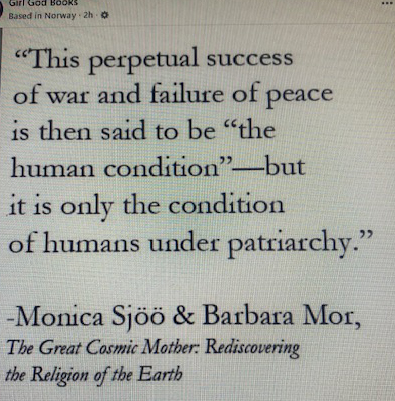
It has long seemed to me that patriarchy cannot be separated from war and the kings who take power in the wake of war. Many years ago I was stunned by Merlin Stone’s allegation that in matrilineal societies there are no illegitimate children, because all children have mothers. Lately, I have been trying to figure out why the Roman Catholic and other churches and the American Republican party are so strongly opposed to women’s right to control our own bodies and are trying to prevent access to birth control and abortion. In the above definition of patriarchy . . . I bring all of these lines of thought together in a definition which describes the origins of patriarchy and the interconnections between patriarchy, the control of female sexuality, private property, violence, war, conquest, rape in war, and slavery.
From the Facebook page of GirlGodBooks
Here Carol lays it all out. I, too, have wondered why the Church, why conservative politicians are so obsessed with women’s bodies and reproductive systems. No wonder abortion, in fact all of the healthcare of women is so on the political radar. Taking away the agency of women when they become pregnant is dehumanizing, reduces women to incubators. And that doesn’t even go into the fear of treating women for any health issues when they are pregnant. Take the tragic case of Tierra Walker who died in Texas, pregnant and facing growing health problems. She had a 14year old son and after weeks of severe distress attempted to get an abortion. She was unable to do due to the strict anti-abortion laws in Texas as she went to doctor after doctor. Here is what they told her: “But the doctor, her family said, told her what many other medical providers would say in the weeks that followed: There was no emergency; nothing was wrong with her pregnancy, only her health.” Its as if there was a cabal to diminish the value of women’s lives that even the doctors, who know better, participate in. And that is the templated of patriarchy. True that the doctors are threatened with loss of license and 10 years imprisonment begin. But when they spout the “party” line, they not only risk their patients, they deepen the already ingrained belief that women and our bodies are without worth.
This post was originally published on November 1, 2o23. It is about a chapter I was working on at the time. That piece was recently published in Catholicism: End or Beginning? by Mary Daly, and edited by Meg Stapleton Smith.
I thought it a good time to repost since the first public discussion of our volume will take place next Wednesday, March 11, 2026 at 1PM (EST) on Zoom. Mary E. Hunt will be hosting Meg Stapleton Smith for a WATERtalk. I and other contributors will also join the conversation.
~~~~~~
I just submitted to the editor the final draft of a chapter I’ve been working on for about two years (no joke). Sometimes when I really care about a subject, it can take me a long time to process, reflect, and write on the subject (I shared a bit about this project on FAR early this year)—but this one might have taken the cake in terms of how slow a process it ended up being. Still, it is now submitted and in the hands of the publishing company, Oxford University Press, for the next step in the process.
Yesterday was mild (mid 40’s in January) so Coalie and I went to our favorite forest to walk. The roads were icy, but the seeps were brimming and ringed with footprints. Over one of my favorites (because declining wood frogs still lay eggs there in the spring), an elderberry bush arced over rippling water like some sort of plant protectoress.
Seeps fascinate me because they defy freezing weather bubbling up through deep in the earth. Water seeps in the forest are small wetland areas where groundwater naturally emerges at the surface, often at the bases of slopes. They create moist spots with lush plants in season (like elderberries) and serve as important habitats for wildlife by providing clean water sources all year-round. They form from underground layers of rock that force water to flow horizontally until it surfaces. Seeps care for their animal and bird neighbors by providing clear waters at any time of year. There were so many fox and partridge tracks leading to and from these pools that I was surprised we didn’t startle one of the latter. (At home I have a pair that are feasting on the last of the crabapple berries). A couple of chickadees were chirping from nearby maples probably annoyed because we were taking our time. Coalie was nosing every blade of grass in the area.
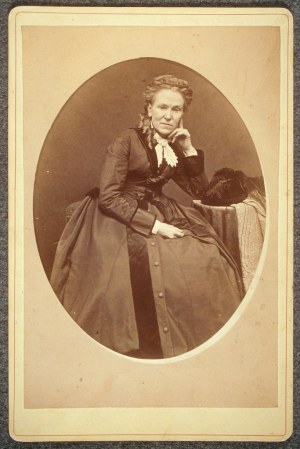
Matilda Joslyn Gage was an activist in the nineteenth century struggle for women’s rights equal to Susan B. Anthony, and a writer and theorist equal to Elizabeth Cady Stanton. That she is not remembered is due in large part to Susan B. Anthony’s efforts to write her out of history.
Matilda Joslyn Gage was also a scholar of women’s history unrivaled in her time. In Woman Church, and State, Gage argued that “the most grievous wrong ever inflicted upon women was in the Christian teaching that she was not created equal with man.” (page 1) From this it follows that feminists must never lose sight of the role Christian teachings have played and continue to play in the unequal treatment of women.
According to Gage, women’s position in church and state did not improve in the Christian era. To the contrary it declined! Gage proved this thesis in chapters titled: The Matriarchate, Celibacy, Canon Law, Marquette, Witchcraft, Wives, Polygamy, Woman and Work, and The Church of Today.
We here at FAR are so honored and grateful to be the custodian of so many of Carol’s writings. Her 3-part seminal piece Patriarchy as a System of Male Dominance Created at the Intersection of the Control of Women, Private Property, and Warfirst appeared on our site in 2013. We have committed to re-running it each year on the anniversary of her death in July. It is a piece that needs to be read over and over again until the understanding of what she writes seeps into our very bones. And even for those who already know this in our bones, it is important to articulate. We shouldn’t have needed the Epstein files to provide proof of Carol’s work. But alas . .. it does provide it in slews. And the fact that we needed the Epstein files for society at large to even begin discussing this proves Carol’s points of how insidious patriarchy is. It is so ingrained into our world that it is invisible unless there is a stimulus to bring it to the forefront. Will that be enough to make change?
For this two part post, I quote Carol from Part I of her essay (linked above – her wordsin italics). My commentary is based on recent events as well as the Epstein revelations. Really this is just scratching the surface and I plan to write more posts highlighting the work that Carol did on patriarchy. Here is her definition of patriarchy.
February, the month designated as Black History Month, will see us focus on the voice, the faith, and the heartbeat of one of the greatest singers in all of US History. Many have stated that the voice and songs of Mahalia Jackson can be considered one of the most influential voices of the 20th Century. She not only became one of the most modern voices to bridge popular music, blues, and religious hymns but she also is intrinsically linked to the Civil Rights Movement. She is one of the first commercially successful Black musicians of the modern era.
Mahalia (1911-1972) was born Mahala in New Orleans, Louisiana. Both sets of her grandparents were born into slavery. Mahala’s childhood was filled with hardship, yet a persistent faith emerged. Mahala was raised in a very charismatic Baptist church, Mount Moriah Baptist Church. It is at church that Mahala would start to sing, find her voice, and start to uplift the souls around her.






 Feminism and Religion