

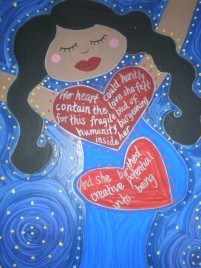
It’s no secret that the holidays are often a difficult time for queer people. Disproportionately estranged from family, we often must create our own family. While these chosen families can be tremendously life-giving, it’s tough not to long for our families of origin during Christmas time. Many still in relationship with family are forced to retreat to the closet for fear of safety or exclusion this season.
Queer folk who have affirming families of origin still experience the twang of heteronormativity in holiday commercials, family events, and church services throughout December. There’s a reason why many refer to it as “Blue Christmas,” because, well, the holidays can leave us feeling pretty blue when our identities are invalidated, excluded, questioned, or marginalized.
In every nativity scene, we see images of a so-called “holy family” that likely doesn’t look very much like the family’s most queer folk create: a straight, cisgender couple, and a baby. This family is lauded by the Church as the quintessential iteration of what family should look like. When our families don’t look anything like this, it’s easy to see how celebrating the birth of Jesus is fraught with emotional and spiritual hardship.
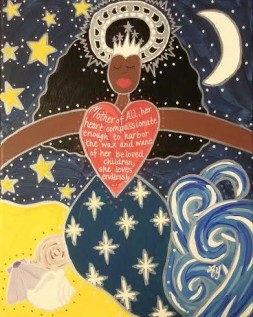
There is good news, though. We can subvert this narrative of traditional family by queering the story. So, I’d like to talk a bit about the revolutionary power of queering Mary. Abolitionist and Women’s Rights Activist, Sojourner Truth, said it best at the 1851 Ohio Women’s Convention. Once a slave, Truth questioned the whitewashing done to women of color by white women working only for white women’s right to vote by asking the famed question, “Ain’t I a woman?” In that same speech, she notes that male clergy claim that women “can’t have as much rights as men ‘cause Christ was a man.”
This adage is familiar, not only to women, but also to LGBTQs who have been told that our iterations of family aren’t real or true or right because they don’t reflect the so-called holy family of Joseph, Mary, and Jesus. In an act of theological brilliance and subversion, Sojourner Truth poses this question to the male clergy gathered at the convention: “Where did your Christ come from? Where did your Christ come from? From God and a woman. Man had nothing to do with him!” Continue reading “Painting Mary(s), Queering Mary(s) by Angela Yarber”

 Be still, and know that I am God.
 I always felt curiously distant from the figure of Mary. I always sensed that there is so much there and yet, I could never connect to it emotionally.
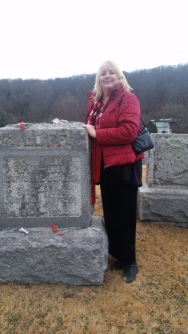 In the past week I visited Cherry Ridge, Honesdale, Wayne, Pennsylvania in the Pokonos, where I was welcomed by my third cousin Marcia Perry Gager whose family never left the place where our ancestors settled. Marcia and I have been corresponding about our family’s history since Ancesty.com connected us about three years ago. During that time, together with another cousin, Debra Ball, we have managed to decipher the complicated history of
 Santa Claus is really a shaman. He wears red and white and black (the three sacred colors of the so-called ancient triple goddess) and he’s fat because he’s well-fed. (A traditional shaman once told me never to trust a skinny shaman; if his people don’t provide for him, he’s not doing his job.) Santa flies from the frozen north, where the Saami (or Lapp) shamans still wield their full traditional powers. He’s drawn through the air by magical reindeer whose antlers symbolize the surging force of life. The Christmas tree is the world pole. From Mongolia to the American Southwest, shamans traditionally ascend the world pole to make their astral journeys. Santa knows everything, especially if we’ve been good or bad, and like karma itself, he brings us our just desserts. His gifts are the gifts of the spirit made material. His attendants, the toy-making elves, are the Old Ones who help the deserving and play tricks on the undeserving. Santa is not a god, but let’s honor him along with the solar gods and goddesses in our midwinter ritual.
 As the winter months approach, at least one “Christmas” gathering will be on my schedule. As this holiday has been co-opted by consumerism as evidenced by my memory of the throngs of sales and shoppers in large shopping centers to get “the perfect gift,” I wonder how to give the perfect gift to Mother Earth simultaneously. At the December meeting of my local chapter of the Sierra Club, one of the members passed out a list of gift ideas for a “low-impact” season. Some of the items on the list include or have inspired the following:

 I am tired.
 I just got home from the first yoga class I’ve attended since the recent (11/8/16) U.S. presidential election. I cried for the entire 75 minutes—through forward folds, downward facing dogs, exalted warriors, and especially shavasana (corpse pose). The young man (probably in his thirties) doing his yoga practice next to me asked after the closing Namaste, “Are you all right?” “No, not really. I’m very upset.” He nodded his head as if to say he understood.

