“We Knocked” :: A Review of Mormon Feminism by Caryn D. Riswold

caryn2Mormon feminists experience what most feminists of faith have heard at some point. Utter dismissal of the possibility of their existence.

We know several variations:

You can’t be Christian and feminist.

There’s no such thing as a Catholic feminist.

You can’t seriously be Jewish and feminist.

You can’t possibly be Muslim and feminist.

To be Mormon and feminist? Preposterous.

In response, scholars, activists, and writers within each tradition have had to document their history, make their theological case, and engage their scriptures as robustly as any conservative traditionalist would. In order to achieve meaningful institutional change, unimpeachable work and confident testimony is required. Continue reading ““We Knocked” :: A Review of Mormon Feminism by Caryn D. Riswold”

The Acid Attack on WomanPriest Alexandra Dyer: The Cancelation of Evil with the Face of God/ess by Cynthia Garrity-Bond

cynthia garrity bondOn August 20, Alexandra Dyer, a Roman Catholic WomanPriest was the victim of a targeted acid attack to her face.  Dyer had just left a meeting at The Healing Arts Initiative in Queens, NY.  As she was walking to her car, a man in his 30’s came up from behind and said, “Can I ask you something?”   As she turned to face her assailant, he threw a full cup of thick acid into her face.  In her pain and hysteria, Dyer somehow managed to get into her car, driving approximately 200 feet before losing complete control.  Her screams from the pain drew the attention of others, who called for help.  Dyer suffered third degree burns to her face and hands.  Here’s the thing about acid—it continues to inflect damage to the skin and bone after the fact.  While Dyer will survive the physical attack, she will never be the same woman.  Her outer scars will forever remind her of what she suffered—those physical features that made her Alexandra are gone, replaced by years of reconstructive surgery and further pain.

“Can I Ask You Something?” Continue reading “The Acid Attack on WomanPriest Alexandra Dyer: The Cancelation of Evil with the Face of God/ess by Cynthia Garrity-Bond”

Feminist Interpretations by Elise Edwards

Elise EdwardsI’ve written a few posts recently referencing biblical themes or stories. I’m not a biblical studies scholar; I’m an ethicist and theologian. So I know that ways I use the texts disturb some people who study them from a historical or biblical studies perspective. To say I don’t use the Bible as those scholars do, though, doesn’t mean I don’t have a disciplined approach. I aim to apply a consistent approach to scripture and to encourage my students to do the same.

I get really annoyed when someone proclaims a variation of “The Bible says it; I believe it; that settles it!” in moral debates. Obviously, people within a religious tradition are going to believe there is truth in the scriptures of their tradition. That’s simply how scripture functions. So I’m okay with “I believe it.” I have a problem with the two other parts of the statement – the Bible says it, and that settles it. The assertion that “the Bible says it” masks the task of interpretation that anyone encountering a text takes on. The statement “that settles it,” when adopted in moral debate, rejects the accountability and humility in sharing our interpretations with others. Continue reading “Feminist Interpretations by Elise Edwards”

Embracing the Hebrew Priestess by Jill Hammer

Jill HammerEven after I was ordained as a rabbi, I longed to be a priestess. The spiritual leadership I wanted most was less about leading traditional Torah study and prayer (though I’d done plenty of that) and more about immersing in the ocean, creating new rituals, reading kabbalistic sources on Shekhinah (the divine feminine mentioned in Talmud and kabbalah), or interpreting legends about women. My deepest desire was for there to be a school for Jewish women on a priestess path.

Ten years ago, my dream came true. In 2005, Taya Shere and I founded the Kohenet Hebrew Priestess Institute to bring to life the traces of the priestesshood we were finding in the Bible, in Near Eastern archaeology, and in Jewish lore and history. In Kohenet sacred space, we explore the women of spirit among our ancestors, resist their erasure, and bring forward the practices that were sacred to them. We discover in these forgotten teachings the mysticism of the material: the understanding that in our lived experience on the earth we are closest to divinity. At Kohenet, we meet the submerged version of deity called Shekhinah, Imma Ilaah, Elat, Goddess, Divine Mother, and understand why she has been so feared and rejected, yet also has been a deep and lasting part of our tradition as Jews.

The Kohenet Institute has ordained four classes of women and now meets twice a year for training weeks at the Isabella Jewish Retreat Center in Falls Village, Connecticut, and at Ananda Meditation Retreat in Nevada City, CA. We and our students run workshops and services in venues like Limmud UK and the Parliament of World Religions, as well as classes at retreat centers, local synagogues and women’s centers. Days at Kohenet are filled with spiritual exploration: prayer in the feminine in Hebrew and English; ceremony to grant new names or celebrate elders or heal the sick; making incantation bowls in the style of ancient Babylonia; slideshows of ancient priestess and Goddess art from the lands of the Bible; drum circles and labyrinths; stories of witches dueling with Talmudic sages, immersing in the lake before the Sabbath. At Kohenet, we celebrate and embody the sacred feminine, and prepare our students to lead ritual in an earth-based, embodied, feminist way that is rooted in Jewish tradition. Continue reading “Embracing the Hebrew Priestess by Jill Hammer”

The Politics of Being a Woman in a “Christian Nation” by Gina Messina-Dysert, Jennifer Zobair and Amy Levin

FF Editors.001

The far right is pitting God against women. Mike Huckabee’s support for the decision to deny a 10-year-old rape victim an abortion is just another example in a long history that continues this election season.

At Fox News’ Republican Presidential debate in Cleveland, Jeb Bush boasted that, informed by his faith, he “defunded planned parenthood and created a culture of life in my state.” When Megyn Kelly asked Scott Walker if he would “really let a mother die rather than have an abortion,” he refused to temper his position that there should be no exceptions to his “pro-life” position.

Ted Cruz professed “God speaks to me every day through the scriptures and this informs my position on religious liberty, life, and marriage.” And Marco Rubio argued that even in the case of rape, women should not have the ability to make choices about their pregnancies. Sadly, such proclamations ignore individual rights, freedom of religion, and the fact that faith as a guiding principle can be dangerous when the foundational teachings of social justice are ignored. Continue reading “The Politics of Being a Woman in a “Christian Nation” by Gina Messina-Dysert, Jennifer Zobair and Amy Levin”

Relaxation as a Spiritual Discipline by Katey Zeh

Katey HeadshotI have a productivity obsession. I wouldn’t go so far as to call it an addiction, though in describing to a friend how euphoric it feels to check off a bunch of to-dos, he said, “You kind of sound like a junkie.” He may be right. Up until a year ago I didn’t think I had a problem. When I heard experts talk about self-care and meditation and “me” time, I’d roll my eyes a bit. Self-care is for wimps, I thought to myself. And I was certainly not one of those. I didn’t need time off for self-care. I had my to-do lists.

I started to question if I really had this all figured out when I was two weeks postpartum and back to work full-time because like most workers in the United States, I didn’t have paid family leave. Between the hormonal fluctuations and sleep deprivation, I lacked the mental clarity I needed to prioritize tasks. So then every task became the most urgent thing. On top of caring for a newborn and recovering from the birth, this created a perpetual state of mental exhaustion that was simply not sustainable. I needed to do something before I burned out completely.

One of the first steps I took was doing a self-assessment of the current state of my overall wellness–physical, mental, emotional, and spiritual. The first thing I jotted down was, “I’m stretched to my limits. I’m productive to a fault.” That was telling. My next step was to write out a wellness prescription. Since lists and schedules are my drugs of choice, could I try using them for good? I wrote out a self-care to-do list with a dozen different items, including weekly yoga sessions and scheduled downtime. Continue reading “Relaxation as a Spiritual Discipline by Katey Zeh”

Dionysian Rites by Carol P. Christ

In today’s blog, I offer an excerpt from A Serpentine Path: Mysteries of the Goddess. The setting is Zaros, Crete, the time of year is mid-October.

We had a scrumptious dinner of fresh fish, salad, fried potatoes, local amber-colored wine, and tiny olives.  Later the two waiters, Themis and Nikos, bearing another pitcher of wine, sat down at our table.

They told us they were best friends and had just gotten out of the army. When they discovered that we were writers, the two young men were intrigued. “Our village has a very interesting history and many interesting customs,” they told us. “If you would like to come back and write about it, we will introduce you to all of the old people.” This conversation was in Greek, but I translated for Naomi. “This must indeed be a very interesting village,” I said to her, “because when they learn that I am a writer, most Greek men will say ‘write about me, I have a very interesting story.’ These men, in contrast, want us to write about their village.”

When we finished our wine, the young men offered to give us a lift back to our hotel on their motorbikes, suggesting we could have a coffee at the hotel bar. When we got to the hotel, they didn’t stop. “What happened?” I asked. “The bar wasn’t open at the hotel, so we’re looking for another place.” I wondered what Naomi, perched on the back of a motorbike and unable to speak Greek, must be thinking—especially since she was afraid of the unknown. We drove through the town and turned down a dirt road, arriving at the Zaros water factory. “We wanted to show you this,” they said sheepishly. “People drink our water all over Crete.” “O.K., “Naomi said, “but then you must take us back.” There were a few workers on the night shift, and the boys told us they had worked there too, before going into the army.
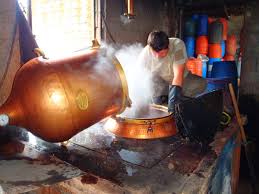
making rakiLeaving the factory, we continued down the dirt road heading away from the town. “Where are we going?” I asked, wondering what we had gotten ourselves into. “Just a minute,” Themis said, as he got off the bike in front of what looked like a small house in the middle of nowhere. “We need to go back,” Naomi said definitively. “Yes, I already said that,” I answered. “Come inside,” Themis beckoned. “We want to show you how they make the raki (the colorless alcoholic drink that had been offered to us in shot glasses us after meals). This is the still,” he continued, as he showed us into a small dark room with a glowing fire. “After the wine is pressed, they put the skins and stems into barrels like those you see in the corner. The mixture takes six weeks to ferment, and then they bring it to a still, where it is heated over a fire. The steam that rises is directed through long curved pipes, and comes out as raki,” he said, pointing to various parts of the mechanism. Continue reading “Dionysian Rites by Carol P. Christ”

Broken Mirrors, Broken Bodies, and Sophia Wisdom by Angela Yarber

angelaFreshly cleansed, I stood naked in front of a foggy full-length mirror. I had just taken my first hot, indoor shower in nearly two months. I’ve been volunteering in a National Forest all summer with my wife and toddler; it is stunningly beautiful. While there is a lake for bathing, we have no access to running water and there are certainly no mirrors hanging from the birch trees. Sure, I can catch a glimpse of myself in the rearview mirror of my car, but this was the first time I saw all of me—sun-kissed and mosquito-bitten—in a while. This may not seem like a big deal, and I didn’t think it would be, but the absence of mirrors has had a profoundly holy impact on me this summer.
As the dirt of two months swirled down the drain and I savored every drop of warm water pouring endlessly over my aching body, I thought about the mirror that awaited me. I thought about how it has been almost 15 years since I’ve intentionally starved myself or shoved my finger down my throat to induce calorie-purging vomiting. I thought about how I weigh thirty pounds more than I did during the nadir of my eating disorder. I thought about how much grace I’ve offered my body over these years. The grace to grow. The grace to age. The grace to gain. The grace to work hard. The grace to accept.

I thought about the tremendous privilege my body carries: the privilege of my whiteness, the privilege of being temporarily able-bodied, thin privilege. I thought about how my white body has never feared for her life when pulled over for a traffic violation. I thought about how my body has access to do whatever she wants—climb stairs into inaccessible buildings, or mountains to stunning vistas. I thought about how I can find clothing in my size in virtually any store, how no one offers me health advice when ordering at a restaurant, or diminishes my concerns at the doctor’s office based on my size. I thought about racism, ableism, and fatphobia. I thought about what it means to be a queer femme body. Continue reading “Broken Mirrors, Broken Bodies, and Sophia Wisdom by Angela Yarber”

Drawing the Four Together: Rosh Hashanah, Yom Kippur, Sukkot and Immigration.

10953174_10152933322533089_8073456879508513260_oLast Sunday, the Czech Republic’s Narodní Divadlo (National Theater) had its opening celebrations. The National Theater is a big thing here sort of like America’s Hollywood where actors, actresses and directors are household names. The opening celebration is even broadcast on television by Česká Televize (Czech TV, the national television company).

This year, Narodní Divadlo and Česká Televize have decided to dedicate all of the profits of the day’s long events to one organization: Organizace pro Pomoc Uprchlíkům (Organization for Aid to Refugees). It is the longest running and the most well-known NGO in the Czech Republic helping refugees, immigrants and asylum seekers. In addition, it also happens to be where my partner is a lawyer and Head of the Legal Department. So I have a personal connection.

As the High Holy Days begin tomorrow evening, I’ve been thinking a lot about their connection to immigration and Sukkot. My reflection starts with the fact that we too were once refugees. We too were once persecuted and forced into slavery. We too escaped and wandered in a foreign land even though sometimes we yearned for the comfort of the familiar. The sukkah is supposed to remind us of this history. At the same time, we have also been unwelcomed by many, been seen as suspicious and have even been expelled from the many lands we once called home. We have been murdered in mass numbers too many times to count. All of this is to say, that we know the situation of the down-and-out, because we have been there. Likewise, we have in many places overcome it and have a mission to help others in similar situations.

Continue reading “Drawing the Four Together: Rosh Hashanah, Yom Kippur, Sukkot and Immigration.”

Rosh Hashanah and the Goddess by Joyce Zonana

Joyce Zonana head shotWhen I was growing up in the 1950s in my Egyptian Jewish immigrant home, each of the High Holidays was imbued with sacredness, thanks largely to my mother’s commitment to a creating a harmonious and memorable gathering of family and friends.  Around a long table, covered with an embroidered white cloth and set with sparkling silver and delicately fluted china, she served at each season the festive meal that made manifest for us the presence of the Divine.

My father, an Orthodox man who prayed each morning and went regularly to the local Sephardic synagogue in Brooklyn, privately followed the tenets of his faith.  But it was my mother, unconsciously devout, who brought the public rituals of our religion to life.  As a child, I longed to be at prayer with my father and was envious of the men and boys who studied and recited the sonorous ancient Hebrew; I did not want to be confined to polishing the silver and setting the table.  But today, as an adult, I am grateful for the silent teachings bequeathed to me by my mother. Continue reading “Rosh Hashanah and the Goddess by Joyce Zonana”