


As a follow up to my last post on Poppaea Sabina, I want to focus on Poppaea’s interest in astrology, one of the few facts about her that can be confirmed independently of the hostile (and hence questionable) depiction of her by the Roman historian Tacitus, who, apart from Josephus, is the primary source of information about her. Indeed, she may have practiced astrology, for as Empress she was given a celestial sphere on her birthday by the poet Leonidas, who said it was a gift “worthy . . . of her learning.” Another possible indication of Poppaea’s special interest in astrology is the fact that a large banquet hall in the Roman imperial mansion built during Nero’s reign (recently discovered), probably conceived of and designed before Poppaea’s death (perhaps with her input), had some rotational feature, effectively making it a planetarium.
Though Tacitus thus would appear to be accurate on Poppaea’s interest in astrology, there is good reason to be wary of sharing his negative opinion about it. He never expressly explains himself on the issue, but it is not hard to spot what bothered Tacitus about astrology and hence Poppaea. Famous for his appreciation of freedom of speech, Tacitus wistfully looked back on a time when that was a freedom enjoyed only by men. By contrast, ancient astrology was but one part of a comprehensive philosophy of nature that viewed the entire cosmos as governed equally by male–and female–powers. Continue reading “Astrology and Its Relevance to the Jewish (and Christian) Belief of Poppaea by Stuart Dean”
 We were playing six-degrees of separation, I think. I don’t know if there are rules to follow. It was after dinner, and we were talking about people we had encountered and their linkages to others. Surprisingly quickly, we found ourselves connected to Dwight D. Eisenhower, Elvis, Winston Churchill, and the Queen of England, herself. My mom had autographs from Jerry Lee Lewis, Duke Ellington, the Globe Trotters, and a gaggle of NFL players and professional golfers. She once chatted up Tori Spelling in a bathroom in Canton, Ohio at a Football Hall of Fame Induction ceremony. My husband worked in film in Los Angeles and Cleveland, meeting a crowd of stars and politicians over the years. One time he had a chance, face-to-face encounter with Prince (the artist himself!) as one rode up and the other rode down an escalator at a Borders in Chicago. As the distance between them closed, my husband quietly acknowledged him, saying, “Bravo!” Prince, whose head was angled away so as to avoid having to say anything, apparently, after a moment of consideration, looked back over his shoulder as they passed and silently mouthed, “Thank you.” I still give my husband kudos here… I mean, what else do you say to Prince? This connection, moreover, gave us our links to Morris Day, Jerome, Apollonia, and Shelia E., so we were all excited at his impressive list. I had a far less remarkable cast of characters to contribute, but I could offer a Vatican insider acquaintance, providing thereby a papal connection, which gave us our links to several world leaders. I felt I had contributed my part, even without autographs and celebrities.
 Last October I wrote
 Read Part One of this story
  How much longer do I as a Muslim American female, have to deal with the “gang-buster,” terrorizing, “Satan” worshipers high-jacking my faith for the sake of trying to supposedly ‘preserve’ it? Who are these wackos and why do they seem to represent my faith in mainstream media? Where did they all come from? Which terrorist schools have they all graduated from and what truly is their agenda?
 Feeling safe again is often the healing and elusive aspiration of a person like me.
 The wasp nest dwells at the edge of my vision waiting for me to notice what it has to show me. In my mind, I have come to this beloved circle of earth beneath the embracing branches of this tree to ponder because the need is urgent for all the world’s women to have lives of peace, safety, equality, opportunity, and enough prosperity to guarantee necessities, and to save our planet from ecological disaster. I seek new ways of thinking about my life and actions and those of the global community of women to inspire more effective means of progress.
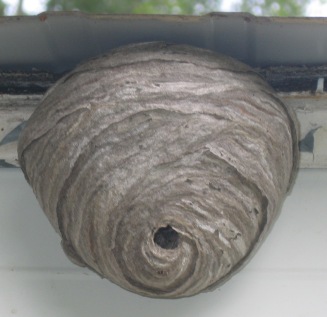 I finally spy the wasp nest. I follow its spiral shape, beginning at one point and then expanding in circles ever-outward and upward. I wonder, what if, in addition to perceiving my life as the more traditional journey or age-defined stages, I imagined it as a spiral like the galaxy, flowers, ancient sea creatures caught forever in fossils, swirling water, and so much else of nature? What if at my birth I was like a spiral’s central point, perhaps me at my most essential or as an infinite potential, and then, over time, I spiraled endlessly into the cosmos?
  Feminism and Religion