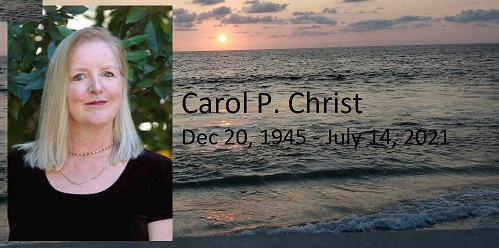
Legacy of Carol P. Christ: Argument from “Absence” and Absence of Dialogue

This was originally posted August 31, 2015

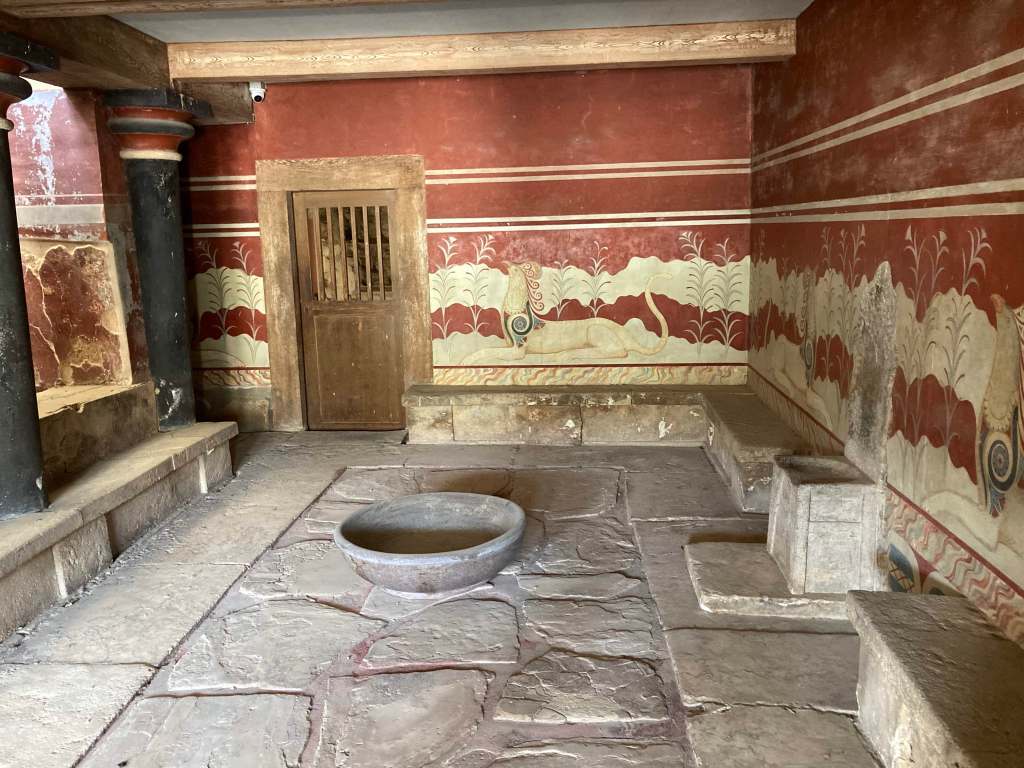
Recently in a conversation with a noted archaeologist and his male graduate student assistant, I proposed that the absence of war and the trappings of war, including images of larger than life-size warrior kings, suggested to me that we should not understand the social structure of ancient Crete on the model of patriarchal kingship. “Kings are always warriors,” I said, “yet there is no clear and convincing evidence of organized warfare in ancient Crete. And,” I continued, “because warrior kingship is not a ‘natural state,’ but one achieved through warfare and domination, kings must legitimate and celebrate their power through larger than life-size images of themselves. Such images were common in ancient Sumer and in ancient Egypt, but are not found in ancient Crete.”

The response I received was unexpected: both archaeologists seemed dumbfounded. “Is kingship always associated with war?” they asked. “Yes,” I responded, “this is a conclusion I reached many years ago while studying the cultures of ancient Greece and ancient Israel, and I have recently elaborated this theory in a series of essays on the blog Feminism and Religion ( See “Patriarchy as a System of Male Dominance Created at the Intersection of the the Control of Women, Private Property, and War”).”

Continue reading “Legacy of Carol P. Christ: Argument from “Absence” and Absence of Dialogue”

Matot-Massei: The Question of Women’s Agency and Lives under Patriarchy.

The Torah portion for July 15th is the double-portion, Matot-Massei  (Bamidbar/Numbers 30:2-36:13).  Matot, meaning tribes, runs from Numbers 30:2 to 32:42 and covers vow making as well as what the spoils of war with the Midianites are.  Massei, or journeys, is Numbers 33:1 to 36:13 and describes the Israelites journey through the desert after fleeing Egypt and the boundaries of the Promised Land.  While Matot-Massei have so much that could be discussed including war, images for the deity, and cities of refuge, this post focuses on their women. 

There are three occasions where women are specifically mentioned.  The first concerns vows and their atonement when broken.  Next, women are discussed as spoils of war.  Finally, Matot-Massei describes what to do with inheritance when there are only daughters. 

Continue reading “Matot-Massei: The Question of Women’s Agency and Lives under Patriarchy.”

Integrating Snake Medicine Part 2

In Part 1 of this post, published yesterday, I described the first steps of my personal journey of soul recovery, including my first encounter with Green Snake, in statues, dreams and hypnotherapy. Those experiences led to choosing to tattoo Green Snake on my left arm. Read more about finding my Medicine and embracing my Golden Shadow as I stepped into an ancient lineage of Snake Healers.

Sometimes we encounter really sweet, or funny gems on the road of individuation… Let’s start with one like that!

Sweet Intermezzo (6 years ago…)

In the film The Matrix, Neo receives a message to “follow the White Rabbit.” Just before I met my partner, he encountered a live Green Snake slithering across a forest trail in Thailand, followed by a Neo-like dream to “follow the Green Snake.”

Continue reading “Integrating Snake Medicine Part 2”

Integrating Snake Medicine Part 1

This post describes some of the steps on my personal journey of soul recovery across many, many years. It can be traced back to when I was 3 or 4 years old. Each header reflects a significant moment towards finding my Medicine and embracing my Golden Shadow of stepping into an ancient lineage of Snake Healers.

Although many of the steps created an immediate shift in my consciousness, this kind of individuation usually doesn’t happen overnight. I’m sharing it to honour the unfolding trails across time, and to encourage people to surrender to their journey, while letting go of a specific outcome. Part 2 will be published tomorrow.

Continue reading “Integrating Snake Medicine Part 1”

From the Archives: The Three Mothers: Feminine Elements and the Early Kabbalah by Jill Hammer

This was originally posted May 22, 2108

For over ten years, I’ve been teaching a work of early Jewish mysticism known as Sefer Yetzirah, or the Book of Creation.  There are widely differing opinions on the book’s origin and dating, but many scholars date it to the sixth century.  Its core concept can be described simply: the Divine used the Hebrew letters as metaphysical channels to create the different aspects of reality: the directions, the elements, the planets, the months of the year, and so forth.  Each letter is a channel by which God creates a unique form or entity, and meditating on the letters provides us with a connection to divine creative power. In its discussion of the letters, Sefer Yetzirah shows a strong connection to feminine imagery, and thus helps the later kabbalah develop its own link to the feminine.

Continue reading “From the Archives: The Three Mothers: Feminine Elements and the Early Kabbalah by Jill Hammer”

A World in Which to Be by Xochitl Alvizo

My brother moved to Europe sometime between 2012 and 2013. He went for love, moving there with the woman from Germany who he planned to marry. He didn’t marry her, but he did marry someone else from Germany. He lived there a good while, but then also in Spain, then back to Germany, and eventually Basel, Switzerland. That is where he was living when he died on Monday, June 12, 2023, just three weeks ago, five days before (what would have been) my dad’s 70th birthday. I’ve now lost my dad and my brother, the two men in my family, within a two year period. It sucks – it really sucks to lose the people that help bring meaning to your life, those whom you most enjoy and from whom you learn life’s biggest lessons.

Continue reading “A World in Which to Be by Xochitl Alvizo”

Understory by Sara Wright

If this isn’t the manifestation of the Great Goddess Greening the Earth I don’t know what is.” – Sara

Time stretches, folds back on herself as I gaze out the window squared by the four directions. A slanted sun glows golden green in early twilight. How comforting to see the trees rotting on the ground and new green wrapped all around me like a cape. The hemlock branches are almost black against the sun that sets early in the gorge. The phoebes are still – a few leaves flutter – lemon lime emerald – we haven’t names for all the impossible hues of green. I am suspended. All thought disappears into shadowy sheltering hemlock and pine against a darkening sky – the day is fading into twilight…. To be steeped in green is to be blessed by the trees who will get to live out their lives as Nature intended because of the people who cared enough to save these forests – a gift for all who see…. Beyond the window a steep gorge has sprung to life – jewelweed and oxalis bubbling out of stone. Crystalline water flows down the hillside…It is clear to me why springs were experienced as holy places. The crisscrossing of downed trees fallen under wind and winter weather is nourishing the next generation of seedlings. Fallen birches send anti- bacterial mycorrhizal mycelial fungal threads to protect other trees and plants from disease. We know almost nothing except that the skin of this precious earth holds the seeds of new life. No wonder I can sleep…\

Continue reading “Understory by Sara Wright”

Legacy of Carol P. Christ: “God is Not a Man, God Is Not a White Man”

This was originally posted February 1, 2016

“The pictures that line the halls speak volumes about the history of racism and sexism and they shape the future in powerful ways.”–Simon Timm

The author of these words recently posted a short video on Youtube entitled “Mirror Mirror on the Wall: The Legacies of Sexism and White Supremacy at Yale Divinity School.”* The video begins with a catchy little ditty with the words, “God is not a man, God is not a white man.” It tracks paintings and photographs of professors and other luminaries in the field of theology on the walls of the Yale Divinity School. By Timm’s count: 99 white males, 6 women, and 3 blacks. The single black woman is counted in both categories.

Continue reading “Legacy of Carol P. Christ: “God is Not a Man, God Is Not a White Man””

Archives from FAR Founders: Rosemary Radford Ruether’s Quests for Hope and Meaning by Gina Messina-Dysert

This was originally posted on December 18, 2013. This is part of a project to highlight the work of the four women who founded FAR: Xochitl Alivizo, Caroline Kline, Gina Messina, and Cynthia Garrity-Bond

Rosemary Radford Ruether is one of the most brilliant theologians of our time and her newly released autobiography, My Quest for Hope and Meaning, is a gift to those of us who have been so touched by her work.  In this intimate and beautiful piece, Ruether shares her personal journey in feminist scholarship and activism.  The autobiography opens with a profound forward by Renny Golden (that is also shared here on Feminism and Religion) and continues with an introduction and six chapters where Ruether guides us through an exploration of the influence of the matriarchs in her life, her interactions with Catholicism, her continued exploration of interfaith relations, her family’s struggle with mental illness, and her commitment to ecofeminist responses to the ecological crisis.

Ruether states that “Humans are hope and meaning creators” (xii), and her autobiography details her own quests for hope and meaning.  She reflects on the incredible impact made by the female-centered patterns in family and community in her life.  According to Ruether, these “matricentric enclaves” grounded and shaped her interest in feminist theory and women’s history.  She also describes the spiritually and intellectually serious Catholicism that she received from her mother and articulates her continued frustration with Vatican leadership that has undermined the efforts of Vatican II.  For Ruether, her ongoing affiliation with feminist theological circles is crucial as she continues to work toward shaping an ecumenical and interfaith Catholicism.

Continue reading “Archives from FAR Founders: Rosemary Radford Ruether’s Quests for Hope and Meaning by Gina Messina-Dysert”

From the Archives: Earth-Spirituality in the Qur’an and Green Muslims by Elisabeth S.

This was originally posted on March 14, 2017

There is some very helpful guidance in the Qur’an for how we should and should not treat the earth. In my exploration of Qur’anic verses on the environment, I have found a great deal of Earth-love that I want to share.

The first idea is that the earth is not ours to trash and misuse recklessly or indulgently. Sura 2:284 says, “Whatever is in the heavens and in the earth belongs to God.” This sentiment is found throughout the scriptures. Individual wealth and the practice of financial profit and salary as reward has given us the illusion that, if we’ve earned the cash, we can do with it whatever we like. We can buy anything we want, show it off, hoard it, and then trash it. How often do we quell our suffering or attachments through consumerism as if there were no consequences? But we need to begin to shift to the perspective of honoring the earth as not something we are entitled to or even deserve. If we are supposed to be stewards of the earth, then fine. But it seems that selfishness and personal gain have distracted us, making us neglect our duty. The idea that the earth is a bestowed gift is embedded into the Qur’anic “golden rule”: “You who believe, give charitably from the good things you have acquired and that We have produced for you from the earth. Do not seek to give bad things that you yourself would only accept with your eyes closed” (2:267). Yes, we work the land to produce food, but not everything is within our jurisdiction.

Continue reading “From the Archives: Earth-Spirituality in the Qur’an and Green Muslims by Elisabeth S.”