Actually it comes twice, once in midsummer, the longest day of the year, and once in midwinter, the longest night. Winter Solstice is also known as the first day of winter.
For those of us attuned to the cycles of Mother Earth, Winter Solstice is a time to celebrate the dark and the transformations that come in the dark. Many of the customs associated with Christmas and Hannukah, including candles, Yule logs, and trees decorated with lights were originally associated with Winter Solstice. The extra pounds put on during winter feasting were insulation against the cold winter nights.
Those who fear that many of the customs of the Christmas season might be pagan are right. As we learn again to honor our place within the cycles of birth, death, and regeneration, we can return these customs to their roots in the circle of life.
The collision of the 2023 Christian liturgical season of Advent with American reproductive politics has been jarring. Feminist religious critique and transformative activism are imperative.
With the Texas Supreme Court decision on a dire abortion case, alongside increasing criminalization of women having miscarriages, we are witnessing the principle of patriarchal dominance of female reproductive capacity and the denigration of women’s full, equal personhood pushed to the extreme. In part, this barbarity is perpetuated by Christianity. Even though this tradition often challenges social systems of injustice, and it does not actually support their hollow theology of “life at conception,” misogynist oppressors have plenty of Christian religiosity to stand on.
I have just recently taken on debt with the divine feminine app. I made the decision to go to the Parliament of World Religions. We added a weekly email feature and an affiliate program. I have been investing in some other features in an attempt to make the app sustainable. I find myself $13,000 in debt.
And I’m not done. Both the Operating System that the app is built on and the smartphone apps need to be updated. In technological terms, they are ancient, and we are starting to have different issues pop up with them.
If I am lucky and continue to work without a paycheck as I have the past ten years and with the company in India who is about 1/8 the cost of doing this state side, this will cost us about $7,000.
What do I want Santa to bring? Or rather, the goddess? The reindeer goddess –what do I want her
to give queer people—
My queer performance company, Queer Wise? And especially, of course, to give me?
Wisdom. Well, shit, we already have that.
Riches? Well if you count riches by the number of friends you have… as a friend said last night at another group xmas gathering- my lesbian book club—then we are already rich
I’m a Capricorn. People seem not to be surprised when they find out. I’m also the oldest of three siblings and a keeper of people’s secrets. Stories and secrets – my family’s included – I hear them all, take them all in. Sometimes someone will share something with me that involves another and afterward say, Now, don’t you go telling so and so that I said this. And of course I always reply, I don’t tell no one nothin’. And it’s true, I don’t tell – I simply take it in. I listen and I take it all in. The stories shared, stories of joy and of love, excitement and disappointment, of hurt feelings and misunderstandings, all of them inform me. They all cause me to reflect and consider the fragility of us all, the precariousness of life. We affect each other so much, from the smallest moment to the largest system, all of it makes such a difference to us.
Tonight we celebrate the Winter Solstice – it marks the boundary of darkness and light – it is the shortest day and longest night of the year.
Today, I embark on my retelling of the biblical story of Jacob, the section usually referred to Jacob’s ladder or Jacob’s pillow. The entire story-arc of Jacob is filled with mystery and a sense of shamanic-style questing. What is the goal of a shamanic quest? There are many but the foundation is to open gateways to travel amidst thresholds. It is through these passages that we can gain knowledge of ourselves, have ecstatic experiences, do healing work, divination . .
I believe this is a feminist issue because when we look at Jacob’s story more holistically, we can strip away the patriarchal assumptions inherent in the tale as it’s come down to us. For example, in my retelling, there is no male grand deity standing above, judging and dictating human actions and interactions.
I have become increasingly uncomfortable with the phrase ‘the earth is our mother’ used by so many westerners.
Indigenous peoples have been in an intimate relationship with the earth since the beginning of time so for them calling the earth “Mother” makes perfect sense (they know how to treat her with respect).
In my way of thinking westerners who appropriate the Native perspective, co -opting the sentiment to make it their own feels inauthentic and inappropriate.
The most glaring difference between the two perspectives is that Indigenous peoples consider all living beings their relatives, treating them with deep respect, honoring their individual and collective gifts and by NEVER taking more than they need, be it medicines, trees, animals, or plants for food.
Two and a half years ago, our beloved friend and mentor Carol P. Christ passed to the realm of the ancestors. It’s been wonderful to read her archive posts every week as well as so many posts remembering and referencing her brilliant work. The FAR community was so important to her: as Carol herself pointed out, she not only offered her own posts each Monday, she also read and responded to every post, every day. I also cherish the daily connection to our FAR ‘family’, and find profound comfort for the loss of such a tremendous presence through this daily connection with others who knew her and miss her as as I do.
In an essay called Sister, You Can Be Anything God Desires You to Be,[1] Kara Triboulet recalls a discussion in her theology class at her Christian college. When the professor opened up the floor and invited students to express their views on women in leadership, these are some of the things her classmates said:
“I believe women can be in leadership, just not as pastors.”
“Allowing women to teach other women and children isn’t limiting. At least they have a place to serve.”
“Women can be directors, but not pastors.”
“The Bible is very clear . . . women can’t teach or lead men because men were created first. It’s just the way God ordained it, and we all just need to accept that.”
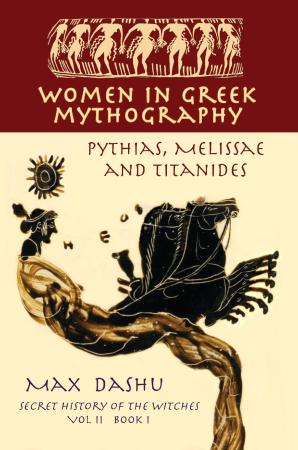
Cover photo: Eos, titanis of Dawn, Black-figure lekythos attributed to the Sappho Painter, Athens, circa 500 bce (Public Domain, courtesy of New York Metropolitan Museum)
Demeter and Persephone, Hera, Athena, Medusa, Artemis are often the first, sometimes only, goddesses modern women experience, and they have profoundly influenced our 21st century attitudes about gender, violence, and more. Yet, as Max Dashu says in her new book, Women in Greek Mythography, Greek history has “served as a template for supremacy, from male domination and Hellenic colonization, to modern Eurocentric ideologies about history” (xi). While most Greek scholarship generally glosses over these malevolent influences and ignores women’s lives, Dashu focuses on “female spheres of power, priestesses, witches, and of course systemic patriarchy” (xi) in order to “map realities of women’s lives, both their spiritual authority and their subjugation; the spaces they carved out, their ceremonies, and the stories they wove into their tapestries” (xi).
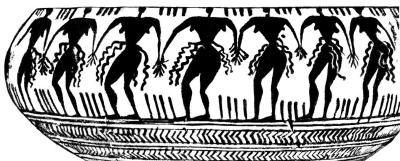
Women in Greek Mythography is not only a fascinating historical story of Greek myth and religion to be read cover-to-cover, but a rich sourcebook full of meticulously documented facts. She draws from scholarly works of history and mythography, as well as analyzing images on vases, friezes, sculpture and more. She has carefully rendered 270 drawings of these images so that readers can judge their meaning themselves. She delves into language, seeking out the origins of words that may indicate where goddesses and myths originated and their relationships to one another. She demonstrates that goddess mythologies often had many variations, sometimes conflicting, with many “countless regional deities that were subsumed under Olympian names, the local origin myths, ceremonies, and customs” (xiv).









 Feminism and Religion