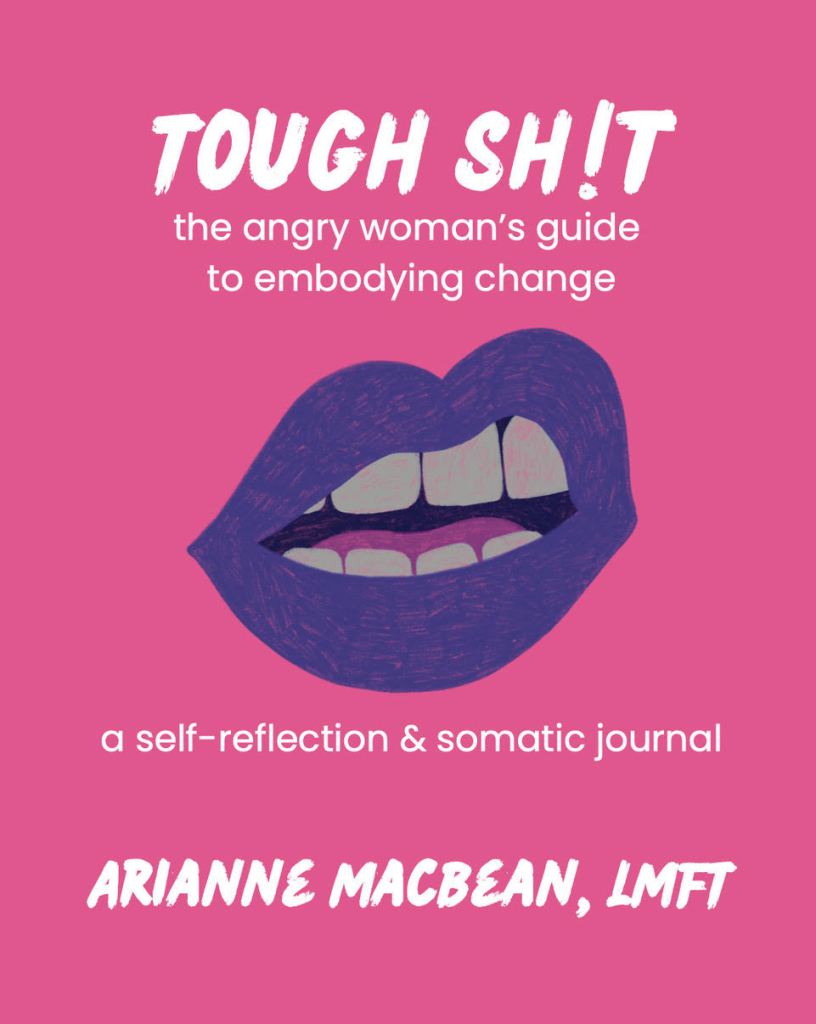
tough shit – a few words by Arianne MacBean

Cover Design by Kathleen Henrion

Before I knew what form my self-reflection and somatic journal for women would take, I knew what its title had to be. Through my work as a somatic psychotherapist, I understand how repressed anger, fear, sadness and hurt affects the psyche and the body. At best, suppressed emotional pain can show up as sensations that limit pleasure in daily life. At worst, unprocessed trauma can lead to chronic and debilitating illness. I wanted to create a journal that was not only anti-oppressive but also subverted the misnomer that divisive feelings are negative and should be stifled. Mostly, I wanted to expose how emotional censorship has its roots in its chief proponent: patriarchy.

Tough Shit. – the angry woman’s guide to embodying change is a journal that supports consciously tracing difficult feelings to understand one’s true self and make positive change. The title isn’t about being provocative or crass. I chose it because the phrase “tough shit” has a long history related to gender stereotyping and dominance—all of which my journal actively challenges. But the phrase is not just cultural; it’s personal. An iteration of this phrase was used against me growing up. As the concept of the journal became clearer, I felt my body insist on throwing “tough shit” back out, not as a degrading echo, but as a reclamation—a fierce refusal to silence valid emotional pain.

Continue reading “tough shit – a few words by Arianne MacBean”
Two Poems by Alice Bullard, PhD

Dear FAR Community, These poems arise from feminist spiritual practice with syncretic dimensions. The Irish-American Catholicism of my family mixes with the popular American confessional-style that charts and embodies emerging spirit, yet this very American path of self-styling and narrative self-creation has been refined via the influence of Zen practices, originally via the influence of the Soto practictioners of Green Gulch in Marin and then later via the teachings of Vietnamese refugee and Zen Buddhist monk, Thich Nhat Hanh. The feminism here is deeply personal, political, and spiritual.

This post was inspired by one written my Janet Maika’i Rudolph about Alice Munro which you can read here.

About Alice Munro: I experienced the revelations of her daughter very personally … I’ve read Alice Munro since I was very young and used to read my parent’s copy of the New Yorker. Because we shared the name Alice and also shared the cold Midwestern prairie though she was further north and across the border, I had always felt some affinity for her but also I felt something I really didn’t get. To me her stories took inexplicable turns and now we know why. Her daughter’s experience is dreadful and probably much more common than anyone would care to admit. That Alice Munro was famous doesn’t make that type of negligent mothering something rare.

Continue reading “Two Poems by Alice Bullard, PhD”

On Persephone and the Racetrack: My Experience at Lake Pergusa.

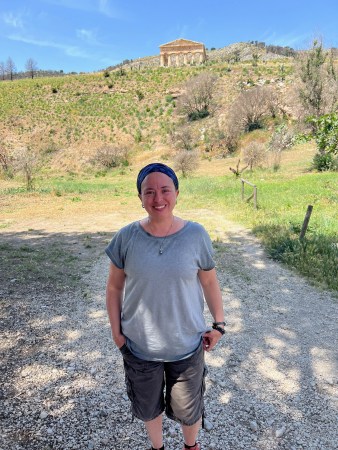
At the Segesta temple.

This May, I visited Sicily to present at the European Academy of Religion’s Annual Meeting. There I saw various historic, religious sites: parts of the city of Siracusa; the Valley of the Temples in Agrigento; mikvot in Palermo; various churches including the Cathedral in Palermo and the Church of St. Cataldo; the Segesta temple; and lake Pergusa where Hades emerges from the land to abduct Persephone. In this blog, I will focus on this lake. As an ecofeminist focusing on religion, this place gave me mixed feelings.

Continue reading “On Persephone and the Racetrack: My Experience at Lake Pergusa.”

Mother of All Fears by Trelawney Grenfell-Muir

This time of year, the general public tends to pay more attention than usual to witches. Much of it is lighthearted – halloween costumes and memes about where to park your broom. Some of it is spiritual – adherents of the modern religions of Wicca and neopaganism discussing symbolic and supernatural beliefs. And some of it is historical – analyzing the witch trials of past centuries and wondering how they apply, ethically, to modern day intolerance and violence.

Within all these discussions, usually unnamed and unexamined, is the framing metaquestion: what should we fear? And what should we do about that which we fear?

Historic witch trials (from a time when witches were believed to be evil agents of Satan) reveals how we humans always try to externalize badness and goodness, so we can exterminate badness and excuse ourselves for our lack of goodness. So we have heroes and villains, neither of them very human, but rather idols and symbols of our fears. I honestly think the patriarchy’s fear of females is as strong as it ever was. When the most popular videos on the most popular internet porn sites are of ****TRIGGER WARNING RAPE, INCEST**** raping a stepsister, or doctors raping a teenage girl in the hospital for cancer, or of border agents raping a pregnant young refugee, and these sites are visited by 98% of the men in our society, what does that say about us as a species? Or a culture? As Tallessyn Grenfell-Lee says, “Scary, scary vaginas!

Continue reading “Mother of All Fears by Trelawney Grenfell-Muir”

Spinning the Fire, Shifting the Current by Chris Ash

Christy at the beachSeventy-two hours out of every week, I carry a hotline phone. While calls come in waves and some shifts are silent, my everyday and professional lives are peppered with reminders that evil doesn’t just pierce reality through acts of power, control, and violence – it seeps through in discrediting voices and disbelieving questions. It rolls into us off the well-meaning tongues of community members who’d rather protect the status quo than hold people accountable. It wraps its tendrils around us as we walk through each system we are forced to navigate – systems that are not set up to protect our vulnerable hearts and human dignity. Evil powers the backlash wave that tries to knock down every survivor who speaks out about gender, sexual, or intimate partner violence, and it also is in the fear we swallow when we choke down our own stories, press them down deeper, grasping to avoid yet another assault on our integrity, intelligence, and truth.

Evil stains our flags with the undeniable imprints of genocide, slavery, and continuing racial injustice and then demands that we wave those flags, smiling and allegiant, as The American Dream itself is held hostage, torn from its family, held in a cage. Continue reading “Spinning the Fire, Shifting the Current by Chris Ash”

Babies and Bathwater by Oxana Poberejnaia

Since patriarchy is atrocious, and capitalism is currently driving the earth to a very real catastrophe, we can get passionate about these issues. We can get angry. We can get self-righteous.
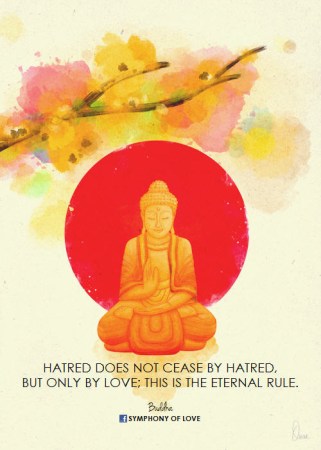
However, as one of the most famous verses of Dhammapada goes:

Hatred is never appeased by hatred in this world. By non-hatred alone is hatred appeased. This is a law eternal.

Dhp I:5, translated by Acharya Buddharakkhita

 We may ask: why should we be patient and kind while we are the ones who are being oppressed and wronged? I don’t have an answer for that, only that through history positive change has ever been affected only by people who made more effort than the ones who wanted to keep the status quo.

Abolitionists, Suffragettes, Socialists and Civil Rights activists all had to be more altruistic, better educated, and more open-minded than their contemporaries. Continue reading “Babies and Bathwater by Oxana Poberejnaia”

I am mad by Mama Donna Henes

Donna Henes, Urban Shaman, Queen of my self, crones,

I am mad. So very mad. No, that doesn’t begin to describe it. I am pissed. I am angry. I am irate. I am incensed. I am outraged. I am enraged. I am livid. I am GODDESS DAMN FURIOUS.

“All men are created equal,” states the Declaration of Independence. From the very beginning, women were denied equality in this country. It has taken over two centuries for women to win the right to vote, to have alleged protection under the law, to earn as much as 68 and 77 cents on the dollar (depending on our skin color) that men are paid, and to gain control over our own bodies and destinies.

And now, nearly 250 years later, we are seeing our rights, our freedoms, our health care being stripped away, one by one, by mean spirited, misogynistic, right wing religious uber-conservatives. In 2015 there is still no Equal Rights Amendment. Women are still not equal under the law. Continue reading “I am mad by Mama Donna Henes”

Anger is Not a Panacea: The “Next Stage” after Rage by Carol P. Christ

carol mitzi sarahIn a recent post Xochitl Alvizo cited Beverly Harrison’s much-loved essay “Anger as a Work of Love.” Harrison captured feelings that were in the air at the time of its writing several decades ago. Women were laying claim to the right to be angry at the silencing of our voices, the double standard, the media portrayal of women, income inequality, lack of access to good jobs, failure to prosecute rape and domestic violence, and a host of other injustices.

Most of all we were protesting the cultural stereotype that the “good woman” (understood to be white, Christian, and married or hoping to be) would not protest loudly or at all, would turn the other cheek, and would think about others rather than herself. (Jewish women and black women had to strive doubly hard to “live up” to this standard, as it was assumed that Jewish women were “overly assertive” and that black women were “too strong” and often “angry.”)

In this context Harrison’s essay and Mary Daly’s epithet “rage is not a stage” gave women—especially white women–permission to get in touch with our feelings of anger and to express them. We understood that “good women” had been hiding and repressing their feelings for centuries if not millennia with the result that the structures of injustice remained intact. Continue reading “Anger is Not a Panacea: The “Next Stage” after Rage by Carol P. Christ”

Surviving and Thriving: For My Defender by Sara Frykenberg

Sara FrykenbergLast year many of my actions, choices and emotions could have been characterized as a part of my ongoing efforts towards what I recognize as survival: I was often ‘trying to make it through,’ live ‘despite,’ exist ‘even though,’ grapple with violence or choose in such a way that I could continue to live in the midst of chaos.

Survival is an extremely important skill, practiced by many people for many different reasons.  And before I continue here, I would like to say that in all of my struggles last year, I always had the basic necessities required to live my life.  Many people do not; and for many, survival is an everyday practice that may or may not be achievable, requiring access to necessities that may or may not be accessible.  No one tried to kill me last year.  I had access to food.  I did not lose my home or livelihood; though I felt these things threatened.  I am privileged to live where and how I do, with many resources available to me.  These resources helped me to make it though, where other people survive with far, far less.  I choose to share my own feelings of survival because I want to decry the self-dehumanizing shame that tells me I am bad or wrong for feeling my own experience.  I identify my survival in an attempt to also, thrive. Continue reading “Surviving and Thriving: For My Defender by Sara Frykenberg”

An Ethics of Anger by Ivy Helman

me bio-suitSometimes I feel angry.  I would say that more often I’m upset, disappointed, annoyed or just plain frustrated.  These are easier emotions for me to handle because I tend to shy away from confrontation and conflict.  Of course, when they come up I can deal with them but I’d rather put time and energy into fruitful communication before difficult conflicts erupt.  Nevertheless, this doesn’t always work and other people handle situations and communication differently than I do.  So how does one approach anger?  The anger inside one’s self?  Another’s  anger?  What about when two individuals are angry with each other?  I would like to spend a little bit of time treating each one of these scenarios separately and then conclude with a few general remarks about the importance of empathic feelings of anger over the situations of others.

First of all, everyone handles anger differently.  I’m not sure that there is only one correct way to approach it.  Personally, I use anger as a reflective tool.  Why am I angry?  What happened or didn’t happen to provoke my anger?  Is my anger an appropriate response to the situation in which I find myself?  Are there some concrete actions I can do to right the situation?  These questions allow space for me to not only explore my feelings and ground myself, but more importantly they give me some space between what made me angry and whatever action or inaction I take toward that feeling of anger. Continue reading “An Ethics of Anger by Ivy Helman”