Meditating on Woman by Oxana Poberejnaia

oxanaI decided to run a little experiment and to explore the notion “woman” from inside meditation. I practice Anapanasati Meditation, or mindfulness of breath. I learnt it from Theravada teachers. However, through my Buddhist career I have studied in various Buddhist centres and from various schools. The latest one with which I went on retreats is the Western Chan Fellowship (Chan is one of the Chinese schools of Buddhism, from which Japanese Zen developed).

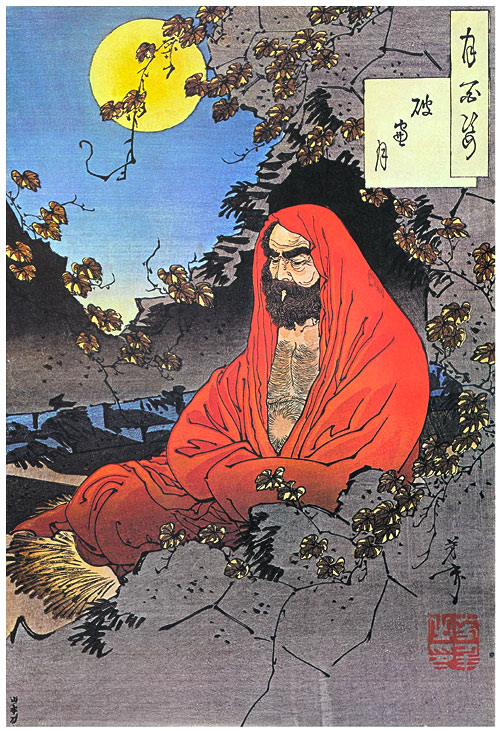
BodhidharmaYoshitoshi1887 Anapanasati meditation involves mindfully staying with your breath and following it as it goes in and out of your body. It is supposed to both quieten the mind and to lead to more clear vision, or insight. In Chan tradition there is also a practice of asking one simple question in meditation, for instance: “What is this?” or “Who am I?” Sometimes exploration of other topics from within the mind which has been quietened and made clearer by meditation is also practiced.

Continue reading “Meditating on Woman by Oxana Poberejnaia”

Creating Space: Mosques Affirming All Bodies, Minds, and Hearts by Laury Silvers

Silvers, Bio Pic FRBlogIn my first blog for Feminism and Religion, I discussed the cognitive and embodied dissonance that some Muslims experience as a result of historically (not eternally) gendered ritual forms. I ended with a promise to share with readers the ways in which el-Tawhid Juma Circle mosques try to create space to break free of those forms. Our mosques affirm all human beings as spiritually, socially, and ritually equal and try to break down the social hierarchy of ritual and theological leadership by opening up a space for all bodies, minds, and hearts to lead and follow as equals among each other.

Continue reading “Creating Space: Mosques Affirming All Bodies, Minds, and Hearts by Laury Silvers”

Seeing Death and Resurrection by Linn Marie Tonstad

Linn Marie TonstadYesterday, I visited the Capuchin catacombs in Palermo, Sicily. In a grotto about a mile or so from the center of the modern city are found the preserved remains of about 2,000 people who paid the monks to preserve their bodies after death, dress them in their finest clothing, and put them on display. Each of them is placed in its own niche along the wall, held up by iron bands, and has a tag around its neck with its name and date of death. The bodies are not displayed in random order: they are sorted (to some extent) by sex, profession, and familial status. In one large recess, a number of children’s skeletons are on display, many of them in heartbreakingly tiny coffins. In another corridor, friar after friar hangs in his robes, some with cords around their necks signifying their adherence to a Franciscan order. Almost indistinguishable from the cords are the braids still hanging from the heads of some of the women’s bodies. Some families are arranged together; in another corridor doctors and lawyers are segregated and in yet another female virgins are gathered together. The oldest body I saw dated from 1599 – high on a wall hangs the body of a monk whose name was almost illegible but who hailed from the Umbrian hill town of Gubbio.

Some of the skeletons presented death’s heads; others had skin dried to a leathery tightness over remaining bony protuberances. Some of their outfits are well preserved; others have disintegrated under the relentless assault of the years. The practice became illegal around 1880, but until then, people chose – or perhaps their relatives chose for them – to be preserved in this seemingly macabre manner. Continue reading “Seeing Death and Resurrection by Linn Marie Tonstad”

How I Loved Myself through Charismatic Worship by Andreea Nica

Andreea Nica, pentecostalismBreaking up with your first love can be an excruciating process; especially when it happens to be completely entangled with your being. God was my first love and he stayed for a long while. We had many exhilarating times together, particularly within the branch of Christianity I was raised in: Pentecostalism. I fell in love with God when I uttered his divine language at 13 years of age.

Currently, I’m writing my memoir and narrative nonfiction, Freeligious ™, for which I explore the scientific explanations of my charismatic experiences in the church, which inevitably led to a closer attachment to God. In the Pentecostal church, we were encouraged to connect with God through supernatural phenomena.

Examples include: speaking in tongues (glossolalia), healings, trances (drunk in the holy spirit), visions (hallucinations), prophetic messages (delusions), rebuking evil spirits (paranoia), and many more god-friendly activities. While some of my church peers and most outsiders found the charismatic ordeal to be phantasmical and plain ol’ crazy, I became enchanted by the initiation. The initiation process was quite simple really. As believers in Christ, we must receive the baptism of the holy spirit which usually took the form of speaking in tongues, clinically known as glossolalia. Continue reading “How I Loved Myself through Charismatic Worship by Andreea Nica”

Menstruation for Buddhist Women by Oxana Poberejnaia

oxanaNot all, but many women menstruate. The menstrual cycle is a contentious areas for feminists. Even men who aspire to be a feminist tend to find it difficult to deal with it. Inappropriate jokes ensue, and completely ignoring the issue is also a popular option.

My journey along a feminist path and toward the Sacred Feminine necessarily included working with my menstrual cycle. In this, Women’s Wisdom and the Menstrual Cycles articles  and Womb Blessings by Miranda Gray have been most helpful.

Continue reading “Menstruation for Buddhist Women by Oxana Poberejnaia”

Your Body is the Body of the Goddess by Marie Cartier

My body is the body of the goddess—witches and shamans and other magical beings (including humans) chant this in spring ritual …and other times of the year as well.

But as we prepare for spring equinox, I thought I would use my blog this March to give the Feminism and Religion community a chakra mediation for spring ritual and renewal. Spring is here. Your body is the body of the goddess. If desired, please say the following aloud or silently, participate in the suggested breathing exercise and allow yourself to sink deeply into the body that is yours and is part of the season– the awakening of spring.

Breathe deeply: in and out; in and out; and in and out. Continue reading “Your Body is the Body of the Goddess by Marie Cartier”

Embody the Sacred – Engaging Through the Senses by Deanne Quarrie

The human body is designed to utilize all senses. We, human beings, have drifted away from our natural state through which, at one time, we engaged with all of life through our natural senses, including the intuitive.  This change has come about through our active, stress filled lives in which we seldom slow down to even appreciate what is around us.  We have ignored much of our sensory ability due to a change-over from right brain functioning, which is more imaginative, creative and intuitive, to left brain functioning, which is linear and analytical. Two of our senses are developed out of proportion to the others.  Many people grow up in an environment lacking in exposure to the natural world.  With television, computers and video games we have become residents of an indoor and often sedentary world.

In early civilization, humans and all other animals depended on finely tuned sensory awareness for survival.  We walked the Earth, using those senses for protection, to find food and to move around.  We did not just see and hear our way around but we felt, touched, tasted and smelled in order to survive. Continue reading “Embody the Sacred – Engaging Through the Senses by Deanne Quarrie”

Smells Like Homeness by Erin Lane

“Tell me why it can’t be that simple,” I plead with my husband. “He needs a bed. We have a guest room.”

I am desperate for an answer that will assuage my guilt and brighten my mood. It’s more than that, though. I want an answer that will fix the problem of Michael’s homelessness, one that will ease both his pain and mine. Continue reading “Smells Like Homeness by Erin Lane”

Working and Working Out: “Health,” Obesity, and Labor by Stefanie Goyette

What I think we must consider in analyzing any form of “health” that is encouraged, and even enforced, is that such encouragement comes back in the end to the ability to work, to be “productive,” and, in turn, to spend the money that one earns. 

What is “health”? What does it mean to be “healthy”? Physical well-being and energy? Mental and emotional balance? A sense of general control over one’s body and self? I had originally meant to speak of the frequent reduction in our culture of “health” to appearance: sexual attractiveness, muscle tone, body size, etc., but Lesley Kinzel has already given an analysis of this paradigm, twice, in fact. Go read her articles, then come back here and we’ll talk about some other stuff.

Attractiveness as a measure of “health,” which we will consider as being already established as a cultural fact, effectively defines health neither as a personal sense of well-being nor as a set of conditions agreed upon in consultation with a physician. Rather, aesthetic criteria render health a metric that lets other people judge – and judge others on – a level of “health.” This judgment affects women disproportionately and, being external, reduces the value of female subjective experience and the power of subjectivity in the individual. Yet this externalization by no means ends with quotidian social interaction, but also extends to the medical establishment and the regulation of bodies in terms of the normal and the pathological – no great revelation here (Foucault already said it) – and these measures are already part of the intrinsic layout and values of the culture to which a given medical establishment belongs. Continue reading “Working and Working Out: “Health,” Obesity, and Labor by Stefanie Goyette”

If You’re Lucky, You get Old, Part II: Stories from the Yoga Mat by Marie Cartier

Yoga is about in the moment, and gifting yourself with that moment.

I am interning right now and teaching classes in yoga. I am teaching in a park– donation based yoga. The other morning, I had no students, so was sitting on my mat and just holding the space as we wait for these classes to catch on and students to come—if we build it, they will come! A woman sat at a picnic table near me. I started up a conversation with her about yoga. She told me her lower back was “frozen” from sitting at a computer and did I know anything she could do? Yes, gratefully I did! I demonstrated some postures to her—cat/cow, cobra, downward facing dog…but also just standing in mountain pose and feeling the pelvis tuck under the hips, tucking the chin slightly and lowering the shoulders. She did not move from the picnic table—in fact held onto the picnic table edges and said she was not ready for yoga. However, she also kept asking me questions and I kept answering and demonstrating.

The next day she returned with a mat, and took a physical class. And has been coming back to my class ever since.

How has increased body awareness through yoga led to a positive change in me? Continue reading “If You’re Lucky, You get Old, Part II: Stories from the Yoga Mat by Marie Cartier”