The solar eclipse has had me sensing deep alignment with earth, sea, and sky, with my sisters and brothers and Self. This, then, from my 1995 journal of my first Goddess Pilgrimage to Crete with Carol Christ, a trip still engraved in my heart:
June 3 – Yesterday, anointing us with rose, lavender, or olive oil, Jana said, “Your journey has begun.” But for me it is this morning, with the purchase of this journal at the biblio on the square across from the hotel, where I sit now in the lobby, traffic noise outside, our group gathering, preparing for our journey . . . happy to be here . . .
Bleeding at the home of the Panagia, the all holy, the sacred mother, sacred myrtle, ancient tree of Aphrodite, Mary, black-bent nuns: we tie ribbons to the tree, sing, “all manner of things shall be well. Blessed be, walk in beauty.” And I am utterly in tears as I walk on the grounds of this ancient place, the birds singing everywhere, yet there is quiet, stillness, an ancient peace . . . A pilgrimage, a shrine, a very holy place.
I want a new religion. I have changed to the point that I cannot be a part of a patriarchal religion and I feel that all of the major organized religions fall into that category. It has taken me a long time, but I can now see that these organized religions were created largely to support the patriarchal culture that most humans have lived in for at least the past 5,000 years.
I started reading Mary Daly, Riane Eisler, Merlin Stone, Carol Christ, Marija Gimbutus and other similar authors in recent years. I was amazed at how much I did not know about life before patriarchy. I was never taught in school that there were cultures – civilized cultures – for tens of thousands of years prior to patriarchy. These pre-historical civilizations were largely matrilineal although not matriarchal.
Women had power in such cultures, but not “power over” others. These cultures were organized as partnership societies, not hierarchical societies. The Divine Presence worshiped was feminine which, of course, makes perfect sense since the female sex is the one that gives birth. As far as I can tell, there is little known about the specific religious beliefs and rituals of these civilizations. However, from the art work that has been discovered, there appears to be a theme of a Great Mother Goddess who gave birth to the world and all that is in it. Although we can’t go backwards to this ancient goddess religion, knowing more about it may open our eyes to other ways of conceiving a Divine Presence. Continue reading “Give Me That “New” Time Religion! by Susan Gifford”
The twelve days between Christmas and the New Year are still held to be holy days in Greece, a mystical and dangerous time when mischievous spirits emerge from the underworld, seeking to wreak havoc in the human realm. On the 6th of January, Theophania or Twelfth Night, masked men in goatskins and sheepbells dance through the streets to dispel these spirits, awaken the fertility of the earth, and ensure a good year. The name Theophania, literally ‘the appearance of god’, here refers to the return of the sun after the winter solstice, and fire and light are very important to this holiday.
The rituals I describe here come from six tiny villages in the region of Drama, just south of the Rhodope Mountains, close to the border between northern Greece and Bulgaria. Similar rituals featuring masked, bell-wearing men appear all through the Balkans and Central Europe as far as the Swiss Alps. They will dance through the village streets, in the cemetery, and in front of every house, in a ritual of blessing and catharsis which has roots in age-old worship of Dionysus, god of fertility and wine.
For me, who came to Greece to study women’s traditional songs, dances and costumes, it makes a refreshing change to observe ritual customs almost exclusively performed by men. These activities take place in winter, either at Theophania or during Carnival, in contrast to spring and summer rituals which are chiefly in the hands of the women. However, as we shall see, in order for men to assume ritual abilities and responsibilities normally ascribed to women, some of the men must dress in women’s clothes.
Here I would like to mention Carol Christ’s recent analysis of essentialism in feminist theory in her excellent post of September 15. In Carol’s words, the essentialist view holds that the “‘essential qualities’ of a thing (a table, a horse, a woman, or a man) precede the ‘existence’ of any individual in the group to which it belongs; these qualities are universally—always and everywhere—expressed by members of the group.”
Carol and I both live in Greece, where, as in many other parts of the world, tradition assigns quite different tasks and attributes to men and to women. Without reawakening the essentialist discussion here, I would just like to say that modern-day feminists do not have to agree on whether women and men are essentially or inevitably different; however, in order to understand Balkan culture, we do need to realise that people here believe in these differences and have done since ancient times.
Angelos Keras, the Archigos of the Arapides in Monastiraki
Back in Drama, in the village of Monastiraki, preparations have been underway for days. The night before the big event, a designated house – half-ruined, but still with a roof intact – slowly fills with the joy of friends and acquaintances greeting one another. Red wine flows, and traditional goat soup is served free to all. A fire has been kept burning here continuously throughout the twelve nights of Christmas, producing sacred ash with healing and protective powers. Musicians play through the night, producing archaic sounds on the Macedonian bowed lyra or kemene, accompanied by large goatskin tambourines called daheres. These are the only instruments. The overall effect is all the more hypnotic as the musicians play in absolute unison; even the singing is monophonic, in a musical structure intended to emphasise old values of community and coherence.
Meanwhile, people dance the same few dances over and over. As on all ritual occasions, the repetition of familiar simple step patterns frees the dancers to focus on the inner work of igniting their own good mood and raising good energy (kefi) to bless the community.
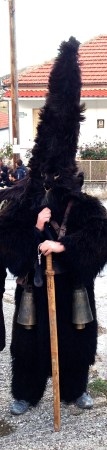
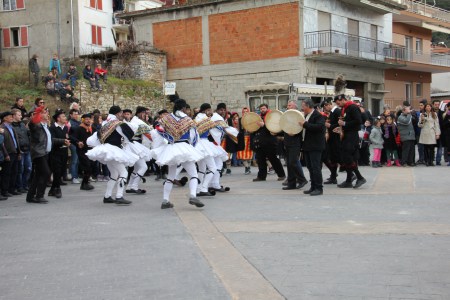
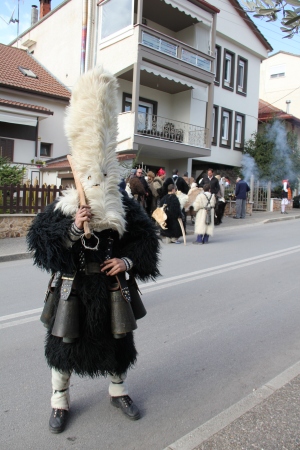
After dancing and drinking all night, the male celebrants help each other dress in the early hours of dawn. They are truly fearsome in shaggy dark skins, tall conical masks, and wide leather belts from which swing three pairs of heavy double bells. One of their names, koudonofori, means bell wearers; they are also called Arapides, the Black Ones or Moors.
Looking behind the apparent racism of the terminology, these ritual dancers blacken their skin with burnt cork both to invoke the power and protection of the sacred fire, and also in order to enter the realm of darkness. Here, the dark is seen as the repository of the earth’s fertile powers, which their bells and dances aim to awaken, as well as the realm of things ‘not seen’ , such as the spirits known as kallikantzari, which pose a threat to the new light and the new year. They themselves must go unseen, in masks and disguises, to enter this realm.
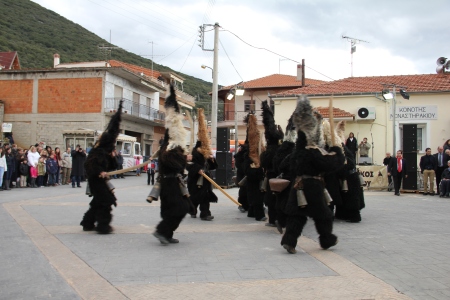
‘Arapides’, masked ritual dancers at Theophania in Monastiraki
Brandishing long wooden swords, this group – known as a tseta – appears fully capable of driving out any number of kallikantzari. The phallic swords and headdresses leave one in no doubt that the Theophania rituals are men’s rituals, yet the ability to give new life, to enter the realms of the dead, and to bestow the blessing of fertility are essentially women’s powers. To claim these powers, some of the men must dress as women, as Dionysian revellers have done since ancient times. These are theGilinges, or Brides.
Pappoudes (‘Grandfathers’) with lozenge-shaped beaded amulets, and Gilinges (‘Brides’) in Ksiropotamos
Wearing women’s clothing may be a means for men to temporarily gain access to the realms of life and death, where normally only women may go, or to symbolically give birth to the life-affirming fertility and joy which bring renewal at this dark and hungry time of the year. (Men wearing women’s clothing for ritual purposes are depicted in archaeological finds dating back to the 5th C. BCE; I think we see it today in the ecclesiastical robes worn by Christian priests.) In an additional affirmation of what is seen as women’s power, the Brides’ costume is rich in goddess embroideries, while all the members of the party wear beaded amulets in the lozenge-shaped symbol of female fertility going back to Neolithic times. Goddess symbols are also stamped on many of the bells.
As well as the Arapides and the Brides, the tseta includes Pappoudes or Grandfathers in Thracian men’s traditional dress, and Evzones or Tsoliades wearing short white pleated foustanella kilts and thetsevres, a special garment made of twelve large white kerchiefs sewn into a triangle densely fringed with beads, sequins and coloured threads, which takes four months to prepare.
Musicians and ‘Tsoliades’ ritual dancers in Monastiraki
There is also an occasionally appearing Bear, who some say represents ancient worship of the Goddess Artemis.
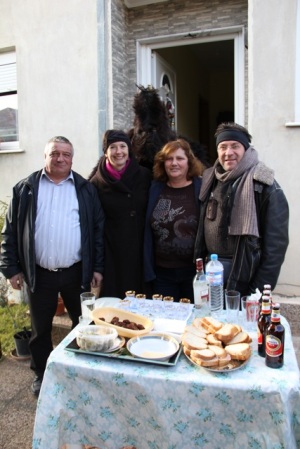
As they journey together through the village, the bell-wearers leap and stamp, swinging their bells back and forth in an apotropaic din – this will indeed awaken the earth! – almost drowning out the eerie sound of the lyras and daïres. The Evzones dance with athletic half-turns which send their short kilts sailing up to their waist, emphasising (so I am assured) the fertile power of the male generative organs, without revealing the organs themselves. At every house the entire tseta is rewarded with abundant food and drink, in the living tradition of sacred hospitality which is the most powerful blessing of all.
Hospitality to strangers in Ksiropotamos
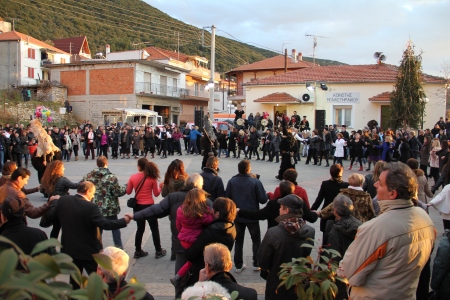
By three o’clock, the whole village gathers at the plateia to dance. Hundreds of people spiral into a single circle with one leader, keeping the large centre open as a sacred space for the tseta to enact ancient rituals of death and resurrection, plowing and planting, and the hieros gamos or sacred wedding. The dancing goes on until dusk and then continues at a taverna through a second consecutive night.
Everyone joins in the great circle dance in the plateia of Monastiraki
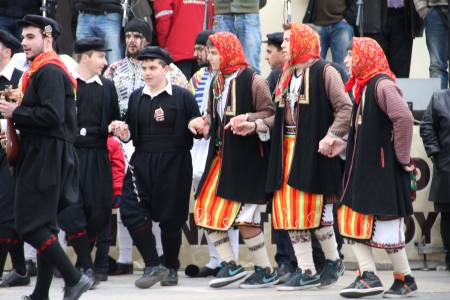
Each village has its own variation of the Theophania rituals. In some places, children and women also participate: in Ksiropotamos young girls dance in traditional costume, while in Petrousa, all the dahereplayers are teenage girls. Some traditionalists view this change with unease, but I must confess my pleasure at seeing thirteen young women lined up like priestesses of Cybele from the time when the drummers were women. Here too, people dance at crossroads, springs, sacred trees and finally around an enormous bonfire.
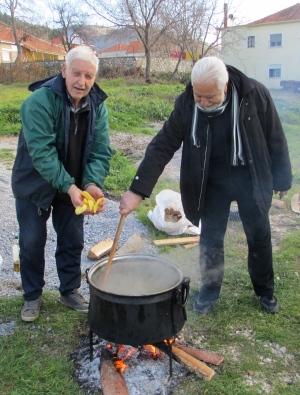
Cauldrons at the crossroads in Ksiropotamos
Fire is important in all the Theophania rituals, and cauldrons on open fires are a key part of the festivities. This is another symbol of women’s power adopted on this occasion by men – traditionally, women cooked in pots; men roasted meat over an open fire.In Petrousa, the Dance of the Cooks can still be seen. Although it is no longer danced around the cauldrons themselves, the symmetrical step pattern still focuses the energy or ‘fire’ of the dancers in a particular way.
It seems to me that these fire-focused rituals hint at the unnamed presence of the Goddess Hestia, whose domain is centred on the hearth, source of light, warmth, food and all that is beneficial to the home. The nikokira, the lady of the house, was seen since ancient times as Hestia’s priestess. Her role is to tend the sacred fire through practical and ritual work and to literally focus its brilliance (estiazo, fromHestia, means ‘to focus’) so that it may bless the household and all its inhabitants. In ritual activities such as the Theophania, through the mediation of men dressed as women, this focused fire can be brought once a year from the private space of the home – the realm of the women – into the public space of the village, the realm of the men. This union of men’s and women’s fertile powers is the hieros gamos, the holy spark of blessing which ensures health, wealth, happiness and abundance for all in the coming year.
In my Ecofeminism class we have been discussing essentialism because some feminists have alleged that other feminists, particularly ecofeminists and Goddess feminists, are “essentialists.” They argue that essentialist views reinforce traditional stereotypes including those that designate men as rational and women as emotional. I too find essentialism problematic, but I do not agree that Goddess feminism and ecofeminism are intrinsically essentialist.
Goddess feminists and ecofeminists criticize classical dualism: the traditions of thinking that value reason over emotion and feeling, male over female, man over nature. We argued that the western rational tradition sowed the seeds of the environmental crisis when it separated “man” from “nature.”
Goddess feminists and ecofeminists affirm the connections between women and nature in an environmental worldview that acknowledges the interconnection of all beings in the web of life.
Recently, in response to the excellent conversation following Nancy Vedder-Shults’ post on the goddess Kali, Carol Christ commented to Nancy, “I too love our conversations, wish there was more in depth talk on our blog [FAR], maybe there will be.” Carol’s comment* struck a deep chord within me. One of the main objectives that the FAR co-founders had in creating Feminism and Religion was that it be a place where we could and would engage with one another across a diversity of feminist issues and the broad range of feminist passions and work – where we could discuss, critique, and build upon on each other’s efforts.
So two things came to mind as I reflected on Carol’s comment. The first was my personal lament that I have not been as actively participating in the discussions that follow the FAR blog posts as I did when we first started Feminism and Religion. FAR has such rich and valuable material – it really does provide a great opportunity for conversation and dialogue – and sadly I have been a passive participant as of late. I read and learn from the discussions, but I have not been joining in. I lament that. FAR is definitely a place where I could engage with others in deep conversations, but how actively am I actually doing this? Continue reading “We are Worth the Time it Takes to Create a Practice by Xochitl Alvizo”
Kyria Loulouda calls to her sister to help her wind the yards of woven girdle around and around my waist. Kyria Stella’s aged fingers, still strong, tuck the sash ends in tightly, smoothing down the fabric she and Loulouda wove themselves. The snug embrace of the sash supports my back and encourages me to stand proudly upright. As they help me with the intricate tucks and pleats of the festival dress, and the careful tying of the flowered headscarf, I see their tired, careworn faces come alight with joy and expectation. When they are satisfied, they turn me towards the mirror, smiling.
We gaze at ourselves, a row of three women, dressed alike. Like the butterflies embroidered in bright silks on the dark cloth of the bodice, we too are transformed. The food is prepared, the housework is done, the animals taken care of for the night; the other women await us in the square where, by tradition, they will open the dance with their own singing as they have done countless times throughout their lives. We are in the village of Pentalofos in Greek Thrace in the early twenty-first century, living a timeless scene which has been repeated through the generations for hundreds, perhaps thousands of years. Continue reading “Women’s Ritual Dances: The Dancing Priestess of the Living Goddess by Laura Shannon”
You raise the important question of what factors lead feminists to leave or remain within the religion of their birth. Your central challenge to me is how I can commit myself to a tradition in which God is imagined as a violent warrior when these images have harmed and continue to harm women and the world. How can I not recoil from using such images in worship? Why is the power of symbols less important to me than to you?
The first thing I would say is that, like you, I find these images profoundly problematic. One of the projects I have taken on in my retirement is reading the Bible from cover to cover, and I was appalled in going through all the prophets together at the amount of violence in their teachings. When I have spoken on the topic of dealing with difficult texts in the Jewish and Christian traditions—a subject that is dear to my heart—I always talk about God’s violence in addition to texts that demean women. And, yes, I have sometimes asked myself how I can remain part of a tradition in which God is depicted in this way. So I do not disagree with your critique of this imagery, but obviously for me, it is not decisive. Why not? Continue reading “Deciding to Leave or Remain in the Religion of Your Birth – Part II by Judith Plaskow”
On January 26, 2013 a rare, devastating tornado hit our community in Queensland, Australia, a coastal town on this sub-tropical coast. My family experienced nature’s elemental force firsthand and hopefully will never again. The tornado viciously shattered houses, peeled away roofs, uplifted cars and trees, and took down power lines, tearing apart everything in its path. With absolutely no warning, literally out of the blue, it formed over the churning sea, rapidly intensifying before striking land, awakening the vulnerability and fragility of all life in its midst.
When it struck, our four kids and I were waiting in our car while my husband ducked into a mate’s house to borrow a tool. We heard the sound of a roaring jet plane overhead, as my husband came running, screaming at us to get out of the car. Turning to my left, in a vision imprinted forever, a spiral of debris flew toward us. Scrambling, we got the kids out of their harnesses and safely indoors. I lagged behind, taking care of the children first, and fell out of the side door of the van with the wind’s impact. As I got up to run, a large piece of roofing tin flew straight for my head. I dove, seeking safety under the front of our running car. My life flashed before my eyes. All of us in a state of shock, the tornado was gone as quickly as it had come, we were unscathed except for a few minor cuts and bruises. It was only a few moments before the immediate danger passed. We ventured outside to inspect the damage, destruction surrounded us. Continue reading “For the Love of Gaia by Jassy Watson”
I asked this question at the family dinner table, on facebook, and by e-mail. Many heartfelt responses were offered, all insightful. Some spoke of romantic love, sexual love (eros), self-love, spiritual love, the love a parent has for a child, unconditional love (agape), primal love, authentic love, universal love, divine love, the source of love, friendship (philia), love of nature, and love of a pet, while others considered the destructive nature of love. What was demonstrated by these conversations was that not only are the possibilities of love’s expressions endless, but there can ultimately be no right or wrong answer when it comes to the meaning of love. Our cultural, familial, religious and spiritual backgrounds all play a part in the way we think and feel about love.
I was raised in a secular, middle-class, two parent, two children, cat, and sometimes a dog kind of family. Despite the usual ups and downs, our family life was full of love. I remember having feelings of love as a child that were so incredibly overwhelming I would be brought to tears. I loved everything and everybody. Mum still reminds me that if I could have, I would have brought every elderly person along with every stray animal home to look after. After reading about the process view in Carol Christ’s book She Who Changes: Re-Imagining the Divine in the World, I see now that this love I felt was born out of feelings of deep sympathy.
Because we did not have a religious or spiritual background, I had no idea what divine love meant. My idea of the divine was the male, Christian, biblical God that our family rejected. It is said that Christian love is selfless and is best seen in actions such as compassion and kindness. This may be so. But selflessness, compassion and kindness are not limited to Christian values. They are human values. In his book The Art of Happiness, the Dalai Lama says that “love and compassion are necessities, not luxuries. Without them humanity cannot survive”. All religious, spiritual and philosophical traditions speak of the values of love. They say that love encompass compassion, kindness, selflessness, acceptance, gratitude, sympathy, sharing, grace, justice, charity, and liberation. They also speak of tension, wrath, discomfort, unkindness, loss, and judgement. For me, love is all these things and more.
Ancient myths address these values of love through tales of passion and devotion. Diane Wolkstein celebrates some of these myths in her book The First Love Stories. Each story expresses a distinct aspect of love. For instance: the tale of Isis and Osiris represents love that is stronger than the forces of nature, Innana and Dumuzi expresses the cyclical quality of love; Shiva and Sati reveals the eruption of passion and the taming of the mind; the Song of Songs celebrates love’s yearning; the story of Psyche and Eros portrays the forging of the self. All of these stories emphasize the sacred nature of love.
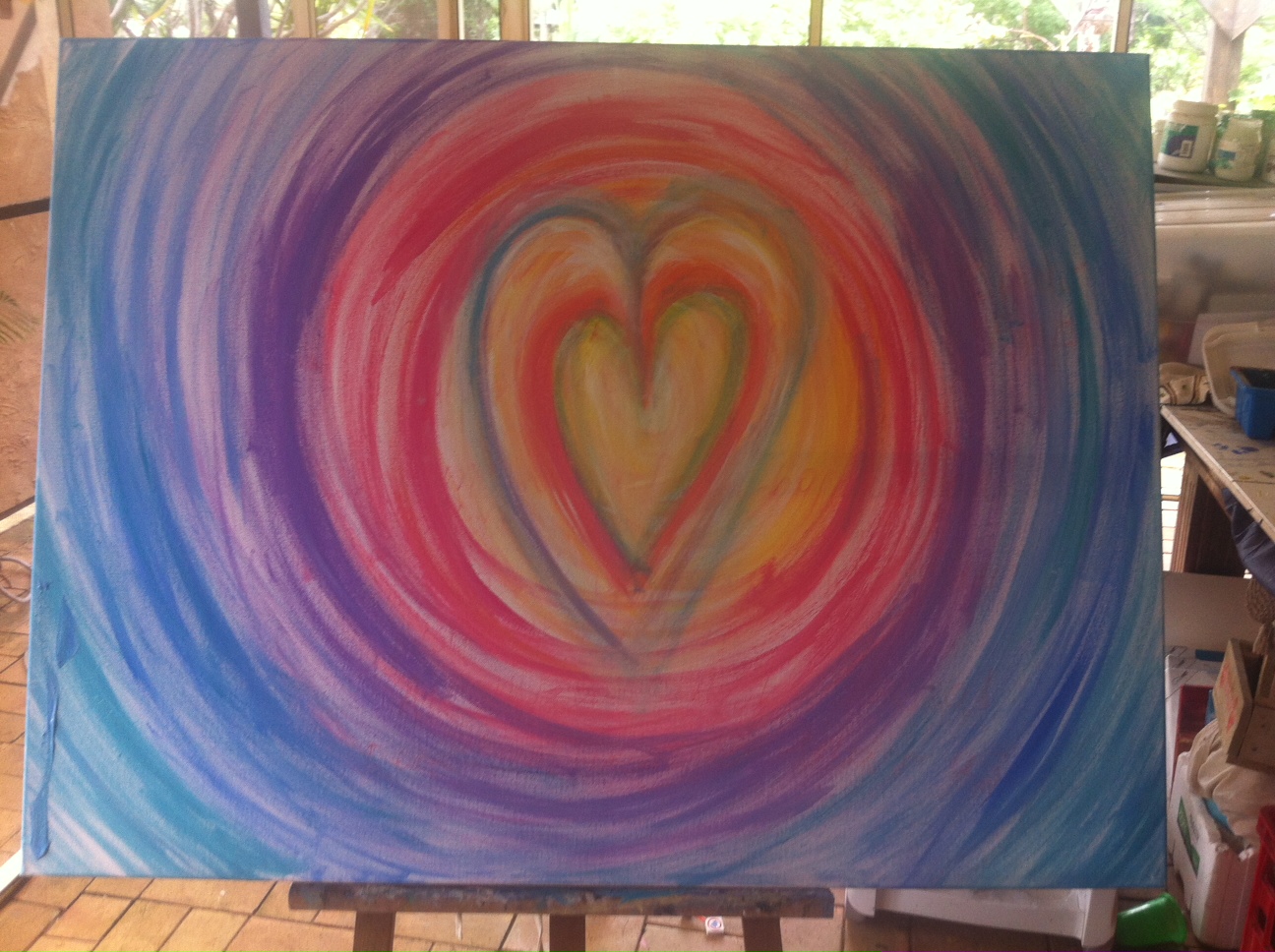
For me, having children awakened a love so very deep within. When I gazed into the eyes of my first born son at the tender age of 18, I was so overwhelmed by love I thought my heart would burst. I now have four children a husband and a loving extended family and friends who all teach me much about the true nature of love. They teach me above all else that love is patient, non-judgmental, and unconditional. It is through the growing awareness of my spiritual being and my journey with the Goddess that love has become something deeper than I ever thought possible. Love, for me has become a union with something higher than my individual self. My love extends beyond the family to include every living being on this planet and beyond. It is not just all about giving and receiving, but rather it is a state of being. It is personal yet universal and comes from deep within my sub-conscious. Love for me, not unlike the tales woven in ancient myth, is profoundly sacred.
Embodied with love I set out to create my next painting. Out of this portal of love:
Let’s talk about Mars and Ares. It’s common to think the Greek and Roman pantheons were identical and the gods and goddesses just had alternate names. This is not true. The Roman gods and goddesses personified civic virtues, whereas Greek mythology was largely philosophical.
I’ve been thinking about Carol Christ’s two excellent blogs about patriarchy and its connection to war and our so-called heroes. We read or watch the news today and learn about “our heroes” serving in the Middle East, about warriors who’ve come home and are suffering from deep wounds both physical and emotional. Yes, these men and women do indeed deserve our support…but, still, I ask, Why are people who are trained to kill other people called heroes? It’s a very thorny problem, and I must set it aside as I write this blog. Continue reading “Gods of War by Barbara Ardinger”



 I want a new religion. I have changed to the point that I cannot be a part of a patriarchal religion and I feel that all of the major organized religions fall into that category. It has taken me a long time, but I can now see that these organized religions were created largely to support the patriarchal culture that most humans have lived in for at least the past 5,000 years.

 Recently, in response to the excellent conversation following



 Feminism and Religion