
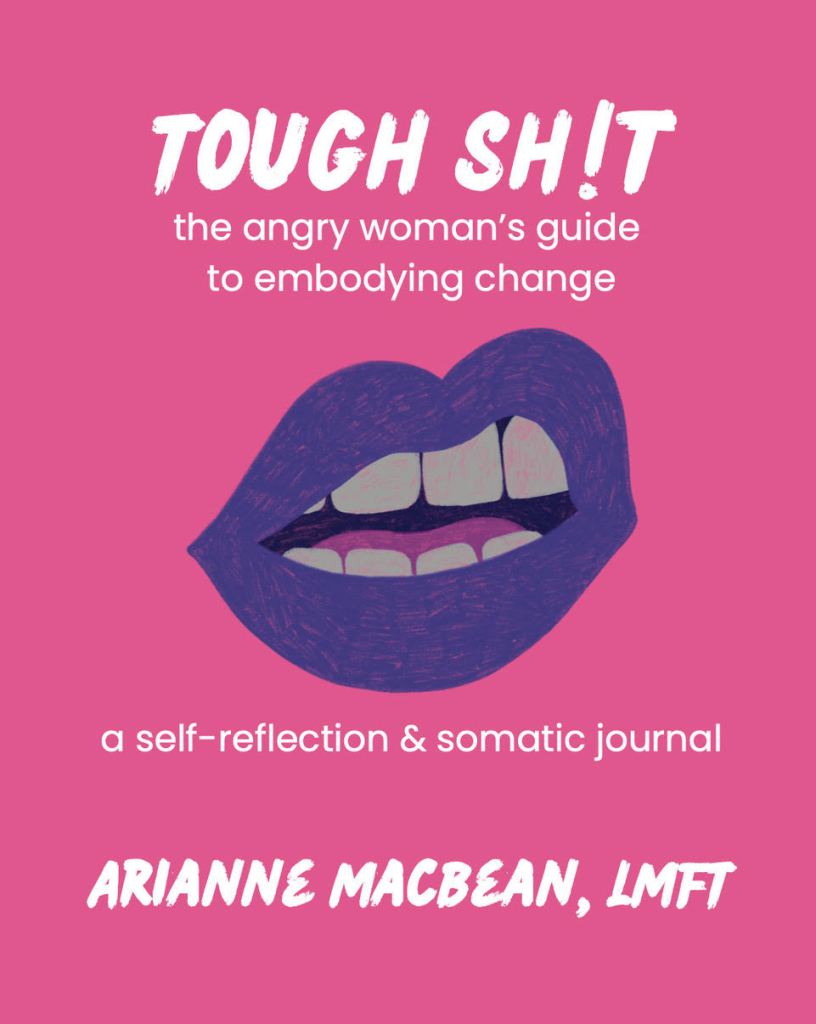
tough shit – a few words by Arianne MacBean

Cover Design by Kathleen Henrion

Before I knew what form my self-reflection and somatic journal for women would take, I knew what its title had to be. Through my work as a somatic psychotherapist, I understand how repressed anger, fear, sadness and hurt affects the psyche and the body. At best, suppressed emotional pain can show up as sensations that limit pleasure in daily life. At worst, unprocessed trauma can lead to chronic and debilitating illness. I wanted to create a journal that was not only anti-oppressive but also subverted the misnomer that divisive feelings are negative and should be stifled. Mostly, I wanted to expose how emotional censorship has its roots in its chief proponent: patriarchy.

Tough Shit. – the angry woman’s guide to embodying change is a journal that supports consciously tracing difficult feelings to understand one’s true self and make positive change. The title isn’t about being provocative or crass. I chose it because the phrase “tough shit” has a long history related to gender stereotyping and dominance—all of which my journal actively challenges. But the phrase is not just cultural; it’s personal. An iteration of this phrase was used against me growing up. As the concept of the journal became clearer, I felt my body insist on throwing “tough shit” back out, not as a degrading echo, but as a reclamation—a fierce refusal to silence valid emotional pain.

Continue reading “tough shit – a few words by Arianne MacBean”

3 Taoist Secrets for Embodying your Life

Taoism is an ancient Chinese philosophy and spiritual tradition that offers a unique perspective on life, existence, and human experience. Where many religious practices aim to transcend and sometimes even punish the body, Taoism cultivates a deep connection with our physical self in ongoing relationship with nature around us. 

This resonates with my own experience, in which I see the body as starting point and place of return for everything we do in life. Leaving the body in order to meet spirit or the divine has never made any sense to me. 

In this article I’ll highlight a few elements of Taoism as an embodied philosophy, specifically zooming in on principles and practices that promote holistic wellbeing and inner peace.

Continue reading “3 Taoist Secrets for Embodying your Life”

Paradigm Shifts: Playing the long game

You’re probably tired of hearing it… We live in a time of major change. But hardly anyone acknowledges that change doesn’t happen overnight. 

In anthropology and ritual studies, the state of change between the old and the new, is called liminal or threshold space. It is the in-between time. I believe we are living in such a time now. Our familiar frames of reference are crumbling, yet there are no clear new ones in place yet. 

In this post I reflect on a few aspects of this long-dance with the unknown.

Continue reading “Paradigm Shifts: Playing the long game”

Activate your Body to Navigate Overwhelm

We live in a time of radical change, in a steam cooker of accelerated alchemy. No wonder most of us struggle with chronic overwhelm.

Beliefs, habits, thought patterns and organisational structures don’t change overnight, and we need ways to boost our resilience in the long arc of paradigm shifts. How can we look after ourselves during this personal and collective dance of change?

In this post I reflect on the connection between movement and health, breathing, and the role of our nervous system. I propose 5 simple steps to minimise and transform overwhelm when it happens.

Continue reading “Activate your Body to Navigate Overwhelm”

On Chronic Illness and Justice by Ivy Helman

29662350_10155723099993089_8391051315166448776_oFor almost four years, I’ve been living with the long-term effects of an inner ear lesion.  The lesion is long gone but its side effects are not.  Throughout the day, I feel a combination of unsteadiness and sudden, unpredictable sensations of movement.  On better days, the unsteadiness is almost non-existent and the feelings of movement are minimal.  On worse days, I’m troubled with a type of brain fog that makes it hard to concentrate as well as disrupting unpredictable sensations of being on a boat that can’t pick one direction in which to move.  It’s frustrating, tiring and demoralizing.
Summer is the season of worse days.  There is really nothing I can do to feel better.  Even staying well-hydrated and taking it easy often doesn’t steady the boat.  So, instead, I often continue my life as normal.  Then, I lay in bed at night and hope sleep comes soon. Continue reading “On Chronic Illness and Justice by Ivy Helman”

Bans are Bandages not Solutions by Ivy Helman

meandmini1I’m heartbroken by yet another shooting in the United States.  I want to believe that all humans are, deep-down, intrinsically good.  I want to trust humans to act in the best interests of others.  I want peace between and inside human beings.  I want animals to be cared for, respected and deemed inherently valuable.  I want humanity to live in harmony with nature.  And, I want human societies that are just, equal and fair.

Even though I’m certain this world is achievable, it does not exist.  In fact, it often feels like we take one step forward, but something changes and we go back again.  This type of existence is no way to live.  In fact, Las Vegas was yet another example of how our way of life is worse than that.  It’s quite literally killing us.  And, I’m beyond any sort of ability to articulate just how upset I am. Continue reading “Bans are Bandages not Solutions by Ivy Helman”

The Coming of Spring: Reflections on Pesach and Judaism by Ivy Helman

meandminiIt is, I think, quite common knowledge that most Jewish holidays relate to the seasonal cycles of the Earth.  Sukkot celebrates the fall harvest.  Chanukah sheds light on the winter darkness.  Tu B’Shevat marks the end of the dry season and so begin the prayers for rain in Israel.  For Purim, we throw off our winter doldrums and let off a little steam to settle our cabin fever.  Pesach is no exception: welcome spring: birth, renewal and even creation.  The leaves return to the trees, baby animals are born, flowers bloom, warmer weather arrives and somehow the possibilities of the coming summer are endless.
In fact, the associations between Pesach and spring are many.  Arthur Waskow in Seasons of Our Joy explains the origins of the connections (pages 133-139).  There were probably two different seasonal celebrations – one of shepherds and one of farmers – that came together around the time of the Babylonian exile into one festival which we can see in Exodus 12 – 13: Pesach.  Farmers in preparation for the harvest of spring wheat cleared out the old crumbs and fermentations of the last year to make room for the new.  Shepherds celebrated the arrival of baby sheep and their flock’s fertility in general by slaughtering a sheep, putting its blood on their tents and dancing around a fire.   Continue reading “The Coming of Spring: Reflections on Pesach and Judaism by Ivy Helman”

Dystopian Fiction Inspiration and Religious Lessons by Ivy Helman

me-hugging-treeWe live in a dystopia.  This world is filled to the brim in dichotomies: poverty and extreme excess, hunger and mountains of food, disease and cutting-edge medicine, materialism and an immense environmental crisis, and hour-long walks for water and hour-long luxurious baths.  There are so many parts of our world that are not just unfair, unequal, broken and undesirable, but violent, traumatic and deadly.  And, sometimes it feels like it is only getting worse, or at least, again teetering on the edge of yet another catastrophe.

Most of the world’s religious traditions agree that this is not the way the world should be.  My own religious tradition, Judaism, traces this separation between the Creator’s utopia, the Garden of Eden, and our current situation all the way back to the beginning of humankind.  The actions of the first two humans resulted in exile from the Garden: enter the world diametrically opposed: dystopia.  Nonetheless, the Jewish religious tradition’s call for tikkun olam (repairing the world) suggests that it is possible to lift the veil between the Divine and us and consequently recreate the utopian Eden once again.  One could say it is why we are here.

That being said, while the dystopian genre has been around for many decades, I have noticed a recent rise in the popularity of dystopian fiction.  While I have always had a keen interest in science fiction, from Star Trek to FireFly and beyond, I myself have, as of late, become an avid reader of dystopian novels.  I blasted through the Divergent series by Veronica Roth, have reread The Fifth Sacred Thing by Starhawk more times than I can count and just began my dip (25 pages) into The Mandibles by Lionel Shriver – not so action-packed as the others.  I’ve also been, one could say, addicted to dystopian films (yes many were books first) like The Hunger Games, Maze Runner, Gattaca, The Fifth Element and Serenity to name just a few.

Continue reading “Dystopian Fiction Inspiration and Religious Lessons by Ivy Helman”

Goodnight, Sweet Friends by Natalie Kertes Weaver

Natalie Weaver

Yesterday, to this day of my writing, two of my friends died.  Both endured years of struggle against cancers, and both finally yielded to death at nearly the same hour.  I received notices of their passing within moments of one another.  We sat vigil with the family of one of my friends until late in the evening, while the other friend was prepared for repatriation in the land of her ancestors.

In the home where we sat vigil, I entered the room where my friend had passed away.  I wanted to feel the last fading traces of her physical presence.  I don’t know whether any part of her was there or not, but I was grateful to be in the place where she had been.  The room was very full.  It held the medical equipment that had briefly sustained her life for the last few days, but it was mostly stuffed with the clutter and the souvenirs of a life.  Porcelain trinkets, formal family portraits, travel photographs, colorful shot glasses collected from the cities she had visited, and everything covered with a fine layer of dust. Continue reading “Goodnight, Sweet Friends by Natalie Kertes Weaver”

Give Away All That You Have, and Then You Shall Receive…by Natalie Kertes Weaver

Natalie WeaverOne of the loudest refrains I perceive in the Bible is the message that good spirituality means giving everything away.  It is a radical concept that begins in an obvious way with material things, especially those that we have in excess.  The wisdom here is not too difficult for me to grasp: one cannot meet the Lord if s/he is wrapped up in the routines of acquisition and hoarding.    

But, this is only the beginning.  The teaching reaches down much deeper than the critique of riches and speaks in some totalizing fashion to the very essence of personal being.  It seems to say to me that good spirituality involves letting the self be so entirely poured out of the ordinary instincts and behaviors of self-consciousness and self-preservation, of the self qua self, that it is capable of receiving the inpouring of God’s wisdom and light.  

Put another way, the self has to condition itself to receive that which is genuinely extrinsic, that which is outside itself, and that encounter cannot occur so long as one is self-absorbed.  This insight, of course, is not exclusively biblical or Christian.  Indeed, it is perhaps the most common point of agreement among all the great spiritual traditions. Continue reading “Give Away All That You Have, and Then You Shall Receive…by Natalie Kertes Weaver”