I’m currently developing a book that considers how theological and ethical considerations in architectural design can define good architecture. My book discusses five virtues related to the architectural design process that promote human participation in bringing out God’s intention of flourishing for humanity and creation. Those five virtues (or values) are: empathy, creativity, discernment, beauty, and sustainability. In the book, I’ll explain how these virtues orient design tasks to the social and ethical aims of architecture.
In this virtual space, I want to have a discussion about what these virtues mean from a feminist standpoint. In my writing, I draw from theological ethics, architectural theory, and feminist theory to emphasize community discernment and participation. It’s fitting, then, to claim opportunities in my work to acknowledge the feminists who have influenced me while also opening up the dialogue to the feminists in this community who continue to inspire and guide me to do my best work. Continue reading “What Dorothee Soelle Taught Me about Creativity by Elise M. Edwards”
If you ever eavesdrop on a conversation between my husband and me around the clamor of our four children’s voices, you will probably hear me making a tired lament: “All I want is a broad swath of uninterrupted time.” In listening to Elizabeth Gilbert’s newest book, Big Magic, on audio book I was interested by her mention that many creative people lament not having long stretches of uninterrupted time available in which to work. She quotes a letter from Herman Melville to Nathaniel Hawthorne, lamenting his lack of time and how he is always pulled “hither and thither by circumstances.” Melville said that he longed for a wide-open stretch of time in which to write. She says he called it, “the calm, the coolness, the silent grass-growing mood in which a man ought always to compose.”
…I do not know of any artist (successful or unsuccessful, amateur or pro) who does not long for that kind of time. I do not know of any creative soul who does not dream of calm, cool, grass-growing days in which to work with- out interruption. Somehow, though, nobody ever seems to achieve it. Or if they do achieve it (through a grant, for in- stance, or a friend’s generosity, or an artist’s residency), that idyll is just temporary—and then life will inevitably rush back in. Even the most successful creative people I know complain that they never seem to get all the hours they need in order to engage in dreamy, pressure-free, creative exploration. Reality’s demands are constantly pounding on the door and disturbing them. On some other planet, in some other lifetime, perhaps that sort of peaceful Edenic work environment does exist, but it rarely exists here on earth. Melville never got that kind of environment, for instance. But he still somehow managed to write Moby-Dick, anyhow.
When I create a new sculpture, I am most often creating something that I need to remember or want to learn. The original figures for my Centered Mama sculpture and my Meditation Goddess sculpture were both created while at a friend’s house for a weekend work exchange as my baby toddled around. While I love making figures of mothers and babies, I was feeling a strong urge to make a goddess representation complete unto herself. It felt like a reclaiming of my non-maternal identity and a declaration of self-sovereignty. She turned out a little bigger than some of my other figures, strong and secure and independent. Then, the baby crawled over and knocked off one of her breasts, knocked her over on the tray, smashing the side of her head. I came close to crying. I felt annoyed with my husband who’d “let” him come over and destroy my work rather than noticing him doing it and stopping him. I was frustrated, dismayed, and my feelings felt hurt in a sense. First I felt like, Argh! This is a metaphor for life! And, then I realized it was not just a metaphor for life, it is my actual life! I pouted a bit and said I was just going to smash her and give up and I made some bitter faces at my husband and some long-suffering huffs and signs, but then the baby fell asleep in the Ergo, held close against my chest. I kissed his soft hair and I took my clay and started again. I reclaimed her from the smashed parts and she sat stronger and taller than ever.
She reminds me not to give up and that beautiful work can come from struggle, but also of interdependence (not just the independence I was going for!), co-creation, and tenacity. When the finished version of her, cast from the original sculpt, sits by my bed at night or overlooks my dinner preparations, she reminds me that I am strong and that persistence is worthwhile. She also tries to remind me to be calm and steady, centered and Zen, even though I more often feel like a whirlwind.
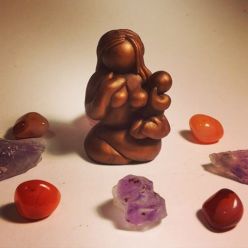
That same Saturday at my friend’s house, as my baby tentatively toddled around the kitchen, chewed on a piece of watermelon, and snoozed on my chest, I felt moved to begin creating a new Centered Mama sculpture. I had been going through an emotional rough patch, feeling buffeted by variable emotions and erratic and unpredictable in my enthusiasm and confidence. I was also feeling impatient, snappy, and irritable.
“I will be gentle with myself. I will be tender with my heart. I will hold my heart like a newborn baby child.”
This song by Karen Drucker replayed in my mind as I sculpted. The baby woke, the watermelon got dragged along the floor collecting dust, and it was time for our collaborative dinner, so I had to put her away unfinished. When we got back to our own home, I was compelled to finish her, working feverishly as the baby pulled on my legs and I said, “just a few more minutes!” to the older kids who were trying to play with him to let me work. Again and again I re-rolled the clay baby’s head, trying to make it “perfect,” and worked to lay down the strands of her hair, against of the backdrop of this often-chaotic, noisy, home-based life we’ve consciously and intentionally created together. She was created to represent holding my own center in the midst of motherhood. I will be tender with my heart. I don’t create sculptures like this because I AM so “Zen” and have life all figured out, I make them to remind me what is possible if I listen to my soul.
As I do extensive rearranging, construction, and reconstruction on my slowly ongoing dissertation project, I typed out a quote from the book Priestess: Woman as Sacred Celebrant by Pamela Eakins about her past life memories of making clay goddess figures as a temple priestess:
…to me it brought a continuation of the energy of the sacred objects of the grandmothers. I contained this energy in a new form in the dolls that would be placed upon the altars and in the graves of the daughters living now and the daughters to come…
I felt this process made my own clay stronger, too. Some of the pieces cracked in the fire because of the added ‘impurities’…but, in this case, I felt the impurities were the purest of pure and I worshipped each crack knowing the crack contained the wisdom of the priestesses who had occupied the doll-making table for more moons than I could even imagine. It contained too, the devotional energy of every grandmother who had held it in her hands or placed it on her altar. Sometimes ‘impurities’ sanctify further that which is holy to begin with.
While I tend to have a knee-jerk skepticism about past-life memories, there is something in Eakins’ words that I know at a bone-deep level as I do my own work with goddesscraft:
…Each goddess was imprinted with the sound of sacred life coursing through the Universe. I changed with the priestesses as the figures came through my hands. Each doll received the sacred vibration of life…For seventy-seven moons I made the dolls at the long table with the young Sisters of Nun. My hands were so fast. I made thousands of figures: beautiful little faces, etched collars of gold plates, pubic hair swirled into tiny rows of connecting spirals. They were so precious. At the end of the day, my baked clay shelves were covered with little women.
The clay goddesses healed…
This is how I apprenticed. I learned, in this manner, the art of healing. I learned that to heal means to make whole, and that becoming whole involves learning many levels of purification, balance, and reformation” (p. 32-33).
In Anne Key’s marvelous priestess memoir, Desert Priestess, she makes this important point: “It is of course no small wonder why graven images are so tightly controlled by religious traditions.” (p. 52) Sometimes I feel like this is what I’m tapping into when I make my own goddess sculptures—a resistance to tight control over graven images and over personalization of divinity as male.
I occasionally get requests to make bigger goddesses–-people ask about figures that are large altar pieces 12-18 inches tall or taller. The goddesses I make are all about three inches tall and there’s a reason for that: they fit in the palm of my hand. When I create them, I feel as if I’m part of an unbroken lineage stretching back 30,000 years to the person who carved the Goddess of Willendorf. I feel connected to the priestesses of the Mesopotamian temples who sculpted hundreds upon hundreds of tiny clay goddesses. Someone commented on my sculptures once saying, “echoes of Mesopotamia.” And, I said, “exactly.” I feel the connection between the clay in my hand and the clay in their hands, running through the ripples and eddies of time.
I’ve been inspired recently to re-read Starhawk’s The Spiral Dance, finding new bits of wisdom from it that speak to something different in me than they did the first time I read it. She writes of the attempts to discredit Goddess religion by invalidating the historical narratives or archaeological evidence: “The idea seems to be that if they can disprove our origin story, they can invalidate our spirituality…Is Buddhism invalid if we cannot find archaeological evidence of Buddha’s existence? Are Christ’s teachings unimportant if we cannot find his birth certificate or death warrant?…the truth of our experience is valid whether it has roots thousands of years old or thirty minutes old…a mythic truth whose proof is shown not through references and footnotes but in the way it engages strong emotions, mobilizes deep life energies, and gives us a sense of history, purpose, and place in the world. What gives the Goddess tradition validity is how it works for us now, in the moment, not whether or not someone else worshipped this particular image in the past” (p. 4).
The ancestry of my goddess sculptures may not be the same energy that raised temples and built monuments (or walls), it is the energy that carried a baby on one hip and a basket of supplies on the other and needed a goddess just the right size to tuck down the front of a shirt…
Sometimes I describe my life in the woods as being held in the hand of the goddess. And, I make goddesses that I hold in my hand. Am I in the palm of her hand or is she in the palm of mine? The answer is both.
(One of my all-time favorite fan photos–a rainy day traveling goddess picture, taken by my friend/SIL (this one is only an inch tall, but look how she calls in the waters of the world!)
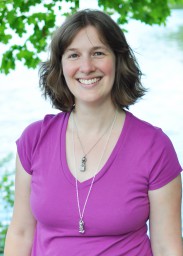
Molly has been “gathering the women” to circle, sing, celebrate, and share since 2008. She plans and facilitates women’s circles, seasonal retreats and rituals, mother-daughter circles, family ceremonies, and red tent circles in rural Missouri. She is an priestess who holds MSW and M.Div degrees and she is finishing her dissertation about contemporary priestessing in the U.S. Molly’s roots are in birth work and in domestic violence activism. She has worked with groups of women since 1996 and teaches college courses in group dynamics and human services. Molly is the author of Womanrunes: a guide to their use and interpretation, Earthprayer, Birthprayer, Lifeprayer, Womanprayer, and The Red Tent Resource Kit, as well as three social service oriented booklets and a miscarriage memoir. She has maintained her Talk Birth blog since 2007 and writes about thealogy, nature, practical priestessing, and the goddess at her Woodspriestess blog. Molly and her husband Mark co-create original birth art, goddess sculptures, ceremony kits, and pendants at Brigid’s Grove.
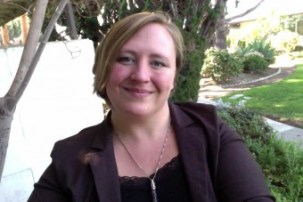
I never liked the metaphorical use of the word “pregnant” as it tended to be used in the academy. Reading the “pregnant phrases,” of mostly men who were “pregnant with thought,” as a student, I felt angry by what I saw as a co-optation of my female potential, and even, a patriarchal ranking of what kinds of “pregnancy” were deemed important or worthy of “serious” consideration.
At this time in my life, I did not know if I wanted to have children or ever be a mother. However, retrospectively, I know that I had internalized the picture of “good” motherhood projected all around me by my religious community. Specifically, I remember watching two female leaders who had been vibrant and vocal members of one community become quiet, even silent, objects of adoration. It was as though I watched them walk behind and close a door, marked in my mind with the sign “appropriate female role,” and they ceased speaking. Other people spoke about them, even doted on these women—but I didn’t know where the women themselves had gone. These women were certainly pregnant, but seemed somehow less significant, no longer worthy of “serious” consideration, like sacred chalices holding the all-important blood of another life. I began to believe that you could not be you and be a mommy. I remember telling a friend or a sister, rather judgmentally, “I will never become a mother if I have to be like that.” Continue reading “Pregnant with Thoughts by Sara Frykenberg”
November, which begins with All Saints Day (yesterday) and All Souls Day (today), gives us a quiet, welcome break between the loud make-believe of Halloween and the incessant caroling of the winter solstice season with its popular holidays. In the Northern Hemisphere, the days are noticeably shorter and darker now. Where I grew up, it’s gray, cloudy, and often rainy. It has always seemed to me that people are turning inward and the month is closing in on itself. Even today in southern California, I feel a delicious melancholy composed of silence and rest from hard work.
For two millennia, the standard-brand churches have admonished women to be silent. As it is written, “Let the woman learn in silence with all subjection. But I suffer not a woman to teach, nor to usurp authority over the man, but to be in silence” (1 Timothy 2: 11-12).
Let’s say that today is a typically gloomy November day. The sun is lazy and clouds are floating mysteriously across the sky. Look, they’re gathering over there in the east. As clouds often do, they begin to assume shapes. Let’s look closer…and we begin to see a fiery mountain. Above that fiery mountain floats a giant head. Listen! The head is speaking. “I am One, the Great and Powerful. Thou shalt not take My Name in vain. Thou shalt have no other gods before me for I am a jealous God—”
But the silence of this gloomy November day is suddenly broken as the women standing in the mud at the foot of the fiery mountain suddenly begin to shout back at the preaching giant head. “There’s been plenty of gods before you,” one woman shouts. “And even more goddesses came before you,” calls another woman. Continue reading “November, A Silent Month? by Barbara Ardinger”
An artist’s place in society is ambiguous and one not often discussed. Artist’s often have difficulty claiming themselves as ‘artist’ for fear of criticism and rejection both inside and outside the art world and from within. Historically, artists have had their work labeled as narcissistic, sexist, racist, classist, elitist, indulgent, hermetic…and the list goes on.
I have been on the end of some harsh criticism. Comments made by the board of Queensland’s most prestigious art school have stayed with me for over 15 years. “Impressive folio” they said, however, using images of indigenous persons is ‘cultural appropriation’ and ‘unacceptable’. They were referring to a series of pieces I had been encouraged to create under the mentorship of a fine, accredited artist Wim De Vos.Continue reading “Social Responsibility of the Artist by Jassy Watson”
I am visiting my home town in Russia for holidays. I have not been home for 3 years and I have not lived there for 12 years. Many things surprise me. One of the features of contemporary life in my home town is the relentless and often destructive onset of capitalism. As I have said already, currently patriarchy has joined forces with capitalism in order to suppress nature and oppress women.
One of the ways capitalism does this is by involving women and men into an endless rat race and by substituting their Wild Nature (as Dr Clarissa Pinkola Estés describes it) with an identity of a consumer. People willingly put on masks of consumers who live to make money and to spend it on entertainment which is sold to them.
According to Robert. C. Fuller author of Spiritual not Religious, “an idea or practice is ‘spiritual’ when it reveals our personal desire to establish a felt-relationship with the deepest meanings or powers governing life” (2001, p. 2). According to this definition, creativity and even more specifically, artistic expression, can be considered a spiritual practice. Christine Paintner, writing for Spirituality in Higher Education states that “cultivating the arts as a spiritual practice is a path to freeing our imaginations and developing valuable skills for vital living in the world” (2007).
What is Spirituality?
Spirituality is usually considered to be a search for meaning in life. By making sense of and finding meaning, spirituality can often align us to our purpose. It also provides “a set of values to live by, a sense of direction, and a basis for hope” (Paintner, 2007). Spirituality can also assist us in encountering mystery and further developing and nurturing a relationship with it. It is also about transformation, for it challenges us to grow and expand. Spiritual practice also invites us to commit to a set of practices such as prayer, ritual, meditation, chant and service that enable us to encourage a way of being intentional in our relationship to the self, others and the divine. Continue reading “Creativity as Spirituality by Jassy Watson”
Years of patriarchy and masculine domination, rapid technological advances, exclusivist religious dogma, separation from nature, materialistic attitudes and the daily course of our busy lives have left women (and men) largely disconnected from their essential primal feminine energies. We get so caught up in all these “doings” that we fail to tend, nurture or even recognize the primal part of our self that is essential to our being. Women from all walks of life are seeking ways and means to connect back to their core, primal feminine self. But who is she really? Moreover, how do we connect to, or awaken her? Continue reading “Creativity as our Primal Instinct”
Poetry is a gift from our ever-creating goddess, but you know what? She also has a major sense of humor. Nearly every night, I go to bed, pet the cats awhile, and think I’m going to go right to sleep. And what happens? Words happen. Beginnings of blogs. (This one. Last night.) Lines of dialogue or description that will end up in my revisionist fairy tales. First lines of poems. Most nights, I “talk” myself to sleep.
Because the Goddess is endlessly, continuously creative and her art is our blessed planet, so are all her children creative, and so am I also creative and kinda artsy, too. I learned to embroider when I was about seven years old. I learned to sew, I learned to knit, I learned to crochet. For years I crocheted granny-square afghans, but I ran out of people to give them to about ten years ago. As a child, I sat on my father’s workbench and learned to work a little with wood. I started taking piano lessons the day after my sixth birthday. Although my mother and my brother were artists, I missed out on that talent, but made up for it by taking a right-brain drawing class and doing a magnificent contour drawing of a brussels sprout. I don’t remember when I couldn’t read, and I’m told that I started writing fiction when I saw seven years old and wrote a story for my daddy. Along the way, of course, I’ve also learned a lot of very practical creative skills, of course, like touch typing. Continue reading “Where Does Poetry Come From? By Barbara Ardinger”
All of us have the same creative power as artists to contribute to the world in our own domains. When we do so, we re-create the world and participate in its ongoing creation.
For years, my friend Lisa Cole Smith has been working with artists and thinking about their important role in the world. She has been building a community to support artists and other creative people through a Christian church in the Northern Virginia/Washington DC area and at times, I’ve been fortunate enough to participate in that effort. My conversations with Lisa are always rewarding, whether we are simply catching up as friends, giving each other encouragement for our work, or discussing theological concepts. Although she works in a church and I work in an academic setting, we have similar pursuits. Continue reading “Re-creating the World by Elise Edwards”


 I’m currently developing a book that considers how theological and ethical considerations in architectural design can define good architecture. My book discusses five virtues related to the architectural design process that promote human participation in bringing out God’s intention of flourishing for humanity and creation. Those five virtues (or values) are: empathy, creativity, discernment, beauty, and sustainability. In the book, I’ll explain how these virtues orient design tasks to the social and ethical aims of architecture.
 “If there is one chant in the universe it is to create.”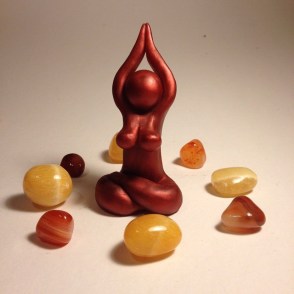
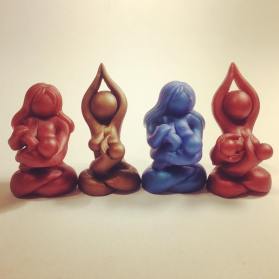
 inches tall or taller. The goddesses I make are all about three inches tall and there’s a reason for that: they fit in the palm of my hand. When I create them, I feel as if I’m part of an unbroken lineage stretching back 30,000 years to the person who carved the Goddess of Willendorf. I feel connected to the priestesses of the Mesopotamian temples who sculpted hundreds upon hundreds of tiny clay goddesses. Someone commented on my sculptures once saying, “
 I never liked the metaphorical use of the word “pregnant” as it tended to be used in the academy. Reading the “pregnant phrases,” of mostly men who were “pregnant with thought,” as a student, I felt angry by what I saw as a co-optation of my female potential, and even, a patriarchal ranking of what kinds of “pregnancy” were deemed important or worthy of “serious” consideration.
 November, which begins with All Saints Day (yesterday) and All Souls Day (today), gives us a quiet, welcome break between the loud make-believe of Halloween and the incessant caroling of the winter solstice season with its popular holidays. In the Northern Hemisphere, the days are noticeably shorter and darker now. Where I grew up, it’s gray, cloudy, and often rainy. It has always seemed to me that people are turning inward and the month is closing in on itself. Even today in southern California, I feel a delicious melancholy composed of silence and rest from hard work.


 Feminism and Religion