This semester I am teaching the course EcoJustice and chose Sallie McFague’s A New Climate for Theologyas our foundational text. Something I greatly appreciate about McFague is that she continually calls us to radically redefine our understanding of the Divine and of our roles as human beings — fundamental questions that could easily lead to an existential crisis as one student reminded me.
My class and I ponder these questions, discussing our own interpretations of God, why we exist, what it means to pray, and understandings of salvation. Not surprisingly, many of us have an anthropocentric theology — one that puts ourselves at the center. We are so focused on what we need from God, we forget to ask what God needs from us.Continue reading “EcoJustice and Our Relationship with God by Gina Messina”
She is not crying in the wilderness. She is not railing in the streets.
She sits quietly and speaks softly and with absolute clarity and certainty.
To let all the water systems and food systems and planetary climate systems get destroyed. That is the stupidity which rules us today.
No fire and brimstone, no angry God.
I do not think the planet will die. I think the earth is too powerful.
A simple truth.
We need to protect our home.
Men have lost the way.
Going to war and killing was considered important. Making profits at the cost of others was considered important.
Women must lead.
The values we need are in the knowledge of how to live with nature. That’s what women’s knowledge is. We need knowledge of how to care. That’s knowledge: it’s … called emotional intelligence now. We need knowledge of how to share.
We are part of the earth.
Working with our hands is not a degradation.
Could it really be as simple as that?
Some gender scholars will protest. “This is essentialism,” they will say. “This will keep women in the home where they have always been,” they will say.
If they say this, they will miss the point. This is not gender essentialism. The situation Shiva describes is a product of history. A history in which powerful men determined that war, killing, and profit are the highest values. It may or may not be in women’s nature to know how to live with nature, to care, and to share. These values are part of “women’s knowledge”* because they derive from the work women have been doing while men were making war and making profit on the backs of others.
Shiva is not telling women to stay in the home. She is telling women to confront “deceitful, dishonest, brutal power.” She is telling women to teach those who rule the world how to live with nature, how to share, how to care.
If women are can teach what they know, how to live with nature, how to care, how to share, women’s knowledge will become human knowledge once again and we may be able to save our home.
If not,
. . . we are dispensable. She’ll find a way.
A prophet is speaking. listen to her words. Etch them on your heart. And save the world.
*Shiva has stated that women do most of the farming in the world. Women who are not farmers care and share and may tend gardens. Women’s knowledge is a relative term. Some women in industrialized countries place ambition, competiton, and profit above caring and sharing. Even in this situation, women generally care for children. See Shiva’s Staying Alive: Women, Ecology, and Development.
I remember so vividly entering graduate school in my early forties and being told I was an “eco – feminist” by my professors. What does that phrase mean I asked having no relationship that I knew of to feminism. Feminists, I thought vaguely, naively, even stupidly, burned bras and hated men…
I was asked to read “Woman and Nature; The Roaring Inside Her” by Susan Griffin to help me see who I was, and after finishing this one book I submerged myself in feminist writings like a starved woman – child. My teachers were right. I was a feminist – an eco –feminist because I had already made the connection between what was happening to the Earth and what had happened to me. Every tree that was chopped down was a part of me, every stream that was polluted was a part of me, every animal that was slaughtered was a part of me because I was a part of Nature. I owed my life to Nature, the only mother I had ever had. I loved Her, honored her, became her fierce advocate and in the process She eventually taught me to love myself.
On February 20, 2018, the Greek government issued a Presidential Decree mandating the formation of government bodies to monitor and protect the more than four hundred bird and wildlife habitats in Greece designated as part of the European law Natura 2000. This decision came after decades of government inaction regarding the enforcement of the Natura law it accepted as part of its entrance into the European Union.
Whether the Presidential Decree will result in protection on the ground remains to be seen, but it is an important step in the right direction. The Presidential Decree was issued after years of negotiations initiated by the European Commission to compel the Greek government to comply with the law. A Complaint to the European Commission regarding failure to protect the Natura wetlands of Lesbos on which I was the first author formed part of the basis of these negotiations.
a ditch drains a wetland to produce agricultural land
Almost as soon as I became a birdwatcher in 1999, I began to notice the degradation of bird habitats by dumping, drainage, and building, especially in wetland areas. Wetlands are seasonal bodies of water created by winter rains that dry out in the summer heat. Generally, they are shallow, which means that they are a perfect stopping over place for migrating birds. The most common visitors to wetlands are wading birds that stand in shallow pools and puddles without immersing their bodies in the water. Lesbos, the island where I began to watch birds, has some of the most important wetlands in Europe, visited by birds migrating from Africa to Europe in the spring for rest and feeding. Because of this, Lesbos is also a destination for birdwatchers.
Wetlands are not only important for birds. In rainy periods they act as a sponge between rivers and the sea and dry land, absorbing water that otherwise could cause flooding. The devastating flood damage to New Orleans in recent years is the result of building on wetlands. Similar damage occurs regularly wherever wetlands are drained, including on the island of Lesbos.
In 2001, I wrote a petition that was signed by over 600 birdwatchers and others urging the Greek government to protect the wetlands of Lesbos. I presented it at an open meeting in May 2001 organized by the Mayor of Kalloni, Lesbos, Aris Eleftheriou, to explain the plan to protect the wetlands of Kalloni which had been funded by the European Union. Instead of being congratulated for his work and vision, the mayor was met by an angry mob. Many of the Natura wetlands are privately owned fields traditionally used for grazing sheep and goats. As local economies were transitioning to tourism, landowners did not want any restrictions placed on their ability to drain and build on their land.
flamingos are now permanent residents of Lesbos
It was in this context that John Bowers, a longtime birdwatcher in Lesbos, an environmental economist, and the first to sign my petition, formed Friends of Green Lesbos, an international internet-based group dedicated to protecting the wetlands of Lesbos that soon counted over 800 members. I became its Vice President. In 2003, Friends of Green Lesbos, in co-operation with Idatinos, a local environmental group, drafted an internet letter and petition, that was automatically sent to the Greek government every time it was signed, asking the Greek government to fulfill its legal responsibility to protect the wetlands of Lesbos. The government responded that it was required to enforce the Natura law even though no specific Greek law had been passed specifying how this was to be done. A committee in the department of building and land development in Lesbos was created and charged with the responsibility of protecting the local wetlands.
We did not understand that this committee would not be monitoring the wetlands on a regular basis, but would only respond to complaints. This was clarified at a meeting organized by World Wildlife Fund in Athens in 2005. I was then put in touch with a new local environmental group, Nautilos en drasi that was also formed to save wetlands. Together with WWF, we began to draft complaints about the degradation of individual wetlands. These complaints, numbering well over fifty, were all decided in our favor. Fines were issued, but there was no mechanism to ensure compliance. Numerous meetings with the Governor of the island resulted in promises that were not kept. We finally realized that he was more interested in currying favor with landowners and developers than in enforcing the law.
In 2008 while lecturing at a conference in Ireland, I met a Green Party member of the European Parliament who encouraged me to write a complaint to the European Commission. After six months of intense effort, I completed a formal complaint of over 100 single-spaced pages, supported by two large files of documents, detailing the government’s failure to protect the wetlands under the Natura law. It was immediately approved by Friends of Green Lesbos and Nautilos en drasi, but it took over two years for World Wildlife Fund and Hellenic Ornithological Society to revise and sign it.
The complaint was submitted to the European Commission in September 2011. After several requests for additional documentation, the Commission found Greece in violation of the Natura law in Lesbos in October 2014. In August 2016 the Commission informed us that it had made our case part of horizontal negotiations with Greece regarding its failure to protect all of its Natura sites. The February 2018 Presidential Decree is the fruit of these negotiations. It is certain that the European Commission will continue to watch the situation in Greece to ensure that the government follows through with the monitoring and protection mandated by the new law.
This has been a long and tiring and often discouraging struggle of nearly two decades and it is still ongoing, but if the end result is the protection of all of the Natura sites in Greece, it will have been well worth it.
Others involved in Natura struggles in Lesbos besides John Bowers and myself include Eleni Galinou, Michael Bakas, Costas Zorbas, and Stellios Kraonakis, and in Athens, Foteini Vrettou, George Chassiotis, and Elias Tzirtzis of World Wildlife Fund Greece, and Malamo Korbeti of Hellenic Ornithological Society.
Rosemary Radford Ruether wrote a classic text: “Gaia and God: An Ecofeminist Theology of Earth Healing.” Ever since I laid eyes on this amazing book and was convinced of the genius Ruether offered within these pages, I adored images of Gaia.
The great goddess is usually pictured holding the world as her womb, a loving representation of compassionately pulling all the hurt and agony to her abdomen for healing.
Ruether says in “Classical Western cultural traditions” of which “Christianity is a major expression,” we “have justified and sacralized” notions of God and domination (3). Such ideas teach us that domination is “the ‘natural order'” and “the will of God” for the “male monotheistic God” and his followers (3).
But Gaia is so much more and challenges these patriarchical messages in today’s culture. To imagine the divine with this motherly image helps with “ecological healing” (as Ruether says), and, being able to picture a “personified being” in the feminine (4). Gaia is truly special.
I love a road trip. It’s exciting to get behind the wheel of a car, get out on the highway (or bi-way), and just go. The road seems to stretch out forever in front of me, full of possibilities, adventure, and fun. Again, this summer I drove two thirds of the way across the United States from Virginia to New Mexico and back again. I varied my route because why not? The country is vast and diverse. I want to see as much of it as I can. The broad, open, colorful skies of Texas and New Mexico. The wheat fields in Kansas. The green, rolling hills of Kentucky and Tennessee. On this particular trip back to Virginia, though, one of the sights disturbed me deeply.
The second day of my journey eastward, I drove from Amarillo, Texas, to Springfield, Missouri. All along the panhandle of Texas and into Oklahoma, I encountered feedlots. These are places where cattle live for several months in order to fatten up before slaughter. The animals are fed grain (mainly corn), growth hormones, and antibiotics. They live in crowded spaces and in the feedlots I saw, the cattle had difficulty walking due to the layers of muck, mire, and manure all over the ground. I could smell a feedlot long before I saw one. The stench nauseated me.
This earth is my sister; I love her daily grace, her silent daring, and how loved I am how we admire the strength in each other, all that we have suffered, all that we have lost, all that we know. We are stunned by this beauty, and I do not forget: what she is to me, what I am to her.
These words are from Susan Griffin’s Woman and Nature which I often recommend as one of my favorite books. Over the years I have read this passage and others from Woman and Nature aloud with my students, and we have always been moved, most of us to tears. More recently these words have become the center of the “Morning Blessing” on the Goddess Pilgrimage to Crete.
In the epigraph to the book Griffin writes,
These words are written for those of us whose language is not heard, whose words have been stolen or erased, those robbed of language, who are called voiceless or mute, even the earthworms, even the shellfish and the sponges, for those of us who speak our own language . . .
“Let the beauty we love Be what we do
There are hundreds of ways to kneel and kiss the Earth.”
–Rumi
Introductory note: At the end of 2016, my parents purchased a piece of land about one mile from where I already live (they live one mile further away than that). In addition to woodland and meadow, this land has two springs, three creeks, a cave, and ¼ mile of river access. While I have been deeply connected to the land of my birth, the Missouri Ozarks, for a long time, and have written about that connection in multiple past posts for FAR, this new-to-us land has offered a new opportunity: the chance to get to know another section of land “from scratch,” deeply, wildly and well, and to become wise stewards of it for the time in which it is in our care. It is also the first time I have been able to so closely and intimately observe the origin source of a body of water. Previously not giving it much thought, I now have the daily privilege of observing the source of the flow as I watch water emerge directly from the ground. First, there is simply none and then, suddenly, a deep blue pool constantly bubbling as water rises to the surface and flows away on its long, long journey to the sea. This essay is a series of three vignettes as I spend this year immersing myself in relationship with this land.
We walk along the nearly vertical hillside hanging onto small trees for support. Finally, though we almost miss it, we spy the opening to the cave nestled behind several mossy stones. The sun is still on the rise above the tree line and the rays filter through the trees so one ray is pointing directly at the cave entrance. We crawl inside, bumping our heads and scraping our backs as we wiggle into this womb in the earth. Once inside, the chamber enlarges so we can stand up. Unlike other caves we have experienced in this area, the only human signs we find are a single bottle cap, a glass bottle, and two sets of initials carved into a rock. In the dark silence we hear the sound of water dripping steadily. I make my way further into the cave, acutely aware that this is living cave and being careful not to step on the fresh, wet, cervix-shaped beginnings of new stalagmites on the floor. At the back of the cave, I find her. A Madonna-like stone column, glistening with water. In the silence of the cave, I quietly sing Ancient Mother to her, as tears well in my own eyes.
I am of this earth for this earth and by this earth.
We skirt carefully along the bank of the creek, making our way to the largest spring. Over three million gallons of water a day flow effortlessly from this small, deep pool nestled quietly in the middle of the woods. I am stunned by the magnitude of this flow as I stand there with my husband, my head resting on his shoulder, hawks wheeling overhead, redbud trees in full bloom. It has never seemed more clear to me how very “small” we are, but a blink of an eye to this spring and its countless years and countless gallons of water, not caring whether it is witnessed in its work or not, but simply, continually, creating and producing. I try to explain this feeling aloud, but words fail me. It is a humbling sensation, not a depressing one. The actual emergence of the water at this origin point of the river is nearly invisible, the continuous gentle, small popping of bubbles on its surface, the only sign that something significant is happening here that distinguishes this body of water from a pond or pool. Yet, those never-ending bubbles rapidly expand to a wide, swift-moving creek, which joins the river and another smaller spring-fed creek to continue to make their way southward across the state. We smell something sharp and see a dead armadillo by the roots of a giant sycamore. We hear a shrill cry and look up to see two bald eagles riding the currents of air high above us. We are so small. So many thousands of years of water have passed, but we are here right now.
Unfathomable eons
Glacier time
I am just a blink of an eye
But I can sit, and watch, and wonder.
We scramble along the uneven terrain on the rocky and wooded hillside, slipping, laughing, and looking. I am exhilarated by the simple thrill of exploring the world right here in front of me. We find tiny flowers. I kneel by the roots of fallen trees. We stop to admire moss on stones. We find gigantic black snake napping in the sun. A complete turtle shell. A shed antler. Each moment feels like a new opportunity to “kiss the earth.” I sing Reclaiming’s song-version of the Rumi quote over and over and as I kneel in each spot to see what it has to show me, in each, I kiss my fingers and press them to the earth. I see all the kissing going on around me…the sun filtering through branches, the fiddlehead ferns kneeling to kiss the earth, the roots wound through rocks, the trillium and bloodroot blooms pushing up between leaves, the water seeping out of the ground and flowing down the hill, the dogwood blossoms opening to the sun, the moss covering stones, the fallen trees stretched along the slope.
“And that is just the point…how the world, moist and beautiful, calls to each of us to make a new and serious response. That’s the big question, the one the world throws at you every morning. ‘Here you are, alive. Would you like to make a comment?’”
–Mary Oliver
We emerge from our walk to find morels growing alongside the path (morels are wild, edible mushrooms found for about two weeks in Missouri each spring and considered a delicacy by many). The afternoon suddenly becomes even more rewarding and we stoop and peer through fallen oak, sycamore, and elm leaves looking for the telltale conical form of these forest treats. We quickly discover that we must tune in and “listen” for the mushrooms, so to speak, or we’ll walk right by them, none the wiser. The moment I start thinking about anything else, I stop finding any. Once I settle into my body and the moment and really look at the world again, there another morel will be.
“I think this is how we’re supposed to be in the world … present and in awe.”
–Anne Lamott, Bird by Bird: Some Instructions on Writing and Life
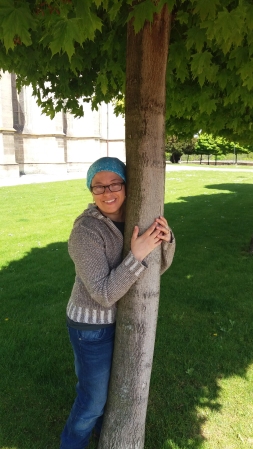
Molly has been “gathering the women” to circle, sing, celebrate, and share since 2008. She plans and facilitates women’s circles, seasonal retreats and rituals, mother-daughter circles, family ceremonies, and red tent circles in rural Missouri and teaches online courses in Red Tent facilitation and Practical Priestessing. She is a priestess who holds MSW, M.Div, and D.Min degrees and finished her dissertation about contemporary priestessing in the U.S. Molly and her husband Mark co-create Story Goddesses, original goddess sculptures, ceremony kits, and jewelry at Brigid’s Grove. Molly is the author of Womanrunes, Earthprayer, and The Red Tent Resource Kit and she writes about thealogy, nature, practical priestessing, and the goddess at Brigid’s Grove.
One of the concerns of ecofeminism is the modern materialistic mindset of capitalism. Materialism in capitalism instills not just owning many possessions, but it also inculcates the “need” to own the newest innovation. In addition, materialism advocates a throw-it-away mentality. In other words, it is often cheaper to buy a new shirt or computer than to have them repaired. Similarly, it is not enough to have a cell phone. Rather, one must have the newest and best one! The environment pays the price.
One attempt to deny the hold of materialism is minimalism. The minimalist movement seems to run the spectrum. From the ideals of less is more, there seems to be some competition between mindful consumerism and extreme self-denial. Mindful consumerism suggests that minimalism is a journey of recycling, reusing and repairing combined with well-researched, well-considered, as-ethically-produced-as-possible purchases when necessary. Extreme self-denial advocates owning almost no material possessions. While I strive toward mindful consumerism, I have serious concerns about extreme minimalism. Continue reading “On Minimalism by Ivy Helman”
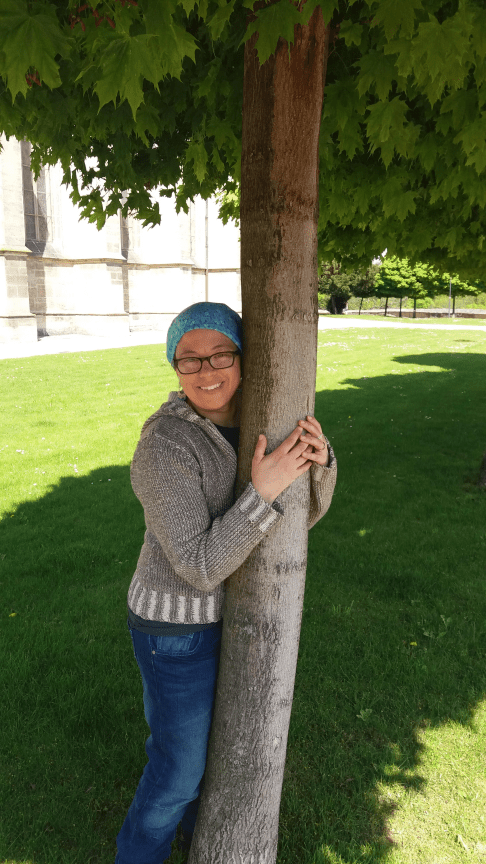
“Why is religion important to ecofeminism?”A student, in the Master’s course I teach at Charles University, asked this as we began the class session dedicated to the topic.Given the overwhelming presence of atheism in the Czech Republic, I wasn’t too surprised by the inquiry.Nonetheless, the idea has been at the back of my mind ever since: what does religion have to do with ending patriarchy and bolstering the health of the planet?While I may take the connection as obvious, it is clearly not for many feminists out there.Here is how I understand it.
First, it is true: many of our inherited religious traditions have been and still are considerably patriarchal.Because of that, some feminists outright reject religion.In fact, some feminists even consider religion dangerous and threatening, as it is often utilized to contradict many feminist aims.Yet, there are many, many feminists who find, within their given or chosen tradition, non-patriarchal elements that can be recovered, remembered and/or (re)created.Religious feminists work tirelessly to transform religions in life-sustaining and post-patriarchal ways not just for themselves but also for those women and men who belong to the same communities.Continue reading “The Importance of Religion for Eco-Feminism by Ivy Helman”


 This semester I am teaching the course EcoJustice and chose Sallie McFague’s A New Climate for Theology as our foundational text. Something I greatly appreciate about McFague is that she continually calls us to radically redefine our understanding of the Divine and of our roles as human beings — fundamental questions that could easily lead to an existential crisis as one student reminded me.
  Carol P. Christ



 This earth is my sister; I love her daily grace, her silent daring, and how loved I am how we admire the strength in each other, all that we have suffered, all that we have lost, all that we know. We are stunned by this beauty, and I do not forget: what she is to me, what I am to her.
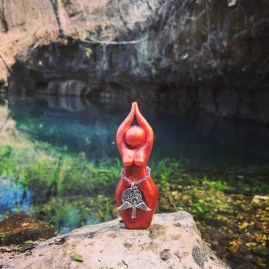 live (they live one mile further away than that). In addition to woodland and meadow, this land has two springs, three creeks, a cave, and ¼ mile of river access. While I have been deeply connected to the land of my birth, the Missouri Ozarks, for a long time, and have written about that connection in multiple
 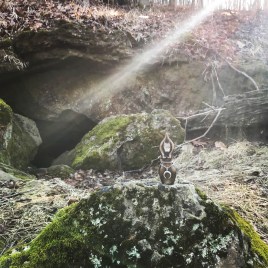 spy the opening to the cave nestled behind several mossy stones. The sun is still on the rise above the tree line and the rays filter through the trees so one ray is pointing directly at the cave entrance. We crawl inside, bumping our heads and scraping our backs as we wiggle into this womb in the earth. Once inside, the chamber enlarges so we can stand up. Unlike other caves we have experienced in this area, the only human signs we find are a single bottle cap, a glass bottle, and two sets of initials carved into a rock. In the dark silence we hear the sound of water dripping steadily. I make my way further into the cave, acutely aware that this is living cave and being careful not to step on the fresh, wet, cervix-shaped beginnings of new stalagmites on the floor. At the back of the cave, I find her. A Madonna-like stone column, glistening with water. In the silence of the cave, I quietly sing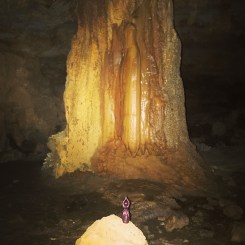
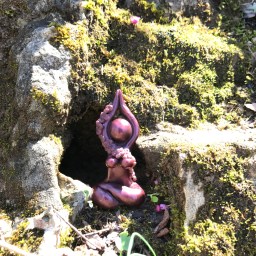
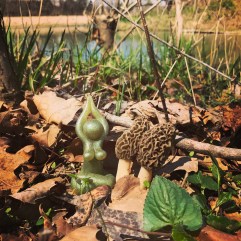 about two weeks in Missouri each spring and considered a delicacy by many). The afternoon suddenly becomes even more rewarding and we stoop and peer through fallen oak, sycamore, and elm leaves looking for the telltale conical form of these forest treats. We quickly discover that we must tune in and “listen” for the mushrooms, so to speak, or we’ll walk right by them, none the wiser. The moment I start thinking about anything else, I stop finding any. Once I settle into my body and the moment and really look at the world again, there another morel will be.
 Molly has been “gathering the women” to circle, sing, celebrate, and share since 2008. She plans and facilitates women’s circles, seasonal retreats and rituals, mother-daughter circles, family ceremonies, and red tent circles in rural Missouri and teaches online courses in
  One of the concerns of ecofeminism is the modern materialistic mindset of capitalism. Materialism in capitalism instills not just owning many possessions, but it also inculcates the “need” to own the newest innovation. In addition, materialism advocates a throw-it-away mentality. In other words, it is often cheaper to buy a new shirt or computer than to have them repaired. Similarly, it is not enough to have a cell phone. Rather, one must have the newest and best one! The environment pays the price.
 “Why is religion important to ecofeminism?”
 Feminism and Religion