Kissing the Earth by Molly Remer

 “Let the beauty we love 
Be what we do
There are hundreds of ways to kneel and kiss the Earth.”

–Rumi

Introductory note: At the end of 2016, my parents purchased a piece of land about one mile from where I already live (they live one mile further away than that). In addition to woodland and meadow, this land has two springs, three creeks, a cave, and ¼ mile of river access. While I have been deeply connected to the land of my birth, the Missouri Ozarks, for a long time, and have written about that connection in multiple past posts for FAR, this new-to-us land has offered a new opportunity: the chance to get to know another section of land “from scratch,” deeply, wildly and well, and to become wise stewards of it for the time in which it is in our care. It is also the first time I have been able to so closely and intimately observe the origin source of a body of water. Previously not giving it much thought, I now have the daily privilege of observing the source of the flow as I watch water emerge directly from the ground. First, there is simply none and then, suddenly, a deep blue pool constantly bubbling as water rises to the surface and flows away on its long, long journey to the sea. This essay is a series of three vignettes as I spend this year immersing myself in relationship with this land.
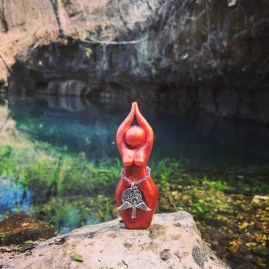
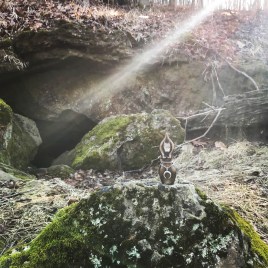
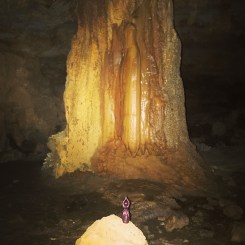
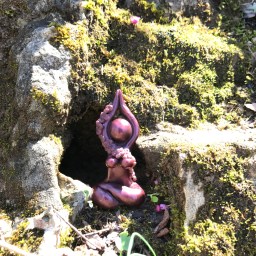
We walk along the nearly vertical hillside hanging onto small trees for support. Finally, though we almost miss it, we spy the opening to the cave nestled behind several mossy stones. The sun is still on the rise above the tree line and the rays filter through the trees so one ray is pointing directly at the cave entrance. We crawl inside, bumping our heads and scraping our backs as we wiggle into this womb in the earth. Once inside, the chamber enlarges so we can stand up. Unlike other caves we have experienced in this area, the only human signs we find are a single bottle cap, a glass bottle, and two sets of initials carved into a rock. In the dark silence we hear the sound of water dripping steadily. I make my way further into the cave, acutely aware that this is living cave and being careful not to step on the fresh, wet, cervix-shaped beginnings of new stalagmites on the floor. At the back of the cave, I find her. A Madonna-like stone column, glistening with water. In the silence of the cave, I quietly sing Ancient Mother to her, as tears well in my own eyes.
I am of this earth
for this earth
and by this earth.

We skirt carefully along the bank of the creek, making our way to the largest spring. Over three million gallons of water a day flow effortlessly from this small, deep pool nestled quietly in the middle of the woods. I am stunned by the magnitude of this flow as I stand there with my husband, my head resting on his shoulder, hawks wheeling overhead, redbud trees in full bloom. It has never seemed more clear to me how very “small” we are, but a blink of an eye to this spring and its countless years and countless gallons of water, not caring whether it is witnessed in its work or not, but simply, continually, creating and producing. I try to explain this feeling aloud, but words fail me. It is a humbling sensation, not a depressing one. The actual emergence of the water at this origin point of the river is nearly invisible, the continuous gentle, small popping of bubbles on its surface, the only sign that something significant is happening here that distinguishes this body of water from a pond or pool. Yet, those never-ending bubbles rapidly expand to a wide, swift-moving creek, which joins the river and another smaller spring-fed creek to continue to make their way southward across the state. We smell something sharp and see a dead armadillo by the roots of a giant sycamore. We hear a shrill cry and look up to see two bald eagles riding the currents of air high above us. We are so small. So many thousands of years of water have passed, but we are here right now.

Unfathomable eons
Glacier time
I am just a blink of an eye
But I can sit, and watch, and wonder.

We scramble along the uneven terrain on the rocky and wooded hillside, slipping, laughing, and looking. I am exhilarated by the simple thrill of exploring the world right here in front of me. We find tiny flowers. I kneel by the roots of fallen trees. We stop to admire moss on stones. We find gigantic black snake napping in the sun. A complete turtle shell. A shed antler. Each moment feels like a new opportunity to “kiss the earth.” I sing Reclaiming’s song-version of the Rumi quote over and over and as I kneel in each spot to see what it has to show me, in each, I kiss my fingers and press them to the earth. I see all the kissing going on around me…the sun filtering through branches, the fiddlehead ferns kneeling to kiss the earth, the roots wound through rocks, the trillium and bloodroot blooms pushing up between leaves, the water seeping out of the ground and flowing down the hill, the dogwood blossoms opening to the sun, the moss covering stones, the fallen trees stretched along the slope.

“And that is just the point…how the world, moist and beautiful, calls to each of us to make a new and serious response. That’s the big question, the one the world throws at you every morning. ‘Here you are, alive. Would you like to make a comment?’” 

–Mary Oliver

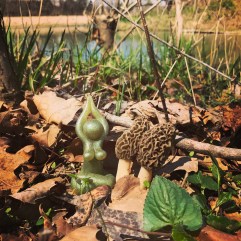
We emerge from our walk to find morels growing alongside the path (morels are wild, edible mushrooms found for about two weeks in Missouri each spring and considered a delicacy by many). The afternoon suddenly becomes even more rewarding and we stoop and peer through fallen oak, sycamore, and elm leaves looking for the telltale conical form of these forest treats. We quickly discover that we must tune in and “listen” for the mushrooms, so to speak, or we’ll walk right by them, none the wiser. The moment I start thinking about anything else, I stop finding any. Once I settle into my body and the moment and really look at the world again, there another morel will be.
 “I think this is how we’re supposed to be in the world … present and in awe.”

–Anne Lamott, Bird by Bird: Some Instructions on Writing and Life

Molly has been “gathering the women” to circle, sing, celebrate, and share since 2008. She plans and facilitates women’s circles, seasonal retreats and rituals, mother-daughter circles, family ceremonies, and red tent circles in rural Missouri and teaches online courses in Red Tent facilitation and Practical Priestessing. She is a priestess who holds MSW, M.Div, and D.Min degrees and finished her dissertation about contemporary priestessing in the U.S. Molly and her husband Mark co-create Story Goddesses, original goddess sculptures, ceremony kits, and jewelry at Brigid’s Grove. Molly is the author of Womanrunes, Earthprayer, and The Red Tent Resource Kit and she writes about thealogy, nature, practical priestessing, and the goddess at Brigid’s Grove

On Minimalism by Ivy Helman

untitledOne of the concerns of ecofeminism is the modern materialistic mindset of capitalism. Materialism in capitalism instills not just owning many possessions, but it also inculcates the “need” to own the newest innovation. In addition, materialism advocates a throw-it-away mentality. In other words, it is often cheaper to buy a new shirt or computer than to have them repaired. Similarly, it is not enough to have a cell phone. Rather, one must have the newest and best one! The environment pays the price.
One attempt to deny the hold of materialism is minimalism. The minimalist movement seems to run the spectrum. From the ideals of less is more, there seems to be some competition between mindful consumerism and extreme self-denial. Mindful consumerism suggests that minimalism is a journey of recycling, reusing and repairing combined with well-researched, well-considered, as-ethically-produced-as-possible purchases when necessary. Extreme self-denial advocates owning almost no material possessions. While I strive toward mindful consumerism, I have serious concerns about extreme minimalism. Continue reading “On Minimalism by Ivy Helman”

The Importance of Religion for Eco-Feminism by Ivy Helman

untitled.png“Why is religion important to ecofeminism?”  A student, in the Master’s course I teach at Charles University, asked this as we began the class session dedicated to the topic.  Given the overwhelming presence of atheism in the Czech Republic, I wasn’t too surprised by the inquiry.  Nonetheless, the idea has been at the back of my mind ever since: what does religion have to do with ending patriarchy and bolstering the health of the planet?  While I may take the connection as obvious, it is clearly not for many feminists out there.  Here is how I understand it.

First, it is true: many of our inherited religious traditions have been and still are considerably patriarchal.  Because of that, some feminists outright reject religion.  In fact, some feminists even consider religion dangerous and threatening, as it is often utilized to contradict many feminist aims.  Yet, there are many, many feminists who find, within their given or chosen tradition, non-patriarchal elements that can be recovered, remembered and/or (re)created.   Religious feminists work tirelessly to transform religions in life-sustaining and post-patriarchal ways not just for themselves but also for those women and men who belong to the same communities.   Continue reading “The Importance of Religion for Eco-Feminism by Ivy Helman”

The Heart of the Labyrinth: BOOK REVIEW by Mary Petiet

the-heart-of-the-labyrinth_cover_front_72What if it really is as simple as changing our minds?
This is the central question of Nicole Schwab’s book, The Heart of the Labyrinth (Womancraft Publishing, 2014). This question paves the way for her eco-feminist approach to balancing the self and the environment. Schwab’s book is a parable as multilayered and complex as human nature, and it moves through the ages to probe the pure core of the self and the sustaining energy that connects all. Continue reading “The Heart of the Labyrinth: BOOK REVIEW by Mary Petiet”

Do You Eat Animals? Ecofeminism and Our Food System by Ivy Helman

10953174_10152933322533089_8073456879508513260_oCarol Adams in her article “Ecofeminism and the Eating of Animals,” argues that ecofeminists should be vegetarians, since ecofeminism is, among other things, action-based and “one’s actions reveal one’s beliefs,” (129). According to ecofeminism, the patriarchal domination of animals and nature is linked to the oppression of women. For her and many ecofeminists, the survival of our planet rests on two foundations: first, fixing the conditions of women and other oppressed groups and, second, envisioning differently our relationship to the natural world. In other words, a better arrangement of human relationships requires better human relationships with the environment. Vegetarianism and veganism are two ways in which ecofeminists opt out of the patriarchal system of domination and exploitation and help create a better world.

But, does one really? Does adopting a vegetarian or vegan lifestyle really have such an impact on the world? Yes and no. Yes, because it has been shown that raising animals to eat uses exorbitant amounts of fuel, water and land, not to mention, the larger environmental impact of farm run-off in the forms of disease-carrying manure, valuable topsoil and harmful pesticides. Yes, because animals are often inhumanely treated, housed in horrible conditions, genetically and/or hormonally-modified and cruelly killed. Continue reading “Do You Eat Animals? Ecofeminism and Our Food System by Ivy Helman”

Painting for the Earth by Jassy Watson

JassyI have spoken about the Social Responsibility of the Artist on numerous occasions. This blog approaches similar subject matter, but in relation to using art as a potent tool for change and as a platform for raising awareness of important environmental and ecological issues that all of humanity is currently faced with.

All forms of art have the potential to be tools for healing. I believe that through the creative process the relationship with self and the environment can be transformed. Why? Because when creative work is approached from a place of passion and purpose and art is brought to life with intention, great shifts can occur. Not only for the artist, but also for the viewer. I believe wholeheartedly that I can approach the canvas and paint intentionally to heal the earth and deepen my connection to it, and in doing so inspire others to deepen and honour a connection to the earth creatively.

There are many contemporary artists who are agents of environmental change and who are using their creative gifts and talents to build awareness and provoke thought through their work and process. Many artists, such as myself are working with transformative approaches and processes towards a new vision that is ecological and participates with the living cycles of nature. Many topics are approached such as oceans, climate change, water quality, recycling, water purification, natural disasters, de-forestation, endangered species and more.

Artists today are finding all sorts of inventive ways to call attention to the problems facing our environment, as corporate greed and profit impose destruction on our planet. While each artist works very differently and explores diverse territories, they share awareness about the critical loss of natural resources and a desire to save the planet from human destruction.

Take the words of Nigerian painter Jerry Buhari:

“Today the talk of the world is about an endangered Earth. One often wonders how much of the talk is backed with genuine concern and the will to take positive steps. But it should not surprise the world that artists are in the forefront of the discussion on the environment.”

Eco-feminist artist Ann T. Rosenthal and activist artist Steffi Domike have been collaborating on environmental installations for years. Their wall installation, Watermark: Wood, Coal, Oil, Gas (2011) consists of four panels that illustrate an evolutionary timeline of energy resources—wood, coal, oil and natural gas.

shallow-ann-rosenthal-200x300

Dominique Mazeau is a poet and artist from Santa Fe, New Mexico. She has made an exquisite journal of poems and drawings of cleaning up the Rio Grande River over many years. She has made sculptures from the trash and she teaches school children about the river with her poems and her art.

There are many more Eco-feminist and Environmentalist/Activist artists such as Charla Puryear and Helene Aylon using their art to raise awareness of ecological issues. These few examples alone demonstrate that art, in its myriad of forms, has the capacity to effect positive change on the earth and its environments.

Artists are catalysts for change, and this “change” takes place when we feel deeply for a precious cause. I feel deeply for the state of the earth and feel that it is largely humanity’s spiritual disconnection from the earth and from the earth as sentient that has contributed to the current state of not only the health of the earth body, but also the health of our bodies.

Coming up in October I will be presenting an exhibition ‘Voices for the Earth’ in Bundaberg, QLD Australia. This exhibition will feature the works of select regional artists who are using their art to speak for the earth. It is held in conjunction with RONA-16 an Earth Arts Festival as part of the The Rights of Nature Tribunal that is taking place the same month. Artists of all genres from around Australia are participating in creative activities to raise awareness of the urgency required to make the necessary changes so that ways can be found to make the health of our planet an absolute priority.

I know that more has to be done, and some might see ‘art’ as a hedonist, self absorbed way to attempt to bring about change – but the power of image should NEVER be underestimated.

I am Painting for the eARTh.

This Earth is my sister
I love her daily grace
Her silent daring
And how loved I am.
How we admire this strength in each other
All that we have lost
All that we have found
We are stunned by this beauty,
And I do not forget
What She is to me
And what I am to Her.

(from Susan Griffin, Woman and Nature – The Roaring Inside Her, p.219, caps added).

'The Earth is my Sister'
‘The Earth is my Sister’

Jassy Watson, who lives on the sub-tropical coast of Queensland Australia, is a Mother of four, passionate organic gardener, Intuitive/Visionary & Community Artist, Teacher, Intentional Creativity Coach and a student of Ancient History and Religion at Macquarie University, Sydney. She is the Creatress of Earth Circle Studios; a school for the Sacred Creative Arts. Jassy teaches regular painting workshops in person, nationally and internationally, and online based around themes that explore myth, history and our connection to the earth. 

Ecofeminism is in the House (at the AAR) by Grace Yia-Hei Kao

Grace Yia-Hei KaoMy social media accounts have recently been ablaze with announcements of meetings, sessions, and receptions to attend for those of us who study or work in religion/theology in the U.S. Some 12,000-15,000 scholars and students will descend upon San Diego this weekend for the annual American Academy of Religion/Society of Biblical Literature (AAR/SBL) conference.

While as a theological and philosophical ethicist I attend this gathering every year regardless of venue or conference theme, I’m particularly excited about this year’s focus on climate change.

Sessions devoted to the topic include a panel on the release of the Public Religion Research Institute/AAR National Survey on Religion, Values, and Climate Change (Sat, 9-11:30am, CC-20D) presentations by the Intergovernmental Panel on Climate Change (IPCC) (Sat, 11:45-12:45, CC-20D), a talk by environmentalist Bil McKibben (Sat, 7:30-8:30pm, CC-20D),  the AAR Presidential Address by Laurie Zoloth (an eminent bioethics and Jewish Studies scholar; Sun 11:45-12:45,CC-20D), and remarks by former president Jimmy Carter on “The Role of Religion in Mediating Conflicts and Imagining Futures: The Cases of Climate Change and Equality for Women” (Mon, 4-5:30pm, CC-20) among others.

Ecofeminism

Beyond that, I’m especially excited about the number of sessions I see devoted to discussing ecofeminism–the scholarly and activist movement that takes seriously the interconnections between the oppression of women and the exploitation of nature. Let me enumerate a few of these (n.b. the following is a non-exhaustive list):

– On Friday, 1:30-3:30pm (CC-14A), the Women’s Lounge Roundtable will entail a pre-conference luncheon on “Ecofeminism and Earth Healing” featuring emerging scholars from Claremont Graduate University.

– On Sunday, 9-11:30am (CC-3), the Feminist Theory and Religious Reflection Group will feature a panel of papers on “ecological, epistemological, and ethical habitations.”

– On Sunday, 1-2:30pm (CC-30A), the Feminist Theory & Religious Reflection Group will sponsor another session tied to the conference theme: “Strategic Negotiations with Feminism on the Borders: Rhetoric in American Homiletics, ‘On the Move’ Ethics in Ecofeminism.”

– On Sunday, 3-4:30pm (CC-26), the Womanist Approaches to Religion and Society Group will convene a session entitled “Ecowomanism 101: A Roundtable Discussing Vital Themes and Trajectories.”

I’m looking forward to this conference and wish all AAR/SBL attendees an enriching and eventful time as well!

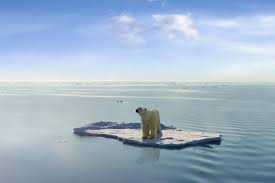
Climate change (Polar Bear on Melting Ice)

Grace Yia-Hei Kao is Associate Professor of Ethics and co-director of the Center for Sexuality, Gender, and Religion at Claremont School of TheologyShe is the author of Grounding Human Rights in a Pluralist World (Georgetown University Press, 2011), has a forthcoming co-edited anthology with Ilsup Ahn on Asian American Christian Ethics (Baylor University Press), and is working with Rebecca Todd Peters on anthology of women’s theological lives. Read more about her work on her website.

Essentialism Reconsidered by Carol P. Christ

carol mitzi sarahIn my Ecofeminism class we have been discussing essentialism because some feminists have alleged that other feminists, particularly ecofeminists and Goddess feminists, are “essentialists.” They argue that essentialist views reinforce traditional stereotypes including those that designate men as rational and women as emotional. I too find essentialism problematic, but I do not agree that Goddess feminism and ecofeminism are intrinsically essentialist.

Goddess feminists and ecofeminists criticize classical dualism: the traditions of  thinking that value reason over emotion and feeling, male over female, man over nature. We argued that the western rational tradition sowed the seeds of the environmental crisis when it separated “man” from “nature.”

Goddess feminists and ecofeminists affirm the connections between women and nature in an environmental worldview that acknowledges the interconnection of all beings in the web of life.

This view has been criticized as essentialist. Is it? Continue reading “Essentialism Reconsidered by Carol P. Christ”

WHY I AM RUNNING WITH THE GREEN PARTY IN ANOTHER ELECTION IN GREECE by Carol P. Christ

carol christOn Sunday May 18 the first round of Municipal and Regional Elections were held in Greece, and I ran for office again. A month or so before the 2010 Regional Elections were held in under a newly reorganized electoral system, my friend Michael Bakas sent me an email saying simply: “You are running with the Green Wind in the upcoming elections.”  Michael asked me to run because we had worked together to save the wetlands in Lesbos and he had supported me as I wrote an official Complaint to the European Commission documenting the failures of national and local authorities to uphold European laws.

I did not know what I was supposed to do as a candidate on a Greek parliamentary-system list, but in the end I passed out flyers in my village and the adjoining one. My name was mentioned in a newspaper article because I was foreign-born. To everyone’s surprise, I came in 3rd of 18 candidates for the Green Wind in Lesbos, and we elected our first councilor in the regional government. After the election Michael told me that we were going together to Chios to meet with candidates to celebrate our victory. There I met an amazing group of green activists and despite being a “foreigner” was warmly received.

In 2012, I ran again in the national elections, that time passing out flyers in more than 20 villages and towns.  As I have been pretty busy campaigning, I thought I would share translations of 2 statements from me that were posted in Greek on the blog and facebook page of the Green Wind. Continue reading “WHY I AM RUNNING WITH THE GREEN PARTY IN ANOTHER ELECTION IN GREECE by Carol P. Christ”

WOMEN AND WEEDING, THE FIRST 10,000 YEARS* by Carol P. Christ

carol-christMary, Mary, quite contrary, how does your garden grow? With silver bells and cockle shells, and pretty little maids all in a row.

From the beginning of horticulture about 8000 BCE or earlier to the present day, weeding has been women’s work. Women, who were the gatherers and preparers of food in traditional nomadic societies, no doubt were the first to discover that seeds dropped at a campsite one year sometimes sprung up as plants the next year. When this discovery was systematized, agriculture was invented, and human beings began to settle down in the first villages and towns.

In the early days of horticulture (the name for the earliest stage of agriculture before the plow was developed), the cycles of planting and harvest and all the stages in between were understood to have been given to mothers by the Great Mother, the Source of Life.  The secrets of planting, seed collection, harvest, and food preparation and preservation were all perceived to be “mysteries” connected to the ongoing cycles of birth, death, and regeneration in the universe.

My grandmother Lena Marie Searing who was born on a farm in Michigan must have learned agricultural secrets from her mother, for she not only created a beautiful garden, she also farmed an orchard and preserved its fruits in glass jars that lined her pantry.  It was she who taught me and my brothers and cousins to love nature.  My mother learned to garden from her mother, but she did not harvest food crops. I think of both of them whenever I work in my garden.

The past few days I have been weeding my garden after heavy rains that left the soil clumpy and moist.  I have weeded before, but I have never enjoyed it so much.  My garden has matured over the past seven years, and now the weeds are more “under control.”  There aren’t so many of them, and as I have now been weeding them out over the years, their roots are shallow.

As I slide a trowel into the earth the weeds lift up and with my fingers I gently pull the plants with their roots from the soil.  The weeds are familiar, though I don’t know all of their names. The “sticky weed” has many tough roots, the clover has many fine ones—both are hard to eradicate. Other weeds are easy to pull up and do not reappear again until the next year.

wild chamomile blooming among "weeds"
wild chamomile blooming among “weeds”

I am discovering that weeding is a delicate process. Sometimes the roots of plants I want in the garden are entangled with those of the weeds. I work carefully choosing the ones to save and the ones to discard.** I leave poppies, chamomile, yellow daisies, and marigolds where I find them, as I consider them to be wildflowers that will provide beauty in my garden when they bloom in spring. I also take care to “keep the soil in good heart” by not discarding too much of it along with the weeds.

As I weed, I think of the women in my village who harvest greens from the fields, feeling certain that some of the weeds I discard are edible.  I marvel at all of the knowledge women have shared and passed down over the past 10,000 years and more, as I realize how little of it I know. My suspicion that some of my weeds could be food is validated when a friend and I order boiled “greens from the mountains” for lunch at a local taverna and are served one of the plants I had thrown into the garbage can.

As I weed, I am reminded of an essay called “Keeping the Soil in Good Heart: Women Weeders, the Environment, and Ecofeminism” by Candice Bradley which was published in Karen J. Warren’s EcofeminismBradley writes that weeding is women’s work in almost all cultures.  As I work, I understand that this is so because weeding is delicate work that requires concentration and patience and that must be repeated. Bradley says that in many cultures men disparage weeding as they disparage housework—not considering either to be “real” work.

Horticulture is the most environmentally friendly form of farming, according to Bradley, because it does the least harm to the soil, and because the weeds that are not eaten are burned or composted and turned back into the earth to replenish it.

While weeding by hand has been considered work for women and children, men have generally controlled the plow and its recent successor, the tractor. However, as Bradly states, the plow and the tractor do not eliminate the need for hand-weeding.  In many cases they encourage the weeds to regenerate. Women and children still weed.

The chemical gardening and farming industry (“round it up”) is based on the premise that weeds can and must be eradicated. Rachel Carson warned us of the danger this approach to agriculture presents to human and all other forms of life.  A by-product of chemical agriculture is that the careful work of women weeders is further discounted.

I do not use chemicals or pesticides in my garden, and I will be out there weeding on a regular basis in the next months.  As I put my hands in the earth, I will think of all the women before me who have weeded and planted, weeded and harvested, and weeded again. Blessed be.

*The title of this essay is an homage to Elizabeth Wayland Barber’s Women’s Work: The First 20,000 Years which discusses and celebrates women and weaving.

**I am aware that no plant was born a “weed” and that the designation of some plants as weeds is a by-product of human digestive systems, human taste, agriculture, and the creation of gardens for the celebration of beauty.

Carol P. Christ created a newly released new website for the Goddess Pilgrimage to Crete which she leads through Ariadne Institute.  Early bird special for the spring pilgrimage available until February 15.  Carol can be heard on a WATER Teleconference.  Carol’s books include She Who Changes and Rebirth of the Goddess and the widely-used anthologies Womanspirit Rising and Weaving the Visions