Leaving chores behind I bundled up and grabbed a trowel and drove between still waters to my beloved forest. The premature snow had melted, cracked ice created fantastic glittering patterns in shallow waters informing me that it was probably too late to dig plants for the frog house. Al, scientist, scholar and naturalist, Owl, my friend had just given me a terrarium, someday to become a frog house… my intention was to gather moss and jagged pieces of lichen covered bark…maybe a partridgeberry or two for both of us. Coming here to Hemlock Hollow seemed like just the right place. I also had come to say goodbye to my friends the Hemlock trees for the winter season…
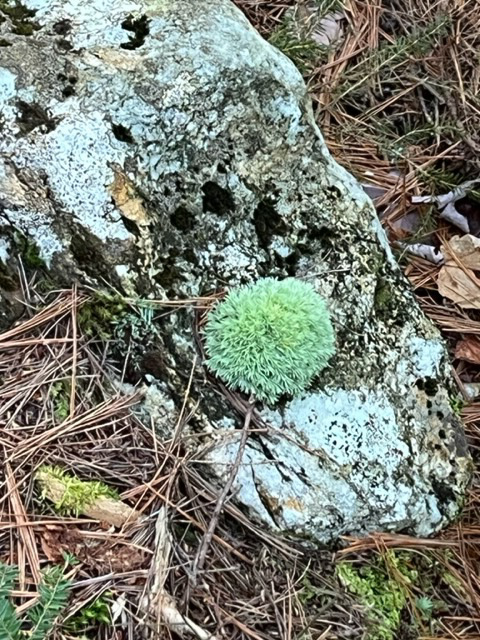
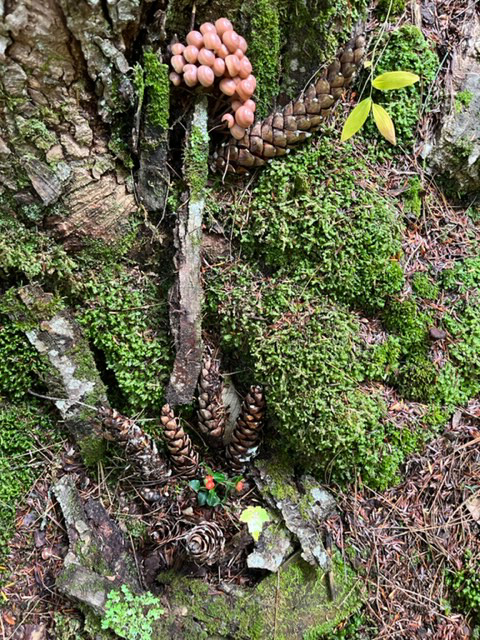
At first, I scrambled around disappointed that most plants were frozen in including the sphagnum moss. Not wanting to disturb sleeping plants, I lifted pincushion and red stemmed moss that grows quickly and visited an old log ripe with rich soil and rotting sides which came away easily. This decaying wood would make walls for my frogs to cling to as vines crept up the sides. Picking up lichens on old sticks, I also uprooted two tiny hemlocks growing on a log that would thrive in a moist environment. Satisfied, that a little of this forest would spend the winter with me I returned to the car with enough bounty to satisfy both Al and me. I was going to give him and his frogs more than half of what I gathered as a surprise.
me from behind Autumn light shimmers, leaves a testament to breeze
some withered
by a freeze. Burnt umber Gold Salmon the understory in full glory Bare hardwoods
peer down
sentries stationed Overhead Acorn browned oak leaves smudge
sage greens
dark crimson
bleeds geese fly by
haunting goodbye A dragonfly lands on my foot Not a grouse in sight Hunted in thickets too thorny for stealth She’ll live to see another dawning Scarlet pockmarked palms lie face up
on the ground.
Warning.
Signs are everywhere. Insect ridden leaves – puncture marks deform once
The older I get the more important the forest becomes to me because it is a place where I find inspiration and peace. I also play in the woods! During the month of October and what I call the “Witching Moon” that has just passed I think of all the women healers that lived alone in the forests with their animal and plant ‘familiars’. These women learned that nature instructs those who apprentice themselves to her. Animals and plants spoke to these women through intuition, sensing, feeling, or through their dreams because these women listened to them. Did these women play too? Westerners fear nature because they are so separate from her. Unable to imagine conversation (let alone play) occurring between women animals and plants, even today women who live close to nature are viewed with suspicion. I know because I am one of them.
I spend a lot of time in a 12,300 acre wood that one family has preserved for perpetuity. Recently these generous people have leased the land to the local land trust so it is getting more attention. I am not sure that this is a good thing. I note the amount of motorcycle and four wheeler use has increased dramatically on the roads that run parallel with the forest; some of the once quiet woodland paths are either echoing or saturated with sound.
We use the word “transformation” very casually in our culture. Humans including feminists have ‘adopted’ the word to describe an inner shift in mental awareness, and of course this can happen, although not usually after a weekend spiritual retreat. The dictionary defines transformation as a dramatic change in form or appearance. In animals, transformation becomes a metamorphosis – a true change in form during that creature’s life cycle. In physics the word denotes an induced or spontaneous change of one element to another by a nuclear process. As a naturalist and ethologist it seems to me that humans may not really know what the word transformation really means. Doesn’t transformation include both mind and body? Perhaps we need to turn to nature to find out! One point becomes abundantly clear. Transformation is fraught with danger and only some creatures (and humans?) are able to survive the shift. What follows is a story of transformation that moved me to tears.
When the extraordinary creature emerged from a split translucent capsule I could hardly believe my eyes. Although I have witnessed butterfly transformation many times over the course of my life none have moved me like this butterfly birth did.
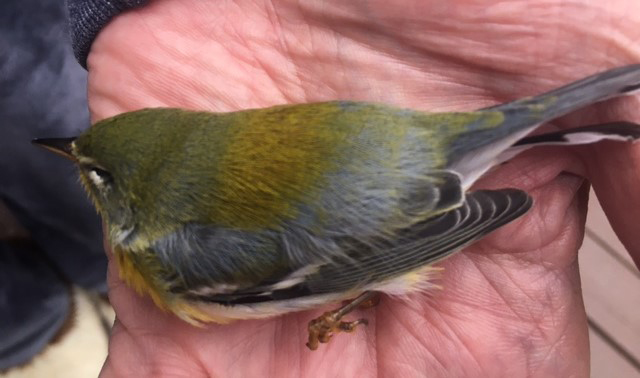
Small, perfect, magnificent! The creature lay in Mark’s hand, unmoving. Stunned or dead—we couldn’t tell. Some birds recover from impact with our sliding glass door and some do not. This was a hard hit—I could hear it from another room—and as I gazed at the beauty of this bird—a blue-winged warbler Mark said, I felt pretty sure the Goddess would call home it soon.
As I write this, fall equinox—Mabon to some of us—is two days away. Already here in Maine the days are noticeably shorter. The dark times are upon us now. Daylight will diminish minute by minute until winter solstice when the sun will grace us with nine whole hours of light before the Wheel of the Year turns and the days begin to lengthen, almost imperceptibly. The anniversary of my first husband’s death is a few days after equinox so this is always a hard time of year for me as I face into the darkness and the inevitably of death.
The heat wave was real. Suzie squinted into the afternoon light glinting off her pink ’69 VW. How was that still running, she thought, rebuilt and rebuilt? Work?
That’s how. And that’s how she’d keep running. Work. You just had to not freak out. You just had to not over heat.
But it was 125 degrees in Bakersfield. And she, like everyone else, had no air conditioning. And it wasn’t supposed to get better—it was supposed to get worse. She got in her VW and drove with the windows down—no AC– but a breeze was better than nothing. She pulled into the parking lot and waited for a spot to open up. She turned off her car to wait. Ten minutes but it was worth it. Six p.m. – it was a good time to have come. She walked out and got into the cart area.
Barely inside the supermarket she stood and let the air wash over her—air conditioning. Conditioning the air. The security guard asked if she was a buyer or a browser. Browsers could be in the front area with the carts, as long as there was room. Buyers could enter and walk up and down, and down and up—the breeze lifting the sweat from their skin.
On July 4 countless people in the United States celebrated Independence Day and many enjoyed a long leisurely Independence Day weekend. While there’s nothing wrong with celebrating freedom and all that is good in your country, I’ve become increasingly nervous about any form of unchecked, uncritical nationalism. Lately in global politics there’s been a resurgence of nationalism, populism, and isolationism of the ugliest kind. The kind that says, “Our own people first,” and “We need to build a wall,” and “Let’s drive out the immigrants,” and “Let’s start a trade war with China.” In Europe this sort of nationalism manifests itself in political movements like Brexit and in right wing populist parties like Front National in France.
To counter these divisive trends, I believe we need a new global holiday and a global Declaration of INTER-dependence. Our stark reality is that we inhabit an increasingly densely populated and fragile planet with finite resources. All human and non-human life on the planet is facing the specter of climate change and other environmental factors that threaten the fabric of our very existence. We live in an increasingly interdependent global economy. If China crashes, we will all feel the repercussions. Russian interference tipped the 2016 US election. A war in Syria and wars and grinding poverty in Africa have flooded Europe with refugees, which, in part, gave rise to this right wing, populist, anti-immigration push back. But if people in the developing world continue to suffer the worst ravages of climate change and the resulting famine, war, and poverty, our global refugee crisis is only going to escalate. Continue reading “Declaration of INTER-Dependence by Mary Sharratt”
On February 20, 2018, the Greek government issued a Presidential Decree mandating the formation of government bodies to monitor and protect the more than four hundred bird and wildlife habitats in Greece designated as part of the European law Natura 2000. This decision came after decades of government inaction regarding the enforcement of the Natura law it accepted as part of its entrance into the European Union.
Whether the Presidential Decree will result in protection on the ground remains to be seen, but it is an important step in the right direction. The Presidential Decree was issued after years of negotiations initiated by the European Commission to compel the Greek government to comply with the law. A Complaint to the European Commission regarding failure to protect the Natura wetlands of Lesbos on which I was the first author formed part of the basis of these negotiations.
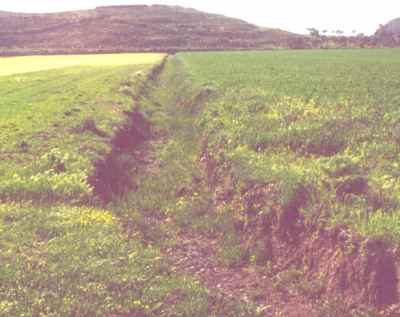
a ditch drains a wetland to produce agricultural land
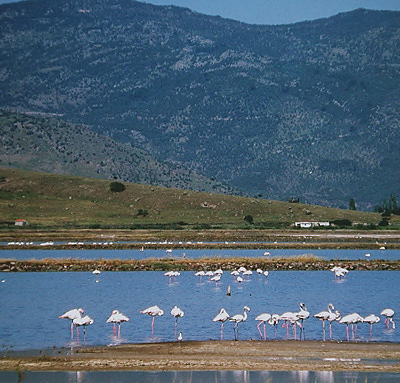
Almost as soon as I became a birdwatcher in 1999, I began to notice the degradation of bird habitats by dumping, drainage, and building, especially in wetland areas. Wetlands are seasonal bodies of water created by winter rains that dry out in the summer heat. Generally, they are shallow, which means that they are a perfect stopping over place for migrating birds. The most common visitors to wetlands are wading birds that stand in shallow pools and puddles without immersing their bodies in the water. Lesbos, the island where I began to watch birds, has some of the most important wetlands in Europe, visited by birds migrating from Africa to Europe in the spring for rest and feeding. Because of this, Lesbos is also a destination for birdwatchers.
Wetlands are not only important for birds. In rainy periods they act as a sponge between rivers and the sea and dry land, absorbing water that otherwise could cause flooding. The devastating flood damage to New Orleans in recent years is the result of building on wetlands. Similar damage occurs regularly wherever wetlands are drained, including on the island of Lesbos.
In 2001, I wrote a petition that was signed by over 600 birdwatchers and others urging the Greek government to protect the wetlands of Lesbos. I presented it at an open meeting in May 2001 organized by the Mayor of Kalloni, Lesbos, Aris Eleftheriou, to explain the plan to protect the wetlands of Kalloni which had been funded by the European Union. Instead of being congratulated for his work and vision, the mayor was met by an angry mob. Many of the Natura wetlands are privately owned fields traditionally used for grazing sheep and goats. As local economies were transitioning to tourism, landowners did not want any restrictions placed on their ability to drain and build on their land.
flamingos are now permanent residents of Lesbos
It was in this context that John Bowers, a longtime birdwatcher in Lesbos, an environmental economist, and the first to sign my petition, formed Friends of Green Lesbos, an international internet-based group dedicated to protecting the wetlands of Lesbos that soon counted over 800 members. I became its Vice President. In 2003, Friends of Green Lesbos, in co-operation with Idatinos, a local environmental group, drafted an internet letter and petition, that was automatically sent to the Greek government every time it was signed, asking the Greek government to fulfill its legal responsibility to protect the wetlands of Lesbos. The government responded that it was required to enforce the Natura law even though no specific Greek law had been passed specifying how this was to be done. A committee in the department of building and land development in Lesbos was created and charged with the responsibility of protecting the local wetlands.
We did not understand that this committee would not be monitoring the wetlands on a regular basis, but would only respond to complaints. This was clarified at a meeting organized by World Wildlife Fund in Athens in 2005. I was then put in touch with a new local environmental group, Nautilos en drasi that was also formed to save wetlands. Together with WWF, we began to draft complaints about the degradation of individual wetlands. These complaints, numbering well over fifty, were all decided in our favor. Fines were issued, but there was no mechanism to ensure compliance. Numerous meetings with the Governor of the island resulted in promises that were not kept. We finally realized that he was more interested in currying favor with landowners and developers than in enforcing the law.
In 2008 while lecturing at a conference in Ireland, I met a Green Party member of the European Parliament who encouraged me to write a complaint to the European Commission. After six months of intense effort, I completed a formal complaint of over 100 single-spaced pages, supported by two large files of documents, detailing the government’s failure to protect the wetlands under the Natura law. It was immediately approved by Friends of Green Lesbos and Nautilos en drasi, but it took over two years for World Wildlife Fund and Hellenic Ornithological Society to revise and sign it.
The complaint was submitted to the European Commission in September 2011. After several requests for additional documentation, the Commission found Greece in violation of the Natura law in Lesbos in October 2014. In August 2016 the Commission informed us that it had made our case part of horizontal negotiations with Greece regarding its failure to protect all of its Natura sites. The February 2018 Presidential Decree is the fruit of these negotiations. It is certain that the European Commission will continue to watch the situation in Greece to ensure that the government follows through with the monitoring and protection mandated by the new law.
This has been a long and tiring and often discouraging struggle of nearly two decades and it is still ongoing, but if the end result is the protection of all of the Natura sites in Greece, it will have been well worth it.
Others involved in Natura struggles in Lesbos besides John Bowers and myself include Eleni Galinou, Michael Bakas, Costas Zorbas, and Stellios Kraonakis, and in Athens, Foteini Vrettou, George Chassiotis, and Elias Tzirtzis of World Wildlife Fund Greece, and Malamo Korbeti of Hellenic Ornithological Society.
I love a road trip. It’s exciting to get behind the wheel of a car, get out on the highway (or bi-way), and just go. The road seems to stretch out forever in front of me, full of possibilities, adventure, and fun. Again, this summer I drove two thirds of the way across the United States from Virginia to New Mexico and back again. I varied my route because why not? The country is vast and diverse. I want to see as much of it as I can. The broad, open, colorful skies of Texas and New Mexico. The wheat fields in Kansas. The green, rolling hills of Kentucky and Tennessee. On this particular trip back to Virginia, though, one of the sights disturbed me deeply.
The second day of my journey eastward, I drove from Amarillo, Texas, to Springfield, Missouri. All along the panhandle of Texas and into Oklahoma, I encountered feedlots. These are places where cattle live for several months in order to fatten up before slaughter. The animals are fed grain (mainly corn), growth hormones, and antibiotics. They live in crowded spaces and in the feedlots I saw, the cattle had difficulty walking due to the layers of muck, mire, and manure all over the ground. I could smell a feedlot long before I saw one. The stench nauseated me.