 I am a student of the Northern European/Old Icelandic worldview known as Seidr. What I find particularly fascinating in my studies are not the deities but rather the creatures living on the World Tree, along with the Primordial Giants who predated the gods. One such creature is Níðhöggr, the “Derision Striker.” Níðhöggr is a great dragon who lives at the base of Yggdrasil, the World Tree. She gnaws on the roots of the tree, stimulating new growth. Her home stretches from icy Niflheim, near what is called the “Roaring Kettle”, the sacred well of all the rivers of Niflheim, all the way to Dead Man’s Shore in Helheim where she devours the piled corpses.
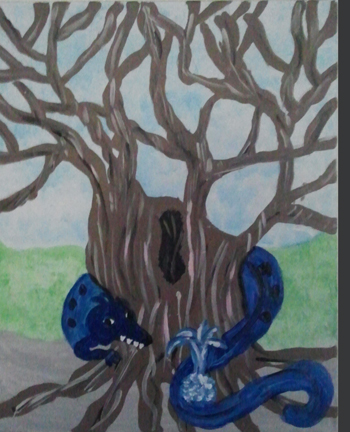 Níðhöggr embodies the principle of rot, which is that all things must decay to make room for those things that are new. It is Níðhöggr’s job to clean up the mess! She is involved in acts of undoing. She reminds us of the impermanence of life and that eventually, all that is must become undone. It is important to know this so that we can be prepared for unexpected or difficult changes in our lives.
Níðhöggr is there to devour nasty things in one’s self, both physical and emotional. She is there to take away anything that no longer serves us, as long as we are willing to give it to her. She also is there to help anyone working to clean up the environment, especially from our own pollution.
Many fear Nidhogg because of the job she must do but without this part of the life cycle there would be no cycle at all. We make every effort to hide things that are unpleasant. We flush our human waste into our water supply instead of simply giving back to the Earth where we can restore it and use it as nourishment for new life. Menstrual blood is hidden away as if somehow shameful. We hide all that is ugly or that which makes us uncomfortable. And so it is too, with creatures and characters in mythology. Somehow in our dualistic world, the lines between good and bad, negative and positive are clearly drawn. So often those things we suppress, hide and call negative are actually, what save our lives. They are the things in our basic natural spirit that propel us forward into becoming better human beings.
Níðhöggr also serves us as a moral agent, reminding us that our own cruelty, especially harmful acts that undermine another’s sense of self. Bullying behavior is a good example. She reminds us that our actions always have consequences to the energy of the whole, not just our own lives.
Her work is much like that of the vulture, a bird so ugly it is beautiful. I have always thought of vultures as the great recyclers, returning what is lifeless and no longer useful back to the Earth to make ready for new growth.
She is truly all about roots, and keeping them clean. As that, she reminds us that real strength is found in one’s roots.
In her story, at the end of days, Níðhöggr chews through a root and upends the World Tree. Clearly if this were the root upon which all else depended, the mighty tree would fall. Perhaps this would represent our own failure to clean up after ourselves, both in our own lives as well as here in this place we call home, the Earth.
Deanne Quarrie. D. Min. is a Priestess of the Goddess. She is the author of five books. She is the founder of the Apple Branch where she teaches courses in Feminist Dianic Witchcraft, Northern European Witchcraft and Druidic Shamanism. She mentors those who wish to serve others in their communities. She is also an Adjunct Professor at Ocean Seminary College and is the founder of Global Goddess, a worldwide organization open to all women who honor some form of the divine feminine.


 Much of our lives lack the rich culture of ritual that I think would help us repair the relationships we have with our own bodies and with the earth. The Rg Veda is one of the oldest collection of hymns from India. In them, I find a playful and introspective expression of desires and fears that, at first, did not seem to me to hold much wisdom for a modern contemplative. But lately, I have been noticing how the speakers communicate to or about the earth, and how their lives seem centered around trying to take a part in creation. Mostly, these hymns are stories and supplications for rain, cows, victory in battle, and a long life. But there is a deep understanding of the power and divinity in the universe that is the very earth-based wisdom that our humanity-in- crisis needs. If the Qur’an is God calling for humanity to be grateful, the Rg Veda is a model of a humanity that could be nothing else.
 The reason for this blog, and for writing it on this day, is to celebrate and remember the life and legacy of Sor Juana Inés de la Cruz.
 There is some very helpful guidance in the Qur’an for how we should and should not treat the earth. In my exploration of Qur’anic verse
 At the time of climate change and crises of capitalism we need to drop our sense of entitlement to comfortable life or even to life at all. Nature will not spare us just because we are humans. When the meltdown of economic and environmental systems occurs, we are all going down: humans and non-humans, women and men, spiritual or not. We have
  It starts with the main character, a Chinese Buddhist Were Fox who lives in present-day Moscow, consoling herself: “What else (or What the fuck) did you expect from life, A Huli?” A Huli is her name, supposedly meaning Fox A in Chinese. It is also a swear phrase in Russian, meaning “What the fuck?”