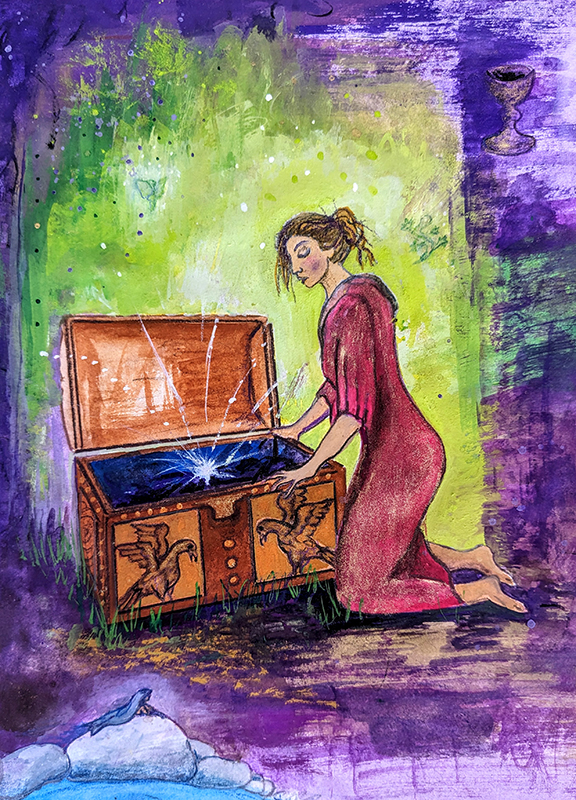
Pandora/Gaia—Bringer of Gifts by Judith Shaw

As we move deeper and deeper into full autocratic rule, the timeless themes found in mythology help me find my way. 

My first thought for these days was of Pandora, whose story in the myth of Pandora’s Box serves as a powerful metaphor for the complexities of human choice—relevant today by the choice of many to elect Trump, resulting in multiple destructive consequences. 

Hope Endures, by Judith Shaw, gouache on paper, 7.5″x10″
Continue reading “Pandora/Gaia—Bringer of Gifts by Judith Shaw”

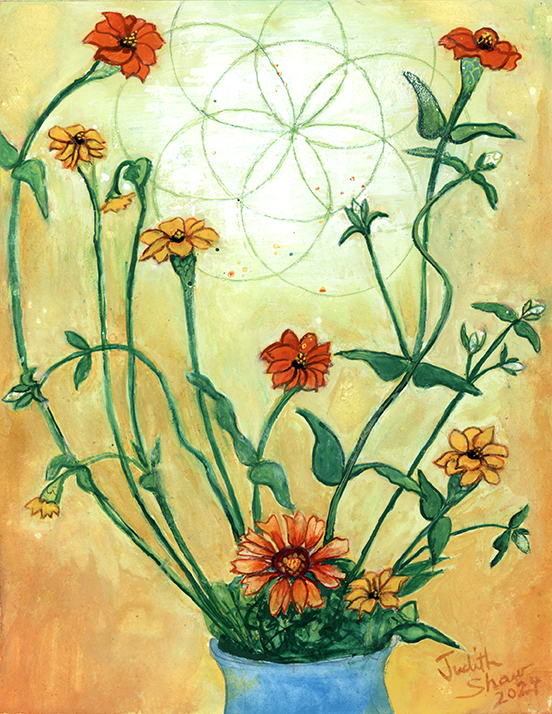
Flowers — Gifts of Goddess by Judith Shaw


I was captivated by a bunch of wispy, weedy zinnia flowers on my dining-room table, with its bright blossoms sprinkled on the curling stems. The zinnias pulled me from my current obsession with sea goddesses into a different zone, into the Kingdom of Plants (Kingdom Plantae). The Plant Kingdom is an important part of Goddess manifest, having come into being long before the appearance of our human family. It’s no wonder that flowers and other members of the Plant Kingdom play an important part in the mythology of our ancestors worldwide. 

Zinnia Joy, gouache on paper by Judith Shaw
Continue reading “Flowers — Gifts of Goddess by Judith Shaw”

Mother’s Day: From Pagan Origins to Modern Celebrations by Judith Shaw

On May 12th families will gather together in the United States to celebrate another Mother’s Day. This is a good time to reflect on mothers, motherhood and why we take a day to celebrate our mothers.  

“Yemayá, Mother Goddess,” oil on canvas by Judith Shaw
Continue reading “Mother’s Day: From Pagan Origins to Modern Celebrations by Judith Shaw”

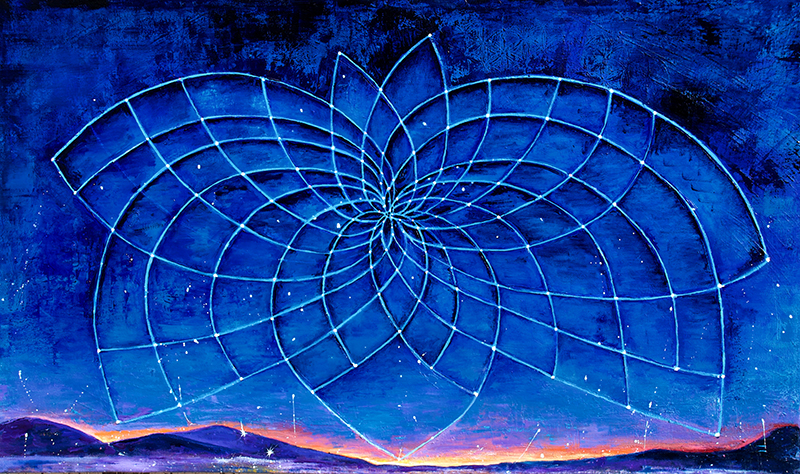
Elena and the Reindeer Goddess: The Mission Begins by Judith Shaw

As much as I wanted to finish my fairytale project in time for the winter holidays, the muse had a different idea. Perhaps the energy of winter was what I needed in order to finish the grand finale painting for the tale. It depicts a night sky filled with magic and wonder.

Continue reading “Elena and the Reindeer Goddess: The Mission Begins by Judith Shaw”

Prehistoric Feminine Icons

In this blog post I’d like to take you with me on a recent visit to the special exhibition “Arts and Prehistory”* in the Museum of Mankind (Musée de l’Homme) in Paris.**

Like the Feminine Power in London exhibition I wrote about last year, this is another ode to human imagination and creativity in connection to the mystery of life.

The exhibition features women figurines and cave paintings from dating between 26.000-34.000 years old, and I wonder how these prehistoric icons can inspire us to look at female bodies today…

Continue reading “Prehistoric Feminine Icons”

What If? A New Urban Myth for Our Times by Barbara Ardinger

What if Daedalus had not been imprisoned and forced to build a labyrinth to hold a monster-bull that would eat everyone who dared to enter its domain? (Is it true that that monster-bull was named Donald?) What if the three Mother Goddesses took off their aprons and went out into the world to survey its peoples and its troubles and to bring aid and comfort (much more useful than thoughts and prayers) to everyone in distress?

“Well,” says Queen Bettycrocker, “the first thing we can do is look at all these walls. They’re all over the place. They separate people. That’s not good.”

“You’re right,” agrees Queen Saralee. “People should be neighbors, and neighborhoods should be areas where children can safely play and safely go to their schools. And eat good lunches, too.”


Continue reading “What If? A New Urban Myth for Our Times by Barbara Ardinger”

Carol P. Christ’s Legacy: Great Goddess, Mother Goddess, Creatrix, Source of Life

This post was originally posted on February 5, 2018

The symbol of the Goddess is as old as human history. The most ancient images of the Goddesses from the Paleolithic era are neither pregnant nor holding a child. In Neolithic Old Europe the Goddess was most commonly linked with birds or snakes and only rarely portrayed as mother. Yet we tend to equate the Goddess with the Mother Goddess. I suspect that images of the Virgin Mary with Jesus on her lap and prayers to God as Father have fused in our minds, leading us to think that the Goddess must be a Mother Goddess and primarily a Mother.

In a recent blog, Christy Croft reminded us that in our culture, women’s experiences of mothering and motherhood are not always positive:

[The mother] doesn’t always appear in our stories in simple or easy ways. Some of us mother children we did not or could not grow in our bodies; some of us birth babies who are now mothered by others. Some of us are not mothers at all. Some of us had mothers who could not love us unconditionally, or did not have mothers in our lives, or had mothers who brought us more pain and humiliation than comfort, from whose effects we are still recovering, are still healing.

Continue reading “Carol P. Christ’s Legacy: Great Goddess, Mother Goddess, Creatrix, Source of Life”

Carol P. Christ’s Legacy: Women And Weeding, The First 10,000 Years* by Carol P. Christ

Moderator’s Note: We here at FAR have been so fortunate to work along side Carol Christ for many years. She died from cancer in July, 2021. Her work continues through her non-profit foundation, the Ariadne Institute for the Study of Myth and Ritual and the Goddess Pilgrimage to Crete. To honor her legacy, as well as allow as many people as possible to read her thought-provoking and important blogs, we are pleased to offer this new column to highlight her work. We will be picking out special blogs for reposting. This blog was originally posted February 10, 2014. You can read it long with its original comments here.

Mary, Mary, quite contrary, how does your garden grow? With silver bells and cockle shells, and pretty little maids all in a row.

From the beginning of horticulture about 8000 BCE or earlier to the present day, weeding has been women’s work. Women, who were the gatherers and preparers of food in traditional nomadic societies, no doubt were the first to discover that seeds dropped at a campsite one year sometimes sprung up as plants the next year. When this discovery was systematized, agriculture was invented, and human beings began to settle down in the first villages and towns.

Continue reading “Carol P. Christ’s Legacy: Women And Weeding, The First 10,000 Years* by Carol P. Christ”

Mother Goddess and Mothers Hold the Key

judith shaw photoI am of my mother –
from the swirling stars of the cosmos
through the long passage,
contacting and expanding –
birthed of her body,
nourished by her love.

Continue reading “Mother Goddess and Mothers Hold the Key”

Cow, Nursemaid to Humanity by Judith Shaw

judith shaw photoOur human connection to Cow goes back to the days of prehistory. Aurochs (wild oxen), cattle’s wild ancestors, are found in prehistoric cave art throughout Europe, India and Africa. About 10,500 years ago modern cattle were domesticated from only 80 wild oxen in southeastern Turkey. This was not an easy task as wild aurochs are much bigger than cattle and not at all docile. But succeed they did and cattle became a foundation of human civilization. They provided not only food and clothing but also became beasts of burden for agriculture. An estimated 1.4 billion cattle exist today.

Continue reading “Cow, Nursemaid to Humanity by Judith Shaw”