
“Don’t break the bucket” by Oxana Poberejnaia

oxanaVictor Pelevin is a prominent contemporary Russian author, with books translated into a multitude of languages. To me, his novels act as a series of Dhamma talks (Buddhist sermons, if you will).

I have also always thought that Pelevin’s novels can be broadly divided into two groups: “This is how to do it” and “This is how not to do it” groups. For instance, “The Clay Machine Gun” and “The Sacred Book of the Werewolf” are “How to do it” stories, with the protagonists reaching his and her (respectively) destinations. “Babylon”, on the other hand, is the “How not to do it” story, as the protagonist ends up enslaved by the world he has created.

Victor Pelevin
Victor Pelevin

One of my favourite novels by Pelevin is “Life of Insects”, which tells the tales of a number of characters, all of them “How not to do it” stories bar one. One of the most interesting quotes from the positive story for me is “Don’t break the bucket”.

Continue reading ““Don’t break the bucket” by Oxana Poberejnaia”

The Hidden Curriculum in Evangelism: Patriarchy by Erin Lord Kunz

Erin kaylaspic12

A good evangelist, especially in college ministries, acts as if there is no agenda to his or her evangelism. It’s very, “Do you want a cup of coffee? How are your classes going?” with a lot of understanding head nodding. The goal is to stay cool and not seem threatening (even though eternal damnation is at stake). A good evangelist then finds the opportunity to advance on whatever personal problem the interlocutor divulges, and the solution from the evangelist remains constant: “You need to accept Jesus Christ as your personal Lord and Savior.”

A ‘good evangelist’ does not believe this interaction is an agenda at all, as evidenced by new slogans popping up in evangelist circles. There is “Jesus without Religion,”“I am Second,”“H20,”“Freedom Churches,” etc. All of these evangelist slogans attempt to portray “real” Christianity as something other than doctrine, simply a relationship with God, a freeing experience, a nonthreatening choice.  Continue reading “The Hidden Curriculum in Evangelism: Patriarchy by Erin Lord Kunz”

Feminist Musings on Mother’s Day.

photo1Happy Mother’s Day!

Yes, I said it, but Mother’s Day invokes within me a certain hesitancy. Now before you say, “Well that’s because you don’t have children of your own so you don’t understand what it is like to be a mother or because your relationship with your own mother is awful, you hate the day.” I would respond that that is an unfair assessment of the situation. First, Mother’s Day doesn’t bother me because I don’t have children. (By the way, I find the idea that I don’t truly understand love or commitment and/or motherhood because I don’t have kids unbelievably condescending. Yes, motherhood can give one gifts and insights but those can also come from other areas of one’s life and/or other experiences.) I am also not hesitant about Mother’s Day because my mother and I have an awful relationship.  We don’t. In fact, it is quite good.

Rather, Mother’s Day bothers me for three reasons. First, it often seems fake. People seem to go through the motions because it is expected and not because they sincerely want to honor their mothers. Second, I often wonder if Mother’s Day isn’t just some consumer-driven, capitalist, patriarchal creation asking us to buy expensive cards and “remember” all our mothers have done for us this one very special day of year.

Third, what are we celebrating about mothers?  Most of the cards at the store and advertisements on television (if we would take them as research on what the general sentiments on Mother’s Day are) honor a mother’s love, support, guidance and acknowledge the child’s needs.  They thank mothers for all they do.  Continue reading “Feminist Musings on Mother’s Day.”

Responding to Global Gender Injustice by Grace Ji-Sun Kim

Grace KimThe church’s traditional understandings of the Creation story, the Trinity, the Eucharist, the Resurrection, Ecclesiology, Anthropology, Body, Atonement, and Sin have reinforced the subjugation of women. The book, Reimagining with Christian Doctrines:  Responding to Global Gender Injustice” co-edited with Jenny Daggers (Palgrave Macmillan) provides a snapshot of feminist voices within the United States and the United Kingdom who are examining theology from a global woman’s perspective. These voices reveal some of the pain and injustice which still exists in our churches as we continue to teach doctrines in ways which support complementary gender roles that feed the imagination of what women and men might be, in their own right and in relation to one another. Continue reading “Responding to Global Gender Injustice by Grace Ji-Sun Kim”

Was Ariadne the Most Graceful Bull-leaper of All? Deconstructing and Re-visioning Greek Mythology by Carol P. Christ

carol-christSometimes we think of Greek myth as a pre-patriarchal or less patriarchal alternative to the stories of the Bible. After all, Goddesses appear in Greek myths while they are nearly absent from the Bible. Right?

So far so good, but when we look more closely we can see that Greek myth enshrines patriarchal ideology just as surely as the Bible does.  We are so dazzled by the stories told by the Greeks that we designate them “the origin” of culture. We also have been taught that Greek myths contain “eternal archetypes” of the psyche. I hope the brief “deconstruction” of the myth of Ariadne which follows will begin to “deconstruct” these views as well.
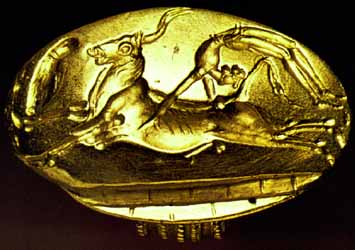
bull leaping ring before 2000 bc phourniAriadne is a pre-Greek word. The “ne” ending is not found in Greek. As the name is attributed to a princess in Greek myth, we might speculate that Ariadne could have been one of the names of the Goddess in ancient Crete. But in Greek myth Ariadne is cast in a drama in which she is a decidedly unattractive heroine.

In the story told by the Greeks, Ariadne falls in love with Theseus, a handsome young man who was sent with 11 other Greek young people to be fed to a monster (who is half man, half bull) known as the Minotuar. The Minotuar is Ariadne’s half brother (see below). Because of her “love” for Theseus, Ariadne helps him to murder her brother.  She then flees with Theseus on his boat.

However, this “love story” does not have a “happy ending” as Theseus abandons Ariadne on a nearby island–long before he arrives home in Athens. Theseus is ever after celebrated as a hero who killed a monster, while Ariadne is just another cast-off female.  Whose story is this? Continue reading “Was Ariadne the Most Graceful Bull-leaper of All? Deconstructing and Re-visioning Greek Mythology by Carol P. Christ”

Who Is Jephthah’s Daughter? The Sacrifice of Women and Girls by Carol P. Christ

Last week I reflected on Angela Yarber’s insightful essay and painting on Jephthah’s daughter. For those who did not read the earlier posts, the story of Jephthah’s daughter is found in the Hebrew Bible.  Jephthah’s daughter was sacrificed by her father after he swore in the heat of battle that if his side won, he would sacrifice the first person he would see on returning home.  Angela called us to reflect on who Jephthah’s daughter is in our time.

In my earlicarol p. christ 2002 colorer midrash on the story, I invoked Daniel Cohen’s powerful retelling of the story of Iphigenia.  Cohen concludes that Artemis told Agamemnon that his ships would sail only if he sacrificed his daughter not because she wanted him to do it—but because she hoped this challenge would induce him to realize that the costs of war outweigh any possible gain.

I suggested that these words be spoken whenever the story of Jephthah’s daughter is told: Continue reading “Who Is Jephthah’s Daughter? The Sacrifice of Women and Girls by Carol P. Christ”

Waiting for Jesus… I mean, Superman by Melinda Bielas

mindy BielasI grew up in a white-middleclass-fundamentalist-Protestant community. As a result I learned to think of God as my Father, and Jesus as my savior, similar to the fairytale prince in shinning armor or the ultimate boyfriend. As an undergraduate studying Religious Studies, I learned of other ways to relate to the Divine and discovered how to be a Feminist Christian. However, many women with backgrounds like mine do not have the opportunities that I did to discover different and liberating pictures of God. As a result they must choose between a religious life that enforces patriarchal norms, or life as a “secular” feminist. A recent song by a modern rock band, Daughtry, “Waiting for Superman,” reveals how the dependence on a male savior prevents Christian women from claiming their own personhood, independent of a patriarch. Continue reading “Waiting for Jesus… I mean, Superman by Melinda Bielas”

Buttons and Hooks by Oxana Poberejnaia

oxanaI have a problem. Some women push my buttons. Some men anger me, but in the context of feminism it is different. I usually dismiss men’s offensive actions and words as expressions of patriarchy. I take action, when I can – for instance recently I complained about the BBC radio 2 broadcasting misogynist statement when discussing a proposed Paternity bill. Complaining about the BBC to the BBC is like trying to stop a tide single-handedly. However, if no one does anything, nothing changes, as we know. In addition, I hope that statements such as “women of child-bearing age should only be employed by striptease bars” broadcast completely unopposed on the national radio service (for which we the listeners pay annual subscription) will raise more than one objection.

But coming back to women. I have noticed recently that very often I end up in deadlocks with women over silly issues. Once I was engaged in a debate about capitalism with a woman to the point when I completely forgot that I was supposed to be doing something completely different for work. The mysterious aspect of these “quarrels” is that more often than not the women have more in common with me than not: they are intellectual, independent and strong-willed. I suppose it is slight differences that unnerve me.

Continue reading “Buttons and Hooks by Oxana Poberejnaia”

Liberations of Immigrant Women in Western Religious Conversion by Andreea Nica

Andreea Nica, pentecostalismThe prolonged debate around feminist subjectivity and religious participation continues to evoke much compelling discussion in academia, political arenas, and public space. There have been a number of academic studies around the intersection of gender, religion, and migration, specifically on how gender and immigration assimilation is constructed and managed within western religious systems.

I am currently researching the trajectories of immigrant assimilation and conversion, and how gender relations and religious identities are managed within these processes to further develop my proposal for doctoral study. I find this area of research fascinating as it’s so diverse and pertinent to the progression of gender equity amongst religious participants. Continue reading “Liberations of Immigrant Women in Western Religious Conversion by Andreea Nica”

Two Reflections for the New Year: 5774 By Ivy Helman

ivyIn June, my friend, Shifra, and I became Co-Chairs of the Ritual Committee at our shul. During the past few weeks, we have occasionally turned to one another and said, “I can’t wait for the High Holy Days to be over!”  Then, we have paused realizing what we have said and have sworn that we didn’t mean it.  We don’t.  Truly, we don’t.  But we are overwhelmed by the sheer amount of detail required for the days to go well.  There are babysitters to find, flowers to pick-up and drop off and pick-up again, kiddushim to organize, chairs to arrange, musicians to contact, mahzorim to bring up from the basement, bulletins and programs to coordinate, volunteers to recruit, parking to find for Tashlich, carpets to be cleaned, pianos to be tuned and so much more.  Thank G-d there is a committee and a community to help us, but we still have much of the organizing and synchronizing to do.  It’s a lot for two people who also have jobs, family and other responsibilities to fit in as well.

What concerns me more than anything in all of this organizing and busyness is that I won’t be personally prepared for the High Holy Days.  These days require personal, spiritual and relational work which all takes time.  I can’t show up on Yom Kippur morning and expect to have an amazingly deep spiritual experience if I have done nothing to prepare myself for it.  To me, this would be the irony of all ironies: the one who has spent the past three months making sure the shul is ready isn’t prepared herself.  Since the last week of August, I have been setting aside time away from the details to make sure that doesn’t happen.  Within the personal work I’ve done, I have found two inspirational and meaningful reflections which I’d like to share with you. Continue reading “Two Reflections for the New Year: 5774 By Ivy Helman”