Despite all of the ways Western society has separated the spiritual pursuit from the material and deemed spirituality superior to physicality, the religious holiday of Pesach doesn’t. In fact, it is the physical liberation of the Israelites from slavery in Egypt that starts them on their path toward the covenant and an even deeper spiritual connection to the divine. The Exodus story overflows with images, tales and situations in which: bodies are not ignored; nourishment, comfort and care is addressed spiritually as well as physically and the divine’s spiritual gift, so to speak, to the Israelites is not some other-worldly paradise but a this-worldly land flowing with milk and honey.
Of course, this doesn’t mean that the story is perfect: it is replete with war, murder, militarism, forms of colonialism and other manifestations of patriarchal violence. Patriarchal influences encourage androcentric tellings of events and sexism as well. Three examples are the all-male priesthood, the tenth plague “death of the first-born” (of course the only first born that counts are boy children), and the over-the-top covenantal concern about women as menstruators, adulterers, untrustworthy and so on. These aspects are important to acknowledge and critique, but we cannot stop there. We must cherish the story for its insights as well. Continue reading “Pesach, Toilets, and Clean, Local Water: Seemingly Mundane Yet Necessary Components of an Embodied Liberation by Ivy Helman”
With Black History Month fast approaching, it is fitting to investigate the latest call to get rid of it.
This investigation may seem futile to some feminists/womanists since we know denials of racism are part of life in white supremacy patriarchy. As a feminist theologian, however, I’ve got nothing in my tool kit if I lose my hope for redemption and transformation. The following is my attempt to not give up on the possibility that white supremacy culture can be dismantled.
White patriarchy has all kinds of messengers of its narrative—not just white men of privilege, but anyone who has internalized the muscle twitches of white supremacy. This time, the messenger is Stacey Dash, an African-American actress and contributor to Fox. Ms. Dash chastised Spike Lee and Jada Pinkett Smith for saying they will boycott the Oscar awards because of the all-white list of nominees. She called their protest “ludicrous.” She added that if we want to end segregation, we need to “get rid of BET and Black History Month.”
Having a person of color deny the existence of systemic racism is a big win for white supremacy patriarchy. A person of color as the carrier of white supremacy culture is a Trojan Horse full of social capital for those in power—enough to fool scores of people into thinking they are justified in their misconceptions about race. Dash’s protest of the protest comforts everyone who is tired of all the “whining” and “anti-white” rhetoric they hear in the #blacklivesmatter movement.
A brief scroll down through #OscarsStillSoWhite encapsulates white supremacy apologetics rhetoric. Actress Charlotte Rampling suggests that Black actors just weren’t good enough to make it. Actor Michael Caine asks Black actors to “be patient.” Others say that since Denzel Washington won two Academy Awards the Oscars can’t be racist. And there are several using the tired old accusation of “reverse racism.”
All the bases of white defensiveness are covered: asserting the inferiority of people of color, the benevolent call to be patient, the case in point of the person of color who “made it,” and the accusation of Black on white “racism.” The tenacity of this defensiveness is remarkable. And it is time for its demise.
Why can’t the race discussion in the United States break through this moral inertia? I believe it is because of the two archenemies of healing and justice: moral lethargy and willful blindness.
No matter how many times white patriarchy’s apologists want to accuse people of color of “reverse racism,” they cannot alter the very nature of racism itself. Racism is only racism when it comes with the power of systems, institutions, cultures, and a societal pay off. Racism is a system of privilege based on race in which there is power to create disadvantage with things like access to power, social capital, and accumulation of resources.
If people of color think too many white people and not enough Black people have access to the social capital of the Academy Awards, that is not racism. That is an observation. There is no payoff to this observation. There is no power imbalance solidified. There is no oppression created. If people of color even just don’t like white people, that is not racism. That may be a racialized bias, but it is not racism.
All biases based on race do not equal racism. Some of those biases are a result of racism. But not all of them are expressions of racism. Racism is, at its core, about power: the power to create and entrench advantage and disadvantage. And many of the subtleties of systemic racism and racialized biases carry with them the power to entrench disadvantage for people of color and advantage for people who are identified as white.
It is moral lethargy and willful blindness that keep so much of American culture from seeing the contours of racism and its resulting racialized disadvantage.
Moral lethargy is failing to listen to the cues of our conscience when racism is pointed out. Defensiveness is the way moral lethargy gets its way. If you push back against the narrative you don’t want to hear with enough denial, then you don’t have to change. Moral inertia is like eating too much sugar—at first, you are hyped up on indignation, and then you slump back into a poorly nourished fog of familiar ethical fatigue.
Willfull blindness takes more effort to maintain itself. It requires a counter narrative to the one we choose not to see. And so, it gets filled up with rights and wrongs, shaming and blaming, and all sorts of other value judgments and norms that are seen as “right,” “good,” and “common sense.” This willful blindness then can actively NOT see racism, because it sees all the ways people of color are, themselves, the problem. And every day, this willful blindness is infused with more reasons not to see what we need to see because of what we think we see all around us.
If it sounds circular, it is because it is.
Willful blindness is a tightly wound system of millions of tiny little choices not to see what is right in front of our eyes because of what we’ve trained our eyes to see.
Racism depends on moral lethargy and willful blindness from all kinds of well-meaning people. These habits are racism’s lifeblood. Overt racism is just the gravy. The everydayness of moral lethargy and willful blindness do the heavy lifting to keep the systems of racism working smoothly.
In recent years “the Sacred Feminine” has become interchangeable with (for some) and preferable to (for others) “Goddess” and “Goddess feminism.” The terms Goddess and feminism, it is sometimes argued, raise hackles: Is Goddess to replace God? And if so why? Does feminism imply an aggressive stance? And if so, against whom or what?
In contrast, the term “sacred feminine” (with or without caps) feels warm and fuzzy, implying love, care, and concern without invoking the G word or even the M(other) word–about which some people have mixed feelings. Advocates of the sacred feminine stand against no one, for men have their “sacred feminine” sides, while women have their “sacred masculine” sides as well.
Nothing lost, and much to be gained. Right? Wrong.
Perseus with the Head of Medusa: Sacred Masculine and Sacred Feminine?
When Goddess feminism emerged onto the scene early in the feminist movement, it had a political edge. It was about women affirming, as Meg Christian crooned in “Ode to a Gym Teacher,” that “being female means you still can be strong.” Goddess feminism arose in clear opposition to patriarchy and patriarchal religions. It was born of an explicit critique of societies organized around male domination, violence, and war; and of the male God or Gods of patriarchal religions as justifying domination, violence, and war. In this context, “the sacred masculine” was not understood to be a neutral or positive concept. To the contrary, the male Gods of patriarchy were understood to be at the center of symbol systems that justify domination.
The terms “the masculine” and “the feminine” were floating around and sometimes evoked in early feminist discussions, but when examined more closely, they were rejected by most feminists as mired in sex role stereotypes. The psychologist Carl Jung, for example, associated the masculine with the ego and rationality and the feminine with the unconscious. True, he argued that modern western society had developed too far in the direction of the masculine and needed a fresh infusion of the feminine in order to achieve “wholeness.” This sounded good, but when feminists looked further, they discovered that Jung and his followers harbored a fear of the uncontrolled feminine.
Jungians consider the unconscious to be the repository of undisciplined desires, fears, and aggressive feelings that require the rational control of the ego. Though strong and intelligent women were among Jung’s most important followers, Jung and his male companions retained a fear of independent women, speaking of women who developed their rational sides fully enough to argue with men and male authorities as “animus-ridden,” a term not meant as a compliment.
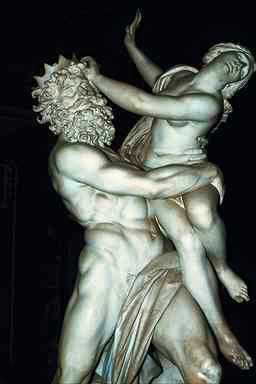
Hades Abducting Persephone: Marriage of Sacred Masculine and Sacred Feminine?
Jungians, following Erich Neumann, understand the progress of history through an evolutionary model in which humanity began in a matriarchal stage in which the unconscious reigned. This period of culture, which spawned the image of the Great and Terrible Mother, was primitive and irrational. Matriarchy was naturally superseded by patriarchy, in which the individual, the ego, and rationality emerged. In the patriarchal stage of culture, male Gods and heroes were the primary symbols, and rationality reigned supreme.
The patriarchal stage of culture had its limitations, which were revealed in the two World Wars of the twentieth century and the nuclear and environmental crises that followed. Rational man, Jungians argued, had come to the point where he needed to reconnect with his feminine side. The unconscious feminine was now understood to be a nurturing matrix that included the body, nature, and feeling, from which rational man should and could never fully separate himself.
The great archaeologist Marija Gimbutas also spoke of two cultures within Europe, an earlier matrifocal one she called Old Europe and a later patriarchal one. The Jungian Joseph Campbell endorsed Gimbutas’ work, leading some to assume that Gimbutas and Jungians hold similar theories of human history. In fact they do not: Gimbutas did not subscribe to an evolutionary theory of culture. She would never have said that the earlier matrifocal culture “had to be superseded” by the later patriarchal culture “in order for civilization to advance.” The clear conclusion to be drawn from Gimbutas’ work is that the patriarchal culture was in almost every way inferior to the one it replaced.
For Gimbutas, the agricultural societies of Neolithic Old Europe were peaceful, egalitarian, sedentary, highly artistic, matrifocal and probably matrilineal, worshiping the Goddess as the powers of birth, death, and regeneration. These societies did not evolve into a higher stage of culture, but were violently overthrown by Indo-European invaders. The culture the Indo-Europeans introduced into Europe was nomadic, patriarchal, patrilineal, warlike, horse-riding, not artistic, worshiping the shining Gods of the sun as reflected in their bronze weapons. Gimbutas did not look forward to a new “marriage” of matrifocal and patriarchal cultures. Rather she hoped for the re-emergence of the values of the earlier culture. Her theories had a critical edge: she did not approve of cultures organized around domination, violence, and war.
This critical edge is exactly what is lost when we begin to substitute the terms “sacred feminine” for “the Goddess” or “Goddess feminism” and “sacred masculine” for “patriarchy” and “patriarchal Gods.” When we allege that we all have our “masculine and feminine sides,” and that it is important “to reunite the masculine and the feminine,” it is easy to forget that in our history, the so-called sacred masculine has been associated with domination, violence, and war.
If we hope to create societies without domination, violence, and war, then we must transform the distorted images of masculinity and femininity that have been developed in patriarchy. We must insist that domination, violence, and war are no more part of masculinity or male nature than passivity and lack of consciousness are part of femininity or female nature. It may feel good to speak of reuniting the masculine and the feminine, but feeling good will not help us to transform cultures built on domination, violence, and war.
No matter how carefully developed they are, theories of female power in pre-patriarchal societies are dismissed in academic circles as “romantic fantasies” of a “golden age” based in “emotional longings” with “no basis in fact.” I was reminded of this while reviewing three books about the Goddess last week.
In one of the books, the co-authors, who define themselves as feminists, summarily dismiss theories about the origins of Goddess worship in pre-patriarchal prehistory. In another, the author traces the origin of certain Goddess stories and symbols found in recent folklore back to the beginnings of agriculture. Inexplicably, she stops there, not even mentioning the theory that women invented agriculture. Considering that possibility might have suggested that the symbols and stories the she was investigating were developed by women as part of rituals connected to the agricultural cycle. To ask these questions would have raised a further one: the question of female power in prehistory. And this it seems is a question that cannot be asked. This question was addressed in the third (very scholarly) book, which I fear will simply be ignored. Continue reading “Fear and Loathing in Discussions of Female Power in the Academy by Carol P. Christ”
My conservative, local newspaper ran an article recently titled, “Gun Control is Not the Answer.” The author, Jay Ambrose, is a contributing columnist employed by the Independence Institute, a libertarian think tank based in Denver, Colorado. The group’s stated mission according to Wikipedia is “…to empower individuals and to educate citizens, legislators and opinion makers about public policies that enhance personal and economic freedom.”
As expected from the title of his article, Mr. Ambrose is against gun control. He writes, “…any move short of the absurdity of confiscation would unlikely reduce killings.” He cites Russia as an example, noting that Russia’s murder rate, with its strict gun restrictions, is more than twice that of the U.S. “Guns,” he writes, “undeniably facilitate murder…[but] do not make a culture.” He contends that “culture is a prime mover of violence.”
And then he says it! “…one cultural circumstance ceaselessly cultivating criminal conduct in offspring is the enormous growth of single-parent–usually single-mother–homes.” Continue reading “It’s Mom’s Fault by Esther Nelson”
A friend recently told me that I deserve a vacation. I brushed it off and replied that I haven’t been working that hard. Ever since, I’ve been troubled by that comment and have been reflecting on why it bothers me so much. Today I am sharing with you why I’m uneasy about the idea of deserving reward.
Most of the time, in Western society, deserving something centers around actions: either done or not done. For example, a firefighter pulling a colleague out of a burning building is a heroic act that many people think deserves recognition. We would be wrong not to honor that act. At the same time, a drunk driver dies in an automobile accident, and most people think the person got what s/he deserved. A non-smoker is diagnosed with terminal lung cancer, and people struggle with explaining the actions she or he has done to deserve that fate. Whereas when a smoker is diagnosed, people often jump quickly to blaming the victim. Continue reading “You Deserve It: Punishment and Reward in a Patriarchal Society by Ivy Helman”
My husband, who is American, first introduced me to the word “negging.” Although I hadn’t come across it before setting foot in America, I soon came to realize it was a concept that knew few cultural bounds. The Urban Dictionary (UD) defines negging as “[when] you use remarks to tap into female insecurity; shake their confidence…neg is a negative remark wrapped in a back-handed compliment.” In the West, as I have learned, negging tends to target a woman’s physical attributes, often as a pick up line. Thus, as the UD again illustrates: “You are nearly as tall as me. I like tall girls (LIFT). Are those heels 4 or 5 inches (DROP)?”[1]
I’m from India and thought I’d provide an example of negging to illustrate its varied and glorious forms. Back when I was growing up, dating wasn’t socially acceptable in my culture – it often had to be done on the sly which probably explains why negging as a pick up line wasn’t the smartest choice. But we South Asians had and continue to have our own cultural equivalents of underhand methods specifically designed to erode a woman’s sense of self. Continue reading “The Guessing Game by Vibha Shetiya”
When I cover my head in respect for the Holy One, it feels right. This act touches on a religious truth of who I am. To me, it not only matches who I am, it also expresses something about who I strive to be and the relationship I want to have with G-d.
Seeing Caitlyn Jenner on the cover of Vanity Fair, I think she’d say something similar about herself. Her outward appearance touches to the very core of who she is and who she has had the strength and courage to become. Not only that, it feels right.
Sure, there is a wide gulf between the public nature of Jenner’s cover photo and my public head covering, yet, in these two examples, I see a number of connections. First, there is the real possibility of harm and danger. Second, there is a link between outside actions that express something true about the person on the inside. Third, value is placed on the agency and autonomy of the individual carrying out those actions. Finally, there is a performativity connection between religiosity and gender. It is the last point that I find particularly compelling.
I don’t cover my head anymore on a daily basis although I used to before I moved to Europe. Even though it doesn’t feel right, with the rise of anti-Semitism, it seems like the safe and unfortunately prudent thing to do. I also don’t wear any signifying my religion except for a small star of David earring. In 2014, by the Jewish community’s own account, anti-Semitism grew 200% in the Czech Republic alone. Statistics seems to support my actions.
Jenner too, like so many members of the trans community, now has the real threat of violence against her person. While her public persona may make her somewhat safer, too many trans men and women have been harmed and even murdered just for being themselves. In fact, many trans people live closeted lives because of this danger and the fear of rejection from family, friends and the larger society.
While not minimizing the fear and danger, I want to return to the more theoretical link between gender expression, gender identity and religious identity. In 1990, Judith Butler wrote Gender Trouble: Feminism and the Subversion of Identity. For Butler, what we think of sex and its connections to gender as masculinity and femininity often come down to a person performing gender in a way that is socially recognizable. People wear clothing, do actions, speak words and use body language that marks them as woman or man and therefore individual agents adhere to societal constructions of gender at the same time they reinforce societal expectations for men and women. Butler’s suggestion is that gender performances, that subvert “normal” discourses on gender expression, show the ways in which gender is culturally constructed. They also disrupt what has been seen as somehow inherently natural. In other words, biologically-sexed females acting, dressing, speaking and behaving in ways typically associated with masculinity disrupts what it means to be both a woman and to be masculine. This would be impossible if things were as natural as society thinks they are.
One of Butler’s goal, in my opinion, is not only to expose the culturally constructed nature of sex/gender, but also to open up individual agency to perform gender in ways that would disrupt the power these “natural notions” have over peoples’ lives. Subversive gender performances, for Butler, creates more freedom in society and would hopefully undermine blanket misogyny and disrupt patriarchal power.
Yes, Butler has often been criticized in many ways, including the attempt to erase any notion of substance behind personhood and its gendered expression especially as it relates to transgendered individuals. Butler has spoken to this specific criticism saying on transadvocate.com that, “…others have a strong sense of self bound up with their genders, so to get rid of gender would be to shatter their self-hood. I think we have to accept a wide variety of positions on gender. Some want to be gender-free, but others want to be free really to be a gender that is crucial to who they are.”
In the end, what is essential for Butler is individual autonomy and freedom to be. Performing sex/gender is one possible way to get there. Let me suggest another that builds off Butler’s ideas of performativity. Religiosity is a type of culturally-laden performance. After all, what are kippot, hijabi, nuns’ habits, ministers’ robes, etc.? They are religious markers tied up in gender identity.
Just as masculine women subvert and disrupt social constructions, couldn’t a Jewish lesbian perform gender in a way that she passes for an orthodox man (or woman)? Doesn’t this disrupt what it means to be both lesbian and orthodox? I think so. This passing person also destabilizes the power of orthodox men to define womanhood and women’s sexuality. She defines for herself who she is. She may very well consider herself to be orthodox and masculine, just as masculine women consider their masculinity as part of who they are. She may connect deeply with Jewish orthodox feminine styles of dress. Nonetheless, her outward performance expresses something about her commitment to G-d and who she is as a Jew at the same time it subverts received religious notions of gender and sexuality. Another example is a woman minister who wears priestly attire including the black shirt and white collar. She too disrupts power relations, gender assumptions and, for some people, the very notion of women and ordination. Religious performance is powerful stuff.
To go back to the point I made at the beginning. I think expressions of religiosity are similar to expressions of gender. In addition, claiming for one’s self a religious identity subverts patriarchal notions of gender. Yet, most importantly, performing a religious identity often expresses an inner truth. In both of these ways, religious identity performances could create freedom, disrupt power-over and destabilize patriarchy just as Butler hopes gender performativity does. I would modify Butler’s approach somewhat to say, “I think we have to accept a wide variety of positions on gender [and/or religious identity]. Some want to be gender-free [and/or religion-free], but others want to be free really to be a gender [and/or religious indentity] that is crucial to who they are.”
A friend who is a spiritual teacher speaks often “bringing back the values associated with the Divine Feminine.” For her this has to do with helping women to understand the beauty of our bodies and the importance of ways of being such as giving and caring for others that have been associated with the undervalued so-called “feminine” side of the masculine-feminine polarity. Though she also speaks about the Goddess, I think she prefers the term “the Divine Feminine” because of the implication that men too have their “Divine Masculine.”
This friend has a wonderful husband who is a teacher in his own right and who often ends up spending a lot of his time among powerful women who enjoy talking about the Goddess. In these conversations he sometimes speaks of the need for men to “recover the Divine Masculine” if they are to become whole.
I was reminded of these conversations when a two other friends, in different contexts, recently voiced their concern that Goddess imagery is problematic if it repeats sex role stereotypes. My response to them was that in the West, the feminist association of femaleness with power and value in Goddess symbolism automatically shatters the most important sex role stereotype: the notion that women are less powerful and less valuable than men. But, I said, after that, problems may arise.
I added that (for me) the categories of Divine Feminine and Divine Masculine are problematic because (it seems to me) that at their core these concepts are rooted in the notion that males and females are fundamentally different, and that the so-called “feminine” is relational, loving, giving, while the so-called “masculine” is independent, rational, aggressive, and sometimes violent and warlike. Those who speak of the Divine Feminine and Divine Masculine as oppositional categories usually try to avoid categorizing men and women by stating that “we all have our masculine and feminine sides.” Still it is hard to avoid the implication that men are more masculine and women are more feminine.
Though I agree that men need new images of what it means to be men as much as women need new images of what it means to be women, I hesitate to speak of these as new images of the Divine Feminine and Divine Masculine for two reasons. Although I recognize that others are inspired by images of the Sacred Marriage, for me it has been more important–and more possible–to find power within myself and in a wide variety of relationships, than to find it in a male-female heterosexual couple relationship in which the opposites are “joined.”
More importantly, I find that images of Divine Feminine and Divine Masculine often do justify patriarchal sex-role stereotypes. An internet search for “Divine Masculine” validated this fear. The first (and therefore most popular) website defined the Divine Masculine through six archetypes: God, King, Priest, Warrior, Lover, Sage.
The site’s author seems to want to help men learn new ways to interact with powerful women—as neither dominant over them nor submissive to them. The author writes: “The Divine Masculine represents an archetypal ideal, the best and most inspiring, elevating, and restorative aspects of masculine expression and manifestation in the universe. For those seeking an expanded understanding of the Self, the Divine Masculine is not a distant, detached, jealous and vengeful male deity. The Divine Masculine (along with the Divine Feminine) acts as a shining mirror of the Self, revealing aspects that need compassionate attention and support to become one’s highest potential.”
Following this insight, he redefines the God archetype as “unconditionally loving, inclusive, open, welcoming, heart-centered, spiritually focused, supportive and inspirational.” For him, the King archetype is “benevolent, evenhanded, calm, caring and thoughtfully present.” And the Warrior “finds his place in collaborative projects, being fulfilled and contented with the collaboration and not by ambition or competition.”
While I appreciate the ways in which this man redefines masculinity and male strength in terms that in the past have been associated with “the feminine,” I am concerned that he continues to view the six “archetypes” that include the King and Warrior as universal. He does not explicitly name patriarchy as a system of male dominance enforced through violence as the reason for redefining the meaning of the “archetypes.” I also worry that a good king is still a king, and that a warrior who fights for the good of others is still a warrior. From a feminist perspective, these archetypes are not universal, but rather are the product of patriarchy. Perhaps instead of redefining them, we should discard them.
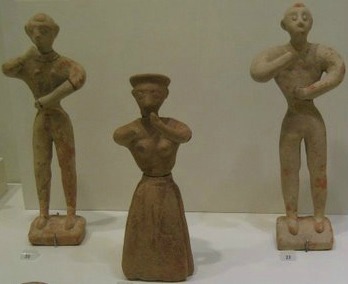
Male and female figures from ancient Crete are not strongly differentiated.
New research suggests that in matriarchies, there is no divine masculine per se, because though men have their own important roles, both males and females are encouraged to embody the values associated with mothers and mothering—in other words to be loving, giving, caring, and generous. In this context there is no opposition or sharp contrast between the divine masculine, the divine feminine, and any other divine gender or transgender.
I believe that that we need a multiplicity of images for divine power that express the diversity and differences of our bodies and all bodies in the web of life. We also need new images of how to be strong and powerful, yet loving and caring above all, in male, female, and other bodies.
However, if the “highest” values are the same for both—and all–genders, then perhaps it is time to retire the oppositional binary of Divine Feminine and Divine Masculine and to speak instead of images of divinity in male, female, and other bodies.
Carol Adams in her article “Ecofeminism and the Eating of Animals,” argues that ecofeminists should be vegetarians, since ecofeminism is, among other things, action-based and “one’s actions reveal one’s beliefs,” (129). According to ecofeminism, the patriarchal domination of animals and nature is linked to the oppression of women. For her and many ecofeminists, the survival of our planet rests on two foundations: first, fixing the conditions of women and other oppressed groups and, second, envisioning differently our relationship to the natural world. In other words, a better arrangement of human relationships requires better human relationships with the environment. Vegetarianism and veganism are two ways in which ecofeminists opt out of the patriarchal system of domination and exploitation and help create a better world.
But, does one really? Does adopting a vegetarian or vegan lifestyle really have such an impact on the world? Yes and no. Yes, because it has been shown that raising animals to eat uses exorbitant amounts of fuel, water and land, not to mention, the larger environmental impact of farm run-off in the forms of disease-carrying manure, valuable topsoil and harmful pesticides. Yes, because animals are often inhumanely treated, housed in horrible conditions, genetically and/or hormonally-modified and cruelly killed. Continue reading “Do You Eat Animals? Ecofeminism and Our Food System by Ivy Helman”


 Despite all of the ways Western society has separated the spiritual pursuit from the material and deemed spirituality superior to physicality, the religious holiday of Pesach doesn’t. In fact, it is the physical liberation of the Israelites from slavery in Egypt that starts them on their path toward the covenant and an even deeper spiritual connection to the divine. The Exodus story overflows with images, tales and situations in which: bodies are not ignored; nourishment, comfort and care is addressed spiritually as well as physically and the divine’s spiritual gift, so to speak, to the Israelites is not some other-worldly paradise but a this-worldly land flowing with milk and honey.
 from Cascade Books in October 2015, is
  ears “the Sacred Feminine” has become interchangeable with (for some) and preferable to (for others) “Goddess” and “Goddess feminism.” The terms Goddess and feminism, it is sometimes argued, raise hackles: Is Goddess to replace God? And if so why? Does feminism imply an aggressive stance? And if so, against whom or what?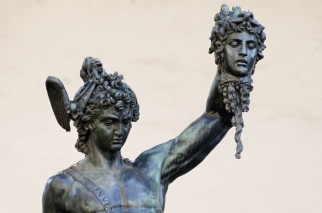
 A Serpentine Path: Mysteries of the Goddess
 No matter how carefully developed they are, theories of female power in pre-patriarchal societies are dismissed in academic circles as “romantic fantasies” of a “golden age” based in “emotional longings” with “no basis in fact.” I was reminded of this while reviewing
  My conservative, local newspaper ran an article recently titled, “Gun Control is Not the Answer.” The author, Jay Ambrose, is a contributing columnist employed by the Independence Institute, a libertarian think tank based in Denver, Colorado. The group’s stated mission according to Wikipedia is “…to empower individuals and to educate citizens, legislators and opinion makers about public policies that enhance personal and economic freedom.”
 My husband, who is American, first introduced me to the word “negging.” Although I hadn’t come across it before setting foot in America, I soon came to realize it was a concept that knew few cultural bounds. The Urban Dictionary (UD) defines negging as “[when] you use remarks to tap into female insecurity; shake their confidence…neg is a negative remark wrapped in a back-handed compliment.” In the West, as I have learned, negging tends to target a woman’s physical attributes, often as a pick up line. Thus, as the UD again illustrates: “You are nearly as tall as me. I like tall girls (LIFT). Are those heels 4 or 5 inches (DROP)?”