From the Archives: I Am in Peace: the Ministry of Margaret Fell by Mary Sharratt

Moderator’s note: This marvelous FAR site has been running for 10 years and has had more than 3,600 posts in that time. There are so many treasures that have been posted in this decade that they tend to get lost in the archives. We have created this column so that we can all revisit some of these gems. Today’s blogpost was originally posted March 6, 2019. It is paired with a new guest post abut Margaret Fell which will be posted tomorrow. You can visit the original post here to see the comments.

margaret fell

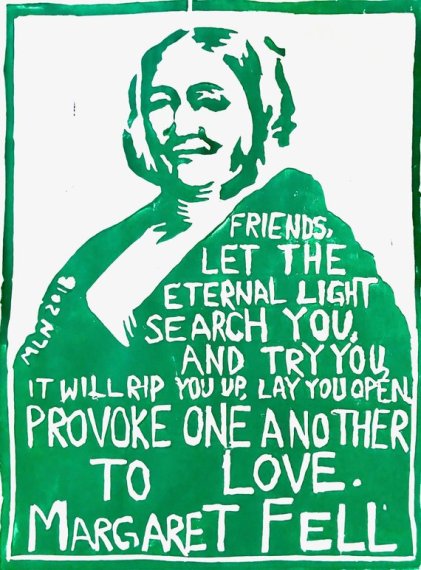
This linoprint of Margaret Fell can be ordered here.

Pendle Hill will forever be associated to the Pendle Witches of 1612 who live on in the undying soul of the landscape and its folklore and who inspired my 2010 novel, Daughters of the Witching Hill. Pendle Hill also gave birth to the Quaker movement.

In 1652, George Fox, a simple weaver’s son and cobbler’s apprentice turned dissenting preacher, wandered across England on a spiritual quest. When he climbed Pendle Hill, his revelation came to him—an event that would change both Fox and the world forever. He envisioned a “great multitude waiting to be gathered.”

Continue reading “From the Archives: I Am in Peace: the Ministry of Margaret Fell by Mary Sharratt”

The Treasures of Vayishlach by Ivy Helman

The Torah portion to be read this Shabbat is Vayishlach (Genesis 32:4-36:43).  It contains the reunion between Jacob and Esau, the twice-renaming of Jacob to Israel, events relating to Dinah, the mass murder of all of the male inhabitants of Shechem, the birth of Benjamin, the death of Rachel in childbirth, the death from old-age of Isaac, and a long list of the descendants of Esau.  Like every blog, there is too much material on which to comment.  Therefore, I will focus on three examples.  Each of these examples in their own way turns expectations or aspects of the Torah on their heads.   

First, we have the way in which Jacob wholeheartedly avoids war.  This is despite the fact that, in the Torah, war is demanded, normalized, or doled out as a form of punishment.  Rarely does fear factored into the Torah’s discussions of war, yet this parshah starts with Jacob’s fears about war: his brother Esau is going to start a war with him.  To avert this war, Jacob sends, in advance of their meeting, large quantities of gifts, mainly in the form of animals.  In addition, as he approaches his brother, he prostrates himself on the ground seven times.  

Continue reading “The Treasures of Vayishlach by Ivy Helman”

The Cuisine Cards by Laurie Goodhart

Suit of Tomatoes

With every wonderful, heart-wrenching, deeply researched, and inspiring  post I read on F.A.R., I feel less inclined to share my own somewhat out-of-step contributions to this world. Nevertheless, I keep reminding myself that they are the things that I do, and I do them because I feel compelled, and have consistently been compelled in those two specific directions — art and agriculture/wildcrafting — since childhood. Also, the paintings and prints are a product of my always thinking about and feeling into both feminism and spirituality, and the fruits of the intersection of the two. So here is another offering.

I’ve always had a fondness for the visual aspect of playing cards, and collect books on them. One image of an uncut sheet of cards printed in 1585 in Frankfurt, where the black and white cards were jammed in every which way on large sheets of paper, inspired the look of these four prints, The Cuisine Cards.

They are conceived as celebrating food and cultures from various parts of the world. The face cards are non-hierarchical in terms of rank and gender. The 10 is a Table of the suit’s food, then there are the Shaper, Mover, and Taster, who, although usually carrying on in a certain sequential order, each contribute equal value to the whole experience of eating food. Two suits have all female face cards and two all male.

Continue reading “The Cuisine Cards by Laurie Goodhart”

Mother of All Fears by Trelawney Grenfell-Muir

This time of year, the general public tends to pay more attention than usual to witches. Much of it is lighthearted – halloween costumes and memes about where to park your broom. Some of it is spiritual – adherents of the modern religions of Wicca and neopaganism discussing symbolic and supernatural beliefs. And some of it is historical – analyzing the witch trials of past centuries and wondering how they apply, ethically, to modern day intolerance and violence.

Within all these discussions, usually unnamed and unexamined, is the framing metaquestion: what should we fear? And what should we do about that which we fear?

Historic witch trials (from a time when witches were believed to be evil agents of Satan) reveals how we humans always try to externalize badness and goodness, so we can exterminate badness and excuse ourselves for our lack of goodness. So we have heroes and villains, neither of them very human, but rather idols and symbols of our fears. I honestly think the patriarchy’s fear of females is as strong as it ever was. When the most popular videos on the most popular internet porn sites are of ****TRIGGER WARNING RAPE, INCEST**** raping a stepsister, or doctors raping a teenage girl in the hospital for cancer, or of border agents raping a pregnant young refugee, and these sites are visited by 98% of the men in our society, what does that say about us as a species? Or a culture? As Tallessyn Grenfell-Lee says, “Scary, scary vaginas!

Continue reading “Mother of All Fears by Trelawney Grenfell-Muir”

I am in Peace: The Ministry of Margaret Fell by Mary Sharratt

margaret fell

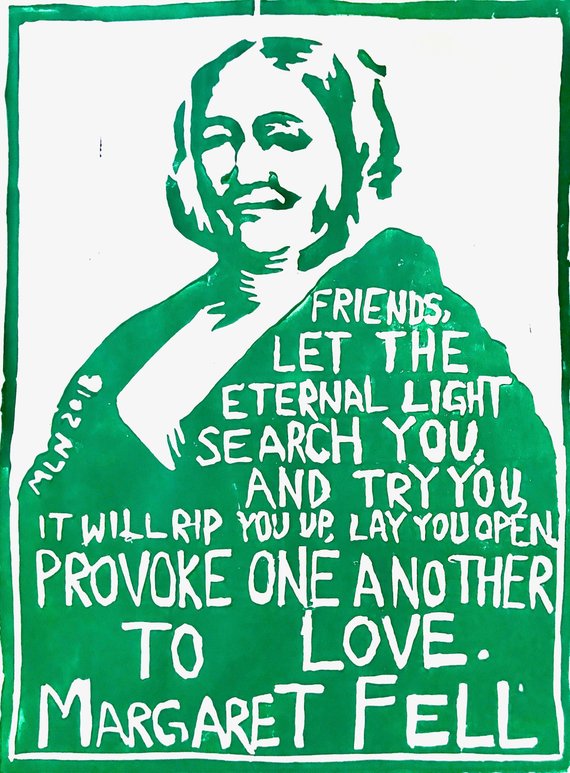
This linoprint of Margaret Fell can be ordered here.

Pendle Hill will forever be associated to the Pendle Witches of 1612 who live on in the undying soul of the landscape and its folklore and who inspired my 2010 novel, Daughters of the Witching Hill. Pendle Hill also gave birth to the Quaker movement.

In 1652, George Fox, a simple weaver’s son and cobbler’s apprentice turned dissenting preacher, wandered across England on a spiritual quest. When he climbed Pendle Hill, his revelation came to him—an event that would change both Fox and the world forever. He envisioned a “great multitude waiting to be gathered.”

As we travelled, we came near a very great hill, called Pendle Hill, and I was moved of the Lord to go up to the top of it; which I did with difficulty, it was so very steep and high. When I was come to the top, I saw the sea bordering upon Lancashire. From the top of this hill the Lord let me see in what places he had a great people to be gathered.

George Fox: An Autobiography, Chapter 6 Continue reading “I am in Peace: The Ministry of Margaret Fell by Mary Sharratt”

Find Your Warrior Archetype, Sisters: We are in the Fight of our Lives by Trelawney Grenfell-Muir

I read a news story this week about dozens of children sex trafficked at an auto show in Detroit. I read about a young man getting no jail time for sexually assaulting a six year old girl… sex traffickers targeting and grooming girls through internet apps for children… white women still earn $0.80 for every dollar men earn, and women of color even less… the Supreme Court may kill Roe v. Wade this week… five women executed in a bank, and the media ignored it… many men used the government shutdown to coerce (rape) poor, desperate mothers into trading sex for money or food… yet another gunman shot his ex-girlfriend and four other people…

There’s plenty more bad news. We live in a collapsing, apocalyptic dystopian misogynistic nightmare. Misogynist violence floods to us in a toxic deluge from billboards, magazines, movies, TV shows, ads, games, and most interactions with family, friends, and our culture.

How do we survive in this holocaust? How do we keep sane? How do we protect that which we hold most dear?

Continue reading “Find Your Warrior Archetype, Sisters: We are in the Fight of our Lives by Trelawney Grenfell-Muir”

Holly Near’s Music and a Holistic Feminist Perspective of Peace by Elisabeth Schilling

It’s hard for me to be dignified and peaceful sometimes. To produce and sacrifice without rewards, making sure I’m not “sacrificing” in a way that quells my truth and power, making sure I look at dignity in a liberating way. Words continually need to be unpacked, and I do that. I know the work. According to the OED, it means “The quality of being worthy.” For me, ‘dignity’ is just being aware of your self-worth and celebrating that. It feels hopeful and romantic and raw. To sacrifice, to me, in the way I’m using it in this moment, is to be life-giving and co-creator; I think of it in the same way as what the earth does, so that it can continue. Like a leaf fallen to nourish its own soil.

The OED definition of ‘sacrifice’ I like is “The destruction or surrender of something valued or desired for the sake of something regarded as having a higher or more pressing claim.” We can decide what is more pressing. For me it is the ethic of generosity and production in a non-greedy way. I do not sacrifice in this more self-empowered, law-of-the-universe way I’ve recently come to understand much. But I would like to. Sometimes, though, I feel tired in my production, like I need more feedback, even if it is another woman willing to listen to me, which is why posting on FAR is so healing and life-giving because there is all of you.

I’m glad I have wisdom in my body. Even if “I” (my mind?) goes chaotic, feels overwhelmed and lost, my body has this natural intelligence to heal and regain balance if I can listen and get out of its way. That reminds me a lot of the earth—regions harmed by human mindlessness have been known to restore itself, even after radiation or toxic explosions, when humans leave for awhile. But if “I” equate myself with my mind, isn’t that also a part of the body? Wouldn’t the mind (the brain? the processes that help mental consciousness and thoughts arise?) then be wise, seeking balance? It just does not feel like it. So if anyone can weigh in on that. . . why so easy for my body-body but not my mind-body?

Continue reading “Holly Near’s Music and a Holistic Feminist Perspective of Peace by Elisabeth Schilling”

Lessons from Shofetim by Ivy Helman.

29662350_10155723099993089_8391051315166448776_oThis is the first part of a series of reflections on the weekly Torah portions.  For those of you unfamiliar with Judaism, we read the Torah in sections.  There are 52 parshot (or portions), one parshah (portion) is read each week (most often during Shabbat morning services).  It is common for rabbis, prayer leaders or someone of the congregation to offer reflections on the week’s parshah at Shabbat services.
The parshah for this week is Shofetim.  It is Devarim/Deuteronomy 16:18 – 21:9 and will be read this Shabbat, 18 August.  Shofetim discusses a range of topics: setting up of a system of judges to make important decisions for Israel; the entitlements of the Levites; the rules of warfare; the importance of justice and just governments; and the acknowledgment of G-d as the true and highest Judge.  It also warns Israel against false prophets and practices of idolatry.  Shofetim contains a number of well-known verses including ‘justice, justice you shall pursue…(16:18),’ and notorious punishments like “…a tooth for a tooth; an eye for an eye…(19:21)”  Continue reading “Lessons from Shofetim by Ivy Helman.”

A Nurturing Environment is Not a Luxury by Elisabeth Schilling

There are two tarot card decks that have accompanied me on my trip overseas this summer: Alana Fairchild’s Rumi Oracle and Lee Bursten’s Tarot of Dreams. In recent readings, I have been presented with messages of place, thus the topic of my post.

But first, Seneca, Stoic philosopher born around the time of Jesus, cautions that people traveling to escape their difficulties are sometimes no better when they have arrived to a distant land because they have not become rid of themselves. Likewise, zen philosophy suggests that it is not our circumstances that matter so much as the peace and calm we create in our inner landscape. Nhat Thich Hanh or Ram Dass or Pema Chödrön (maybe all 3) have a metaphor for the tumultuous ocean – that the sea is often rocky, but it is always calm in the deep beneath. Yet, I see all this as a reminder to be mindful about the added layers of suffering we can create and advice for difficult times when we can’t leave yet. Regardless, I think any wisdom cannot discount the need for a nurturing, healing space when at all possible.

Continue reading “A Nurturing Environment is Not a Luxury by Elisabeth Schilling”

Another Season of Reflection and Review by Elise M. Edwards

elise-edwardsI turn inward and become reflective at this time of year.  It’s the Advent season in the Christian liturgical year, which encourages practices of piety focused on preparation, examination, and hopeful longing.  It’s the end of a semester and a calendar year, which provokes review of the months before.  In the northern hemisphere, it’s a time of darker days and longer nights, which suggest a retreat indoors, in silence or in stillness.

During this time of year, I’m typically exhausted, and so I seem to enact annual rituals with a recurring sense of ambivalence.   I really love the celebration of Christmas, but preparing for it takes a lot of energy.  So I do some decorating, but not as much as I planned.  I attend some parties and celebrations, but end up missing or cancelling others.  I start a new devotional book, only to set it aside within a week or so.  I want this time of year to be both reflective and celebratory.  I want it to be spiritual and religious.  I want to be sociable with friends and family and also find time to rest and recover in solitude.  At some point, those goals seem too contradictory to be realizable and then I start practical negotiations:  How much decorating will I do? What kind of time will I set aside for solitude and self-care?  Will I have enough energy to be joyful and present with my family and friends?

“Some, but not enough” is the answer I seem to come to every year.

Some decorating, but not enough.  Some time for solitude and self-care, but not enough.  Some energy for social occasions, but not enough.  This year, I want to let go of that voice that says it’s not enough.  That voice that says I am not enough.

To help myself let go of the guilt and self-deprecation, while retaining the reflective focus of the season that may be life-affirming, I reviewed my previous years’ December writings on this blog.  What might I discern from this pattern of yearly reflection?

In 2012, I wrote about why women might be tempted to cancel Christmas.  I was in my final year of the Ph.D. program when I wrote that, and was prompted to do so when I heard that friends and colleagues were planning to skip Christmas preparations or scale them back dramatically.  That year, I sought to maintain “religious and social rituals associated with Christmas” so that I could be “spiritually grounded, emotionally provoked, mentally rested, and physically fed.” I don’t have a vivid memory of that year’s holidays, but as I read it again, I wonder if I was carrying a sense of religious obligation rather than release.  Did I feel free or beholden to social custom? I’ve learned that I will only be able to let that “not enough” voice go when I let go of the expectation that Advent and Christmas should look a certain way or I should be present to it in a certain way.  I’m more willing this year to let peace and joy ebb and flow  in celebrations and moments of sadness and mourning that accompany the season, too.

In 2014 and 2016, my Advent reflections were more focused on justice and peace at the societal level than in the household.  They were mournful.  In December 2014, I was trying to stave off despair after Michael Brown’s killer was not indicted by a grand jury.  The police officer would not stand trial for killing the black teen.  That year, I was mourning Michael Brown and Trayvon Martin and the loss of my own naivete as I became more conscientized about racial violence. I had a similar wake-up call last year when Hillary Rodham Clinton lost the US presidential election and I working through the anger and dread I felt at 45’s approaching presidency.  This year, the struggle continues as we anticipate changes to the tax code and DACA.  But at least Roy Moore lost.  We do continue to work for progress and systemic change, and sometimes, it works.

Feminists have long asserted that the personal is political and that the political is personal.  I’m acknowledging this holiday season that my perpetual weariness during Advent and Christmas is legitimate, as it emerges from personal and political struggle.  I am frustrated with the injustices and hardships I encounter at home, work, and the broader community.  I would not be weary if I was not awakened to the suffering.  This year, I accept that the exhaustion is part of the cost of my work and my calling.  The weariness will ebb and flow, as will joy and peace. Being able to teach and write is a blessing that allows me to help others become more aware of injustice and more involved in addressing it.  This year, I’m acknowledging that I’ve done what I can do.  I’m resisting the impulse to assess whether it was enough.  In previous years, I’ve been trying to hold on to hope; this year I’m resting in God’s grace.

As Christmas approaches, I’m embracing the Christian teaching that the divine meets humanity where we are.  The beauty of the Incarnation is that the eternal meets the temporal and that God unites with human to bring light to a suffering world.  That’s a gift for me this year, a comfort to be able to shift the focus from my own action and being to divine action and being.

I can see the sacred work and presence in this online community and other communities of faith.  Holiday blessings to you all.

Elise M. Edwards, PhD is a Lecturer in Christian Ethics at Baylor University and a graduate of Claremont Graduate University. She is also a registered architect in the State of Florida. Her interdisciplinary work examines issues of civic engagement and how beliefs and commitments are expressed publicly. As a black feminist, she primarily focuses on cultural expressions by, for, and about women and marginalized communities. Follow her on twitter, google+ or academia.edu.