Reflections on Marriage by Ivy Helman

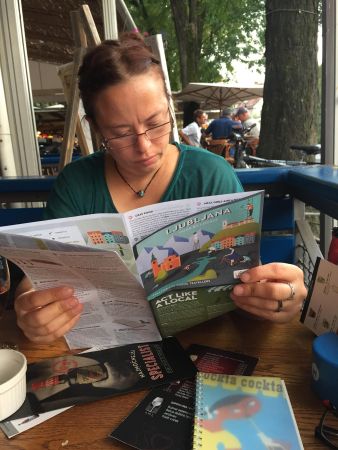
studyMy partner and I are getting married in a little over a month.  She, a lawyer, and I, a professor, live in the Czech Republic.  Technically, we aren’t getting married because the Czech Republic doesn’t have marriage equality.  Our relationship will not be recognized in the U.S.  For that, we need to be married in a state or nation that has marriage equality.  Germany might soon.  Other options would be a number of EU countries or the United States, but that doesn’t affect our status in the Czech Republic.  Finally, our marriage will also not be recognized by some in Jewish circles as well since the ketubah, the Jewish marriage document which possesses legal status in Jewish courts, is between two women.

There is nothing legal about our Jewish wedding except one could argue its Jewishness. So, the day after our wedding our relationship will have the same recognition as it had the day before and the day before that.   This would not be the case if we were a heterosexual couple.  It reminds me of the countless commitment ceremonies that took place before marriage equality in the United States.  They were not prohibited (like the marriages that slaves had because slaves weren’t considered people under the law or eligible to enter into legal contracts while in bondage (see pages 301-302).  Yet, similar to the “contubernal relationships” of slaves performed by their masters or other slaves (page 302), they weren’t particularly legal either.  Despite the ceremony, there was no change in status of the couple within society.  Yet, recognition was and still is an important component of both struggles for rights.  In fact, according to Darlene Goring in “The History of Slave Marriage in the United States,” (345-346), the process of gaining legal recognition was very similar for both ex-slaves and the marriage equality community in the United States. Continue reading “Reflections on Marriage by Ivy Helman”

Human Trafficking by Valentina Khan

Valentina KhanRecently I saw SOLD, a movie based on human trafficking taking place in Nepal and India. Within the first thirty minutes of the movie I was cringing, holding my hands, shrinking into my chair. Naively, I begged the question how families could sell their innocent children to strangers, even if they are fed the lies of working for pay? I am a mother of two children, who are my heart and soul. Deep inside I feel that if we as a family were in desperate times, I would rather sell myself than my children, or I would escape with them, and if we die, we die together. Yes. So extreme. But I can’t fathom letting my children go. Not for any amount of money, no matter how dire times were. I wouldn’t be able to live not knowing where they were, what they were doing, and with who. Just writing this or thinking about it, churns my stomach inside out.

I feel bad to make such statements and appear as if I am passing judgment on these mothers and fathers, who are living in desperate conditions, not knowing what else to do but to sell their flesh and blood to this multi-billion dollar industry. Many are not even aware and might truly believe that their children will go off to earn money for the family. As I write this I have a more informed position, because human trafficking is not a problem concentrated in a certain area of the world, this is a world wide epidemic with mostly women and children being bought and sold not just far away but here in my backyard, Los Angeles, California. Continue reading “Human Trafficking by Valentina Khan”

Changing the American Story? by Carol P. Christ

Carol in Crete croppedIn a moving part of Goddess and God in the World, the book Judith Plaskow and I are writing together, Judith describes how the Sabra and Shatila massacre  forced her to confront the fact that “her people” are just as capable of perpetrating evil as any other group. Growing up in the shadow of the Holocaust and the pogroms that had scattered her people across the world, Judith was taught to think of the Jewish people as the victims of history rather than as the perpetrators of evil. The willingness of the Israeli army to countenance the outright massacre of up to 3500 people told another story: when in power, Jews too were capable of great evil.

I tell this story because I believe the lesson Judith learned is a lesson that Americans as a group still need to learn. I am thinking about this in the days following the heated debate that led to the removal of the Confederate flag from the Capitol of North Carolina.

In a brave and impassioned speech, Jenny Horne explained that though she is a descendant of Jefferson Davis, she was speaking against the display of the Confederate flag because it is a symbol of the harm that has been done and continues to be done to slaves and descendants of slaves in her state. Jenny Horne was rejecting the story she had been told about what it is to be an American in South Carolina. Continue reading “Changing the American Story? by Carol P. Christ”

We Could Have Been Canadians and Other Thoughts about My New England Colonial Heritage by Carol P. Christ

carol mitzi sarahMy 2x great-grandparents Nathaniel Searing and Louisa Caroline Martin were pioneers who cleared the land and built a log cabin in Lyons, Michigan in 1840. They were descended from English Puritan Colonial settlers in New England. At least two of my ancestors are recognized by the Sons and Daughters of the American Revolutions. Other members of my family who were Quakers proudly refused to take part in the Revolutionary War.

My great-grandfather James Augustus married a woman of German descent, his daughter Lena Marie married a Swede, and my mother married a man who was German, Irish, and Scottish. As the descendants of Nathaniel Searing and Louisa Caroline Martin moved around the United States and married into the families of newer immigrants, the succeeding generations also lost touch with their history. Our family’s connections to the New England Colonists were not even mentioned at Thanksgiving! Continue reading “We Could Have Been Canadians and Other Thoughts about My New England Colonial Heritage by Carol P. Christ”

Pesach, Patriachy and the Unfinished Work of Liberation.

headshot2Pesach, or Passover, begins tomorrow at sunset. It has always seemed strange to me that a festival centered on liberation begins with a focus on housework and cleanliness to the point where one is almost a slave to the process of chametz (leavened food) removal.  Not only that, but the spiritual interpretation of what the chametz represents adds to this conundrum.

The Rabbis of the Talmud teach us that chametz represents egotism and arrogance. The divine instruction to eat only unleavened bread for the festival of Pesach is a call to cultivate humility because they believe that our inflated sense of self-worth causes harm to other human beings as we value ourselves and our lives more than them. As we remove the chametz from our homes, we are also supposed to be removing the self-centeredness, arrogance and egotism within ourselves. Cultivating humility redirects our attention to all those parts of our lives that have suffered by being too self-centered, including our relationship with the Holy One. Continue reading “Pesach, Patriachy and the Unfinished Work of Liberation.”

Painting Anna Julia Cooper by Angela Yarber

angelaAs we celebrate Black History Month I’d like to honor a remarkable black woman who joins the Holy Woman Icons with a folk feminist twist that I feature each month. Anna Julia Cooper stands alongside Virginia Woolf , the Shulamite, Mary Daly, Baby Suggs, Pachamama and Gaia, Frida Kahlo, Salome, Guadalupe and Mary, Fatima, Sojourner Truth, Saraswati, Jarena Lee, Isadora Duncan, Miriam, Lilith, Georgia O’Keeffe, Guanyin, Dorothy Day, Sappho, and Jephthah’s daughter.

Cooper was born a slave in Raleigh, NC in 1858.  Her mother was a slave and her biological father was her mother’s white master.  After living and working as a slave until the age of five, Cooper began her formal education at a school for slaves.  She would grow up to become one of the most educated and intellectual black women of her century.  In fact, she was the fourth African American woman to earn a Ph.D. in the United States, writing her dissertation on “Attitudes toward Slavery in Revolutionary France.” Continue reading “Painting Anna Julia Cooper by Angela Yarber”

Slavery and God/dess by amina wadud

amina 2014 - croppedWell the Golden Globe awards have been handed out.  I don’t have a television, so I didn’t actually watch, but a quick google search gives the results.  Highest honors go to a movie about blacks as slaves and whites as criminals.  That’s appropriate. 

But this is feminism and religion, so let me get to the point.  It’s about a chance discussion on social media about the “merciful god” and historical institutions like slavery (holocaust, or oppressions like misogyny, homophobia, Islamaphobia and others…).

My view of the divine, the cosmos and of the world is shaped by my slave ancestry.  Recent area studies about Islam in America estimate that one third of the Africans forced to the Americas were Muslim.   My first African relative on US soil identified as Moor (another term used for “Muslim”).  But Islam did not survive slavery. Continue reading “Slavery and God/dess by amina wadud”

The Story of Juneteenth by Kelly Brown Douglas

Tomorrow is a special day for me. It is Juneteenth.  On June 19, 1865, news finally reached Galveston, Texas that slavery had been abolished. This was of course two and a half years after Lincoln issued the Emancipation Proclamation. While the actual impact of the emancipation for the enslaved remains a source of historical discussion if not debate, the fact of the matter  is that the proclamation of emancipation and the reality of freedom for black women and men did not necessarily coincide. To be sure, for a variety of reasons, the Emancipation Proclamation did not have an immediate impact on the daily lives of enslaved women, men and children.  While the “official” historical records marks   January 1, 1863 as a day of emancipation, the historical record for the descendants of enslaved men and women marks June 19, 1865 as the day of freedom. For, it was on this day that the last slaves were free.

While the celebrations of Juneteenth have waxed and waned over the years, it remains a day in which African Americans reflect upon the “mighty long way” we have come as well as the “mighty long way” we have left to go on the pathway toward freedom.  As I celebrate Juneteenth, in the words of a black gospel song, “My soul looks back and wonders how they got over.”  And so it is that my theological imagination is stirred, for it is clear that it was by faith that they (the enslaved) got over. And so I ask, what kind of faith was it that allowed them to get over, that is, to survive a life of bondage? This question is even more pressing to me each time that I am reminded that there were those who were born into slavery and died in slavery, and thus, as Toni Morrison once exclaimed, “never drew a free breath.” So, what kind of faith was it that carried these people through life? Continue reading “The Story of Juneteenth by Kelly Brown Douglas”