

Part 1 was posted last week. You can read it here.
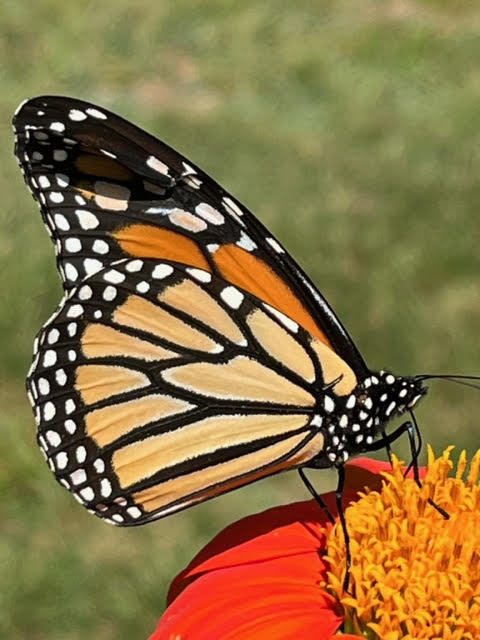
Today I learned that everyone is invited to witness butterfly tagging twice a week during the month of September. Efforts to publicize the value and ‘rightness’ of tagging are being stepped up.
Several people agreed with my assessment, namely that tagging creates trauma for the insect – and the idea that this practice may interfere with the butterfly’s ability to survive the 2000-mile journey, winter over successfully and then fly north to reproduce in the spring.
To my knowledge no one else had openly expressed their personal views to those in charge of the organization. However, some folks have come to talk with me. Most of us know that trauma weakens any organism’s immune system making it more vulnerable.
I also have friends who are biologists or scientists who agree that we have no way of knowing how tagging effects the butterfly or its ability to migrate successfully, and that even a small tag can create an imbalance in flight.
The underlying assumption (now hardened into ‘truth’) is that attaching an object to the hind wing of a butterfly that weighs less than half a gram with a tag that weighs 02 percent of the butterfly’s weight is placed close enough to the butterfly’s center so as not to disrupt flight. What I had just witnessed suggested otherwise.
When tagging began in 1992 scientists wanted to gain more insight monarch migration and decline. Monarchs caught the public’s attention, becoming a cultural icon for ‘save the species’ groups. Monarch Watch and Xerces (there are many others) began their research. Data accumulated as hypotheses came and went. Thirty plus years later we have masses of detailed information, but we have failed to stop the monarch’s steep decline.
As previously stated, the monarchs who hatch in September are the ones that make the long arduous journey to the central mountains of Mexico. The obvious threats of habitat loss – our disappearing forests, grasslands, clean water and air, the continued use of pesticides/herbicides, poisoned waters are compounded by the extremes that are being brought on by our changing climate. In Maine this tropical summer of floods and fog has given us a taste of what’s to come. In southern climates it’s fires and intolerable heat.
I do appreciate one aspect of this long -term research project. It has alerted some people to the plight of a disappearing butterfly and hopefully that will lead to folks seeing the ‘bigger picture’. We desperately need humans to comprehend the enormity of our earth crisis and how it is affecting what’s left of our wildlife, not to mention ourselves. Many people who have lawns are exchanging them for wildflower and pollinator gardens. These actions may assist other species to survive but unfortunately, I think it is too late for the monarchs.
While engaged in my research last year I learned from one reputable source that handling a butterfly removes butterfly powder. The loss of this precious wing ‘dust’ protects the butterfly from aerial predation.
Other researchers are quick to point out that they have learned a lot about the flyways the monarchs use, the problems associated with raising captive monarchs, diseases that affect the species, the fact that migratory behavior is remarkably sensitive to genetic and environmental changes, that even brief exposure to unnatural conditions even late in development may be enough to disrupt flight orientation (like bagging?).
Compiling data gained from gathering and quantifying information seems to be more about what humans want to learn about these insects in general than caring about the lives of actual butterflies.
From my point of view butterfly survival also requires asking what it means when a tagged monarch experiences trauma and then is found dead before it has completed its life cycle. Of course, there are a host of possibilities, but I find it disturbing that not one academic source addresses this issue.
I do not speak Monarch but as an ethologist (a person who studies animal behavior in the wild) I certainly pay close attention to behavior and butterfly tagging does creates trauma for the insect; that much is obvious. Why no one mentions tagging as another reason our monarchs may be in steep decline is an important question that deserves attention.
Western science is supposed to be value free which of course is an illusion. However, the necessity of appearing to remain value free forces those who believe that a butterfly has feelings is dismissed as a person who is anthropomorphizing. Attributing trees and plants, animals, birds, frogs, lizards, and insects with emotions is projecting human qualities onto animals according to this way of thinking. In conservative science, the old story, non- human beings don’t experience feelings of pain etc. have personal relationships or live lives that may or may not intersect with those of humans, let alone communicate with other species.
If an academic or person like me is radical enough to disagree with this perspective severe criticism and ostracizing, follow.
Conservative western science refuses to acknowledge that the new sciences tell us a very different story, one in which all nature is alive and sentient. In this scenario trees, animals, birds, insects etc. experience fear and other emotions that are unique to each species but share a commonality with humans because we are all part of the same whole. Anyone who has ever had a personal relationship with an animal or plant knows this whether s/he admits this or not
Advocating for sentience originally developed out of my naturalist’s life experiences; research came later. I pay close attention to any encounters with non -human beings and draw conclusions from actual encounters as I did with the monarch (even when those conclusions conflict with prevailing theories or popular beliefs).
That human caught butterflies feel fright and anxiety is obvious to anyone who pays attention. The bottom line is that when it comes to tagging butterflies, we do not know what the consequences are.
Is it worth repeating that the tagged monarchs recovered in the mountains of central Mexico are all dead and their natural life cycle has been disrupted permanently?
Tagging creates trauma and may be one more reason the monarch butterfly is in steep decline. It’s time to start caring about the butterfly’s plight.
Postscript:
Andy Davis of Monarchscinece.org is a research scientist at the School of Ecology in the University of Georgia. Andy has been studying monarchs, especially their amazing migration since 1997, and is the editor-in-chief of a scientific journal devoted specifically to animal migration. Andy is the author or coauthor of 35+ scientific studies on monarch biology.
Andy has this to say about tagging:
“We already know that the stressors monarchs face during migration are immense – like cars, loss of nectar, storms, etc. What if the weight of the tags, even if it is incredibly minor, is causing monarchs to burn slightly more energy during flight every day, so that they arrive in Mexico with not quite enough fat to survive the winter. Or, maybe the minor weight of the tag causes the monarchs to not flap as efficiently as it would have normally. Or, maybe the tags are leading to slightly, but chronically-elevated metabolic rates. Or, for all we know, there is a behavioral issue at play here – maybe the white tags cause the tagged monarchs to be shunned by their untagged friends, and the tagged monarchs are then prevented from joining the rest of the monarchs in the safe tree clusters. Who knows? The point is, we really don’t have any data on the effect of tags to monarch physiology, flight mechanics, or behavior to say anything about this, but, given this new evidence (about increasing mortality at the winter sites), maybe it’s time for scientists to take up this issue”.
Andy Davis is a research scientist at the Odum School of Ecology in the University of Georgia. Andy has been studying monarchs, especially their amazing migration since 1997, and is the editor-in-chief of a scientific journal devoted specifically to animal migration. Andy is the author or coauthor of 35+ scientific studies on monarch biology.
Discover more from Feminism and Religion
Subscribe to get the latest posts sent to your email.


Thanks so much for bringing this issue to our attention, Sara. What you are saying about how we need to not just change our methods so we don’t traumatize non-human beings but also fundamentally change our attitudes so as to respect the bodily autonomy of non-human beings, just let monarchs be monarchs, is so important. The point you make that decades of scientific research using mainstream methods hasn’t stopped the decline jumped out at me as proof that we have to be willing to make fundamental changes in our land use and consumption patterns if we are to have an impact on monarchs and so many other non-human beings and save ourselves at the same time. A very tall order – but essays like this that speak honestly about what is happening and why are an essential step.
LikeLiked by 1 person
I thank you and each human who is capable of imagining that all living species suffer not just humans
LikeLike