

We live in a time of radical change, in a steam cooker of accelerated alchemy. No wonder most of us struggle with chronic overwhelm.
Beliefs, habits, thought patterns and organisational structures don’t change overnight, and we need ways to boost our resilience in the long arc of paradigm shifts. How can we look after ourselves during this personal and collective dance of change?
In this post I reflect on the connection between movement and health, breathing, and the role of our nervous system. I propose 5 simple steps to minimise and transform overwhelm when it happens.
Movement and Health
We all know by now that exercise has a positive effect on pretty much every aspect of our health, including the respiratory and cardio-vascular system, our organs, muscles, and tissues. It reduces the risk of chronic disease, and improves our immune function. It helps with weight management, balance and overall strength. It also positively impacts our sleep quality. Regular exercise can improve both the duration and the quality of our sleep, enabling us to wake up feeling refreshed and rejuvenated. We’ll get back to why this is important in a little while.
Now all these benefits are of course awesome, and I’m really glad that this is finding its way into mainstream views on health and wellbeing.
But I’m even more excited about the effects of movement on emotions and our psyche. Physical activity has been linked to improved brain function, cognitive ability, memory, focus and concentration. Movement improves the plasticity of our brain and has the capacity to create new neural connections. Finally, movement stimulates the production of happy hormones, such as endorphins and dopamine, which promote feelings of happiness and well-being. This elevates our mood, reduces stress, and alleviate symptoms of anxiety and depression.
Now you may have noticed a shift in my choice of words. Where science speaks of exercise, I prefer to speak of movement. I don’t mean necessarily going to the gym, or going for a run, although that could of course be part of your movement practice.
For me movement equals life. We only truly stop moving when we die. Consider your breath. You are breathing right now. That means you’re always moving, yes, even right now when reading this. How can we nourish this innate capacity to resource ourselves?
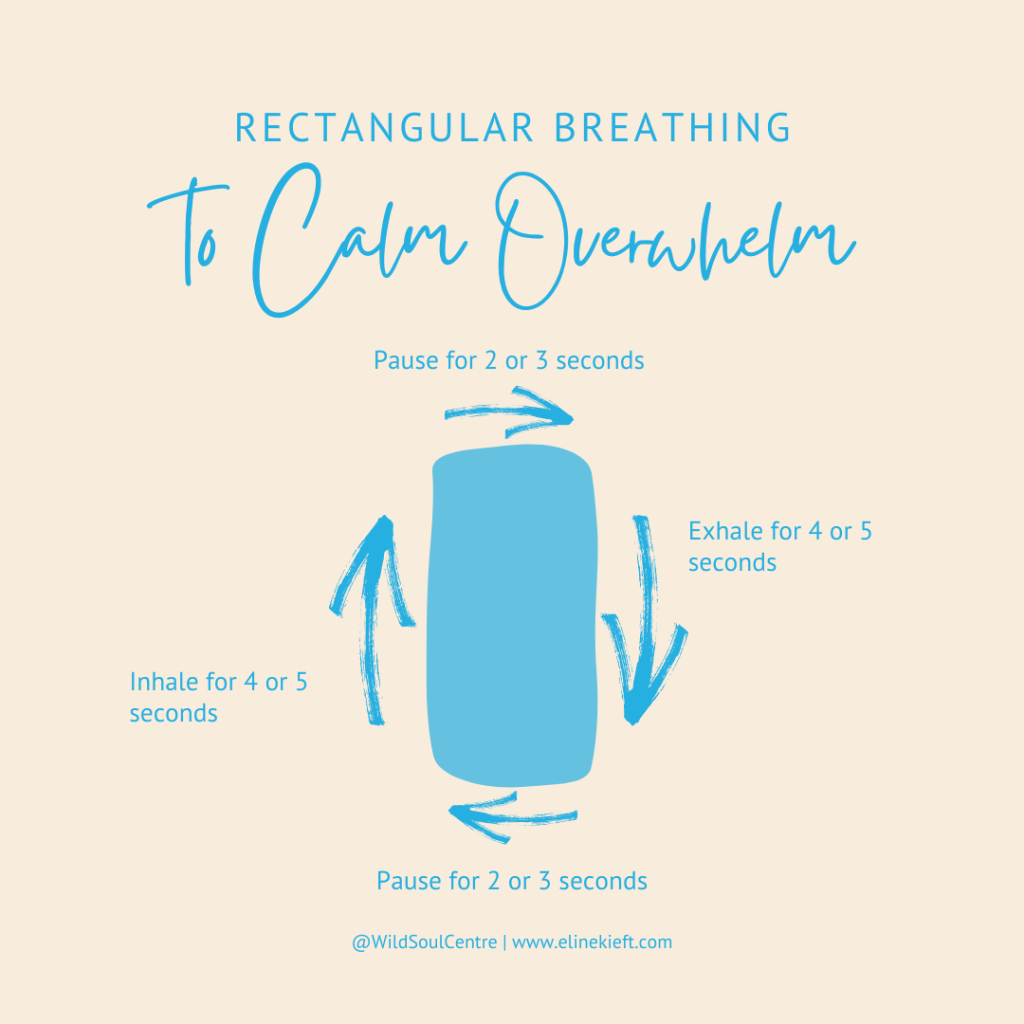
Let’s take a few deep breaths. In and out. Notice how your ribs open, your chest widens, your shoulders rise and fall with your breath, and literally more space opening up inside. With movement, even as simple as breathing, you can always shift your inner state. Breathing in, you can top up your energy, breathing out you can let go what no longer serves. This is an incredibly powerful transformation that is accessible to us at anytime.
Our Nervous System
Overwhelm is the feeling of not being able to cope or deal with something. Now this is a very personal experience, and what is overwhelming for one person, might not be overwhelming for another. What matters is that you experience it. There is no need for justification, or a feeling of failure. Overwhelm is simply a state, but not one you have to reside in most of the time.
I consider overwhelm as a form of stress. Let’s have a closer look at the arousal state in our nervous system.
When we feel safe, calm, and connected, we are open to engage with others, to play, to learn, and the self healing capacity of our body is switched on. This is our ideal state, in which we want to hang out as much as we can. It is called the parasympathetic nervous system, when the self-healing capacity of our body is active.
We are hardwired in such a way that the moment we perceive a threat, we automatically switch to the sympathetic nervous system. This is important to keep us safe from danger. Our blood pressure, heart rate and adrenalin increases, and our fight or flight mode is switched on. That means we can take action as needed. Fight mode expresses as frustration, irritation, anger or range. Flight mode expresses as panic, fear, anxiety, worry and concern.
Both of these in themselves are absolutely fine, indeed, they will keep us safe. However, most of us are pretty much permanently in fight or flight mode, without switching back. And when we experience a chronic trigger in the form of overwhelm, stress, or deep trauma, the nervous system enables a further ‘shutdown’ response to conserve energy and protect us from further harm. There can be a sense of internal collapse, immobility, dissociation, numbness, or helplessness. As you can understand, remaining stuck in this state can have serious adverse effects on our physical, emotional, and mental well-being.
So what can we do to return to the parasympathetic nervous system on a regular basis – and indeed, make that our generic default state?
How to Transform Chronic Overwhelm
- Increase Energy: Have you ever noticed that you’re more easily able to deal with life and unexpected things, when you feel energised? One of the best things you can do to minimise overwhelm is to strategically increase your energy. Find out what resources and energises you, and make this a regular priority, preferably daily.
- Raise body awareness: Learn to pay close attention to your body, and notice when your muscles tense up & contract, your breath gets shallow or quick, your energy goes down or you feel anxious. This way you can take action before overwhelm occurs.
- Slow down: When you feel triggered, slow down and acknowledge your feelings. Step back from the circumstance to create space. When you have enough space, the problem becomes smaller. If you can, desensitise the trigger with humour and give yourself a compassionate wink.
- Move your spine while breathing consciously. This helps to switch back to the parasympathetic nervous system.
- Make a new choice: Figure out the direction of energy you want to take, how you want to show up, and re-engage when you are ready.
Let us know in the comments what helps you to minimise and work with overwhelm!
I’d also love to invite you to my free Movement Masterclass on 13 March, in which you can learn 5 specific movements to transform overwhelm and reset your energy. You’ll find the details below.
Events
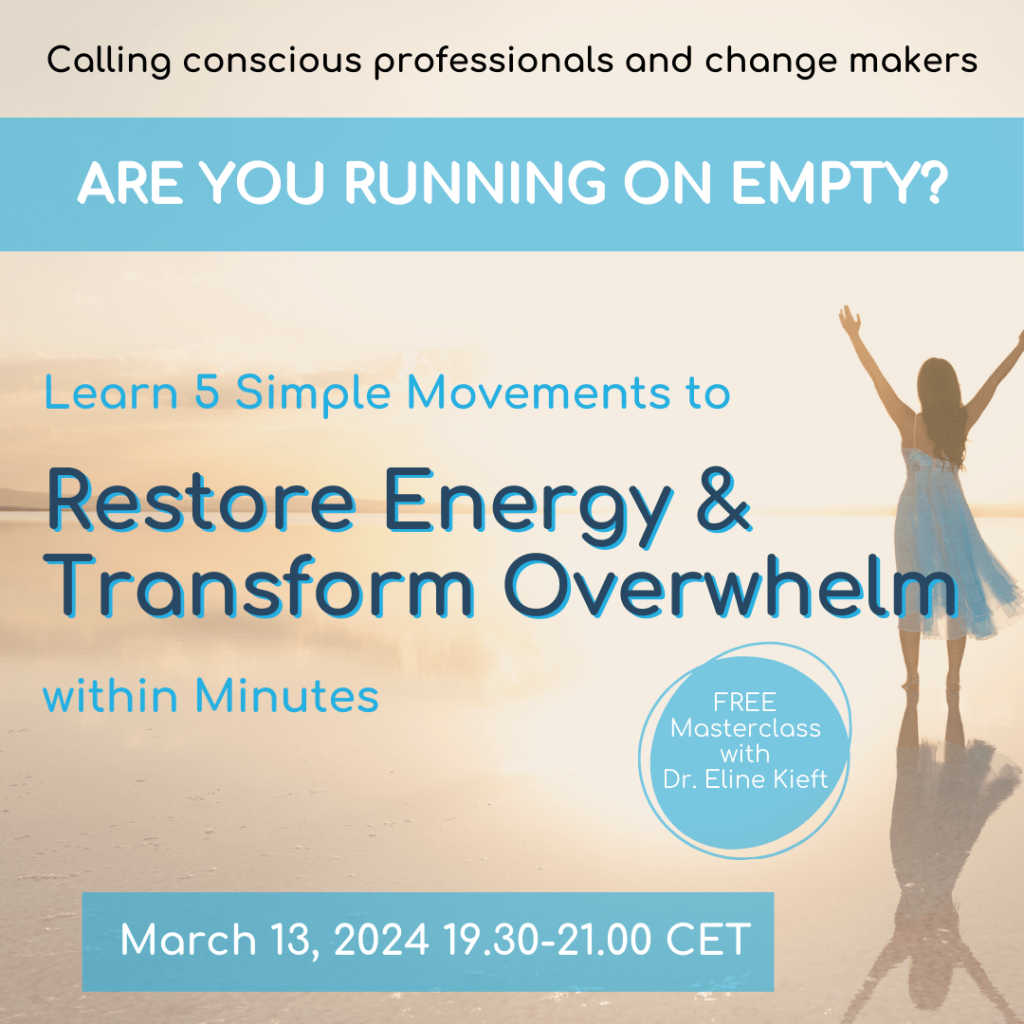
March 13th: Free Movement Masterclass! Learn how movement can reset your nervous system, release unhelpful thoughts and emotions, shake off stress, call your power home, and boost your protective energy field so you can meet life with centred confidence. You will learn an easy movement routine to reset, release, recharge and reclaim your energy. Read more here.
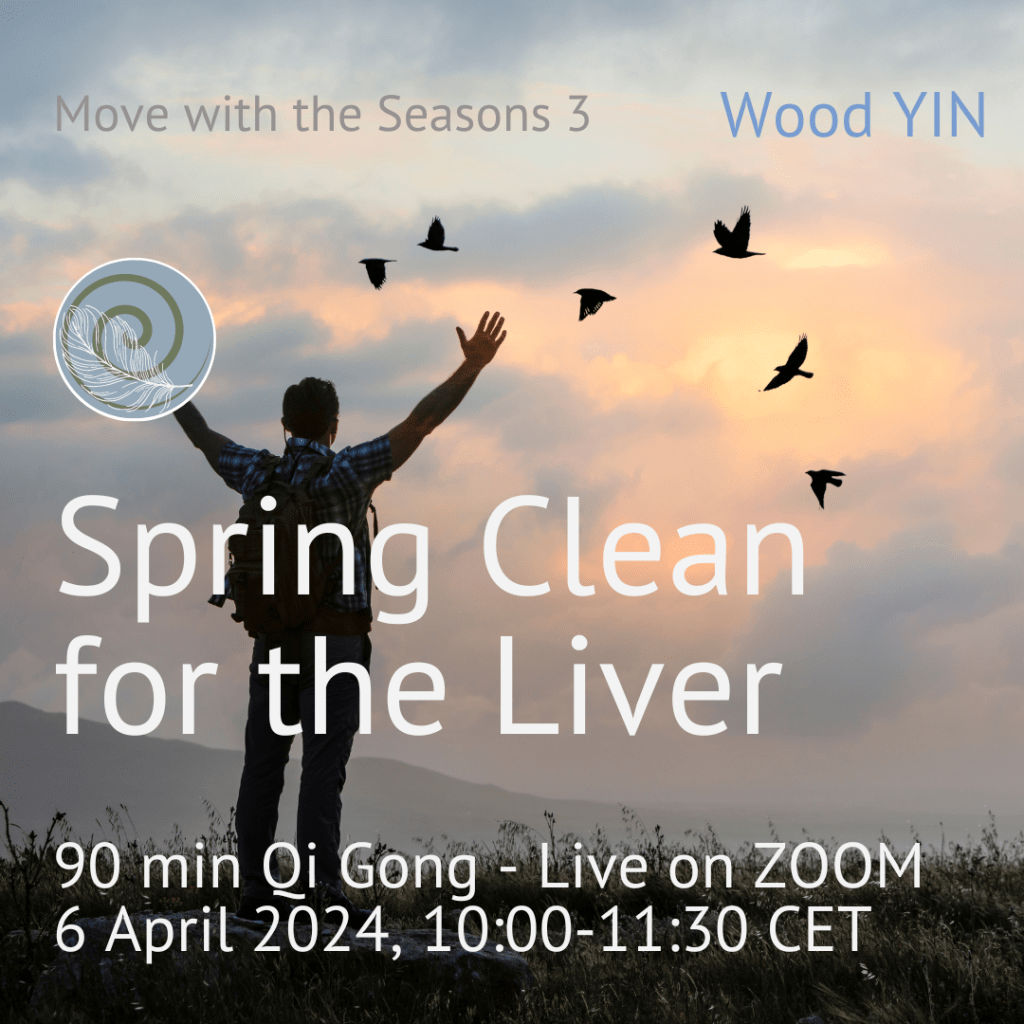
Qi Gong Spring Workshop. Live Drop in class on April 6th, 2024 at 10-11.30 CET. We focus on the Yin aspect of the Wood Element, with deep cleansing practice for the liver. It also helps to transform irritation and anger. This way we create space for optimal inner growth for the Spring Season. Enjoy the deep juice of following the elements from Traditional Chinese Medicine (Water, Wood, Fire, Earth and Metal) – Read more here.
Bio

Eline Kieft danced from a young age, including rigorous classical and contemporary training to become a professional dancer. She then studied anthropology, deepening her fascination with worldwide similarities between indigenous traditions regarding intangible aspects of reality and other ways of knowing, including embodied epistemologies and shamanic techniques.
She completed her PhD in dance anthropology at Roehampton University, trained in depth with the Scandinavian Centre for Shamanic Studies and the School of Movement Medicine. Eline worked at the Centre for Dance Research (C-DaRE) at Coventry University for five years, where she created a Somatics Toolkit for Ethnographers, and pioneered soulful academic pedagogy. Her recent book Dancing in the Muddy Temple: A Moving Spirituality of Land and Body was well received as a unique blend of theory and practice and a medicine for our times.
She is now a full-time change-maker and facilitates deep transformation through coaching and courses both online and in person. Wild Soul Centre offers a set of embodied, creative, and spiritual tools to re-connect with inner strength and navigate life’s challenges with confidence.
Website: https://www.elinekieft.com Also on Facebook | Instagram | Twitter | LinkedIn
Discover more from Feminism and Religion
Subscribe to get the latest posts sent to your email.

 Feminism and Religion
Eline, how to contact you? Interested in class but have a couple questions. Searched your entire site, went to the nonexistent Instagram link, can’t find it anyway. You can message me through my WordPress site. Thanks, Laurie.
LikeLike
Thanks for letting me Know Laurie – have updated the links!
LikeLike
Eline, I love how you delve into “underwhelm.” There is so much discussion of “overwhelm” underwhelm happens too. And I am so taken with using our body to balance, to heal and to be present to our lives. It is so beautifully done! Our bodies hold the key to how we experience our life here on Earth.
LikeLiked by 1 person
Oh I see I read that wrong. I just love engaging the body and balancing ourselves through movement – overwhelm or underwhelm.
LikeLiked by 1 person
Yes, and language is so personal. What does overwhelm / underwhelm mean to you?
LikeLike
Good point, I agree language is personal. It is interesting that I misread that line. I am sure Freud would have something to say about that. I guess both speak to me about being unbalanced. And I guess to be “underwhelmed” would indicate a lack of passion. I don’t feel that so much personally, but I do see it all around me in the general mood of people struggling. Perhaps the two aren’t so different after all.
LikeLike
I see underwhelmed in the state of ‘freeze’ – when we have been sooo overwhelmed for a long time, that we get immobilised… we numb out… we dissociate because it’s been too much for too long… So yes, I think you’re right in seeing them as connected!
LikeLike