


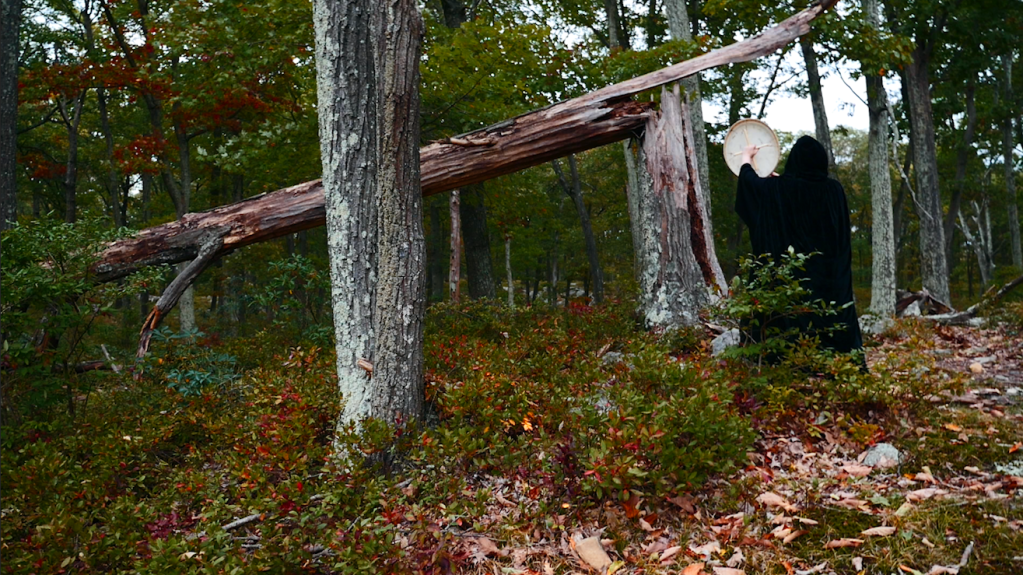
Creation of artist Jym Davis.
As a film history professor, I am intimately aware that women’s representation on screen is historically lacking. While preparing to teach a new course, I found myself hard-pressed to uncover significant academic discourse that highlights the divine feminine that doesn’t solely live in the realm of a Christian worldview. Indeed, film scholar Tenzen Eaghll points out that much of the existing scholarship from the past 100 years “all tend to equate religion with Christian theology in some manner, and … focus[es] narrowly upon Christian themes such as Jesus, salvation, faith, etc.” He states that scholars of religion and film essentialize all religion as Christianity, and that many scholars of cinema additionally speak of religion as an all-encompassing umbrella organization giving us a condensed notion of a shared theological worldview, devoid of nuance and alternate meaning. Eaghll goes on to argue, as I do, for a more critical approach to the study of film that requires us to pay closer attention to how “representations of religion in film conceal issues of race, class, gender, colonialism, secularism, and capitalism – common themes in ideological critique – as well as notions of origin, authenticity, narrative, violence, and identity.” I believe the solution lays in the inclusion of women’s visionary films.
We thankfully have a handful of feminist, psychoanalytical, and post-modern approaches that help give us a language to build upon when discussing women’s sacred symbolism on screen. For example, Laura Mulvey revolutionized feminist film theory in 1975 with her groundbreaking essay, Visual Pleasure and Narrative Cinema, in which she defined the female gaze and provided feminist filmmakers with alternate ways of viewing, analyzing, and creating filmic narratives. In Reel to Real: Race, Sex, and Class at the Movies, bell hooks makes an insightful assertion that “cinema assumes a pedagogical role in the lives of many people… [and] that [her] students learned more about race, sex, and class from movies than the theoretical literature [she] was asking them to read.” The feminist language for film criticism given to us by such scholars assists in framing discourse centered on women’s spiritual depictions on screen. But truly, it is filmmakers who push the conversations further by intertwining female driven narratives with sacred symbolism and spiritual meaning.
I include films such as Daughters of the Dust and The Mistress of Spices in my syllabi. These films broaden the conversation to encompass multiple modes of academic exploration. We can discuss and appreciate each film mentioned for their significant contributions to cinema history and their contributions to cultural discourse, but the conversation needn’t end there. In order to fully discuss films such as Daughters and Mistress, we must approach our analysis of the religious and spiritual symbolism from an ideological standpoint. Julie Dash crafted Daughters of the Dust in 1991 to Sundance acclaim. Being the first feature film created by a Black woman to receive a general theatrical release in the United States, the significance of Daughters cannot be understated. In class, we analyze the themes of the film and talk at great length about the film’s cultural legacy. Jennifer A. Machiorlatti states that in “centering the dynamics of a Black family, specifically its female members, in the Carolina Sea Islands at the turn of the 20th century, Dash embraces moments of cultural history from an Afro-diasporic-feminist modality. The film is the intersection of numerous identity fragments, braiding them together as a process of cultural (re)membering”. Machiorlatti asserts that Daughters promotes a Black glance and weaves together themes of folklore, religious, and spiritual continuity. We also discuss colonization and the tension in African American communities between the survival of Indigenous African faith systems and symbols with the onslaught of and oppression from colonial Christianity. Religious and spiritual symbols within this film must be examined critically through a socio-political, cultural, racial, historical, and gendered lens in order to gleam the full meaning of the film. The women grapple with questions around the spirituality of the past versus the religion of the future. The site of transformation happens within Eula Peazant’s – a woman’s – body, as the spirit of her unborn child guides her on her quest for spiritual clarity and understanding. Failing to critique the religiosity of Daughters from an ideological standpoint would contribute to the dominant and dismissive attitude of many scholars of religion by effectively glossing over major spiritual themes and part of the cultural significance of the film.
Chitra Banerjee Divakaruni’s book turned film, The Mistress of Spices, directed by Paul Mayeda Berges, examines a woman’s social position in various ways. Frederick Aldama asserts that Divakaruni, as an author, is “centrally concerned with giving shape to South Asian women’s lives in a gendered India and United States society.” She seeks to create characters that give power to the domestic space so often inhabited by women. Like Dash, Divakaruni weaves culture with magical realism to highlight the immigrant and diasporic struggle of her protagonist, Tilo, as she attempts to adjust to her new world. In The Mistress of Spices, Tilo’s body is sacred and must be kept pure and out of reach of the general population. Her body, her spice shop, and her chili peppers act as healer and prophetess, mediating between the hands of fate and the harsh realities of the mundane world. An ideological analysis of religion’s impact on women’s social location and freedom of movement is necessary here. The expectation for Tilo to operate as healer and caretaker while suppressing her own desires is a theme often found in historical and theological discourse. Tilo must choose between passion and piety while navigating the cultural and religious restrictions placed upon her by her elders. To ignore the connections between conservative religious doctrine and thoughts about the female body would do Mistress a great disservice.
This takes my students into discussions of the representation of the feminine on screen. We can then speak to what these films are saying about women, their spiritual lives, their moral struggles, and the challenges the world has placed upon them. We cannot do that with narrowly defined definitions and approaches to religion. By presenting a more inclusive and globally diverse canon of cinema, we naturally introduce our students to other ways of thinking and talking about religion. I argue that we can revive stale and archaic ideas about religion’s place in a modern world when we demonstrate its persisting presence in modern and inclusive cinema. The mentioned films give us a tool for more in-depth scholarship centered on sacred feminine symbolism. Films such as Daughters of the Dust and The Mistress of Spices, help give magical realism a feminist slant by fashioning strong, female protagonists who employ elements of fantasy and myth with passion to critique patriarchal traditions and dramatize the potential of women in positions of power and agency. By tapping into symbolism that is overtly and delicately feminine, Dash and Divakaruni weave unspoken language into the cinematic landscape that reads: female body as divine. This reading of divine feminine and the ways in which we discuss non-patriarchal cinematic symbolism, creates a blueprint for additional discourse surrounding representation on screen beyond the boundaries of women’s visionary film.

Bio: Freia Serafina is a multi-disciplinary artist and educator whose work highlights the connection between women, nature, myth, and the divine. Her background in film and theatre supports her inquiry into the relationship between ritual and the performing arts where she has analyzed, both creatively academically, the magical and mystical elements found throughout Shakespeare’s body of work. As a PhD student of Women’s Spirituality, Freia has expanded this inquiry to include nature, the feminine archetype in folklore, and Goddess herstory. Freia joyfully works as a Women’s Circle facilitator where she deepens her connection to the cycles of the Earth and her fellow women. Additionally, Freia is available for educational workshops, Goddess informational workshops, women’s circles, and more. www.freiaserafina.com
Discover more from Feminism and Religion
Subscribe to get the latest posts sent to your email.


Thank you so much for this post – you are so right about the importance of women’s visionary film and art in general. I am excited to check out the two films you mention. It is so important for women to support these kinds of films so that more will receive the resources to be made, and your efforts to let people know about them truly make a difference!
LikeLike
thank you, Carolyn! Might I recommend Whale Rider and Monsoon Wedding as well? While the Mistress of Spices is dear to my heart, it has several critiques as a film in general (outside of its themes). My students and I use that film to also discuss the daunting task of adapting something from the page to the screen! Happy viewing!
LikeLike
Daughters of the Dust is a masterpiece, revisioning an African Diasporic cultural world unknown to most people, bringing the beauty through.There are also documentary films that re-vision women’s spiritual worlds, like my own video Woman Shaman: the Ancients. It scans the cultural record across the world, from rock art to sculpture and ceramic paintings, for the ecstatic dancers, healers, seeresses, and women who journey in the spirit. Contents and trailer can be seen here: https://veleda.net/product/woman-shaman-the-ancients-dvd/
LikeLike
yes! Thank you for sharing. I’ve been a big fan of yours since you first spoke in one of my classes at CIIS :) I can’t wait to purchase and watch your film!
LikeLike