On the Removal of the Confederate Statues by Stephanie Arel

In the wake of Charlottesville, and following Xochitl Alvizo’s recent post on the topic, I review the May 2017 speech from New Orleans Mayor Mitch Landrieu who made a compelling case for the removal of confederate statues from public view in his southern city. In his argument, he poses a simple question related to how an African American mother or father explains to their 5th grade daughter the reason why a statue of Robert E. Lee holds a prominent visual position on the New Orleans landscape. He asks, pointing to the audience, “Can you do it? Can you do it? Can you look into her eyes and tell her why Robert E. Lee is there to encourage her?” The implication of course is, “No,” because Robert E. Lee is not placed upon high in this stronghold of southern history to inspire her.

Landrieu asserts in the speech that the wounds of slavery remain raw because they are wounds that have not only gone unrecognized but they are wounds that have never been allowed to heal. Instead, he says, American cities have committed “lies by omission” failing to honor memory through the confederate emblems, instead erecting statues to pay reverence to men and only parts of their legacies. If this were not the case, if the whole story were told, then memorials at lynching sites and monuments of slave ships would be present in the United States, but they are not.

The statues celebrate, he asserts a “fictional sanitized confederacy ignoring the death, ignoring the enslavement, ignoring the terror that it actually stood for” erected to send a message about who was still “in charge.”    Continue reading “On the Removal of the Confederate Statues by Stephanie Arel”

Making America What Again? Reflections for the 4th of July by Sara Frykenberg

I find myself asking (again), when the religious right, evangelicals, and Christian fundamentalists hear Trump say, “Make America Great Again,” do they really hear him saying, “Make America Christian Again?” How can the really hear him saying that in light of what this man has actually said and actually done? The answer: because of the same mythical purity that erases the violence, slaughter, and atrocity attached to this “Christian nation’s” founding.

Sara FrykenbergMy mother sometimes likes to watch the movie “Independence Day,” on the 4th of July—you know, the one where Will Smith, the gutsy and heroic Marine pilot, Jeff Goldblum, scientist, and Bill Pulman, president, save the Earth from extraterrestrial invasion? It’s an action film loaded with implicit myth and exceptionalism, extolling “mankind’s” common humanness in the face of annihilating, “alien” difference. The heroes ultimately unify the globe with fly-by-the-seat-of-your-pants “American” ingenuity, luck, and bravery. Continue reading “Making America What Again? Reflections for the 4th of July by Sara Frykenberg”

The Trees and We Breathe Bombs Long Gone by Elisabeth Schilling

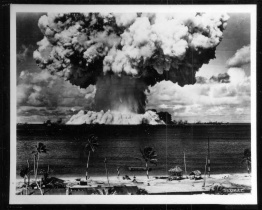
bikini atoll bombI wish that in our pursuit of finding cures for illnesses we would do more as a collective species to prevent the causes, sometimes environmental ones. Why do we vote for people to make decisions that represent us but that we would never in a million years agree to? Bombs and the consequences of them raise questions of health and power. In the Yoga Sutras, 2.30, we read that “Yama consists of non-violence, non-lying, non-stealing, appropriate use of vital energy, and non-possessiveness.” The yamas are our social restraints. They are a negation of behaviors we might usually partake in.

Ahimsā, or non-violence, is listed first. It is the first element of the first limb of yoga; it is the basis for every other ethical aspect of our lives. Bombs are an example of a common and frequent behavior of violence that make the land, water, and sky increasingly uninhabitable. According to Micah Zenko of the Council on Foreign Relations, in 2016 alone, the U.S. is estimated to have dropped 26,172 bombs. Zenko says that this estimate is “undoubtedly low.” (1) This is one year and the bombs from one nation. (2) What is the environmental impact of all of the bombs dropped from every nation since the beginning of bombing history?

When a bomb is detonated, there is not only harm to the immediate life in that vicinity but life in the future and far away. According to the International Campaign to Abolish Weapons (ICAN) website, “the International Physicians for the Prevention of Nuclear War has estimated that roughly 2.4 million people will eventually die as a result of the atmospheric nuclear tests conducted between 1945 and 1980, which were equal in force to 29,000 Hiroshima bombs.” (5)

According to a statistic updated March 2016 on the Ploughshares Fund website, nine countries in the world have a total of 14,900 nuclear weapons, the U.S. and Russia holding 93% of them. (3) They have been used twice, both times by the United States, in war, but additionally they have been used in tests over 2,000 times in more than 60 locations over the globe, according to ICAN. (4) There are already unavoidable consequences to the earth and humans because of this irresponsible behavior that is ongoing.  These tests occur in the atmosphere, under the earth, and under water. (6) Continue reading “The Trees and We Breathe Bombs Long Gone by Elisabeth Schilling”

Pride by John Erickson

When we come together, we are the Divine.  I didn’t think I could experience that twice in one year; clearly, I was wrong. 

If you’re anything like me you not only hate opening up your Twitter feed each morning but also feel compelled to in order to make sure you didn’t miss whatever new atrocity to come out of 1600 Pennsylvania Ave. After the Women’s March, I felt charged. I felt that whatever this administration threw at the proverbial “us,” I knew we could and would overcome it. Although that charge kept me going for a few months, there came a time where I just couldn’t go on anymore and that I was completely drained; then walked in a man named Brian Pendleton.

After the Women’s March on January 21, I didn’t know what to expect. The event was truly so successful that many of the organizers and coordinators were on an activist high as a result of what was a truly magical and divine moment. A few months came and went and the 45th President of the United States continued (much to our surprise) to be as awful as we all knew and expected. However, while I am able to exist in a world, no matter how oppressive, as a cisgendered white male and the full on privilege and power that comes along with that territory, many of the individuals and communities being attacked did not have those same freedoms; and like with the Women’s March and how that all took shape, in walked Brian Pendleton to my life to talk to me about the #ResistMarch.
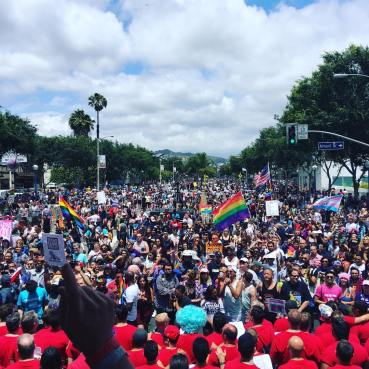
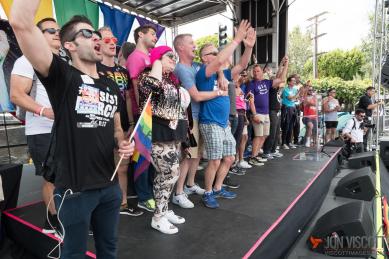
Cover PhotoAlthough my involvement during the 120 days or more that led up to the #ResistMarch happened in a flash, one thing is for certain: miracles exist not because of divine intervention but because G-d places people on this Earth to make positive impacts. The beauty of the #ResistMarch was not just the passion of the organizers but the beauty of the rainbow that came out in full force on June 11

The strength shown by our community was one that, for all intensive purposes, proves that love does conquer all. RuPaul couldn’t have expressed the common and conquering theme better than when he said: “It’s all about love; giving love and being able to receive love. That’s our secret weapon; that’s the one thing they don’t have: our love and our music. That is our activism. That is what we use and what we always use to fight the ugliness.”

That is the one experience that I took most out of the #ResistMarch: the power of love and friendship; the beauty in the unexpected conversation that leads to changing the world, again.  Thank you, Brian. Thank you, for bringing us all together to resist, recharge, and love.
19055531_10158898620590385_6920780108892374453_o

When we come together, we are the Divine.  I didn’t think I could experience that twice in one year; clearly, I was wrong.

John Erickson is the President of the Hollywood Chapter of the National Organization for Women. John is a Ph.D. Candidate in American Religious History at Claremont Graduate University where he is finishing up his dissertation tentatively titled “Step Sons and Step Daughter”: Chosen Communities, Religion, and LGBT Liberation.” John holds a MA in Women’s Studies in Religion; an MA in Applied Women’s Studies; and a BA in English and Women’s Studies. He is the Founding and Past President of the University of Wisconsin Oshkosh’s LGBTQA+ Alumni Association and currently serves as the Chair of the Legislative Committee for the Stonewall Democratic Club, a Diversity and Inclusion Fellow at Claremont Graduate University. He is a permanent contributor to the blog Feminism and Religion, a Co-Founder of the blog The Engaged Gaze, and the Co-Chair of the Queer Studies in Religion Section of the American Academy of Religion’s Western Region, the only regional section of the American Academy of Religion that is dedicated to the exploration of queer studies in religion and other relevant fields in the nation. In April 2017, he was the first openly gay athlete to be inducted into the Wisconsin Volleyball Conference Hall of Fame. Most recently, John was one of the coordinators of the Women’s March Los Angeles, which brought together 750,000 people in downtown Los Angeles on January 21, 2017, and a Committee Member for the #ResistMarch, which brought together 100,000 people from Hollywood to West Hollywood in honor of LA Pride on June 11, 2017.



Preserving the Complete History: Remembering Japanese Internment Camps By Anjeanette LeBoeuf

A couple of months ago I did a day trip to visit the historical site of one of the 10 internment camps which were formed due to Executive Order 9066 issued on February 19, 1942. Manzanar Relocation Camp is located between the Sierra Nevadas and the Owens Valley. Manzanar held over 11,070 Japanese Americans from 1942–1945. EO 9066 forced 120,000 American citizens to leave everything and become in all accounts prisoners; two-thirds of those were native-born American citizens. This executive order largely focused on people living on the West Coast of the United States to eliminate the possible threat of a secondary attack. They were relocated far inland and the majority of the camps were outside of the West Coast. While this was done in the 1940s, our current climate is looming to make it seem like there are forces in this world that are attempting to perform different forms of subjugation and confinement. Continue reading “Preserving the Complete History: Remembering Japanese Internment Camps By Anjeanette LeBoeuf”
Gay Pride and Gay Resistance by Marie Cartier

marie-with-pussy-hat-made-by-sister-cast-member-amandaWelcome to the resistance, Feminism and Religion family. This month is Gay Pride Month in many cities, including mine—Long Beach, California—where we just celebrated our 34th gay pride parade and our annual “Dyke March.” gay pride slogan
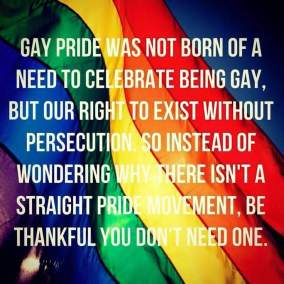
This blog is primarily a photo essay of those events and past pride events I have been in—a celebration of pride and gay family during the spring months which commemorate the first televised gay uprising against police harassment by the gay and lesbian and transgender family on June 28, 1969 at the Stonewall inn in New York City, NY.  Continue reading “Gay Pride and Gay Resistance by Marie Cartier”

Leadership in the Kali Yuga by Elisabeth Schilling


green pathSince the U.S. has elected a reality TV show billionaire to represent our nation, we should be no longer be able to shy away from the ignorance, violence, and frivolity that is within us. Happiness and peace in humanity seem to be in short supply. How many of us experience continuing bliss, or do we only fantasize and find brief reprieves in our suffering? Even the more extreme privileged among us most likely share the same emotional landscape.

In Indian cosmology, Hinduism specifically, there are four stages (yugas) of humanity that occur in a cycle. They represent the ascending and declining spiritual, psychological, and physical well-being of humanity. The Satya Yuga is first (descending) and last (ascending) era, where people are without strife, disease, or fear. Satya means “truth.” Life increasingly deteriorates through out the Treta Yuga to the Dvapara Yuga to the Kali Yuga.

Continue reading “Leadership in the Kali Yuga by Elisabeth Schilling”

Remembering Sor Juana Inés de la Cruz’s Life and Legacy: Champion of Universal, and Non-Human Rights November 12, 1648/51 – April 17, 1695 by Theresa A. Yugar

She studies, and disputes, and teaches,
and thus she serves her Faith;
for how could God, who gave her reason, want her ignorant?

—Sor Juana Inés de la Cruz, Villancico, or, “Carol”, in celebration of St. Catherine of Alexandria (1692)

05.Yugar 1The reason for this blog, and for writing it on this day, is to celebrate and remember the life and legacy of Sor Juana Inés de la Cruz.

In 1994, I was exposed, by chance, to the life and writings of 17th century Novohispana feminist Sor Juana Inés de la Cruz. I am the product of twelve years of Catholic education, eight years of which were in an all-women setting. Again, by chance, I learned about Sor Juana in a liberation theology class while studying feminist theology at Harvard Divinity School. In this class, I learned about Sor Juana’s bold advocacy of the right of women to be educated. This spurred me to learn more about this Catholic Latina theologian whom I would later discover was the last great author of El Siglo de Oro (Spain’s Golden Age), recognized in her era as an esteemed poet, mathematician, astronomer, and more. This was the beginning of my life-long passion to reclaim the legacy of Sor Juana and her-story within the Christian, non-Christian Western tradition, and in Spanish and Mexican history. Continue reading “Remembering Sor Juana Inés de la Cruz’s Life and Legacy: Champion of Universal, and Non-Human Rights November 12, 1648/51 – April 17, 1695 by Theresa A. Yugar”

Painting the Mother of Exiles by Angela Yarber

angelaLast month, my column focused on the importance of intersectionality within the feminist movement by highlighting the revolutionary work of Sojourner Truth, an escaped slave, abolitionist, and women’s rights activist. I’d like to continue to press the importance of intersectionality, particularly given our current political state. Of late, I’ve received a little criticism that some of my recent Holy Women Icons are too political, particularly with reference to Mothers of Black Lives Matter, Dolores Huerta, and the Midwives of Standing Rock. As a woman artist, and particularly a queer woman artist, the personal is always political. Feminists taught us this decades ago. Since the lives, loves, and bodies of LGBTQs, women, refugees, immigrants, people of color, Muslims, Jews, those who are differently abled, and the poor continue to be legislated, violated, excluded, and oppressed, I’d contend that writing about, painting about, and working for liberation for all of these intersectional identities is paramount, especially for those who profess faith in a homeless refugee liberator from the Middle East (that would be Jesus, of course). Needless to say, I believe these recent works in the Holy Women Icons Project fit in quite nicely with the over seventy revolutionaries—political and otherwise—that I’ve painted and written about in the past.

These critiques combined with the current climate of the United States, new legislation passed, proposed, and promised that attacks the lives of the aforementioned marginalized groups. So, I took to canvas and, for the first time, I did not pen the poetry scrawled across the holy woman’s heart. Instead, I relied on the words of Jewish American poet, Emma Lazarus (1849-1877). Most famous for the portion of her sonnet, “The New Colossus,” that graces the pedestal of the Statue of Liberty, I wanted Lady Liberty and Lazarus’ timely words to become my newest Holy Woman Icon. In its entirety, “The New Colossus” reads: Continue reading “Painting the Mother of Exiles by Angela Yarber”

Welcome to the Resistance by John Erickson

john-womens-marchThere comes a time in all of our lives when we have to make important decisions. What do I believe in? Who do I want to be? What and who will I stand up for? There has been a lot going on in the world lately and a lot of it, sadly, is pretty awful. While people are learning pretty quickly that elections have very real and long-lasting consequences, what is critical to make clear in the next 4 years of this fascist regime isn’t just that we are taking to the streets to make our voices heard, but that we are willing to disrupt society at every turn to make sure that people on the other side of the proverbial political coin know we will not go gently into that good night.

I’ve been questioning G-d a lot lately; wondering what has happened to that shining “City on a hill” that John Winthrop called for in his 1630 sermon “A Model of Christian Charity.” The idea that the United States of America is “G-d’s country” is based in an American exceptionalism based not only the rich bounty of land and resources many would soon benefit from, but also on the potential for a different kind of society that America represented in a world full of monarchs. Continue reading “Welcome to the Resistance by John Erickson”