When I first returned from my ancestor quest in Germany, I fell ill with a bad cold and cough and had little physical energy. For two weeks I lived in the dreamtime, communicating with the ancestors and trying to make sense of the information about their lives I had discovered. After I got better, I had difficulty returning to daily life. The ancestors wanted to speak through me. Their stories, based on facts, come to me in waking trance.
Feeding the ducks
Agnes Lattauer Sweitzer : I was born in Ober-Floerscheim (Hessen Darmstadt) on July 9, 1812. I was the first in a family of five children. Four years after me came Jakob, named after Father, and three years later, Rudolph. It was nice to have brothers, but my dream of a sister came true when Catherina was born a month and a day after my tenth birthday. My mother was busy with Jakob and Rudolph, so I became a second mother to Catherina. I could not nurse her, but I could sing to her and rock her to sleep. I changed her diapers and gave her a bath. It was so wonderful to have a baby to take care of. Three years later little Johanetta was born two days after my thirteenth birthday. Another baby for me and Mother bring up together. I was in heaven. I was both mother and sister to the little girls. When they got older, I took my little sisters to play by the stream, where they giggled and cooed as we fed the ducks and the geese. In the summer, Mother and I brought them with us to the fields where we hoed and planted, weeded and harvested. They tried to pull weeds with their little fingers. It was my job to keep them from pulling up the plants too. Continue reading “A Tale of Two Sisters by Carol P. Christ”
I am Carol Patrice Christ, born in Pasadena, California, daughter of Janet Claire Bergman, born in El Paso, Texas in 1919, daughter of Lena Marie Searing, born in Lyons, Michigan in 1891, daughter of Dora Sophia Bahlke, born in Lyons, Michigan in 1858, daughter of Maria Sophia Catherina Hundt, born in Parum, Mecklenburg in 1827, daughter of Catherina Sophia Elisabeth Schoppenhauer, born in Pogress, Mecklenburg in 1798, daughter of Anna Sophia Seehasse, born in Zulow, Mecklenburg in 1756 in the clan of Tara. I come from a long line of women, known and unknown, stretching back to Africa.
In our ritual on the Goddess Pilgrimage to Crete this May, I will have two new names to add to my mother line. The name Sophia was passed down through the maternal line for at least four generations. I am sorry it was not handed down to my grandmother, my mother, and me.
When I left for Germany a little over a month ago, I knew that Dora Sophia Bahlke was the mother of my grandmother Lena Marie Searing and that Dora Sophia’s parents were Anton Bahlke and Maria Hundt, immigrants from the small towns of Parum and Dummerhutte, in Mecklenburg, Germany. I did not have their parents’ correct names, and I had very little information about their lives in Germany. I have now put some flesh on the bones. Continue reading “An Illegitimate Child in Mecklenburg, 1850 by Carol P. Christ”
In the past month I have been on a spiritual journey seeking my German ancestors. Six of my 2x great-grandparents were born in Germany, which means I am 37 ½ percent German. Growing up, I was subjected to a form of patriarchal family disciple I came to identify as German, but I was told very little, positive or negative, about my German heritage.
Though I had been researching my family tree for five years when I began my trip to Germany, I had no clue about where in Bavaria the Thomas Christ-Anna Maria Hemmerlein branch of my family originated. While making final preparations before the trip, I learned that German church records are no longer kept in individual churches, but are grouped together in church archives. Some areas also have family records in state archives. Contrary to popular belief, the majority of German records were not destroyed in the two World Wars. However, many of the German records are not online. Continue reading “Finding Bavarian Ancestors by Carol P. Christ”
If you ever eavesdrop on a conversation between my husband and me around the clamor of our four children’s voices, you will probably hear me making a tired lament: “All I want is a broad swath of uninterrupted time.” In listening to Elizabeth Gilbert’s newest book, Big Magic, on audio book I was interested by her mention that many creative people lament not having long stretches of uninterrupted time available in which to work. She quotes a letter from Herman Melville to Nathaniel Hawthorne, lamenting his lack of time and how he is always pulled “hither and thither by circumstances.” Melville said that he longed for a wide-open stretch of time in which to write. She says he called it, “the calm, the coolness, the silent grass-growing mood in which a man ought always to compose.”
…I do not know of any artist (successful or unsuccessful, amateur or pro) who does not long for that kind of time. I do not know of any creative soul who does not dream of calm, cool, grass-growing days in which to work with- out interruption. Somehow, though, nobody ever seems to achieve it. Or if they do achieve it (through a grant, for in- stance, or a friend’s generosity, or an artist’s residency), that idyll is just temporary—and then life will inevitably rush back in. Even the most successful creative people I know complain that they never seem to get all the hours they need in order to engage in dreamy, pressure-free, creative exploration. Reality’s demands are constantly pounding on the door and disturbing them. On some other planet, in some other lifetime, perhaps that sort of peaceful Edenic work environment does exist, but it rarely exists here on earth. Melville never got that kind of environment, for instance. But he still somehow managed to write Moby-Dick, anyhow.
When I create a new sculpture, I am most often creating something that I need to remember or want to learn. The original figures for my Centered Mama sculpture and my Meditation Goddess sculpture were both created while at a friend’s house for a weekend work exchange as my baby toddled around. While I love making figures of mothers and babies, I was feeling a strong urge to make a goddess representation complete unto herself. It felt like a reclaiming of my non-maternal identity and a declaration of self-sovereignty. She turned out a little bigger than some of my other figures, strong and secure and independent. Then, the baby crawled over and knocked off one of her breasts, knocked her over on the tray, smashing the side of her head. I came close to crying. I felt annoyed with my husband who’d “let” him come over and destroy my work rather than noticing him doing it and stopping him. I was frustrated, dismayed, and my feelings felt hurt in a sense. First I felt like, Argh! This is a metaphor for life! And, then I realized it was not just a metaphor for life, it is my actual life! I pouted a bit and said I was just going to smash her and give up and I made some bitter faces at my husband and some long-suffering huffs and signs, but then the baby fell asleep in the Ergo, held close against my chest. I kissed his soft hair and I took my clay and started again. I reclaimed her from the smashed parts and she sat stronger and taller than ever.
She reminds me not to give up and that beautiful work can come from struggle, but also of interdependence (not just the independence I was going for!), co-creation, and tenacity. When the finished version of her, cast from the original sculpt, sits by my bed at night or overlooks my dinner preparations, she reminds me that I am strong and that persistence is worthwhile. She also tries to remind me to be calm and steady, centered and Zen, even though I more often feel like a whirlwind.
That same Saturday at my friend’s house, as my baby tentatively toddled around the kitchen, chewed on a piece of watermelon, and snoozed on my chest, I felt moved to begin creating a new Centered Mama sculpture. I had been going through an emotional rough patch, feeling buffeted by variable emotions and erratic and unpredictable in my enthusiasm and confidence. I was also feeling impatient, snappy, and irritable.
“I will be gentle with myself. I will be tender with my heart. I will hold my heart like a newborn baby child.”
This song by Karen Drucker replayed in my mind as I sculpted. The baby woke, the watermelon got dragged along the floor collecting dust, and it was time for our collaborative dinner, so I had to put her away unfinished. When we got back to our own home, I was compelled to finish her, working feverishly as the baby pulled on my legs and I said, “just a few more minutes!” to the older kids who were trying to play with him to let me work. Again and again I re-rolled the clay baby’s head, trying to make it “perfect,” and worked to lay down the strands of her hair, against of the backdrop of this often-chaotic, noisy, home-based life we’ve consciously and intentionally created together. She was created to represent holding my own center in the midst of motherhood. I will be tender with my heart. I don’t create sculptures like this because I AM so “Zen” and have life all figured out, I make them to remind me what is possible if I listen to my soul.
As I do extensive rearranging, construction, and reconstruction on my slowly ongoing dissertation project, I typed out a quote from the book Priestess: Woman as Sacred Celebrant by Pamela Eakins about her past life memories of making clay goddess figures as a temple priestess:
…to me it brought a continuation of the energy of the sacred objects of the grandmothers. I contained this energy in a new form in the dolls that would be placed upon the altars and in the graves of the daughters living now and the daughters to come…
I felt this process made my own clay stronger, too. Some of the pieces cracked in the fire because of the added ‘impurities’…but, in this case, I felt the impurities were the purest of pure and I worshipped each crack knowing the crack contained the wisdom of the priestesses who had occupied the doll-making table for more moons than I could even imagine. It contained too, the devotional energy of every grandmother who had held it in her hands or placed it on her altar. Sometimes ‘impurities’ sanctify further that which is holy to begin with.
While I tend to have a knee-jerk skepticism about past-life memories, there is something in Eakins’ words that I know at a bone-deep level as I do my own work with goddesscraft:
…Each goddess was imprinted with the sound of sacred life coursing through the Universe. I changed with the priestesses as the figures came through my hands. Each doll received the sacred vibration of life…For seventy-seven moons I made the dolls at the long table with the young Sisters of Nun. My hands were so fast. I made thousands of figures: beautiful little faces, etched collars of gold plates, pubic hair swirled into tiny rows of connecting spirals. They were so precious. At the end of the day, my baked clay shelves were covered with little women.
The clay goddesses healed…
This is how I apprenticed. I learned, in this manner, the art of healing. I learned that to heal means to make whole, and that becoming whole involves learning many levels of purification, balance, and reformation” (p. 32-33).
In Anne Key’s marvelous priestess memoir, Desert Priestess, she makes this important point: “It is of course no small wonder why graven images are so tightly controlled by religious traditions.” (p. 52) Sometimes I feel like this is what I’m tapping into when I make my own goddess sculptures—a resistance to tight control over graven images and over personalization of divinity as male.
I occasionally get requests to make bigger goddesses–-people ask about figures that are large altar pieces 12-18 inches tall or taller. The goddesses I make are all about three inches tall and there’s a reason for that: they fit in the palm of my hand. When I create them, I feel as if I’m part of an unbroken lineage stretching back 30,000 years to the person who carved the Goddess of Willendorf. I feel connected to the priestesses of the Mesopotamian temples who sculpted hundreds upon hundreds of tiny clay goddesses. Someone commented on my sculptures once saying, “echoes of Mesopotamia.” And, I said, “exactly.” I feel the connection between the clay in my hand and the clay in their hands, running through the ripples and eddies of time.
I’ve been inspired recently to re-read Starhawk’s The Spiral Dance, finding new bits of wisdom from it that speak to something different in me than they did the first time I read it. She writes of the attempts to discredit Goddess religion by invalidating the historical narratives or archaeological evidence: “The idea seems to be that if they can disprove our origin story, they can invalidate our spirituality…Is Buddhism invalid if we cannot find archaeological evidence of Buddha’s existence? Are Christ’s teachings unimportant if we cannot find his birth certificate or death warrant?…the truth of our experience is valid whether it has roots thousands of years old or thirty minutes old…a mythic truth whose proof is shown not through references and footnotes but in the way it engages strong emotions, mobilizes deep life energies, and gives us a sense of history, purpose, and place in the world. What gives the Goddess tradition validity is how it works for us now, in the moment, not whether or not someone else worshipped this particular image in the past” (p. 4).
The ancestry of my goddess sculptures may not be the same energy that raised temples and built monuments (or walls), it is the energy that carried a baby on one hip and a basket of supplies on the other and needed a goddess just the right size to tuck down the front of a shirt…
Sometimes I describe my life in the woods as being held in the hand of the goddess. And, I make goddesses that I hold in my hand. Am I in the palm of her hand or is she in the palm of mine? The answer is both.
(One of my all-time favorite fan photos–a rainy day traveling goddess picture, taken by my friend/SIL (this one is only an inch tall, but look how she calls in the waters of the world!)
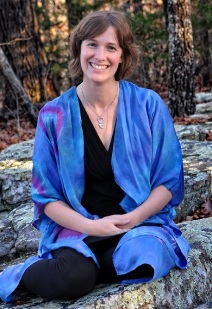
Molly has been “gathering the women” to circle, sing, celebrate, and share since 2008. She plans and facilitates women’s circles, seasonal retreats and rituals, mother-daughter circles, family ceremonies, and red tent circles in rural Missouri. She is an priestess who holds MSW and M.Div degrees and she is finishing her dissertation about contemporary priestessing in the U.S. Molly’s roots are in birth work and in domestic violence activism. She has worked with groups of women since 1996 and teaches college courses in group dynamics and human services. Molly is the author of Womanrunes: a guide to their use and interpretation, Earthprayer, Birthprayer, Lifeprayer, Womanprayer, and The Red Tent Resource Kit, as well as three social service oriented booklets and a miscarriage memoir. She has maintained her Talk Birth blog since 2007 and writes about thealogy, nature, practical priestessing, and the goddess at her Woodspriestess blog. Molly and her husband Mark co-create original birth art, goddess sculptures, ceremony kits, and pendants at Brigid’s Grove.
The last few days I have been living in dreamtime with my Swedish ancestors, most especially with my great-great-grandmother Ingrid, about whom I have learned a great deal over the past year. Through a distant cousin Thomas Sievertsson, who has been researching the part of Sweden from which she came, I have discovered details about the kind of life she lived in the old country that few descendants of immigrants are lucky enough to know. Here are a few of them. Continue reading “In Dreamtime with the Ancestors by Carol P. Christ”
It seems like there is a perpetual debate over acquiring land for progress and growth versus the protection of land that has ties to religion, customs, and cultures. The history of America is littered with stories and events that deal with acquisition of land. The sake of growth, expansion, and progress takes precedence in the history of America. Our country’s geography is a road map of acquired land and the pushing aside sacrality.
In a moving part of Goddess and God in the World, the book Judith Plaskow and I are writing together, Judith describes how the Sabra and Shatila massacre forced her to confront the fact that “her people” are just as capable of perpetrating evil as any other group. Growing up in the shadow of the Holocaust and the pogroms that had scattered her people across the world, Judith was taught to think of the Jewish people as the victims of history rather than as the perpetrators of evil. The willingness of the Israeli army to countenance the outright massacre of up to 3500 people told another story: when in power, Jews too were capable of great evil.
I tell this story because I believe the lesson Judith learned is a lesson that Americans as a group still need to learn. I am thinking about this in the days following the heated debate that led to the removal of the Confederate flag from the Capitol of North Carolina.
In a brave and impassioned speech, Jenny Horne explained that though she is a descendant of Jefferson Davis, she was speaking against the display of the Confederate flag because it is a symbol of the harm that has been done and continues to be done to slaves and descendants of slaves in her state. Jenny Horne was rejecting the story she had been told about what it is to be an American in South Carolina. Continue reading “Changing the American Story? by Carol P. Christ”
When we decided to buy some land on which to build our home, one of the deciding factors was the wonderful big rocks on the hillside behind where we imagined building our house. Over the years, we would go out and walk through the woods and stand on the rocks, and I often said that I wanted to create a sacred space down there to visit regularly. As I realized later, there was no need to “create” the sacred space, it was already there.
Following two miscarriages, I would often go to the woods to sit on a chair-shaped rock and connect with nature and my body. During my subsequent pregnancy with my daughter, I would return to this place to sit and connect with my baby and prepare for her birth. After she was born, I brought her to these rocks and these woods to “introduce” her to the planet. At some point at the end of 2010, I suddenly “heard” the words priestess rocks when I was standing out on these large flat stones that look out over the horizon. It felt like their name, I suddenly knew it. So, in July of 2012 when I became ordained as a priestess, the priestess rocks felt like the absolutely perfect place to bear witness to my ceremony of ordination. They called me. They named me priestess first. Continue reading “Forest Heritage by Molly”
There is a story in the collection called Avadanasataka (One Hundred Legends) of the Sarvastivadin school, one of the schools of early Indian Buddhism that did not survive to present day, relating one episode from the Buddha’s previous lives. The story is about king Padmaka who sacrificed his life to cure his subjects of a disease. Here is an academic article about this episode.
The Buddha was prompted to tell this story of his previous life in order to illustrate to his monks, once again, the workings of karma. All of the monks in the Buddha’s milieu were sick with a digestive disorder, while he remained well. The Buddha presented the story of king Padmaka as a proof that no good deed is ever lost and that what he had done then has an effect now in that the Buddha has good digestion.
I became aware of atDNA (autosomal) tests for ethnicity while watching the PBS American ancestry programs created by Harvard historian Henry Louis Gates. In considering ethnicity, it is important to remember that 99.9% of human DNA is shared. AtDNA testing focuses on the .1% that is not. This type of DNA testing can locate African DNA geographically, and it also can reveal Native American and Jewish ancestry. When the test recently became less expensive, I decided to try it. I was particularly interested to see if my 3x great-grandmother Gertrud Zimmerman might have been Jewish. Continue reading “Ancestor Connection and DNA Testing by Carol P. Christ”



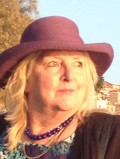 I am Carol Patrice Christ, born in Pasadena, California, daughter of Janet Claire Bergman, born in El Paso, Texas in 1919, daughter of Lena Marie Searing, born in Lyons, Michigan in 1891, daughter of Dora Sophia Bahlke, born in Lyons, Michigan in 1858, daughter of Maria Sophia Catherina Hundt, born in Parum, Mecklenburg in 1827, daughter of Catherina Sophia Elisabeth Schoppenhauer, born in Pogress, Mecklenburg in 1798, daughter of Anna Sophia Seehasse, born in Zulow, Mecklenburg in 1756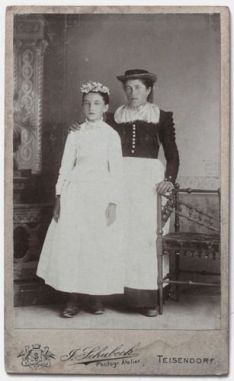
 “If there is one chant in the universe it is to create.”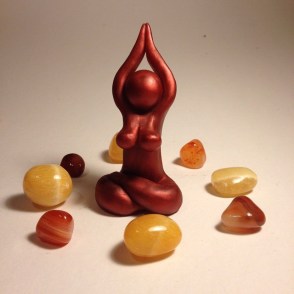
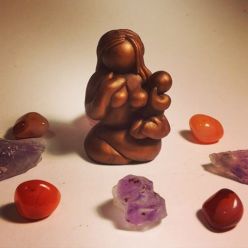
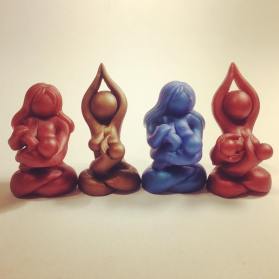
 inches tall or taller. The goddesses I make are all about three inches tall and there’s a reason for that: they fit in the palm of my hand. When I create them, I feel as if I’m part of an unbroken lineage stretching back 30,000 years to the person who carved the Goddess of Willendorf. I feel connected to the priestesses of the Mesopotamian temples who sculpted hundreds upon hundreds of tiny clay goddesses. Someone commented on my sculptures once saying, “
 The last few days I have been living in dreamtime with my Swedish ancestors, most especially with
  It seems like there is a perpetual debate over acquiring land for progress and growth versus the protection of land that has ties to religion, customs, and cultures. The history of America is littered with stories and events that deal with acquisition of land. The sake of growth, expansion, and progress takes precedence in the history of America. Our country’s geography is a road map of acquired land and the pushing aside sacrality.


 Feminism and Religion