Moderator’s Note: This was originally posted on September 19, 2016
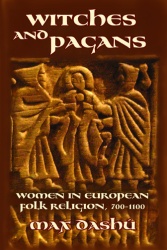
Max Dashu’s Witches and Pagans: Women in European Folk Religion 700-1000challenges the assumption that Europe was fully Christianized within a few short centuries as traditional historians tell us. Most of us were taught not only that Europe became Christian very rapidly, but also that Europeans were more than willing to adopt a new religion that was “superior” to “paganism” in every way. Careful readers of Dashu’s important new work will be challenged to revise their views. When the full 15 volumes of the projected series are in print, historians may be forced to hang their heads in shame. This of course assumes that scholars will read Dashu’s work. More likely they will ignore or dismiss it, but sooner or later–I dare to hope–the truth will out.
History has been written by the victors—in the case of Europe by elite Christian men. These men may have wanted to believe that their views were widely held, but Dashu suggests that they were not. Combing artistic and archaeological records, Dashu finds (to give one example) that images of Mother Earth nursing a snake are far from uncommon and can even be found as illustrations in Christian documents and on Christian monuments. Clerics rage against people—particularly women–who continue to visit holy wells and sacred trees and to practice divination and healing rituals invoking pagan powers. To paraphrase Shakespeare: “Methinks the cleric doth protest too much.” Were these things not happening and happening often, there would have been no need to condemn them. Using these clues, Dashu provides intriguing new readings of the Poetic Edda and Norse sagas.
Jewish amuletic objects come in many forms: salt, the hamsa or hand, the bowl, the scroll with verses, even sword-shaped amulets. These items are meant to provide spiritual protection from malevolent forces such as demons and the evil eye and vary across different times and places. One protective item from Jewish folklore is iron. In medieval Germany, for example, pregnant Jewish women carried an iron object to repel malevolent forces. This was part of a wider cultural norm: across Western Europe, iron was understood to repel fairies and spirits of all kinds, and was sewed into babies’ clothing, hung above cradles and doorways, etc. According to one Jewish legend, when the waters of Egypt turned to blood during the first plague, water in metal vessels was 34245 the only water to remain unchanged. Pieces of iron were placed on all vessels containing water during the solstices and equinoxes—considered to be a time when spirits were roving the world—to protect them from contamination.
We have all been horrified by the Russian invasion of Ukraine as we witness the brutal bombardment of not only military sites but also of civilians, neighborhoods, hospitals, churches, historical sites and nuclear power plants. It has been called the first TicToc war as these images fill up our computers and cellphones, leaving peace lovers challenged to maintain their belief in peaceful resolutions to conflict
In recent days I have been pondering the fact that some people and some feminists seem to see the issues of religious faith and belonging to be rooted in birth, family, and community, while for others the question of belonging to a religious community hinges on belief and judgments about the power exerted by religious institutions. What accounts for this difference in the way we view religious belonging?
Recently I watched The Secret History of Sex, Choice and Catholics, a film featuring Roman Catholic feminists and ethicists who dissent from the Roman Catholic hierarchy’s views on contraception, abortion, and homosexuality. At the beginning of the film those interviewed state almost univocally that for them being Catholic stems from having been born Catholic. These Catholic dissidents continue as Catholics, even though they disagree with major portions of Roman Catholic teaching. It may have been because they were not asked, but most of them did not name reasons of belief for remaining Catholic.
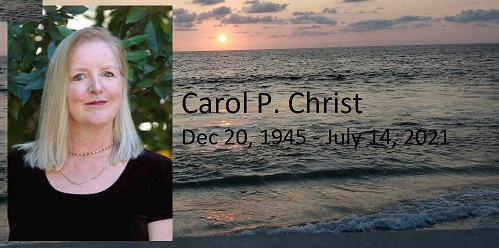
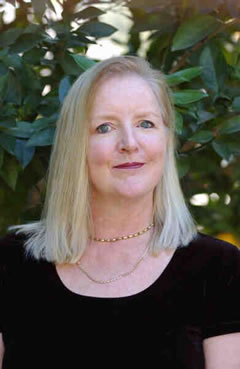
Moderator’s Note: We here at FAR have been so fortunate to work along side Carol Christ for many years. She died from cancer in July, 2021. Her work continues through her non-profit foundation, the Ariadne Institute for the Study of Myth and Ritual and the Goddess Pilgrimage to Crete. To honor her legacy, as well as allow as many people as possible to read her thought-provoking and important blogs, we are pleased to offer this new column to highlight her work. We will be picking out special blogs for reposting. This blog was originally posted February 10, 2014. You can read it long with its original comments here.
Mary, Mary, quite contrary, how does your garden grow? With silver bells and cockle shells, and pretty little maids all in a row.
From the beginning of horticulture about 8000 BCE or earlier to the present day, weeding has been women’s work. Women, who were the gatherers and preparers of food in traditional nomadic societies, no doubt were the first to discover that seeds dropped at a campsite one year sometimes sprung up as plants the next year. When this discovery was systematized, agriculture was invented, and human beings began to settle down in the first villages and towns.
Your ex-boyfriend gave you a solid brass Buddha, one foot high. You hate to think what he had to pay for it. Not knowing what else to do with it, you place it on your bookcase. You must admit that it’s a beautiful object, that it inspires a certain peace. But it leaves you cold, just like the crucifix hanging in your parents’ bedroom always left you cold.
Your ex-boyfriend gave you a solid brass Buddha, one foot high. You hate to think what he had to pay for it. Not knowing what else to do with it, you place it on your bookcase. You must admit that it’s a beautiful object, that it inspires a certain peace. But it leaves you cold, just like the crucifix hanging in your parents’ bedroom always left you cold. Only when you sit in your dead grandmother’s chair and rock yourself into a trance can you reach your world of wonder, that green and gold place where May sunshine washes through newly unfurled birch leaves, where shadow and light dance on the white bark you peel off like onionskin. Long ago, you think, people worshipped their ancestors.
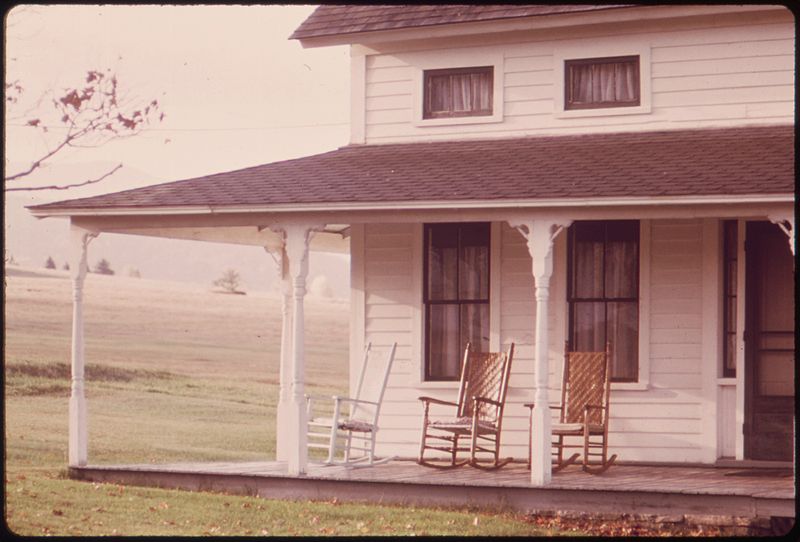
You wake up to cold and gray, to a day so drab that it hurts like a permanent migraine. On the bus ride to the office, the commuters in their career clothes are scrying into their phones. No free seats so you grab the handrail and gaze out the window. Instead of city buildings and dirty snow, you see an old farmhouse at the edge of an apple orchard. A gaggle of geese guards that house. They rush towards you, flapping their wings and hissing. But you walk resolutely on until you reach the veranda, and then the front door, propped open by a pair of gardening shoes. Stepping into the hall, you breathe in the mixture of baking bread and boiled coffee. A woman comes to you, a woman like your grandmother, but older. Her thin silver hair reaches her knees. Her face is so wrinkled, you can hardly see where her glittering eyes end and her crow’s feet begin.
Cocking her head, she says, “What took you so long?” And taking your hand, she marches you into her kitchen where a cat sleeps on the windowsill. She sits you down and serves you elderflower wine in an old jam jar. You take one sip and the kitchen reels around you.
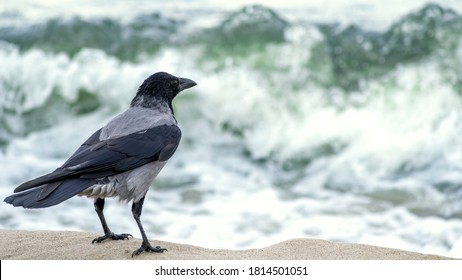
You hear a rushing sound, a pounding, and then you are alone on a beach holding a piece of driftwood shaped like a goose in flight. A strange new weight pulls at your shoulder blades. Craning your neck to investigate, you see the wings sprouting there, blue-black crow wings. Of their own volition, they stretch and flap until you are airborne. Heading out over the waves, the tips of your bare toes graze the water.
“You dream too much,” your ex informs you. “You live on another planet. When’s the last time you watched the news? When’s the last time you voted? You can’t just spend your whole life with your head in the sand.”
Your ex is an activist. He majored in queer theory. He worked on Bernie Sander’s election campaign. He buys everything organic and volunteers one day a month at the soup kitchen. You are humbled by his social engagement, but when he sends you links to articles and videos overflowing with the world’s misery, the weight is too heavy for you to bear. You find yourself wondering how many homeless people he could have fed for the price of that solid brass Buddha.
Your grandmother lived until she was ninety-nine. She quarreled bitterly with everyone who came to visit and expressed concern about the farm falling into disrepair around her. She told them she just wanted to be left in peace. Then one day she died of a stroke while chopping wood on that old farm where she had lived alone for fifty-six years. She died instantly—no lingering pain, hospital gowns, or stench of bedpans or disinfectant. That’s how it is on your mother’s side of the family—the women are widowed early and seem to live forever until the day they suddenly drop dead.
After her death, her children sold her farm to a developer, who tore down her Victorian house to build rows and rows of condos. They left only three of her apple trees standing. Those trees are as old and gnarled as she was when she died. Like old women, they no longer bear fruit but stand and bear witness to what once was, but is no longer.
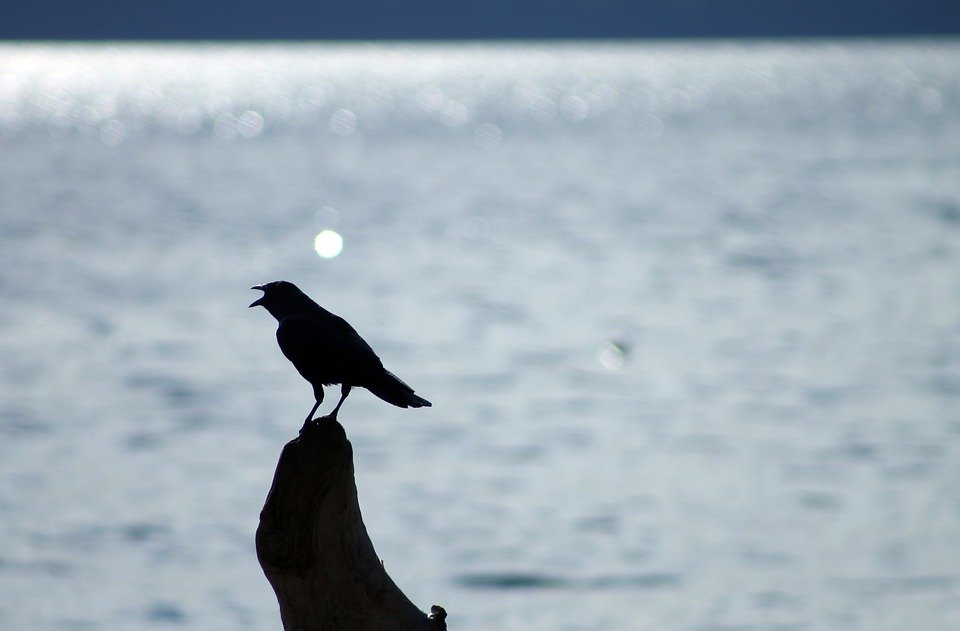
You pack the brass Buddha away in old newspapers, stick it in a cardboard box. You’ve decided to donate it to a drug rehabilitation center. Maybe it will bring the people there peace and clarity. Then you brew a pot of tea and sit in the rocking chair, huddled in an afghan your grandmother crocheted before you were born. You close your eyes and you are far out over the ocean, sometimes floating, sometimes flying. A blast of salt wind fills your shiny black wings, lifting you even higher. Opening your beak wide, you cackle and caw.
Mary Sharratt is committed to telling women’s stories. If you enjoyed this short piece, please check out her acclaimed novel Illuminations, drawn from the dramatic life of Hildegard von Bingen, and her new novelRevelations, about the mystical pilgrim Margery Kempe and her friendship with Julian of Norwich. Visit her website.
We are hard-wired to frame our experience in stories. Almost anything we endure, no matter how painful, can take on a deeper meaning if we see it as one chapter in an overarching narrative. Stories give coherence and meaning to our often fragmented and chaotic lives.
Georgia O’Keeffe lived way beyond Act One!
We live in a youth-obsessed culture. The cosmetic industry pushes wrinkle creams and hair dye on us while celebrities resort to fillers and surgery to preserve an illusion of eternal girlhood. Advancing age, once a mark of honour, has become a source of shame. Popular fiction, literary classics, television, and movies celebrate young heroines, from Elizabeth Bennett to Katniss Everdeen. But where are the stories about older women and why do we all need to hear them?
We live longer than ever before. Women’s lives don’t play out in one act, even though our culture programs us to think that way. It almost seems a travesty to imagine an older Elizabeth Bennett grown bored of Darcy and yearning to reinvent herself and embrace some new adventure.
Old-school male authors were really big on killing off their young heroines so they couldn’t even dream about maturing into women with agency. Shakespeare merrily committed femicide on Juliet, Ophelia, and Desdemona, to name just a few of his hapless heroines.
Ophelia drowning. Don’t try this at home.
Why have so many authors, past and present, refused to let their heroines age? Why this reluctance to write about seasoned female protagonists who have been around the block more than once? Perhaps because too many people, even today, consider experienced women threatening. Since the time of witch burnings and scold’s bridles, male-dominated culture has been petrified of older woman who seize their power. That’s why stories about young women with a certain cut-off date are much cosier and less threatening.
But coming-of-age stories can only take us so far. We need to imagine lives beyond Act One, beyond a vague glimmering on the horizon. We need signposts to help us navigate our long and unavoidably complicated modern lives. We live in an age of divorce, blended families, and many of us pursue several careers and many paths of discovery over the course of a single lifetime. Contrary to cultural expectations, women do have exciting, juicy lives after forty and beyond. Contemporary fiction should explore and celebrate this.
Yes, there have been break-out books about older women—Elizabeth Strout’s Olive Kitteridge, and even literary classics, such as Virginia Woolf’s Mrs. Dalloway—but these are the exceptions that prove the rule. In the publishing marketplace, stories about older women remain a hard sell. Which is bitterly ironic, considering that most fiction is purchased by women over the age of forty.
Yet it’s not just an older audience that needs to read about older heroines. I would argue that girls and young women are in even greater need of literary role models to guide them way beyond a self-limiting Act One.
As a teenager, I was hungry for such stories. Some proof that I had something to look forward to beyond the awfulness of high school (not the best years of my life). Like Holden Caulfield, I was caught in a web of angsty adolescent nihilism which cast everyone from the cheerleaders to the teachers as a chorus of fakes and phonies. I needed a gutsy female role model to pull me out of this miasma.
Eventually I found my heroine, not in the pages of a novel, but in Blackberry Winter, Margaret Mead’s memoir. I was electrified by this strong woman who didn’t give a fuck about preening for the male gaze and yet still had an amazing love life. Born in 1901, in an era when women were programmed for domesticity, she became a pioneering anthropologist and feminist icon. Her memoir, subtitled “My Earlier Years,” is not cut off at Act One, but only ends when she becomes a grandmother. Well into old age, Mead remained a mesmerizing and magnetic presence for being authentically herself.
Mead’s memoir is a rare jewel of female self-confidence in an ocean of women’s self-censorship and self-effacement. In Writing a Woman’s Life, Carolyn G. Heilbrun observes how both biographers and autobiographers have suppressed the truth about lived female experience to force it to conform to society’s script of how a woman’s life should be.
Heilbrun then discusses the Mother of All Female Memoirs, the first to appear in the English language. The Book of Margery Kempe (c. 1436–38) reveals the escapades of a woman mystic who wasn’t enclosed in a cell, but was literally all over the map. Kempe’s call to adventure unfolded amid the bitter disillusionment of midlife. She was forty, a desperate housewife, a failed business woman, a mother of fourteen children, and trapped in an abusive marriage. Marital rape was her lived reality—a fifteenth child might have killed her.
Her story completely exploded my every stereotype of medieval womanhood. Her life choices seem absolutely radical by the standards of our time as well as hers.
Since divorce was not an option, she seized back control by setting off on the perilous pilgrim’s path to Rome, Jerusalem, and Santiago de Compostela. She literally walked away from her unhappy marriage and blazed her trail across Europe and the Near East in an age when very few women traveled, even in the company of their husbands.
Alas, Kempe’s independence and eccentricities drew suspicion. When she returned to England, she found herself on trial for heresy. A guilty verdict would have seen her burned at the stake, yet she kept her spirits high by regaling the Archbishop of York with a parable of a defecating bear and a priest.
Most significantly, the spiritual mentor who stood by Kempe as she made her unorthodox choices was a woman in her seventies, the anchoress Julian of Norwich. Before leaving on her monumental pilgrimage, Kempe sought Julian’s counsel. This was an exceedingly vulnerable time in Kempe’s life. In leaving her husband and children, she had broken all the rules and was filled with self-doubt and uncertainty. Julian’s advice to trust her inner calling and not worry too much about what other people thought seemed to have a profoundly empowering impact on her. While Julian had chosen to wall herself into a cell and live as a religious recluse, she gave Kempe her blessing to wander the wide world.
Kempe’s story would have been lost to history if she hadn’t recorded it in her autobiography, a tremendous act of foresight and courage that made her a literary pioneer. She dictated her story to a priest, who copied it down for her and whose ecclesiastical authority gave gravitas to her narrative.
We are hard-wired to frame our experience in stories. Almost anything we endure, no matter how painful, can take on a deeper meaning if we see it as one chapter in an overarching narrative. Stories give coherence and meaning to our often fragmented and chaotic lives.
Margery Kempe’s story proves that even in the Middle Ages, women had the power to re-invent themselves in midlife and beyond. If Act One disappoints, time to dive feet first into Act Two. We can continually re-vision our own narrative.
Our culture likes to pit women against each other. Divide and conquer. Popular tropes cast young women and older women as rivals or even enemies. In fairy tales a young maiden’s coming of age involves going out into the wild forest to encounter the scary old witch who acts as a foil to the maiden’s youth and innocence.
But if we look past the patriarchal smokescreen, we see that youth and aging are mirrors reflecting one another. The maiden and the witch are not enemies. The true coming of age unfolds when the maiden seeks out the witch who ultimately empowers her. Who teaches her to be fierce and not suffer fools.
As we mature, we are gifted with the superpower of seeing through the false scripts that consumer society hands us. We can see just how absurd it is to kill ourselves to emulate airbrushed fashion models. We understand that the greatest lover in the world can’t fulfill us until we are at peace with ourselves. And so we can let ourselves go, whatever our age. Paint the pictures we’ve always longed to paint. Learn French and travel the world. Dance under the stars and see visions. Offer our own song to the vast symphony of life.
We need stories that honor the entire sweep of womanhood, not just Act One. What would our literary canon and popular culture look like if it truly reflected the depths and breadth of our authentic, lived experience as women and girls today?
This essay was originally published in Literary Hub.
Mary Sharratt is on a mission to write women back into history. Her acclaimed novel Illuminations, drawn from the dramatic life of Hildegard von Bingen, is published by Mariner.Her new novelRevelations, about the mystical pilgrim Margery Kempe and her friendship with Julian of Norwich, is now available and will be released in paperback in April. Visit her website.
, elders are people who have illuminated my path, inspired me to see my own potential. To open my eyes, all my senses, even those I did not know I had. Elders show bravery and model for us how to be strong.
What is an Elder?
The word elder comes from an Old English word which also meant ancestor or chief. A lot can change in a thousand years and many of us no longer honor older people or seek out them out for advice.
In my experience, elders are people who have illuminated my path, inspired me to see my own potential. To open my eyes, all my senses, even those I did not know I had. Elders show bravery and model for us how to be strong.
My first wise woman teachings came from my family. My mother, and her mother, taught me to be myself, to love being outdoors and the importance of having a garden. Feeling the joy of flowers, cooking with fresh herbs, planting a tree to honor the dead. These are a few ancient traditions of my ancestors that have survived even in a modernized and urban setting.
As I rediscover my connection with the earth, my eco-consciousness inspires me to transform. As I go back to nature, I re-awaken my ancient cellular memories of living in harmony with the earth. I feel called to dance barefoot, play drums, make offerings, bathe in moonlight, harvest with my own hands. As I move forward on a path which is both new and old, it is my beloved elders who have shown me how to find my way.
What is an Elder?
The word elder comes from an Old English word which also meant ancestor or chief. A lot can change in a thousand years and many of us no longer honor older people or seek out them out for advice.
In my experience, elders are people who have illuminated my path, inspired me to see my own potential. To open my eyes, all my senses, even those I did not know I had. Elders show bravery and model for us how to be strong.
My first wise woman teachings came from my family. My mother, and her mother, taught me to be myself, to love being outdoors and the importance of having a garden. Feeling the joy of flowers, cooking with fresh herbs, planting a tree to honor the dead. These are a few ancient traditions of my ancestors that have survived even in a modernized and urban setting.
To be transparent, these last four weeks have unintentionally flown by and have been filled with great pain, sorrow, depression, loss, and grief to be honest. I can feel my own spirit at the beginning of a long healing process and have a feeling that these words kept between you and I will be a tremendous part of my healing. Healing in itself is an essential aspect of Womanism and how I found my way to it. I have been privileged to develop spiritual practices that encourage and assist with healing in emotional, physical, mental, and wisdom ways!
Today, I acknowledge the Africana Womanism (Clenora Hudson-Weems) characteristic of strength. I must admit I have a strained relationship with the word as a Black woman. I was raised by strong women to be strong in an environment in which we will always have to strong. As a result, being soft is interpreted as weak. I mourn that Black women rarely find spaces in which they can turn off their survival mode- fight or flight nervous system responses and relax while being soft. It is so foreign. At this point in my life softness is so inconvenient and also something that I don’t even know how to maintain consistently.
(Note: This post briefly references genocide and brothels.)
Every year we can, we go visit my amazing Korean parents in law, Halmeoni and Harabeoji (‘Grandmother’ and ‘Grandfather’). Now in their 80s, they consistently embody the kind of radical trust that I’m trying to build. Their lives tell like a movie script, one dramatic, heartbreaking story after another, interwoven with incredible courage, faithfulness, and generosity. Hunger and genocide, robbery and abandonment, occupation and persecution – and, unexpected, powerful sources of support and inspiration.
Against all odds, their journeys brought them together; then across the world to Germany, a haven to raise their children and minister to lonely Korean workers, far from kin and homeland. Then, uprooted again to chilly Alberta, to learn yet another language and culture, ecosystem and way.







 Feminism and Religion