Beyond Act One: Why We Need More Stories about Older Women

We are hard-wired to frame our experience in stories. Almost anything we endure, no matter how painful, can take on a deeper meaning if we see it as one chapter in an overarching narrative. Stories give coherence and meaning to our often fragmented and chaotic lives.

Georgia O’Keeffe lived way beyond Act One!

We live in a youth-obsessed culture. The cosmetic industry pushes wrinkle creams and hair dye on us while celebrities resort to fillers and surgery to preserve an illusion of eternal girlhood. Advancing age, once a mark of honour, has become a source of shame. Popular fiction, literary classics, television, and movies celebrate young heroines, from Elizabeth Bennett to Katniss Everdeen. But where are the stories about older women and why do we all need to hear them?

We live longer than ever before. Women’s lives don’t play out in one act, even though our culture programs us to think that way.  It almost seems a travesty to imagine an older Elizabeth Bennett grown bored of Darcy and yearning to reinvent herself and embrace some new adventure.

Old-school male authors were really big on killing off their young heroines so they couldn’t even dream about maturing into women with agency. Shakespeare merrily committed femicide on Juliet, Ophelia, and Desdemona, to name just a few of his hapless heroines. 

Ophelia drowning. Don’t try this at home.

Why have so many authors, past and present, refused to let their heroines age? Why this reluctance to write about seasoned female protagonists who have been around the block more than once? Perhaps because too many people, even today, consider experienced women threatening. Since the time of witch burnings and scold’s bridles, male-dominated culture has been petrified of older woman who seize their power. That’s why stories about young women with a certain cut-off date are much cosier and less threatening.

But coming-of-age stories can only take us so far. We need to imagine lives beyond Act One, beyond a vague glimmering on the horizon. We need signposts to help us navigate our long and unavoidably complicated modern lives. We live in an age of divorce, blended families, and many of us pursue several careers and many paths of discovery over the course of a single lifetime. Contrary to cultural expectations, women do have exciting, juicy lives after forty and beyond. Contemporary fiction should explore and celebrate this.

Yes, there have been break-out books about older women—Elizabeth Strout’s Olive Kitteridge, and even literary classics, such as Virginia Woolf’s Mrs. Dalloway—but these are the exceptions that prove the rule. In the publishing marketplace, stories about older women remain a hard sell. Which is bitterly ironic, considering that most fiction is purchased by women over the age of forty.

Yet it’s not just an older audience that needs to read about older heroines. I would argue that girls and young women are in even greater need of literary role models to guide them way beyond a self-limiting Act One.

As a teenager, I was hungry for such stories. Some proof that I had something to look forward to beyond the awfulness of high school (not the best years of my life). Like Holden Caulfield, I was caught in a web of angsty adolescent nihilism which cast everyone from the cheerleaders to the teachers as a chorus of fakes and phonies. I needed a gutsy female role model to pull me out of this miasma.

Eventually I found my heroine, not in the pages of a novel, but in Blackberry Winter, Margaret Mead’s memoir. I was electrified by this strong woman who didn’t give a fuck about preening for the male gaze and yet still had an amazing love life. Born in 1901, in an era when women were programmed for domesticity, she became a pioneering anthropologist and feminist icon. Her memoir, subtitled “My Earlier Years,” is not cut off at Act One, but only ends when she becomes a grandmother. Well into old age, Mead remained a mesmerizing and magnetic presence for being authentically herself.

Mead’s memoir is a rare jewel of female self-confidence in an ocean of women’s self-censorship and self-effacement. In Writing a Woman’s Life, Carolyn G. Heilbrun observes how both biographers and autobiographers have suppressed the truth about lived female experience to force it to conform to society’s script of how a woman’s life should be.

Heilbrun then discusses the Mother of All Female Memoirs, the first to appear in the English language. The Book of Margery Kempe (c. 1436–38) reveals the escapades of a woman mystic who wasn’t enclosed in a cell, but was literally all over the map. Kempe’s call to adventure unfolded amid the bitter disillusionment of midlife. She was forty, a desperate housewife, a failed business woman, a mother of fourteen children, and trapped in an abusive marriage. Marital rape was her lived reality—a fifteenth child might have killed her.

Her story completely exploded my every stereotype of medieval womanhood. Her life choices seem absolutely radical by the standards of our time as well as hers.

Since divorce was not an option, she seized back control by setting off on the perilous pilgrim’s path to Rome, Jerusalem, and Santiago de Compostela. She literally walked away from her unhappy marriage and blazed her trail across Europe and the Near East in an age when very few women traveled, even in the company of their husbands.

Alas, Kempe’s independence and eccentricities drew suspicion. When she returned to England, she found herself on trial for heresy. A guilty verdict would have seen her burned at the stake, yet she kept her spirits high by regaling the Archbishop of York with a parable of a defecating bear and a priest.

Most significantly, the spiritual mentor who stood by Kempe as she made her unorthodox choices was a woman in her seventies, the anchoress Julian of Norwich. Before leaving on her monumental pilgrimage, Kempe sought Julian’s counsel. This was an exceedingly vulnerable time in Kempe’s life. In leaving her husband and children, she had broken all the rules and was filled with self-doubt and uncertainty. Julian’s advice to trust her inner calling and not worry too much about what other people thought seemed to have a profoundly empowering impact on her. While Julian had chosen to wall herself into a cell and live as a religious recluse, she gave Kempe her blessing to wander the wide world.

Kempe’s story would have been lost to history if she hadn’t recorded it in her autobiography, a tremendous act of foresight and courage that made her a literary pioneer. She dictated her story to a priest, who copied it down for her and whose ecclesiastical authority gave gravitas to her narrative.

We are hard-wired to frame our experience in stories. Almost anything we endure, no matter how painful, can take on a deeper meaning if we see it as one chapter in an overarching narrative. Stories give coherence and meaning to our often fragmented and chaotic lives.

Margery Kempe’s story proves that even in the Middle Ages, women had the power to re-invent themselves in midlife and beyond. If Act One disappoints, time to dive feet first into Act Two. We can continually re-vision our own narrative.

Our culture likes to pit women against each other. Divide and conquer. Popular tropes cast young women and older women as rivals or even enemies. In fairy tales a young maiden’s coming of age involves going out into the wild forest to encounter the scary old witch who acts as a foil to the maiden’s youth and innocence.

But if we look past the patriarchal smokescreen, we see that youth and aging are mirrors reflecting one another. The maiden and the witch are not enemies. The true coming of age unfolds when the maiden seeks out the witch who ultimately empowers her. Who teaches her to be fierce and not suffer fools.  

As we mature, we are gifted with the superpower of seeing through the false scripts that consumer society hands us. We can see just how absurd it is to kill ourselves to emulate airbrushed fashion models. We understand that the greatest lover in the world can’t fulfill us until we are at peace with ourselves. And so we can let ourselves go, whatever our age. Paint the pictures we’ve always longed to paint. Learn French and travel the world. Dance under the stars and see visions. Offer our own song to the vast symphony of life.

We need stories that honor the entire sweep of womanhood, not just Act One. What would our literary canon and popular culture look like if it truly reflected the depths and breadth of our authentic, lived experience as women and girls today?

This essay was originally published in Literary Hub.

Mary Sharratt is on a mission to write women back into history. Her acclaimed novel Illuminations, drawn from the dramatic life of Hildegard von Bingen, is published by Mariner. Her new novel Revelationsabout the mystical pilgrim Margery Kempe and her friendship with Julian of Norwich, is now available and will be released in paperback in April. Visit her website.


The Blessing of the Elders by Rachel Thomas

, elders are people who have illuminated my path, inspired me to see my own potential. To open my eyes, all my senses, even those I did not know I had. Elders show bravery and model for us how to be strong.

What is an Elder?

The word elder comes from an Old English word which also meant ancestor or chief. A lot can change in a thousand years and many of us no longer honor older people or seek out them out for advice.

In my experience, elders are people who have illuminated my path, inspired me to see my own potential. To open my eyes, all my senses, even those I did not know I had. Elders show bravery and model for us how to be strong.

My first wise woman teachings came from my family. My mother, and her mother, taught me to be myself, to love being outdoors and the importance of having a garden. Feeling the joy of flowers, cooking with fresh herbs, planting a tree to honor the dead. These are a few ancient traditions of my ancestors that have survived even in a modernized and urban setting.

Continue reading “The Blessing of the Elders by Rachel Thomas”

As I rediscover my connection with the earth, my eco-consciousness inspires me to transform. As I go back to nature, I re-awaken my ancient cellular memories of living in harmony with the earth. I feel called to dance barefoot, play drums, make offerings, bathe in moonlight, harvest with my own hands. As I move forward on a path which is both new and old, it is my beloved elders who have shown me how to find my way.

What is an Elder?

The word elder comes from an Old English word which also meant ancestor or chief. A lot can change in a thousand years and many of us no longer honor older people or seek out them out for advice.

In my experience, elders are people who have illuminated my path, inspired me to see my own potential. To open my eyes, all my senses, even those I did not know I had. Elders show bravery and model for us how to be strong.

My first wise woman teachings came from my family. My mother, and her mother, taught me to be myself, to love being outdoors and the importance of having a garden. Feeling the joy of flowers, cooking with fresh herbs, planting a tree to honor the dead. These are a few ancient traditions of my ancestors that have survived even in a modernized and urban setting.

Continue reading “The Blessing of the Elders by Rachel Thomas”

Strength by Chasity Jones Selenga

To be transparent, these last four weeks have unintentionally flown by and have been filled with great pain, sorrow, depression, loss, and grief to be honest. I can feel my own spirit at the beginning of a long healing process and have a feeling that these words kept between you and I will be a tremendous part of my healing. Healing in itself is an essential aspect of Womanism and how I found my way to it. I have been privileged to develop spiritual practices that encourage and assist with healing in emotional, physical, mental, and wisdom ways!

Today, I acknowledge the Africana Womanism (Clenora Hudson-Weems) characteristic of strength. I must admit I have a strained relationship with the word as a Black woman. I was raised by strong women to be strong in an environment in which we will always have to strong. As a result, being soft is interpreted as weak. I mourn that Black women rarely find spaces in which they can turn off their survival mode- fight or flight nervous system responses and relax while being soft. It is so foreign. At this point in my life softness is so inconvenient and also something that I don’t even know how to maintain consistently.

Continue reading “Strength by Chasity Jones Selenga”

If You Remove the Yoke: the Hidden Home in Life’s Pilgrimage by Tallessyn Zawn Grenfell-Lee

(Note: This post briefly references genocide and brothels.)

Every year we can, we go visit my amazing Korean parents in law, Halmeoni and Harabeoji (‘Grandmother’ and ‘Grandfather’). Now in their 80s, they consistently embody the kind of radical trust that I’m trying to build. Their lives tell like a movie script, one dramatic, heartbreaking story after another, interwoven with incredible courage, faithfulness, and generosity. Hunger and genocide, robbery and abandonment, occupation and persecution – and, unexpected, powerful sources of support and inspiration.

Against all odds, their journeys brought them together; then across the world to Germany, a haven to raise their children and minister to lonely Korean workers, far from kin and homeland. Then, uprooted again to chilly Alberta, to learn yet another language and culture, ecosystem and way.

Continue reading “If You Remove the Yoke: the Hidden Home in Life’s Pilgrimage by Tallessyn Zawn Grenfell-Lee”

My Grandmother’s Clocks

Four hands
are spiraling
around a circle
breaking time
into increments.
 Resonate bells
 call up dark nights,
independently
ushering in a season
without need
 to harmonize.
Percussive voices
soothe an aching
heart overflowing
with grief.
Chimes intoning
the inside out.

Recently I gave myself an expensive gift. I had my two beloved clocks cleaned and oiled, and now both are ticking and chiming again.

Today they circle time.

Continue reading “My Grandmother’s Clocks”

My Father’s Daughter by Xochitl Alvizo

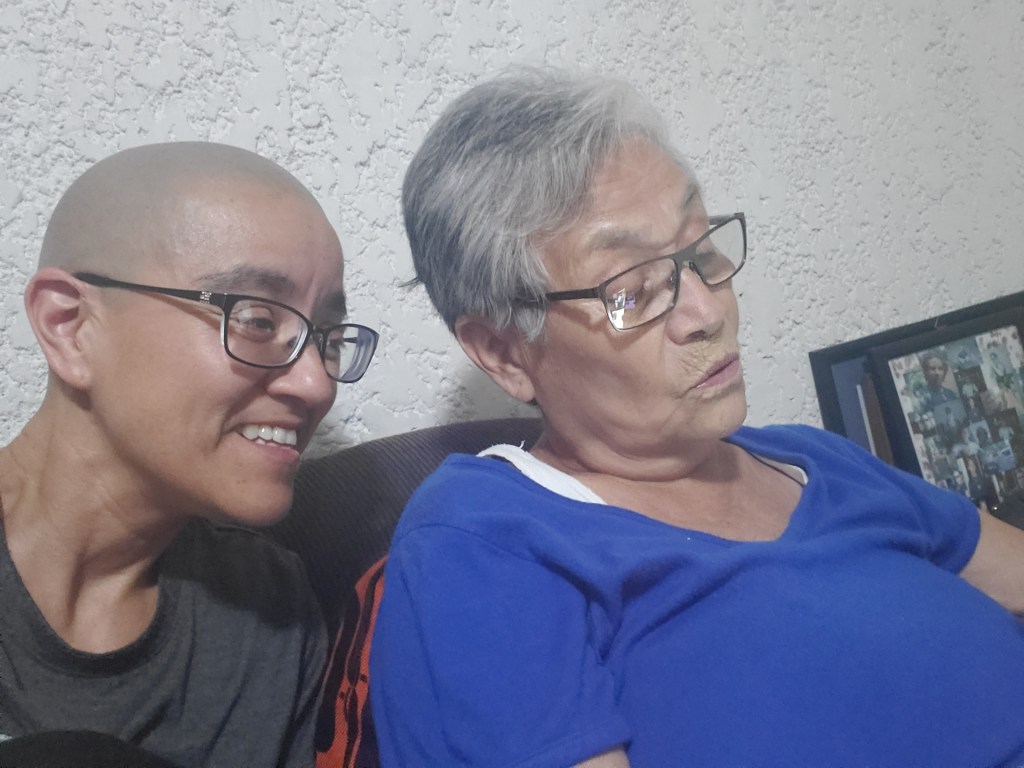
Me with my aunt, my dad’s eldest sister.

I was sometimes told I look like my grandmother on my dad’s side, and although it wasn’t meant as a compliment, I always welcomed it as such. I wanted to be like my grandma. She was a tough, no-nonsense woman who was light-hearted and spunky to the very end of her life. She had a serious expression on her face most of the time but would playfully and unexpectedly stick out her tongue at neighbor-friends when they passed by her house. She had well-developed patterns of good-natured banter with most people in her neighborhood. She was well-known and well-liked, and people also knew not to mess with her. So, if I could be thought to be anything like her, I was good with that.

She lived in Mexico and my family in the United States. In Mexico, even as a younger kid, we were allowed to move around town on the bus if my older cousin was with us. We always landed and stayed with my mom’s side of the family and usually only went to visit my dad’s side for an afternoon or two during the course of our time in Guadalajara, where my parents were from. I couldn’t wait to surprise visit my dad’s side of the family – my grandma, aunt, and grandpa who all lived together. We never announced our visit in advance; so it was fun for me to get to walk into the patio of their apartment complex and find my grandma, as usual, standing in the doorway of her front door, smoking. She was a businesswoman, always running a small business, selling basic grocery items from home, so her door was always open. And she was almost always right there, standing just outside her door, a serious expression on her face, and a smoke in hand.

Continue reading “My Father’s Daughter by Xochitl Alvizo”

Rosh Hashanah and the Goddess – redux – by Joyce Zonana

On our table, the crimson pomegranate seeds my mother had carefully separated from the skin glistened like jewels illumined from within; a pale green jam made from the grated flesh of a gourd, scented with rosewater and studded with thin slivers of blanched almonds, shone with a numinous, interior light. Bowls of black-eyed peas simmered with cinnamon and tomatoes were arrayed beside a delicately-flavored leek omelet, breaded and fried brains, roasted beets, fresh dates, apples, and—best of all—a previously untasted new fruit of the season: usually fresh fig or persimmon or prickly pear.

Joyce Zonana

When I was growing up in my Egyptian Jewish immigrant home, each of the High Holidays was imbued with sacredness, thanks largely to my mother’s efforts to create a meaningful gathering of family and friends. Around a long table, covered with an embroidered white cloth and set with sparkling silver and delicately fluted china, she served at each season the festive meal that made manifest for us the presence of the Divine.

My father, an Orthodox Jewish man, followed the tenets of his faith, praying each morning and attending synagogue each week. But it was my mother who brought to life the seasonal festivals that also characterize Judaism. As a child, I longed to pray with my father and I envied my brother and male cousins who studied and recited the ancient Hebrew; I resented having to polish silver and set the table. But today I’m grateful for my mother’s quiet teachings.

Passover had special meaning for us because our family’s departure from Egypt seemed a reenactment of the ancient Exodus. But Rosh Hashanah, that holy day without explanatory narrative, seemed even purer in its celebration of abundance and blessing, renewal and return.  Each year, I looked forward to the new moon in Tishrei that coincided with the arrival of autumn in New York and the beginning of the school year.

Continue reading “Rosh Hashanah and the Goddess – redux – by Joyce Zonana”

We Are Not Oppressed Because We Remember pt. 3: Sowing Seeds and Braiding Hair by Chasity Jones

Today, once again, I got to touch the earth!

While planting and constructing my indoor container garden, I thought about how my ancestors put seeds into their children’s hair so that in case they were taken away to live and die in chains, they would at least be able to sustain themselves with a piece of the motherland. Rice, okra, yams, watermelon, and so MANY more crops that would go on to make white slaveholding Americans so rich (passing their wealth to their descendants and zero reparations for the descendants of enslaved Africans), that they were willing to fight a war to sustain their evil practices of owning human beings as chattel (Check out High on the Hog Netflix documentary which was adapted from a book by Dr. Jessica B. Harris). Enslaved Africans brought these foods to the new world, a direct result of slavery.

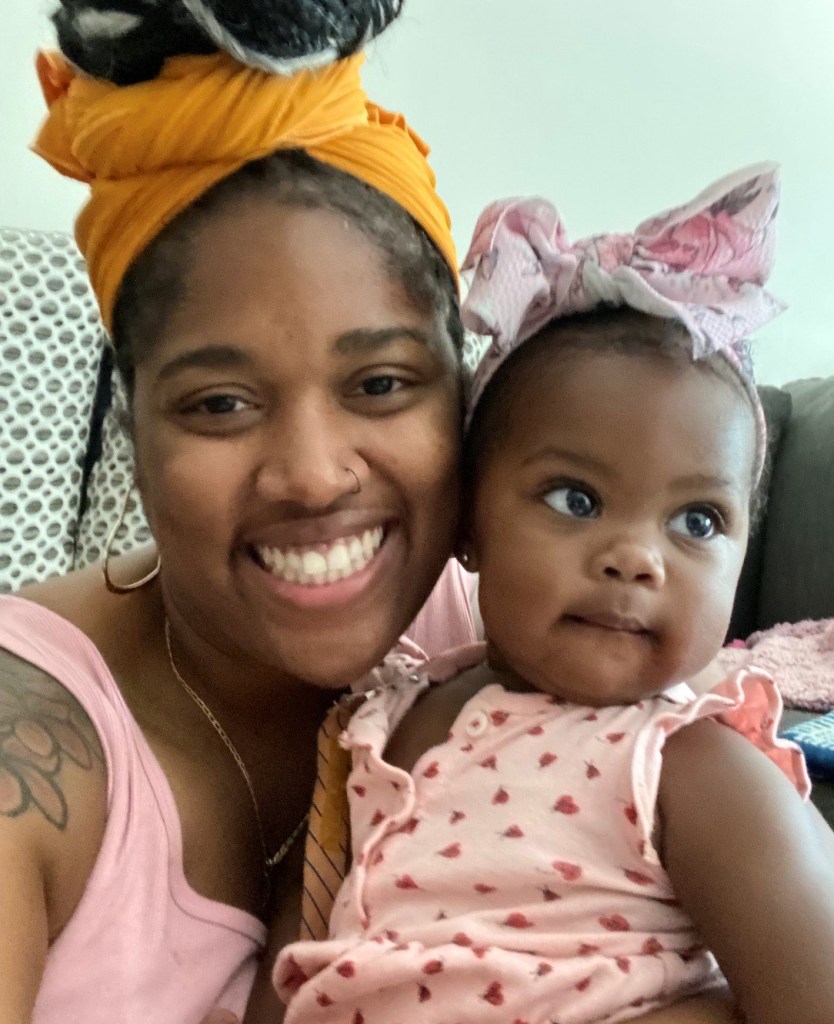
As I wash my daughter’s hair (which for Black women and girls is a PROCESS!!), as I moisturize her hair, and as I braid my hair, I am thankful that no one has a right to my child and that I do not need to fear her enslavement. Instead, I manifest her revolutionary future to carry the torch of our ancestors. A Torch and a commitment to elevate our community and move the community forward. I leave it up to her to choose how she will carry that torch forward!

Continue reading “We Are Not Oppressed Because We Remember pt. 3: Sowing Seeds and Braiding Hair by Chasity Jones”

The Red Hand on the Cave Wall by Carolyn Lee Boyd

As I have gotten older, I find I am drawn more to non-anthropomorphic, inexpressable-in-words, nature, and everyday focused visions of the Divine. Whereas before my spiritual practice involved more rituals and circles, unusually indoors, with others, now I more often engage in solo quiet contemplation, outside in the wild when I can. I think more about ways of being rather than ways of doing and more about the small messages I want to leave to generations to come instead of  major accomplishments.  I feel as if I am contracting in towards the center of the spiral of my spiritual journey.

All over the world, very ancient cave art includes hand prints made by painting or blowing ochre around a hand or putting ochre on a hand and pressing it to the wall. Research has shown that about 75% of these were made by women, making them a very early form of feminist art. I wonder if some of them might have been made by women who had transformations and thoughts similar to mine. Here is a poem in the voice of such a woman. 

Continue reading “The Red Hand on the Cave Wall by Carolyn Lee Boyd”

We Are Not Oppressed Because We Remember by Chasity Jones

Many questions are asked of us as a community, but the answers which are so complex that we should be commended for even attempting to answer, are heard- if they are not interrupted- but rarely understood. As a Black mother and wife, I have accepted the fact that no one will understand my struggle outside of other Black mothers and wives. After being asked questions about how my community relates to slavery, I am convinced that no one outside of my Black American community will ever understand how slavery has impacted our lives, identities, family structures, trauma, and deaths. Furthermore, it has yet to be understood how the past of slavery continues to impact these areas as a people.

Firstly, although slavery has left an immense imprint on our racial memory, the Black community is not stuck in slavery simply because we bring it up. It is brought up because it is a part of our story and we should not be made to feel ashamed of it. Just because you are tired of hearing about it or uncomfortable does not mean that Black Americans should be made to feel as though should avoid speaking of our history. Some many pro-Black groups and movements emphasize and celebrate the achievements of Black Americans before, during, after, and despite slavery. However, these movements threaten the dominant culture, and much of their achievements are ignored or perceived as threats and terrorism. It is hard to educate ourselves and our children about our ancestor pre-enslavement because our legacy, history, sacred knowledge, and culture were destroyed and our memories were erased and replaced with the bible and colonialist interpretations of scripture. Many of these scriptures are interpreted to justify slavery and are still used to justify police brutality, mass incarceration, and psychological warfare on Black Americans. Nevertheless, we do what we can to celebrate ourselves and our heritage. In doing so, we cannot ever forget slavery.

Continue reading “We Are Not Oppressed Because We Remember by Chasity Jones”