While black Churches are burning, and black children are being gunned down by police, I felt it important to speak with someone who is involved in raising awareness on the role of racism and cultural imperialism in American society. I am honored to present to you all, Sikivu Hutchinson.
As a woman of color, and an atheist, how do you respond to the invocation of God in the Charleston tragedy?
It frustrates me but the invocation of God in crisis is a significant part of African American cultural and social history. As I wrote recently in an article entitled “Pushing Back on ‘God’ in Charleston”: “Radical black humanists, most notably Frederick Douglass and A. Philip Randolph, have challenged black religiosity under slavery while acknowledging the crucial role activist churches played in black self-determination.
Randolph’s critique of organized religion and the god concept was always coupled with a critique of capital and the imperialist occupation of black bodies and African countries. Churches dominated black communities because of the nexus of racial apartheid and capitalism.”
Organized religion and God belief continue to dominate African American communities because of these legacies. That said, clearly no loving god would allow a twenty six year-old in the prime of his life to be cut down in cold blood, nor abide by a five year-old having to play dead to avoid being murdered. And no moral god would demand forgiveness for a crime for which there has never—since the first African was stolen, chained, exploited and “imported”—been any reparations. Continue reading “Feminism, Race, and Religion: An Interview with Sikivu Hutchinson by Kile Jones”
On Monday, the picture was on my Facebook feed again: The picture of a girl lying face down in the grass under a police officer pressing his knee in her back. It was from the video of an African-American teenager being pinned to the ground by Eric Casebolt, the police officer in McKinney, Texas who was responding to calls about a pool party. When I saw the picture this time, it was in a screenshot with these words below it:
“Funny how a 14 year old bikini-clad black girl being publicly assaulted by an adult male does not accrue mainstream feminist outrage.” – Yohanna
The screenshot was taken of a post to Yohanna’s Twitter account (@maarnayeri). I don’t know her, but she troubled me.
If you haven’t seen the images we’re talking about, you can view the video here with a description of what is concurring or below from YouTube. I was reluctant to watch the video. It seems voyeuristic to view this young woman’s suffering and screaming. And, if I am honest with myself, it also seems useless. Viewing this from my computer screen, I’m in no position to help her. I hear her cries and it make me cry too. But I can’t push him off of her. When other teens tried to come to her defense, Casebolt pulled a gun on them and chased them. I don’t even have the power to get him fired from his position of authority immediately. No, we must have the investigations and inquiries and due process that seems so indiscriminately afforded to the privileged. Casebolt was put on administrative leave on Friday, and on Tuesday June 9, he resigned.
So how should I respond?
I had a conversation with one of my closest friends a couple days ago that provoked me to reflect on what to do when I’m conflicted about how to respond. Her background is in acting and theatre, and now she is a pastor and artistic director of a Christian church and arts initiative who believes in supporting arts, imagination and creativity. In our conversation about discerning the next steps in our lives, she was reminded of a book by Samuel Wells that proposes “theatrical improvisation as a model for Christian ethics.” That reminded me of books I’ve read that talk about musical improvisation or call-and-response as model for living, and some pieces I’ve written about that. Inspired by ethicists and theologians including Emilie M. Townes and H. Richard Niebuhr, I believe that to answer the question of how I should respond, I must first answer ‘What’s going on?” An improvised response or a fitting response is the response to what is already occurring. We must look at the situation critically to respond appropriately.
What’s going on in this video and the controversy surrounding it? I am certainly not an impartial or all-knowing observer, but here’s what I see:
A white man forcibly throws an unarmed, African-American teenager to the ground yelling “On your face!” We can see that she is unarmed because she is wearing a bikini.
The man is a police officer. He is upset that his authority is being challenged. Other officers are present and seem to be asking questions, but the violent one seems out of control and frantic, running around and yelling. He escalates the situation when he throws the girl to the sidewalk, which causes an outcry in the crowd.
As the video went viral, there were many protests and online statements against this violent event, but also statements of support for the officer. And sadly, I agree with Yohanna’s assessment. I may have missed it (and I hope I did), but I didn’t see a broad, mainstream feminist response against this violence.
I’m a feminist. I’m a black feminist. I’m a Christian feminist. I may not be a mainstream feminist (depending on your definition), but I’ll express my outrage anyway. It is sickening to watch his treatment of this teenage girl. This man’s mistreatment of a young black girl’s body is chilling. It is wrong and he should be held accountable for it.
I don’t think outrage is enough. But outrage does express that our moral sensibilities have been awakened and that we recognize that something profoundly wrong has occurred. In the face of comments that say she deserved this treatment, we as feminists must insist on the officer’s wrongdoing. “She had it coming.” “She incited him.” As feminists, we know that these kinds of statements are used in cases of rape and intimate partner violence to explain away violent actions and to shift the guilt from perpetrator to victim. The backlash against feminists and others who oppose these explanations argues that we ignore the victim’s responsibility or agency.
Bloggers and social media users know all too well the horrific statements that often appear in the comments section of online posts, videos, and articles. One comment I saw about the McKinney video says that the girl was “sassing back” at the police and that “if she wants to talk like adult then she’s going to be treated like an adult.” This kind of justification makes my blood boil! Sassing back is speaking up and saying something to an authority figure when you are expected to be silent. While the term sassing back doesn’t exclusively apply to women and girls, it is nonetheless a phrase with gendered connotations. How many boys are called “sassy”? Is it that no one had the right to say anything to this officer running around yelling at black teen boys to sit on the ground, or is it that this black female should have kept quiet? Regardless, throwing an unarmed person to the sidewalk for supposedly saying something disrespectful is not justifiable behavior to adults or children.
I wish I knew more about what’s going on and how to respond to the violence I see in the world. I know these perennial questions subvert easy answers. I only have a partial response. I am responding with outrage and questioning and take this to my feminist community and into my spiritual practice. “What’s going on?” and “How should I respond?” are questions I ask God. I pray for justice. I pray for God’s presence in the outrage and in the investigations, and in the lives of those children who were violated.
Elise M. Edwards, PhD is a Lecturer in Christian Ethics at Baylor University and a graduate of Claremont Graduate University. She is also a registered architect in the State of Florida. Her interdisciplinary work examines issues of civic engagement and how beliefs and commitments are expressed publicly. As a black feminist, she primarily focuses on cultural expressions by, for, and about women and marginalized communities. Follow her on twitter, google+ or academia.edu.
In my church tradition, we have just entered the 3rd week of Advent. In today’s blog I share just a brief excerpt from the sermon which I preached on Sunday. I hope it at least inspires reflection on where we go from here as a nation, as a people and our responsibility in moving forward. I preached:
On this 3rd Sunday of Advent the stories and testimonies of four women have in many ways pricked the collective consciousness if not the conscious of our nation. These women, mothers all—are names that we sadly have become all too familiar with. They are Sybrina Fulton, the mother of Trayvon , Leslie McFadden, the mother of Michael, Gwen Carr, the mother of Eric and added to the list most recently Samira Rice, the mother of 12 year old Tamir. To call the names of these women and their sons, is to be confronted with the unsettling if not frightening times in which we now live and thus to be reminded of the ways in which our world is broken, the ways indeed in which the sacredness of our very humanity has been betrayed by our separation one from one another. Yet, it is into this unsettled time of brokenness that this season of Advent comes. Continue reading “To Be an Advent People by Kelly Brown Douglas”
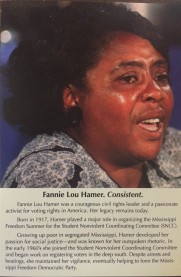
A few weeks ago, I came across a postcard that I was given at a conference last year. I got the postcard (advertisement?) because it has a picture of Fannie Lou Hamer on it, and in my home and office, I like to display images and quotes from inspirational women, especially black women. Hamer was a sharecropper from rural Mississippi who became a leader within the civil rights movement in the United States. I was happy to have something with her likeness on it. It was only later that I looked at the text on the front and back of the card, which read in part, ”Often called the ‘spirit of the Civil Rights Movement,” Hamer worked tirelessly on behalf of the rights of others—including the unborn. [She said,] ‘The methods used to take human lives such as abortion, the pill, the ring, etc. amounts to genocide. I believe that abortion is legal murder.’” I realized then that the card was distributed by an organization called Consistent Life, who, in support of a “consistent ethic of life,” is “committed to the protection of life threatened by war, abortion, poverty, racism, capital punishment and euthanasia.”
I was conflicted about the use of Hamer’s image for this organization’s purposes. It is true, Hamer did have those views about abortion and birth control. But I did not know if her image and story was being manipulated for a particular political and religious agenda—one I do not align myself with. I put the card in a box of other images and quotes. I didn’t display it, but I didn’t throw it away, either, which is why I came across it again a couple weeks ago as I was cleaning and decorating my home office. I had the same misgivings about the image as before, and I set it aside again. Continue reading “Fannie Lou Hamer’s Commitment to Life by Elise M. Edwards”
Within the Christian tradition, this week – l known as Holy Week – is perhaps the most significant week on the Christian calendar. During this week Christians are called to contemplate and to remember the core events of Christian identity—the crucifixion and resurrection of Jesus. Given the focus of this week for many Christians I am sharing my theological reflections on the crucifixion-resurrection event.
As I begin this reflection, it is important to recall that which I and others have pointed out in other places. In Jesus’ first century Roman world crucifixion was reserved for slaves, enemy soldiers and those held in the highest contempt and with lowest regard in society. To be crucified was, for the most part, an indication of how worthless and devalued by established power an individual was. It also indicated how much of a threat that person was believed to be to the order of things. There was a decided crucified class of people. These were essentially the castigated and demonized as well as the ones who defied the status quo of power. It is in this respect that I believe Jesus’ crucifixion affirms his identification with the marginalized and outcasts. Indeed, on the cross Jesus fully divests himself of all pretensions to power and anything that would compromise his bond with those most othered in the world. The reality of the cross further affirms the profundity of god’s bond with put-upon bodies..
I think classroom discussions can be a good forum for modeling the kinds of discussions students might have in their families, peer groups, faith communities, and political contexts. But sometimes I really wish I wasn’t the one responsible for leading the discussion.
I started a new position this year as a lecturer in Christian Ethics. This semester, the high moments of my week are my two 75-minute sessions of an Introduction to Christian Ethics class. I have less than 20 students and they are smart, kind, engaging, talkative, and respectful. They also come to class prepared and eager to participate in discussion. I love it. I count myself as blessed for having the opportunity to teach them. But there have been several days when I haven’t wanted to go to work and face them. Continue reading “A Reflection on Leading Discussions about Difficult Ethical Issues by Elise M. Edwards”
Of the many reasons I am grateful for feminismandreligion.com, I have to say that I am most grateful for the time it requires of me to reflect about feminism’s impact in my life, faith, and work. I decided it was time to reflect on this question: What difference does feminism make for the way I structure and approach my classes?
I recently started a new position as a full-time lecturer in the Department of Religion at Baylor University. Earlier this week, I attended a gathering for the department, where I was introduced, along with a few others, as new faculty. At the end of the evening, the wife of a retired male professor introduced herself to me and remarked about how happy she was to see more women in the department. (Four full-time faculty members were hired this year, and three of us are women.) She had been looking forward to this kind of change for quite a while. I was appreciative of her remarks, just as I have been generally pleased with the warm reception I have received around the University.
Her excitement about the increase in the number of women faculty provoked me to reflect on what I add to my department, particularly for my undergraduate students. I have thought before about how, from a purely representative standpoint, I bring something different to the faculty. I have thought about how my students may not have previously had a professor–especially a religion professor–who looks like me. Even if they had, I’ve had different life experiences than many of my colleagues, and that this bears on my approach to theology and ethics. Therefore, the research I do and share is distinctive in its approach. Yet, I am slightly embarrassed to admit that I have not given much thought about how my being a black feminist woman might impact my students. I am tempted to blame it on the fact that I have just been trying to keep my head above water in a new position. Of the many reasons I am grateful for feminismandreligion.com, I have to say that I am most grateful for the time it requires of me to reflect about feminism’s impact in my life, faith, and work. So I decided to reflect on this question: What difference does feminism make for the way I structure and approach my classes? Continue reading “The Difference a Feminist Makes by Elise M. Edwards”
I have to be honest, Jason Collins’ admission that he was a homosexual, albeit brave, upset me. While coming out is an completely unique experience to every individual that does it, Jason Collins’ story was just another example of the rampant sexist and heteropatriarachal world that privileges male bodies and sexualities over women’s similar experiences. While I applaud Jason’s story and it’s timing, the first thing I asked to my colleagues was: Where was the hubbub over Sheryl Swoopes or Martina Navratilova?
Like marking off items on a proverbial checklist, closeted LGBTQ individuals who exist within and outside of the world of professional sports, can recount the numerous things they struggle with in terms of their sexuality. From fearing of the actual coming out process, dressing in their car or at home to avoid the subtle glances and whispers of individuals in the locker room, to wondering what coming out would mean not only for their game but also for their social and, if they choose, spiritual lives, closeted and out LGBTQ individuals within the multi-billion dollar professional sports industry must grapple with that age old question: what does it mean to be gay and open about it?
I have to be honest, Jason Collins’ admission that he is a homosexual, albeit brave, upset me. While I understand that coming out is an completely unique experience to every individual who does it, for me Jason Collins’ story was also an example of the rampant sexist and heteropatriarachal world that privileges male bodies and sexualities over those of women. While I applaud Jason’s story and the timing, the first thing I asked to my colleagues was: where was the same hubbub over Sheryl Swoopes or Martina Navratilova? Continue reading “Thanks for Coming (Out): Sexuality, Sports, and Spirituality by John Erickson”
In my previous post The Feminist Influence, I began discussing what a feminist perspective might bring to a theological study of architecture. I asserted that a feminist perspective on the ethical function of architecture offers at least two contributions: (1) it provokes questioning about what flourishing is for all peoples and the Earth, and (2) it provokes examination of systems of power and privilege and how they are constructed into our built landscape. I think a feminist vision of architecture could help all of us (even those of us who are not design professionals) promote design that respects and responds to our environment, addressing the harm we have done. I do want to give some thought, though, to what it means especially for architects and other design professionals. Continue reading “A Calling, A Vocation by Elise M. Edwards”
In these past few months, as I’ve been finishing my dissertation about a theological and ethical perspective on architecture, I’ve had the pleasure of speaking often about my work. In March, I was invited to give a talk at a symposium titled “On Christ and Architecture” at Judson University. As they introduced me, the speakers noted that I am a black feminist. Because of the brevity of my presentation, I didn’t speak about things that most people associate with feminism. So I was especially excited when at the end, one of the organizers complimented me by saying, “I really see the feminist influence in your work and I thank you for bringing that to us.” So exactly what does a feminist perspective bring to a theological study of architecture?
Perhaps first I should explain what my theological study of architecture is. The purpose of architecture is sometimes understood as aesthetic or functional—to either make buildings that look nice or serve their purposes well (or both). However, I discuss an ethical approach that expands this common understanding of architecture. Grounding my research in philosopher Karsten Harries’ The Ethical Function of Architecture and theologian Timothy Gorringe’s A Theology of the Built Environment, I argue that architecture presents interpretations of a community ethos, or way of life, for its specific time and place. These representations can either promote or inhibit human flourishing, and therefore, are the proper concern of Christian theology and ethics, which is concerned with questions about how Christians and those in the broader society are to live rightly in the world. Continue reading “The Feminist Influence by Elise M. Edwards”







 Feminism and Religion