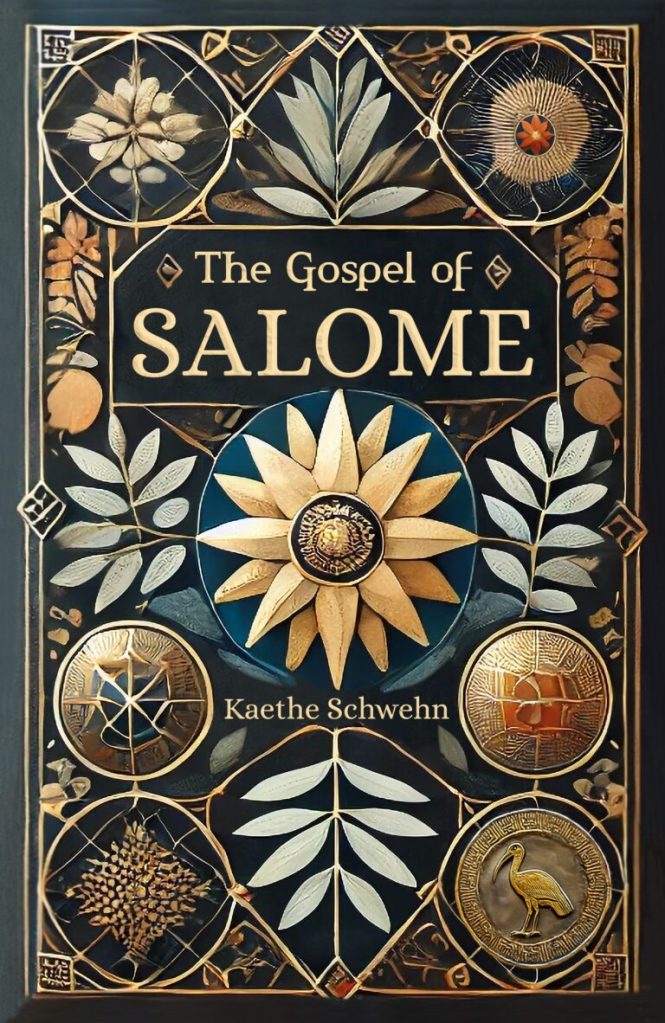
The Gospel of Salome by Kaethe Schwehn, Book Review by Michelle Bodle

What would happen if you were a disciple of Jesus and you had an encounter with someone who told you a different narrative than what you had heard in the past? How would you react? What would you preserve? How would you reconcile the stories you have been told and have told others as an apostle with what someone is now proclaiming?

            The Gospel of Salome is a work of Biblical fiction focused on Salome, a character who we hear of being present at the crucifixion and the empty tomb in the Gospel of Mark. Some scholars have connected her with “the mother of Zebedee’s children” in the Gospel of Matthew or “his mother’s sister” (i.e. Mary’s sister) in the Gospel of John. Schwehn takes a different approach, portraying Salome as a woman who was sought out for her skills in medicine, finds herself in the presence of John Mark, one of Jesus’s disciples who has come to Alexandria.

            Going back and forth between speaking to John Mark in the present and living in her memories of the past, Salome tells the apostle that she is the true mother of Jesus. However, there is another factor to consider in her proclamation – Salome’s dementia, which is threatening to steal her memories. Memories about Salome’s agreements with Mary about Jesus’s desire to learn how to heal or Mary asking Salome to not be present in Jesus’s life. Memories of being at the cross and the empty tomb.

Continue reading “The Gospel of Salome by Kaethe Schwehn, Book Review by Michelle Bodle”

Let’s Have The Talk – What Does “The Birds and The Bees” Actually Mean: By Zoe Carlin

Recently, I have thought about a common idiom that has been used to refer to sexual reproduction, the birds and the bees. I became curious why animals that appear in most gardens were used as an example to explain where babies come from, until I did some research. It turns out that since the birds lay eggs, that is their representation of the female body and the bees represent the sperm due to pollination. It is a very subtle, overlooked message that can be disguised as being more age-appropriate to young children. However, I decided to dig a bit deeper. Ed Finegan, a USC professor of linguistics and law, has stated that this phrase has existed a lot longer than one might think. There is evidence of it being used in a somewhat sexual context going back to at least two authors, Samuel Coleridge Taylor (1825) and an entry from John Evelyn’s The Evelyn Diary (1644). 

In Work Without Hope, Samuel Coleridge Taylor quotes, “All nature seems at work . . . The bees are stirring, birds are on the wing . . . and I the while, the sole unbusy thing, not honey make, nor pair, nor build, nor sing.” This separation of the birds and bees is indicating the loneliness and sadness of missing out on a potential romantic connection. When going even further back in time to 1644, it was noticed in the Evelyn Diary that there was an entry discussing the interior design of St. Peter’s in Rome: “That stupendous canopy of Corinthian brasse; it consists of 4 wreath’d columns, incircl’d with vines, on which hang little putti [cherubs], birds and bees.” This description is illustrating that there is a possible sensual or sexual meaning of the architecture in St. Peters.

Continue reading “Let’s Have The Talk – What Does “The Birds and The Bees” Actually Mean: By Zoe Carlin”

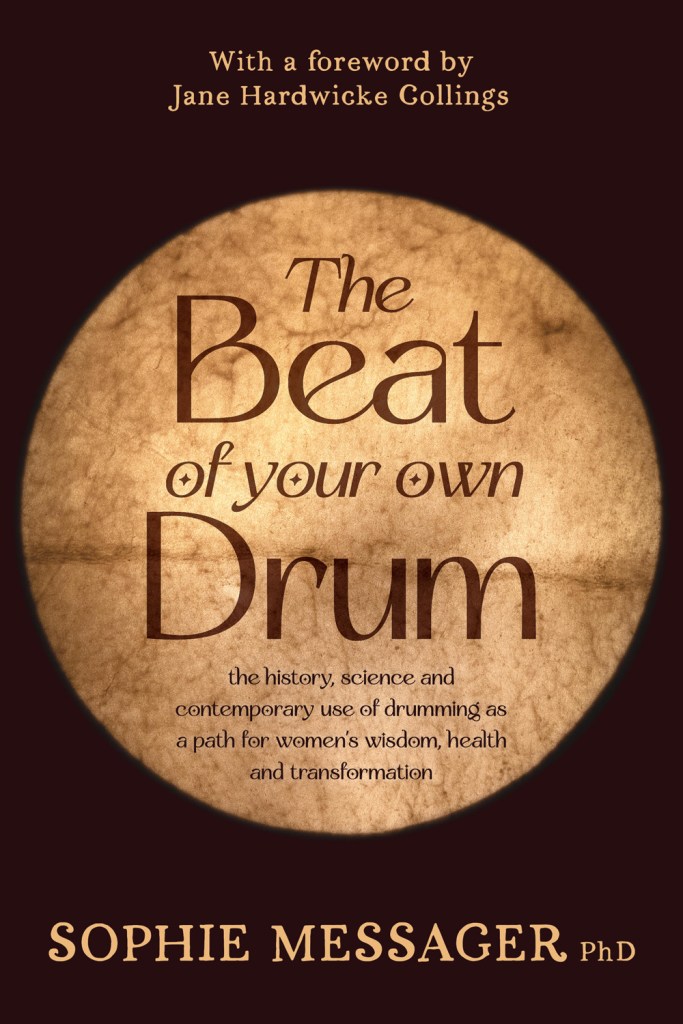
The Beat of Your Own Drum by Sophie Messager – Book Review by Judith Maeryam Wouk

Pick up a drum and start your unique journey with this sacred tool; there is no one right path.  The drum can help women hear their inner voice, access their own wisdom, reclaim their power, and heal. The drum in its simplicity offers a direct link to our deepest selves. 

That is the message of this profoundly personal saga, told through the stories of Sophie Messager and others.  She recounts her own transition from scientist to birth doula to journey guide for women in life transition, through reiki and a diagnosis of ADHD, growing into her identity shift from outer- to inner-centered wisdom.  Her personal practice now includes weekly drumming at dawn in a woodland with two friends and monthly drum circles.      

Continue reading “The Beat of Your Own Drum by Sophie Messager – Book Review by Judith Maeryam Wouk”

Miriam Is For the Girls by Zoe Carlin

The Book of Exodus is a well-known scripture, and it is one that many Jews, Christians, and even people who are non-religious are very familiar with. Growing up, our family continued to tell this story year after year during Passover. It was one of many classic Torah readings shown to us in our temple. So, one of the key figures in this story is Miriam, Moses’ older sister. Most remember that she helped her mother deliver Moses in secret at the Nile River when he was an infant due to the Pharaoh setting an order to kill every Hebrew son because of concerns of the population growing too much (Exodus 11:5-6). She also assisted in leading the Israelites across the Red Sea when Moses opened it up for the Hebrews to cross (Exodus 14:21-22). An article titled “Miriam: Midrash and Aggadah” shares a deeper analysis of the roles that Miriam upheld as a sister, a daughter, and a woman during this time. It has also informed my understanding of Miriam’s story.

Continue reading “Miriam Is For the Girls by Zoe Carlin”

The Wisdom of Cerridwen: Transforming Her Cosmic Brew by H. Bryon Ballard

Moderator’s Note: This is the Preface to the recently published anthology, The Wisdom of Cerridwen: Transforming Her Cosmic Brew.

Cerridwen, ancient Queen,
Dark Mother, take us in.
Cerridwen, ancient Queen,
Let us be reborn.
—a Reclaiming chant

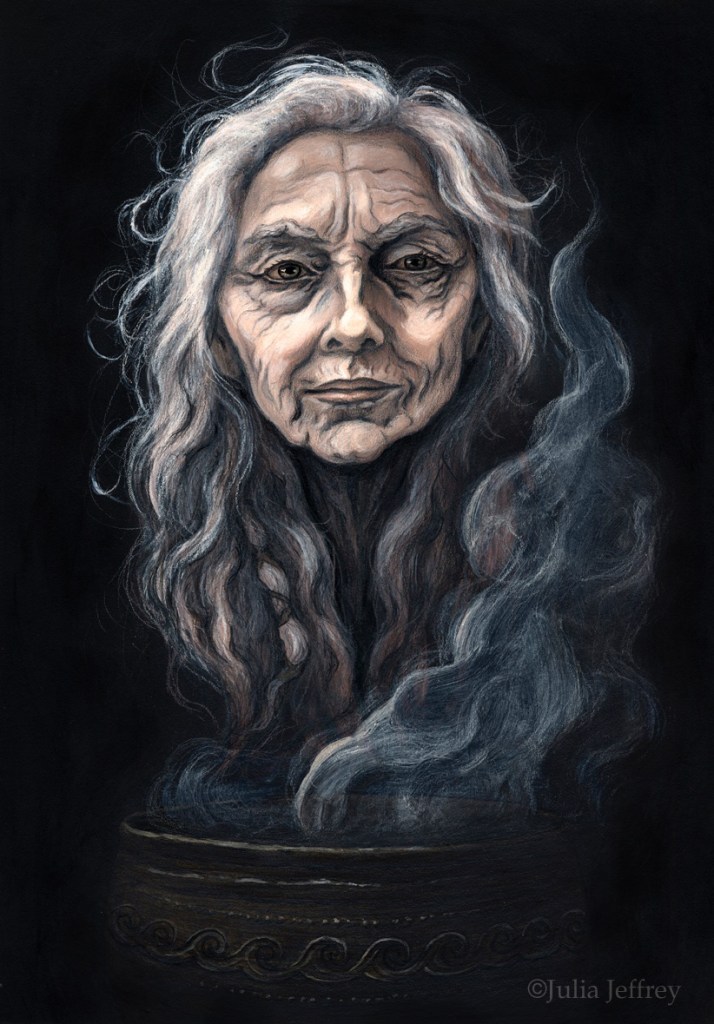
The Cauldron, Julia Jeffries

Open these pages and relish the words of this divine Mother, this wild Sister, this trickster and keeper of the Cauldron of Eternity! Spend time with Her. Learn Her sacred ways, Her stories, Her lore.

I learned the chant above at the Glastonbury Goddess Conference where I taught several years ago. I often use it in both my private meditations and in public rituals. It is simple but direct, quite unlike the Goddess it honors. I learned how to pronounce Her name from a Welsh-speaking colleague who gave it a rolling “r” and an emphasis on the second syllable. Keh-RRRHID-wen. Try it. So delicious to say.

Continue reading “The Wisdom of Cerridwen: Transforming Her Cosmic Brew by H. Bryon Ballard”

Long Live Queer Nightlife! by Amin Ghaziani – Book Review by Marie Cartier

I was invited to be on a panel for the Pacific Sociological Association (PSA) in San Francisco this past March for a new book by Amin Ghaziani, Long Live Queer Night life (Princeton University Press, 2024).

Since I wrote Baby, You Are My Religion – Women, Gay Bars, and Theology Before Stonewall and have discussed aspects of this work here I thought the FAR family would also enjoy this conversation on where queer nightlife is now.

The book is interspersed with visits to club nights, something Ghaziani says helps widen the possibilities for communities—different communities can have their own nights and these chapters where he visits these various hot spots are exciting and first person.

Continue reading “Long Live Queer Nightlife! by Amin Ghaziani – Book Review by Marie Cartier”

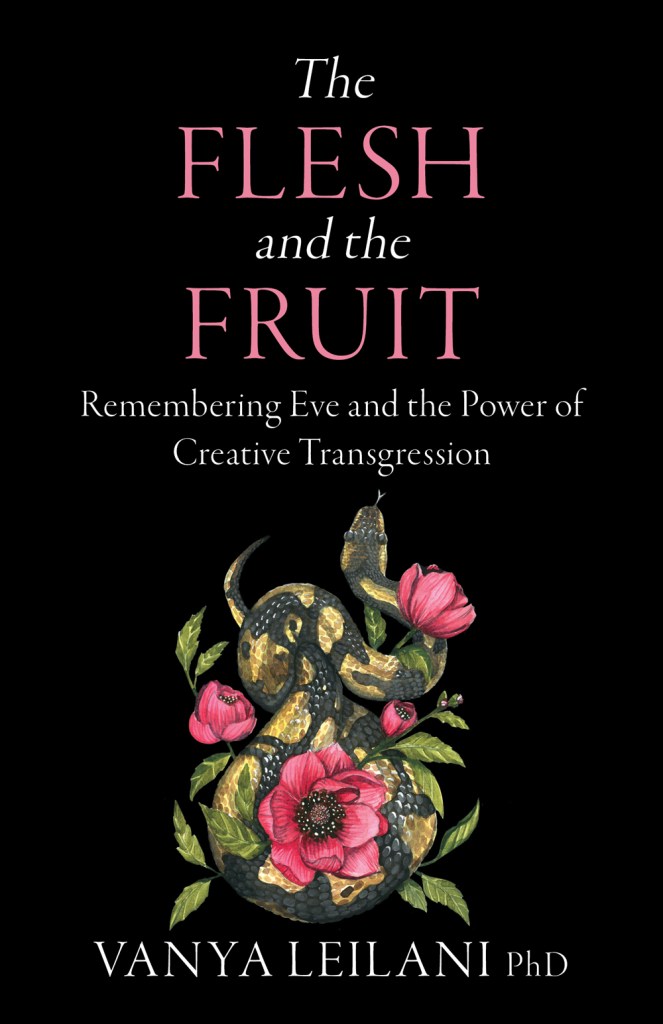
The Flesh and the Fruit by Vanya Leilani, PhD: Book Review by Janet Maika’i Rudolph

Subtitle: Remembering Eve and the Power of Creative Transgression

I have learned that every good story of spirit has many layers of meaning and pathways of understanding. Dr Leilani has found particularly relevant and even beautiful aspects of the biblical story of Eve. She uses Eve’s actions as a template of her own spiritual journey. Her pathway begins in obedience (listening to the voice of authority), travels through transgressive acts (eating of the fruit), and finally results in a self-knowing that had not been possible at the beginning of her journey.  In this book we follow along on her quest to learn about herself with Eve as her inspiration.

This is a luscious book. Vanya Leilani’s insights are not only profound but are written with a poetic sensibility. I found myself speaking some of her passages out loud because the vibration of her words are powerful and feel so sensuous on the tongue. I wanted to take them into my body, as well as read them on the page.

Continue reading “The Flesh and the Fruit by Vanya Leilani, PhD: Book Review by Janet Maika’i Rudolph”

BOOK REVIEW: Religion is Not Done With You by Esther Nelson

Goodwin, Megan and Ilyse Morgenstein Fuerst, Religion Is Not Done With You: Or, The Hidden Power of Religion on Race, Maps, Bodies, and Law. Boston, Massachusetts, Beacon Press, 2024, 165 pages.

If I were still teaching university classes in Religious Studies, I would certainly choose Goodwin and Fuerst’s book as an introduction to this broad, often misunderstood, subject we call religion. Their writing style has a youthful familiarity—probably purposively done—to broaden their reach to all audiences.  The theme running throughout their work is religion is what people do.”  “Religion isn’t just feelings or beliefs—it’s systems and assumptions…that shape our lives every day.”

Both authors have master’s degrees and doctorates in religion. Goodwin focuses on gender, sexuality, and American religions.  Fuerst puts her attention on Islam, race and racialization, and South Asia.  Both women claim to be religious people who “care about justice and repairing our broken world.”  They understand that “religion is a force for change—not always bad, not inherently good, but always changed and changing.”  It’s important, they assert, “to call out bullshit takes on religion: takes that insist religion is always and everywhere good and takes that want to write religion off as irrelevant, irrational, or regressive.”

Continue reading “BOOK REVIEW: Religion is Not Done With You by Esther Nelson”

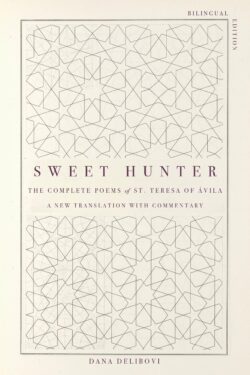
Book Review by Kristen Holt-Browning: Sweet Hunter: The Complete Poems of St. Theresa of Ávila (Bilingual Edition), translated and with commentary by Dana Delibovi

The Catholic mystic women of the medieval and early modern era—such as Hildegard of Bingen, Julian of Norwich, and Theresa of Ávila—can seem unknowable to us now. How did they nurture their fiery love of Christ within the rigid patriarchal (indeed, misogynistic) structure of medieval and early modern European Christianity? How did they find the strength and bravery to write about Jesus as husband, mother, lover? The writing of these mystic women can strike us even now as shocking, given that they often described Christ as their husband, their lover, or even their mother.

In Sweet Hunter: The Complete Poems of St. Theresa of Ávila (Bilingual Edition), poet and professor Dana Delibovi gives us the words of the sixteenth-century proto-feminist in a timbre close enough to our own to help close this gap. As Delibovi notes in her perceptive and illuminating Introduction, she centers Theresa’s balance of the mystical and the practical in her translations. Indeed, Delibovi admits that, “I had to fight the temptation to pretty-up her words and make them seem, well, more saintly.” And yet, it is this precisely this direct language that, paradoxically, heightens the divine fervor behind the writing, as when a shepherd speaks of Mary in “It’s Dawn Already”:

Continue reading “Book Review by Kristen Holt-Browning: Sweet Hunter: The Complete Poems of St. Theresa of Ávila (Bilingual Edition), translated and with commentary by Dana Delibovi”

How we Began the Movement of Goddess Feminist Activist Spirituality in the 21st Century (Part 1) by Helen Hye-Sook Hwang

Mago is an East Asian/Korean word for the Cosmic Mother or the Creatrix. This piece is written as the first of a four-part essay. In this series I am surveying the past 9 years of The Mago Work (A collective effort to restore the consciousness of Mago, the Creatrix), which birthed the Movement of Goddess Feminist Activist Spirituality, while being shaped by the latter.

Continue reading “How we Began the Movement of Goddess Feminist Activist Spirituality in the 21st Century (Part 1) by Helen Hye-Sook Hwang”