Long Live Queer Nightlife! by Amin Ghaziani – Book Review by Marie Cartier

I was invited to be on a panel for the Pacific Sociological Association (PSA) in San Francisco this past March for a new book by Amin Ghaziani, Long Live Queer Night life (Princeton University Press, 2024).

Since I wrote Baby, You Are My Religion – Women, Gay Bars, and Theology Before Stonewall and have discussed aspects of this work here I thought the FAR family would also enjoy this conversation on where queer nightlife is now.

The book is interspersed with visits to club nights, something Ghaziani says helps widen the possibilities for communities—different communities can have their own nights and these chapters where he visits these various hot spots are exciting and first person.

Continue reading “Long Live Queer Nightlife! by Amin Ghaziani – Book Review by Marie Cartier”

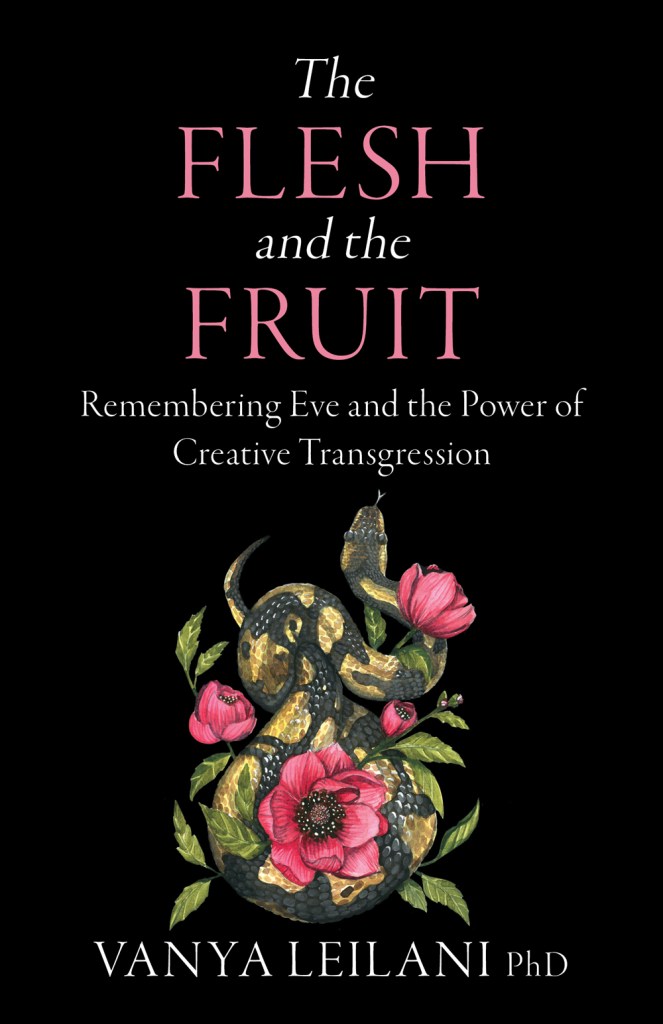
The Flesh and the Fruit by Vanya Leilani, PhD: Book Review by Janet Maika’i Rudolph

Subtitle: Remembering Eve and the Power of Creative Transgression

I have learned that every good story of spirit has many layers of meaning and pathways of understanding. Dr Leilani has found particularly relevant and even beautiful aspects of the biblical story of Eve. She uses Eve’s actions as a template of her own spiritual journey. Her pathway begins in obedience (listening to the voice of authority), travels through transgressive acts (eating of the fruit), and finally results in a self-knowing that had not been possible at the beginning of her journey.  In this book we follow along on her quest to learn about herself with Eve as her inspiration.

This is a luscious book. Vanya Leilani’s insights are not only profound but are written with a poetic sensibility. I found myself speaking some of her passages out loud because the vibration of her words are powerful and feel so sensuous on the tongue. I wanted to take them into my body, as well as read them on the page.

Continue reading “The Flesh and the Fruit by Vanya Leilani, PhD: Book Review by Janet Maika’i Rudolph”

BOOK REVIEW: Religion is Not Done With You by Esther Nelson

Goodwin, Megan and Ilyse Morgenstein Fuerst, Religion Is Not Done With You: Or, The Hidden Power of Religion on Race, Maps, Bodies, and Law. Boston, Massachusetts, Beacon Press, 2024, 165 pages.

If I were still teaching university classes in Religious Studies, I would certainly choose Goodwin and Fuerst’s book as an introduction to this broad, often misunderstood, subject we call religion. Their writing style has a youthful familiarity—probably purposively done—to broaden their reach to all audiences.  The theme running throughout their work is religion is what people do.”  “Religion isn’t just feelings or beliefs—it’s systems and assumptions…that shape our lives every day.”

Both authors have master’s degrees and doctorates in religion. Goodwin focuses on gender, sexuality, and American religions.  Fuerst puts her attention on Islam, race and racialization, and South Asia.  Both women claim to be religious people who “care about justice and repairing our broken world.”  They understand that “religion is a force for change—not always bad, not inherently good, but always changed and changing.”  It’s important, they assert, “to call out bullshit takes on religion: takes that insist religion is always and everywhere good and takes that want to write religion off as irrelevant, irrational, or regressive.”

Continue reading “BOOK REVIEW: Religion is Not Done With You by Esther Nelson”

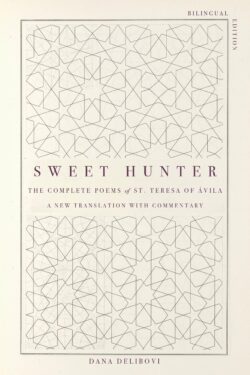
Book Review by Kristen Holt-Browning: Sweet Hunter: The Complete Poems of St. Theresa of Ávila (Bilingual Edition), translated and with commentary by Dana Delibovi

The Catholic mystic women of the medieval and early modern era—such as Hildegard of Bingen, Julian of Norwich, and Theresa of Ávila—can seem unknowable to us now. How did they nurture their fiery love of Christ within the rigid patriarchal (indeed, misogynistic) structure of medieval and early modern European Christianity? How did they find the strength and bravery to write about Jesus as husband, mother, lover? The writing of these mystic women can strike us even now as shocking, given that they often described Christ as their husband, their lover, or even their mother.

In Sweet Hunter: The Complete Poems of St. Theresa of Ávila (Bilingual Edition), poet and professor Dana Delibovi gives us the words of the sixteenth-century proto-feminist in a timbre close enough to our own to help close this gap. As Delibovi notes in her perceptive and illuminating Introduction, she centers Theresa’s balance of the mystical and the practical in her translations. Indeed, Delibovi admits that, “I had to fight the temptation to pretty-up her words and make them seem, well, more saintly.” And yet, it is this precisely this direct language that, paradoxically, heightens the divine fervor behind the writing, as when a shepherd speaks of Mary in “It’s Dawn Already”:

Continue reading “Book Review by Kristen Holt-Browning: Sweet Hunter: The Complete Poems of St. Theresa of Ávila (Bilingual Edition), translated and with commentary by Dana Delibovi”

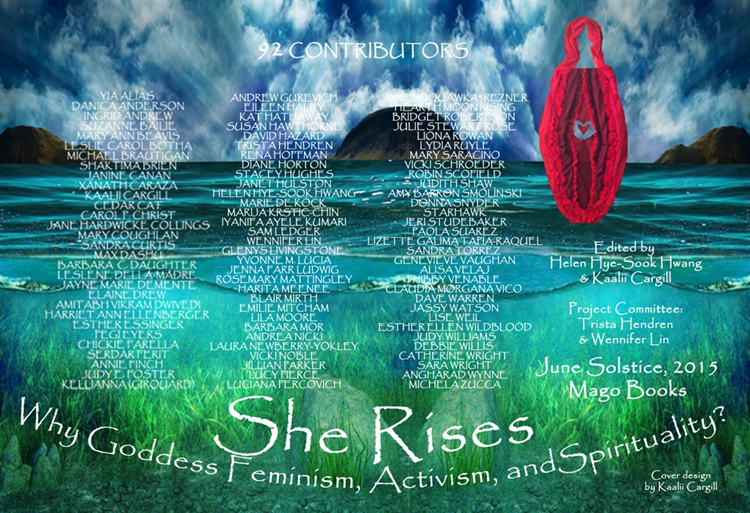
How we Began the Movement of Goddess Feminist Activist Spirituality in the 21st Century (Part 1) by Helen Hye-Sook Hwang

Mago is an East Asian/Korean word for the Cosmic Mother or the Creatrix. This piece is written as the first of a four-part essay. In this series I am surveying the past 9 years of The Mago Work (A collective effort to restore the consciousness of Mago, the Creatrix), which birthed the Movement of Goddess Feminist Activist Spirituality, while being shaped by the latter.

Continue reading “How we Began the Movement of Goddess Feminist Activist Spirituality in the 21st Century (Part 1) by Helen Hye-Sook Hwang”

From the Archives: Tribute to Charlie Russell (1941–2018) by Sara Wright

This was originally posted on May 26, 2020


“Learning entails more than the gathering of information.
Learning changes the learner.
Like dwarf pines whose form develop with winter’s design, the learner is shaped by what he learns.”

Talking with Bears: Conversations with Charlie Russell” G.A. Bradshaw

Learning from Nature: A Personal Reflection on Charlie Russell

Naturalist Charlie Russell never went to college. Instead he spent his youth backpacking through the Canadian wilderness with his family. Nature was his mentor and home.

Continue reading “From the Archives: Tribute to Charlie Russell (1941–2018) by Sara Wright”

From the Archives: Book review: Merlin Stone Remembered: Her Life and Works by Barbara Ardinger

This was originally posted on June 7, 2015

When Merlin Stone’s book, When God Was a Woman, was published in 1976, it was a lightning bolt of feminist scholarship that told the world that before there was a Judeo-Christian god there were goddesses, and before there were goddesses, there was the Goddess. If you’re reading this review and you have not read When God Was a Woman, buy the book. Right now. As you sink into Stone’s book, try to imagine what it was like before we knew about Isis or Inanna or Astarte, before we knew that the tree in the Garden of Eden was probably a sacred fig and that the serpent was a symbol or aspect of the Goddess and that people (mostly women) who ate figs or worked with serpents were honored priestesses and prophets. Just imagine! The work of the second wave feminists added to the work of scholars like Merlin Stone and Marija Gimbutas, but it didn’t begin until the second half of the 20th century. Before that? All there was, was God the Father, maker of heaven and earth. Yes, Merlin Stone hurled lightning bolts into our hearts and minds and bookshelves.

Continue reading “From the Archives: Book review: Merlin Stone Remembered: Her Life and Works by Barbara Ardinger”

Mothers and Dragon-ing by Sara Frykenberg

But what if there was a space for the danger of dragon-ing? What if society expected it, welcomed it, and made room for our, women’s, subsequent growth? It might still be hard and risky, as is all growth and change. But as I believe Barnhill is trying to suggest, it might also be less traumatic, less splitting, and give us so much more space to be.

Knowing that I like dragons and feminism, a friend of mine recently recommended the book, When Women Were Dragons (2022) by Kelly Barnhill. I have been reading it (okay listening to it on audiobook, but that counts right?) all week. The premise of the book is that women dragon, as an act, and can do so by choice or spontaneously; and in the “Mass Dragon-ing of 1955” over 600,000 women flew away from American homes, “wives and mothers all” (Barnhill, 2022). But despite the destruction, eaten husbands and bosses, and destroyed homes that dragons leave in their wake, society, the government, and individual families do everything they can to forget it happened. The history is repressed. Individual memory is policed and repressed. The dragon-ing goes on.

 Beginning this book the week before Mother’s Day, I found the recommendation timely, or even fateful, because with every chapter and hour that I listen, I find myself thinking of my mother. And I wonder if or when she would have dragon-ed if given the chance.

Continue reading “Mothers and Dragon-ing by Sara Frykenberg”

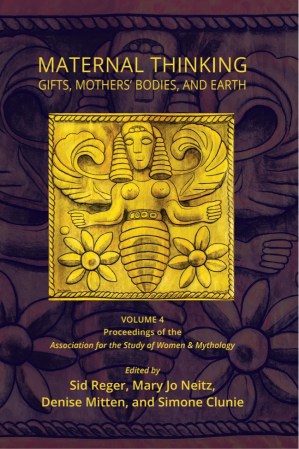
Maternal Thinking: Gifts, Mothers’ Bodies, and Earth edited by Sid Reger, Mary Jo Neitz, Denise Mitten, and Simone Clunie; book review by Carolyn Lee Boyd

Cover designed by Rebekkah Dreskin ~ http://www.blameitonrebekkah.com Front cover art “Bee Goddess of Rhodes Banner” by Lydia Ruyle. Bee goddess logo by Sid Reger

Maternal Thinking: Gifts, Mothers’ Bodies, and Earth, the fourth book of proceedings of conferences held by the Association for the Study of Women and Mythology (ASWM), is an instructional guide to saving ourselves and our planet. Many pre-historic, and even contemporary cultures, especially Indigenous communities, feature “Maternal Thinking.” Such cultures perceive that societies are successful when they center qualities associated with mothering: care, nurturance, cooperation, and meeting everyone’s basic needs while respecting the Earth and reciprocating nature’s generosity. Some 5000 years ago, Maternal Thinking was superseded in many societies by a perspective valuing instead competition, exploitation, and domination, and we and our planet are now facing the catastrophic consequences.

The fifteen contributors and four editors represent myriad disciplines and life experiences. They are academic researchers in wide-ranging fields, artists, activists, a storyteller, a therapist, scientists, educators, and more. This diversity reflects the expansiveness of the book’s vision, including many layers and facets of “mothering,” and the need for as many voices as possible to be heeded if we are to envision and birth a peaceful, just, equitable, compassionate, and environmentally balanced Earth.

Continue reading “Maternal Thinking: Gifts, Mothers’ Bodies, and Earth edited by Sid Reger, Mary Jo Neitz, Denise Mitten, and Simone Clunie; book review by Carolyn Lee Boyd”

Meeting the Melissae: The Ancient Greek Bee Priestesses of Demeter by Elizabeth Ashley, Book Review by Carolyn Lee Boyd

The Mysteries at Eleusis, a nine-day festival in ancient Greece based on the myth of Demeter and Persephone, has fascinated and baffled us for millennia. Here thousands of people from all over Greece and beyond came to understand, in the words of Plutarch, “an undoubted truth our soul is incorruptible and immortal” (277). Producing this festival was the task of the Melissae, the bee priestesses of Demeter, powerful and honored women in a society in which women had few rights, famous in their own time but almost unknown in ours.

In Meeting the Melissae: The Ancient Greek Bee Priestesses of Demeter, Elizabeth Ashley offers us not only facts about the Melissae and other ancient Greek priestesses gleaned from archaeology, art and literature from the period, and modern academic research but her own glimmerings of their deepest spiritual life. She explores what is known about the priestesses and their everyday lives, the goddesses whose temples they presided over, and bees themselves. An aromatherapy researcher, she began her journey to discovering the secrets of the Melissae when she kept reading references to them in ancient botanicals about the herb lemon balm (Melissa officinalis) but nothing more. (The connection between lemon balm and bee priestesses? Pheromones. That’s all I’m going to say).

Continue reading “Meeting the Melissae: The Ancient Greek Bee Priestesses of Demeter by Elizabeth Ashley, Book Review by Carolyn Lee Boyd”