Living by an Ethic of Love by Elise M. Edwards

Elise EdwardsIf we base our love ethic in the love of God, we will be committed to the presuppositions that everyone has the right to be free and to live fully and well. We will not try to deny others access to safety, food, shelter, and companionship, nor prevent them from obtaining opportunities for growth and outlets for self-expression because of their gender, sexual orientation, race, ethnicity, class or cost to ourselves.

I enjoy Valentine’s Day, and this has been the case for many years, whether I have been in a relationship or not.  I think romantic love needs to be celebrated, even if it is at the urging of greeting card companies, chocolatiers, florists and jewelers.  Of course, those of us who are even the least bit critical of consumerism and media propaganda will acknowledge that these companies try to convince us that we need to buy luxury items to demonstrate our love to the important individuals in our lives.  When our consumption of these goods hurts other people in our world and our planet (as in the consumption of blood diamonds or flowers that have been flown around the world, and thus contributing to environmental ills), we must recognize that they are not true reflections of love.   This is not to say that the intent of the giver or recipient is untrue.  I do want to challenge the predominance of these kinds of images of love, and provoke us to reflect on another way – an ethic of love rooted in the love of God. Continue reading “Living by an Ethic of Love by Elise M. Edwards”

Second Class Rape Victims: Rape Hierarchy and Gender Conflict

Deconstructing masculinity isn’t the key to solving social, sexual, and domestic violence across the world but it is a step worth taking when attempting to engage men in affecting change to stop these violent actions since men, statistically are the perpetrators of such crimes that both cause such outcry as well as perpetual silence.

johnThe most disturbing part of the 2006 documentary Deliver Us from Evil isn’t the fact that Father Oliver O’Grady is rewarded by the Catholic Church with a new congregation in Ireland after his short stint in prison for the rape of dozens of children in the 1970s, but rather the hierarchy of gendered victimization which is often created throughout the various rape cases that are both reported and unreported throughout history.

I am often troubled by the ways in which rape cases are discussed and deconstructed via mediums such as blogs, online communities, social media networks, the news, and popular culture.  No series of events troubled me more than the Jerry Sandusky trial, but more importantly, the ways in which the young boys and adult men who were subjected to Sandusky’s abuse quickly overshadowed the other rape cases that are reported on a daily basis, specifically those involving young girls and women. Continue reading “Second Class Rape Victims: Rape Hierarchy and Gender Conflict”

On Pronouns and Liberation in the Classroom by Ivy Helman

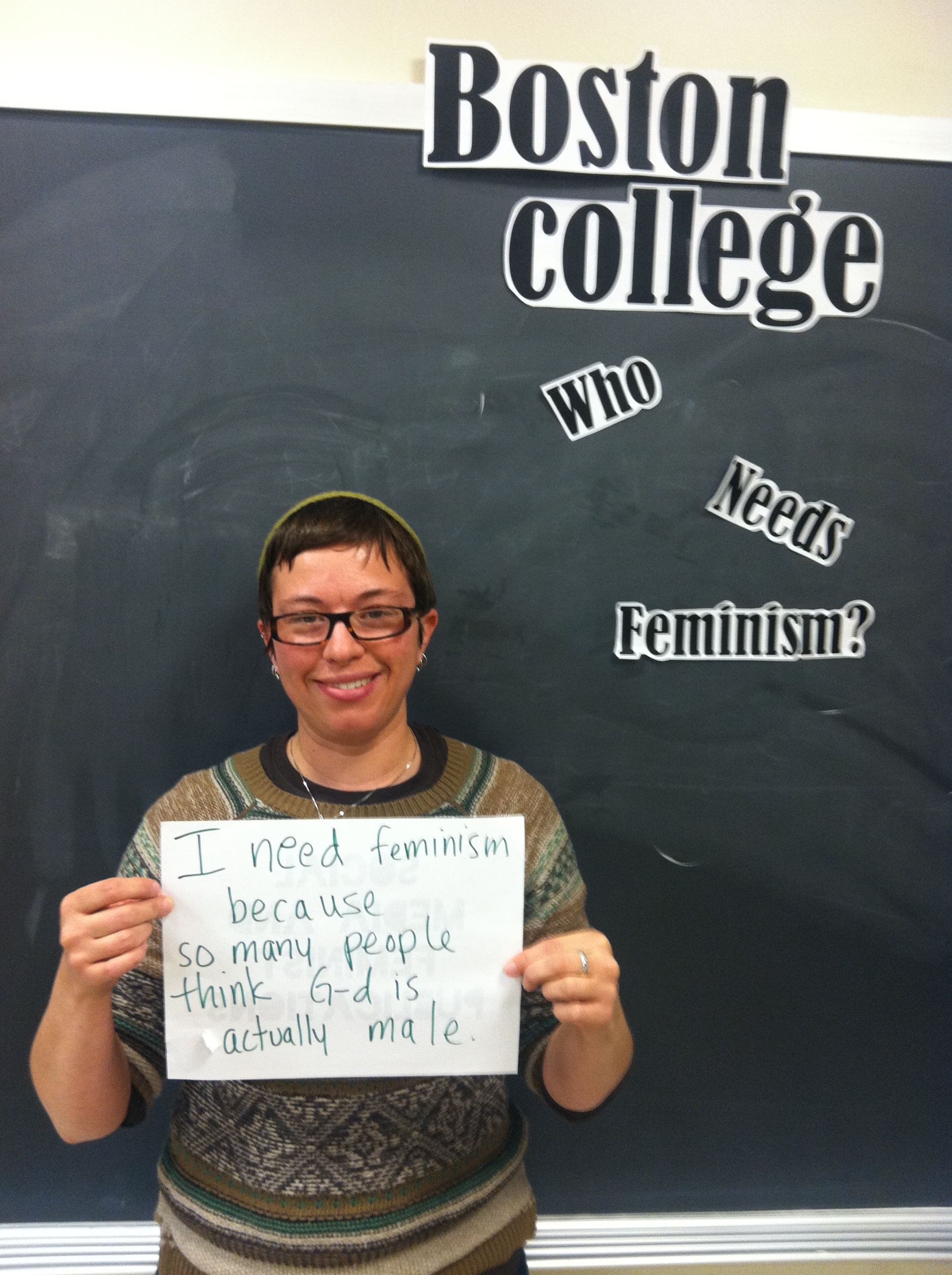
photoIn my introduction to Christianity class, almost every one of my students (who come from diverse religious backgrounds – primarily Roman Catholic, Protestant and Muslim), continues to believe that the best image if not the only appropriate image for G-d is male.  When probed they may speak generically about G-d as genderless, an entity or spiritual presence of some kind, yet conclude by affirming their belief that G-d is male often by adding something along the lines that G-d is best described as Father.  Some go so far in these affirmations that they articulate G-d’s maleness as fact.  It never fails that every semester I struggle with how to address this basic feminist issue within the classroom.

At least as early as 1973, Mary Daly, in Beyond G-d the Father: Towards a Philosophy of Women’s Liberation, articulated the problematic basis of the relationship between gender and divine imagery.  She argues that “If G-d in ‘his’ heaven is a father ruling ‘his’ people, then it is in the ‘nature’ of things and according to divine plan and the order of the universe that society be male-dominated.”  In other words, if maleness is associated with divinity, then the power, domination and running of society by men seems to be divinely ordained. Continue reading “On Pronouns and Liberation in the Classroom by Ivy Helman”

Imagine a Catholic Church that Loved as only a “Woman” Loves by Michele Stopera Freyhauf

Freyhauf, Feminism, Religion, Catholic Church I came across an abhorrent display of ignorance Saturday when reading an article quoting the Pope’s theologian, Dominican priest Wojciech Giertych, on why women cannot be ordained.  This man is in charge of reviewing speeches and texts submitted to the Pope to ensure that they are free of doctrinal error.  Once you read this, I am sure that many of you will have the same thoughts that I do ranging from – that explains a lot — to —  we are in serious trouble!

Giertych touted the common arguments made against ordaining women – Jesus was a man, Jesus chose only male disciples, etc.  However, then he put forth statements about, (1) the theologian’s task, (2) why maleness is essential to the priesthood, and (3) what the vocation of women is and is not.

What is the Theologian’s Task?

According to Giertych, the theologian’s task in determining the definition of priesthood:

 “In theology, we base ourselves not on human expectations, but we base ourselves on the revealed word of God” without the freedom “to invent the priesthood according to our own customs, according to our own expectations.”

According to CTSA (Catholic Theological Society of America), the theological task is described as follows:

Theologians throughout history have promulgated the riches of the Catholic tradition by venturing new ways to imagine and express the mystery of God and the economy of salvation revealed in Scripture and Tradition. This is a Catholic style of theological reflection that very many Catholic theologians continue to practice today. The teaching of the Second Vatican Council in its Pastoral Constitution on the Church in the Modern World (Gaudium et Spes) is especially eloquent on this responsibility” (See Gaudium et Spes #44).

Continue reading “Imagine a Catholic Church that Loved as only a “Woman” Loves by Michele Stopera Freyhauf”

Blessed By Gratitude and Sharing by Xochitl Alvizo

Incarnation, Goddess spirituality, Xochitl Alvizo,  god became fleshCarol Christ’s post yesterday has gotten me thinking about the differences between Christianity and earth-based spiritualities. Of course, there are many differences, that goes without saying. However, being someone who comfortably stands at the intersection of them both I am usually more aware of the ways in which they seem to intersect in life-changing and inspiring ways for me. Nonetheless, Carol has me thinking…

Over the course of the last year here on Feminism and Religion, Carol has written a lot about the importance of ancestors – how when speaking about embodiment and interdependence it is crucial we acknowledge all the ways in which ancestors make us who we are. Mothers literally give us our bodies and our ancestors’ genes, connecting us to a long line of people both materially/biologically as well as historically. Ancestors give us a sense of connection to places and ground us to lands that were meaningful to them and thus become meaningful to us. And Carol also reminds us that our family and ancestors transmit to us memories that impact us psychically and in powerful ways. These emphases on connection, interdependence, rootedness, and embodiment flow from her earth-based Goddess practice and thealogy. Her spirituality leads her to a greater sense of appreciation and gratitude for the Source of Life and for all the sources of life, and she affirms that because of this deep awareness of interdependence and relationality people who practice earth-based spiritualities are “moved to share what has been given to [them] with others.” Continue reading “Blessed By Gratitude and Sharing by Xochitl Alvizo”

Truth and Consequences–This Feminist’s Perspective? by Marcia Mount Shoop

Marcia headshotIn John’s Gospel, Pilate’s response to Jesus’ self-identification as the one who “came into the world to testify to the truth” is a simple question:  “What is truth?”  His question hangs in the air as he moves from that conversation to the throngs he sought to please.  Pilate took the temperature of that crowd to decide Jesus’ fate even though he, himself, found no reason to charge Jesus with a crime.  Pilate asks the question from a position of power—literally holding life and death in the ambivalence and maybe even in the sincerity of his words.

The “t” word has been center stage in our collective conversation of late with Lance Armstrong’s Oprah-event confession  and the Manti Te‘o girlfriend-dying-of-cancer hoax at Notre Dame .   The Internet is abuzz with reactions to both confessional moments.  Lance Armstrong’s confession apparently didn’t play well with the general public.   And people are weighing in about whether Manti Te‘o could really be so naïve or if he just didn’t know how to tell everyone the truth when the story got out of hand.   Continue reading “Truth and Consequences–This Feminist’s Perspective? by Marcia Mount Shoop”

Rebekah of the Hebrew Bible: A Mormon Feminist Model by Caroline Kline

Kline, CarolineThis semester I took a class on women in the book of Genesis. I was particularly interested in learning more about the language used to describe Eve, since she is such an important model of inspired action and proactivity for Mormon women. However, I also discovered another woman in the book of Genesis whom I saw as a potentially powerful model for Mormon feminists, a woman caught in a patriarchal context, but one who decisively and creatively figures out how to insert herself, her ideas, her inspiration into the events at hand: Rebekah.

Let me recap the most crucial incident: When Isaac is old, blind, and believes he is approaching death, he determines to give a special blessing to his firstborn son Esau. When Rebekah hears of his plans, she springs into action, ordering her younger son Jacob to impersonate Esau in order to obtain this blessing. Rebekah feels so strongly that Jacob should get this blessing – and no wonder, given her revelation from God forty years before that Jacob should inherit the promise – that when he objects, fearing a curse from his father if he is found out, she says to him, “Let your curse be on me, my son. Only obey my word, and go…..” (Genesis 27:13). Continue reading “Rebekah of the Hebrew Bible: A Mormon Feminist Model by Caroline Kline”

What It’s Like to Be a Woman in the Academy by Linn Marie Tonstad

Linn Marie TonstadLast fall, I was asked to sit in on the women’s pre-doctoral colloquium at the divinity school where I teach. In the course of a wide-ranging lunchtime conversation, the central question to which the students wanted an answer was: “what is it like to be a woman in the academy?” The question took me by surprise at the time – mostly because I’d expected to be asked more nitty-gritty questions about applying to graduate school, writing samples, and personal statements – but it has stayed with me in the weeks since the lunch as I’ve found myself trying out answers from different directions.

The first answer, and perhaps the most obvious one, is this: there is no such thing as being “a [generic] woman” in the academy (or anywhere else). Continue reading “What It’s Like to Be a Woman in the Academy by Linn Marie Tonstad”

One Thing I Like About Christianity by Erin Lane

Erin LaneI never have good dreams. They always fall into the weird, creepy, or just plain terrifying category. Last night was no exception. I’ll save you the diary entry but after sharing the short saga with my husband this morning (who I’m sure dreams of lollipops, if he could only remember), he looked at me and said, “Geez, Erin. You really care that people like you.”

It was a neighborhood prank gone wrong. In the dream, I had been running through people’s lawns and hiding in bushes with my husband and two other guy friends. We were armed with squirt guns, except that they weren’t squirt guns; they were household cleaners. I don’t know what we thought we were doing exactly – take that organic tomatoes! and that you meddling cat! –  but we soon got caught and I proceeded to be excluded, shamed, and taunted. First by a group of wives who snickered at me from a safe distance in their convertible and whispered, “She’s always trying to be one of the guys.” Then by a work colleague standing nearby who asked me, “How would Jesus feel about your actions?” and then let his wife hose me down with a sprinkler, which in retrospect was very un-Jesus like. And lastly by one of my guy friends in crime who called me “snotty” for hamming it up for a photo opp when the press arrived. Continue reading “One Thing I Like About Christianity by Erin Lane”

Monthly Highlight: Emilie M. Townes


Emilie M. Townes

“In my teaching I want to get students excited about that notion of, you know, you’re not just here to get a Yale degree and have it on your diploma and be able to hang it on your wall…You should be here thinking about what kind of contributions can I make to society….What are you doing that helps enhance the lives of all of us, as opposed to (our) own little idiosyncratic research interests.”  – – Emilie M. Townes

Emilie Townes is a pivotal person in the field of Womanist and Christian ethics as well as a foremother and pioneer in Womanist theology. Cornel West of Princeton University said:

“Emilie Townes is the towering womanist ethicist of our time….In this ice age of indifference and evasion, her powerful voice and viewpoint summon us. And we thank her for her vision and courage.”

At an opening address at the Convocation in 2005, Townes stated that there is a need to live in a “deep walking hope” that shapes lives “in ways that are not always predictable, not always safe, rarely conventional” and protests “with prophetic fury the sins of a world, and sometimes theological world views, that encourage us to separate our bodies from our spirits, our minds from our hearts, our beliefs from our actions.” Continue reading “Monthly Highlight: Emilie M. Townes”