Painting Jarena Lee By Angela Yarber

When we gender the pulpit in the direction of justice, we ordain her spirit with gratitude for the many miles she walked and the countless sermons she preached.

This month I celebrate the release of my second book, The Gendered Pulpit: Sex, Body, and Desire in Preaching and WorshipAs I celebrate the privilege I have as queer feminist to stand behind the pulpit each Sunday—to gender the space in the direction of justice—I must also recall the myriad holy women who have gone before me.  I think of many of my Holy Women Icons with a folk feminist twist: Virginia Woolf , the Shulamite, Mary Daly, Baby Suggs, Pachamama and Gaia, Frida Kahlo, Salome, Guadalupe and Mary, Fatima, Sojourner Truth, Saraswati, and so many others.  And this month I think specifically of my sister preachers, those who raised their voices in bold proclamations when the road was long and unimaginably difficult.  I think of preachers like Jarena Lee.

Jarena leeLee spent thirty years as an itinerant preacher and was the first black woman to be licensed to preach through the African Methodist Episcopal (AME) church.  Despite the fact that the AME issued a definitive ruling that women were not permitted to preach in 1852, Lee spent the bulk of her adult life preaching.  Jarena Lee’s struggle to preach is a familiar story in nineteenth-century American Protestantism, even though the Second Awakening ushered in a period of intense religious revival; with camp meetings around every corner, there was an unprecedented opportunity for women to preach.  Like Jarena Lee, though, they weren’t paid, ordained, or protected. Continue reading “Painting Jarena Lee By Angela Yarber”

Orientations: Body, Space, Authority by Linn Marie Tonstad

Linn Marie TonstadIn her book Queer Phenomenology, Sara Ahmed investigates how we orient ourselves in space with respect to tables – the tables around which we sit, at which we eat with friends and families of choice and birth, and at which we write. She describes moving into a new place and arranging the furniture. “After the kitchen, the room I hope to inhabit is always the study. Or the place that I have decided is the place where I will write. There, that will be my desk. Or it could just be the writing table. It is here that I will gather my thoughts. It is here that I will write, and even write about writing. … Making a place feel like home, or becoming at home in a space, is for me about being at my table. I think fondly of Virginia Woolf’s A Room of One’s Own. How important it is, especially for women, to claim that space, to take up that space through what one does with one’s body. And so when I am at my table, I am also claiming that space, I am becoming a writer by taking up that space.” (11) Ahmed goes on to discuss how certain possibilities are opened up, and others foreclosed, by the way we orient ourselves (or find ourselves oriented) to others and to objects. She describes the bodily postures that result from orienting oneself to the writing table – the way one might hunch over one’s computer, or find oneself with ink-stained fingers.

In a very different context, the queer theologian Marcella Althaus-Reid describes a scene from her childhood in Argentina. She kneels in front of a priest for confession. But instead of kneeling to the side, aslant, as she ‘ought’ to have done, being a girl, she kneels directly in front of the priest, as if she were a boy. Kneeling here too is a form of orientation, a form of direction, a bodily habit of becoming. “Kneeling is troublesome and it has a theological referent in the church’s also troubled waters of sexuality and power. A whole symbolic sexual order is obviously manifested in kneelings as positions of subordination and sites of possible homo- and hetero- seductions, because these are theologically distributed around the axis of the priesthood’s male genitalia. The priest’s penis carries the sacred connotations of the phallus as a transcendental signifier of the theological discourses to everyday Christianity, and kneeling is a liturgical positing designed to centralise and highlight this.” (The Queer God, 11) To kneel in the right (gendered) position in relation to the priest is also to kneel in the right relation to God. Continue reading “Orientations: Body, Space, Authority by Linn Marie Tonstad”

The Feminist Influence by Elise M. Edwards

Elise Edwards

In these past few months, as I’ve been finishing my dissertation about a theological and ethical perspective on architecture, I’ve had the pleasure of speaking often about my work.  In March, I was invited to give a talk at a symposium titled “On Christ and Architecture” at Judson University.  As they introduced me, the speakers noted that I am a black feminist.  Because of the brevity of my presentation, I didn’t speak about things that most people associate with feminism. So I was especially excited when at the end, one of the organizers complimented me by saying, “I really see the feminist influence in your work and I thank you for bringing that to us.” So exactly what does a feminist perspective bring to a theological study of architecture?

Perhaps first I should explain what my theological study of architecture is.  The purpose of architecture is sometimes understood as aesthetic or functional—to either make buildings that look nice or serve their purposes well (or both).  However, I discuss an ethical approach that expands this common understanding of architecture.  Grounding my research in philosopher Karsten Harries’ The Ethical Function of Architecture and theologian Timothy Gorringe’s A Theology of the Built Environment, I argue that architecture presents interpretations of a community ethos, or way of life, for its specific time and place.  These representations can either promote or inhibit human flourishing, and therefore, are the proper concern of Christian theology and ethics, which is concerned with questions about how Christians and those in the broader society are to live rightly in the world. Continue reading “The Feminist Influence by Elise M. Edwards”

The Flesh Made Word: Colm Toibin’s “The Testament of Mary” on stage and in print By Joyce Zonana

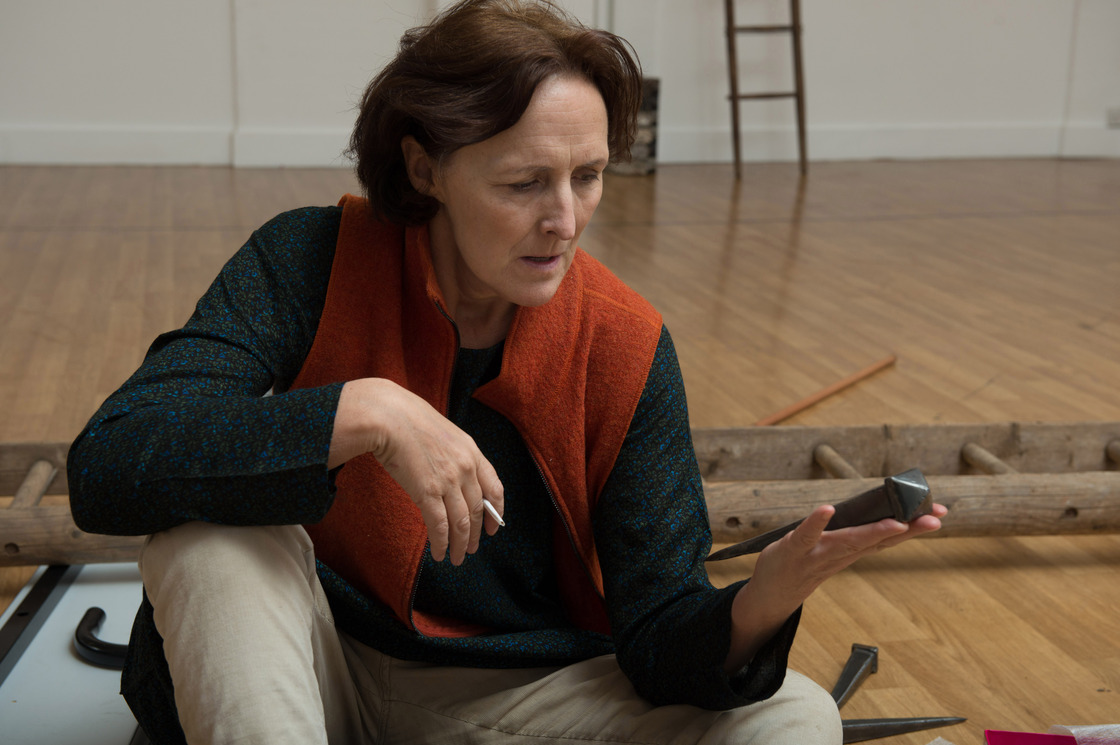
Colm Toibin Fiona Shaw Testament of Mary Ephesus Artemis House of the VirginBefore the play begins, the audience is invited on stage; we walk around, not quite knowing what to do, gazing at the props, uncertain.  A few chairs, scattered jars of honey, jugs of water beside a free-standing waist-high faucet, a tall ladder, a long table, a stripped tree trunk with a wooden wheel at the top suspended from the rafters, a menacing roll of barbed wire, and a live turkey vulture occasionally spreading wide its iridescent blue-black wings: such is the set for Deborah Warner’s searing production of Colm Toibin’s The Testament of Mary, a one-woman show currently in previews at the Walter Kerr Theater in New York.  In a large open-sided box, stage left, the actress Fiona Shaw, draped in blue from head to toe, arranges herself, then sits perfectly still, holding a lily and an apple.  We know this woman.  The Virgin Mary.  The Icon.  Incarnate.

Fiona Shaw rehearses for her role as the Virgin Mary in The Testament of Mary. Irish novelist Colm Toibin's one-woman play opens April 22 at Broadway's Walter Kerr Theater.
Shaw in rehearsal. Photo by Hugo Glendinning

But when we are all back in our seats, Mary casts off her robe to stand before us in a simple black shift, flowing easily over narrow brown pants. Her hair is cropped, her face haunted; wearing short leather boots, she fumbles as she searches for a hand-rolled cigarette to steady herself.   “I remember everything.  Memory fills my body as much as blood and bones.”  No longer an icon, hardly a virgin, this Mary addresses us with the piercing directness of the passion she has suffered: to have seen her only son crucified despite her efforts to save him. Now, interrogated by two unnamed apostles (John and Luke?) who want to fix the story of her son’s life and death and resurrection, Mary insists on reporting only what she knows:  “I was there.  I fled before it was over but if you want witnesses then I am one and I can tell you now, when you say that he redeemed the world, I will say that it was not worth it.  It was not worth it.”

Continue reading “The Flesh Made Word: Colm Toibin’s “The Testament of Mary” on stage and in print By Joyce Zonana”

Grief Beyond Belief and Rebecca Hensler by Kile Jones

Kile Jones, atheistIn my last post, “A Pro-Science, Skeptical Woman Speaks” I interviewed a woman with whom I share many views in common.  One of my goals here at Feminism and Religion is to introduce different secular, atheistic, liberal feminists who share many of the same ethical views as regular contributors and readers, but not the same “religious” or “spiritual” ideas.  In this post I examine an online support network for unbelievers, Grief Beyond Belief, and ask a few questions to its founder, Rebecca Hensler.

I met Rebecca in February in San Francisco while on a visit I made to meet with the Unitarian Universalist Association in regards to my ordination.  My girlfriend and I met Rebecca in North Beach, San Francisco for dinner and drinks.  I experienced her as a compassionate, friendly, and genuine person.  Her experiences and insights inspired me to think more about the role of grief and pain among unbelievers.  I mean, atheists cry, agnostics experience loss, skeptics lose family members, and we do it all without a “God” or “spirit” to help us.  And if we were to meet C.S. Lewis, we would make

sure to exclaim, “No…pain is not some megaphone for God to rouse a deaf world.”
R Hensler

Why did you start Grief Beyond Belief?

The original idea was born of my own grief.  After my son died, I found a group in which to share comfort and compassion with other grieving parents: The Compassionate Friends, a mainstream parental grief support organization with a strong online presence.  It was so close to exactly what I needed, but I frequently felt alienated by the religious and spiritual content — not just the offers of comfort that depended on beliefs I do not hold, but the assumption that everyone there held some sort of belief in life after death. And the assumption, so common in mainstream grief support, that even if I am not the same religion as you are, I have a religion, and I believe in some sort of afterlife was equally alienating and hurtful. Continue reading “Grief Beyond Belief and Rebecca Hensler by Kile Jones”

Women’s Ordination and the Mormon Church by Margaret Toscano

Me April 2011 3Caroline Kline’s March 26 post, “Mormons Who Advocate Women’s Ordination,” marks a new direction in the Mormon feminist movement. As she describes, the website Ordain Women was launched on March 17 by a few dozen Mormon women and men who state: “As a group we intend to put ourselves in the public eye and call attention to the need for the ordination of Mormon women to the priesthood.” By the end of March, 44 people (37 women and 7 men, including a Mormon bishop) have posted profiles with photos where they describe their relationship to Mormonism and why they think women should be ordained. I understand from the organizers of this site that a number of others have submitted profiles for posting and that the site has had close to 100,000 hits. On the corresponding Facebook page, however, only 363 people have given Ordain Women a “Like” sign.

While supporters may appear to be a small group in comparison to the 14 million Mormon (aka LDS) church members worldwide, it is a significant number for a grassroots movement like this. As a Mormon feminist who has publicly advocated for the ordination of women since 1984, this is the first time I have seen more than a handful of people willing to state publicly their belief that women should be ordained. In the past, women’s ordination has always been the dividing issue among Mormon feminists. All Mormon feminists want women to have more voice in the Church, more decision-making power, more visible authority and equality. Very few have wanted to be ordained into the male-priesthood structure of the Church, though more have claimed a private, spiritual priesthood.

And yet, as I have always argued, there is no way that Mormon women can be equal to Mormon men as long as they are denied access to priesthood ordination and offices because the priesthood structure controls all resources, discourses, and practices. In some ways this issue is even more crucial in the LDS Church than in other religious traditions because the Mormon organization is based on a lay priesthood where all active boys and men have priesthood. What this means is that grown women have less practical and religious authority than their 12-year old sons. Continue reading “Women’s Ordination and the Mormon Church by Margaret Toscano”

Pope Francis: A Fisherman for Our Times? by Dawn Morais Webster

Dawn Morais Webster, the Pope off to his summer palace, Castel Gandolfo. He tells the world he will now become just a “humble pilgrim.”

 A thoughtful non-Catholic friend, Mei Li, in largely Muslim Malaysia, wondered aloud in a Facebook chat after the election of Pope Francis: “How many people get to start anew like this?   A new name, a new life, a new kingdom here on earth. He could be what keeps thousands, maybe millions of people from getting AIDS. Even if my vote does not count, so to speak, I have to care what he teaches.”

Yes, believers or not, we all have to care.  The skeptics were right.  Picking a Pope from the ranks of the nuns was expecting the current crop of cardinals to cast their net further than they could. But Pope Francis may yet prove to be a fisherman who casts a different kind of net.

Countries of the South, where Catholics still fill the churches, rejoice at the selection of a Pope with whom they might claim a closer kinship. It is unclear whether he can ensure the success of a soccer team, or even whether his election proves that God is an Argentine.  But the fact that even the weary are tuning in is a good sign. Continue reading “Pope Francis: A Fisherman for Our Times? by Dawn Morais Webster”

Reflections on Good Friday by Kathryn House

Tomorrow is Good Friday on the western Christian calendar, the day when western Christians remember Jesus’ death on the cross. The day is often memorialized in ways that recall Jesus’ last moments, from his final steps to his final words, with great specificity. For as many traditions to observe the day, there are theologies to interpret just what, if anything, the cross “means.” In the past few years, I have found myself moving further and further away from identifying this day as one that saves. If I am honest, it has been, and continues to be, an exercise and practice in theological freedom. For me it started with the moment in my first year of theology class when my professor spoke about Anselm and Abelard, of transactions, of debt satisfaction. Something about seeing this formula within its feudal context – of seeing it for the first time as a deeply contextual rather than eternal or primordial or absolute theology – struck a chord and disrupted some sediments I considered unshakeable.

This fissure and subsequent reimagining has continued as over the years I’ve engaged the work of womanist and feminist theologians. There was sister FAR contributor Xochitl Alvizo’s post last year disrupting the spectacle of Good Friday, of re-imaging new rituals that do not dwell on death. There is the work of JoAnne Terrell, the books Proverbs of Ashes and Saving Paradise by feminists Rebecca Parker and Rita Nakashima Brock, and my professor Shelly Rambo’s work on spirit and trauma. I suppose if I am anywhere on the topic, I am just no longer sure that Jesus paid a debt he did not owe because I owe a debt I cannot pay. I am unconvinced that suffering redeems, that blood atones, that the death of a son – of anyone’s daughter or son – brings satisfaction. Certainly feminists and womanists hold diverse beliefs, but here is where I can stand, for now.

Continue reading “Reflections on Good Friday by Kathryn House”

Mormons Who Advocate Women’s Ordination by Caroline Kline

Kline, CarolineA couple of months ago, I came across the “Ordain a Lady” video by the Catholic Women’s Ordination Conference. Even though it was lighthearted, clever, and fun, it made me cry. Why? Because as a Mormon feminist, I had never seen such confident assertions on video for the need for women’s ordination:

“Woman priest is my call
Women preaching for all
Don’t listen to St. Paul
‘Cuz I can lead the way”

I felt chills run up my spine as I watched these women asserting their strength, their vision, and their truth. Amen, I said to myself. Indeed, “Justice doesn’t look like only male priests.” As this video circulated among various Mormon feminist email lists, several other women mentioned that this video brought them to tears too. Continue reading “Mormons Who Advocate Women’s Ordination by Caroline Kline”

When Feminists Disagree by Linn Marie Tonstad

Linn Marie TonstadA while back I gave a talk on feminist trinitarian theology to an audience of mostly progressive academics, including feminist and womanist scholars of religion. In the course of analyzing what I called the ‘trinitarian imaginary’ in Christianity and its often-patriarchal and masculinist forms, I suggested that transforming that imaginary might require recognizing the hypothetical character of theological statements until the eschaton, a theme that has been developed in depth by a German theologian named Wolfhart Pannenberg. Now, Pannenberg is decidedly neither a feminist nor a progressive theologian. To name just one example: in his three-volume Systematic Theology, his few explicit references to feminist or female theologians include a brief mention of Mary Daly (volume 1, p. 262) in connection with a critique of feminist theologians for projecting (!) masculinity into God in their readings of divine fatherhood, and a critique of Valerie Saiving and Susan Nelson Dunfee’s positions on the traditional Christian doctrine of sin as pride (volume 2, p. 243). So when I mentioned Pannenberg as a resource in my talk, one of the feminist scholars in the audience audibly gasped and flinched – it became clear in the Q&A that she had significant concerns about whether I could count as a feminist at all. After all, to mine someone like Pannenberg for constructive feminist theological work might imply an endorsement of his other positions, or might entail taking over aspects of his system that would taint my own project in anti-feminist directions – all legitimate concerns.  Continue reading “When Feminists Disagree by Linn Marie Tonstad”