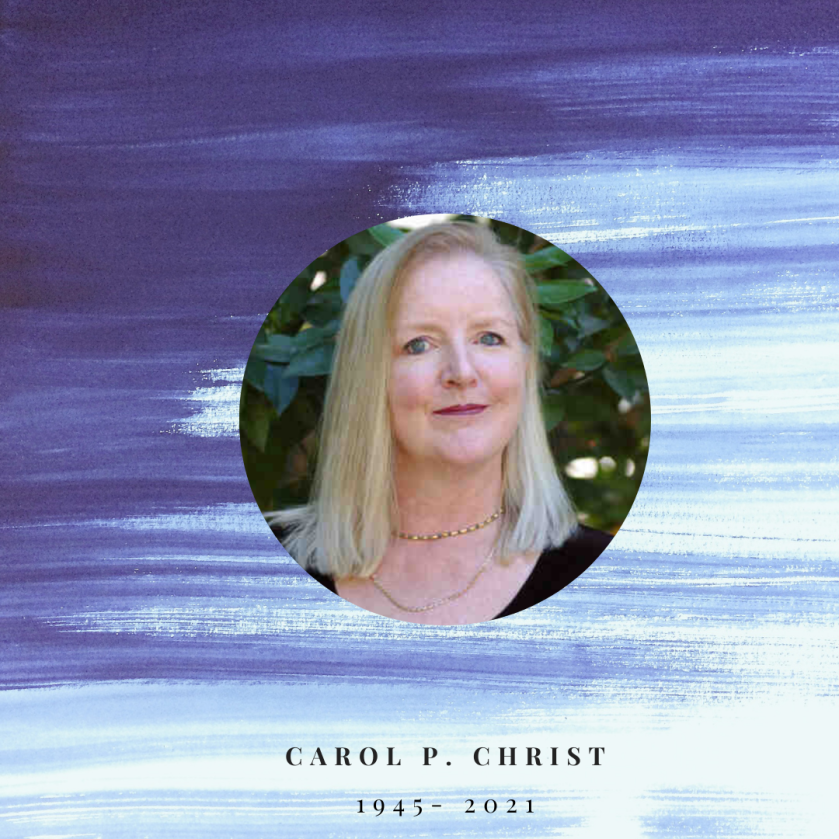
Legacy of Carol P. Christ: Hidden Meanings in the Rituals of the Assumption

“[T]he Old European sacred images and symbols were never totally uprooted; these persistent features in human history were too deeply implanted in the psyche.  They could have disappeared only with the total extermination of the female population.” Marija Gimbutas, The Language of the Goddess, 318.

August 15 is known to Greek Christians as the date of the Koimisi, “Falling Asleep” or Dormition of the Panagia, She Who Is All Holy.  December 25 is a minor holiday in the Orthodox tradition, while Easter and August 15 are major festivals.  The mysteries of Easter and August 15 concern the relation of life and death.  In Orthodox theology, both Easter and August 15 teach that death is overcome:  Jesus dies and is resurrected; Mary falls asleep and is assumed into heaven.  These mysteries contain the promise that death is not the final end of human life.  Yet this may not be the meaning of the rituals for many of those who participate in them.

Continue reading “Legacy of Carol P. Christ: Hidden Meanings in the Rituals of the Assumption”

Legacy of Carol P. Christ: Transcendence, Immanence, and the Sixth Great Extinction

This was originally posted August 4, 2014

In my recent blog “The Flourishing of Life and Feminist Theology” I discussed Grace Jantzen’s view that theology should focus on “natality” or birth and life, rather than life after death or life apart from this world. This week Tikkun magazine published its summer issue with a feature called “Thinking Anew about God.” In it two male thinkers, one Buddhist and one Christian, argue for a similar turn toward the world in their traditions. Their calls for religions to focus on this world were published the same week scientists warned that the world stands on the brink of the sixth great extinction.

I have come to believe that any religion espousing cosmological dualism (devaluing this world in favor of a superior reality such as heaven) and individual salvation (the idea that what ultimately happens to me is disconnected from what ultimately happens to you) is contributing to our world’s problems rather than offering a solution. … [Religions should] stop emphasizing the hereafter and focus instead on how to overcome the illusion that we are separate from this precious, endangered earth. –David Loy, Buddhist, writing in Tikkun Summer 2014

Continue reading “Legacy of Carol P. Christ: Transcendence, Immanence, and the Sixth Great Extinction”

A Serving of Vegetables with Love: Plastic, Poison, and the Simple Salad Solution

Years ago, I remember looking around one day and realizing that I was surrounded by plastic bottles. Of course I already knew it on some level; I had bought them, after all. But it was one of those epiphanal moments – you know, where you kind of freeze, and time seems to slow down, and everything goes a little out of focus. And I realized – yet again – that I had been hoodwinked. That we all have.

Because I felt like I needed every single one of them. Yet somehow – and not that long ago, either – everyone used to get along fine without all these plastic bottles in their lives. Yes, it probably involved more domestic labor; but it also just stemmed from a local, circular economy based on common sense.

Continue reading “A Serving of Vegetables with Love: Plastic, Poison, and the Simple Salad Solution”

Legacy of Carol P. Christ: Sophia, Goddess, and Feminist Spirituality: Imagining the Future

This was originally posted on September 17, 2018

Though represented by its detractors as an incursion of paganism into

Christianity, and presented as an integrally and intrinsically Christian phenomenon by its supporters, the truth about the Re-Imagining Conference and movement is that it was a product of a wider feminist awakening. The critique of patriarchal religions that emerged in the academy and in churches and synagogues in the late 1960s and early 1970s was part of the emerging feminist uprising. The feminist movement placed a question mark over all patriarchal texts and traditions, secular and religious, and as such was beholden to none.

In the spring of 1971, Roman Catholic Christian Mary Daly published “After the Death of God the Father” in the liberal Catholic magazine Commonweal. She asserted that the God whose death was touted in the “Death of God” movement was an idol fashioned in the image of male power and authority. She called for “the becoming of new symbols” to express the new becoming of women. In the summer of 1971, a group of nuns from Alverno College convened the first Conference of Women Theologians. Besides sparking dialogue about the role of women in religions, the conference endorsed my call to form a women’s group at the fall meetings of the American Academy of Religion, up until then a gathering of several thousand male scholars of religion, with only a handful of women scholars in attendance. At winter solstice, Z Budapest launched the Susan B. Anthony Coven #1 in Los Angeles publishing a Manifesto calling on women to return to the ancient religion of the Goddess.

Continue reading “Legacy of Carol P. Christ: Sophia, Goddess, and Feminist Spirituality: Imagining the Future”

A Story About Forgiveness by Sara Wright

Every morning I write a little meditation with attached images that in some way reflects what’s going on in my life. I do this for three reasons. To experience gratitude for something I have learned, to share my thoughts with others and to consciously align myself with LIFE while participating, albeit unwillingly, in a death destroying culture.

As a naturalist my focus is usually on some gift received resulting from my reciprocal relationship with nature. But I wrote this meditation to articulate one of the most important aspects of relating to other humans – perhaps the most important. Forgiveness. And I wrote it after experiencing the freedom and gratitude that followed a powerful act of forgiveness associated with a long-term friendship.

Continue reading “A Story About Forgiveness by Sara Wright”

Legacy of Carol P. Christ: Can You Kill the Spirit? What Happened to Female Imagery for God in Christian Worship?

This was originally posted March 16, 2015

When I first began to think about female language and images for God I imagined that changing God-He to God-She and speaking of God as Mother some of the time would be a widespread practice in churches and synagogues by now. I was more worried about whether or not images of God as a dominating Other would remain intact. Would God-She be imaged as a Queen or a Woman of War who at Her whim or will could wreak havoc on Her own people?

Forty years later, very little progress has been made on the question of female imagery for God. I suspect that most people in the pews today have never even had to confront prayers to Sophia, God the Mother, or God-She. Most people consider the issue of female language in the churches to have been resolved with inclusive language liturgies and translations of the Bible that use gender neutral rather than female inclusive language.

Continue reading “Legacy of Carol P. Christ: Can You Kill the Spirit? What Happened to Female Imagery for God in Christian Worship?”

From the Archives: The Hunger Games, Holy Week, and Re-imaging Ritual by Xochitl Alvizo

This was originally posted on April 3, 2012 and serves as a nice follow up to my recent posts, and to the Christian holy days being celebrated this week.

Being passive spectators of violence and injustice, even if mournfully so, is not just a thing of Panem, it is our everyday reality.

In The Hunger Games Suzanne Collins takes the reality of an unjust society and gives it an imaginative makeover. In Panem, most people are kept at such extreme levels of hunger that even when they do eat they cannot fill the hollowness that has settled in their stomachs, while others are deciding on the next cosmetic alteration they will undertake – whiskers, jewel implants, or green-tone skin color? The disparate conditions between the rich and the poor, the few and the many are absurdly and starkly portrayed but done so in a way that we can still recognize our world in theirs. And at the center of this world is the state imposed ritual of punishment and control, the yearly Hunger Games – a nationally televised competition that all the people of Panem are required to watch. The 12 districts watch mournfully as two kids from each of their districts compete to the death, and the wealthy watch gleefully, for the games are the height of their excesses and entertainment. The yearly Games conclude when one kid, the lone ‘victor’, is left standing. All while the nation watches.

Continue reading “From the Archives: The Hunger Games, Holy Week, and Re-imaging Ritual by Xochitl Alvizo”

Re-imagining the Ritual of Communion by Xochitl Alvizo

I remember the words so clearly: “I know what it’s like to have my body broken, I know what it’s like to have my blood spilt. I won’t celebrate anyone else’s broken body or spilt blood, and I don’t want anyone doing that on my behalf.” Sitting in the pew next to me, my friend spoke her truth in a soft and tentative, but somehow still firm, voice. She then slumped in her seat and folded up her legs, hugging them against her body. While everyone else got up to take communion, I stayed in place beside her.

There was a period of time in my life when I was not willing to participate in communion. My friend’s words stayed with me, transforming the communion table from one of hospitality to one of violence. “Celebrating” communion didn’t feel celebratory anymore. I chose not to take communion for several years. I let my friend’s words guide and deepen my reflection on the practice of communion—especially in light of the trauma suffered by all too many bodies.

Continue reading “Re-imagining the Ritual of Communion by Xochitl Alvizo”

Radical Joy by Beth Bartlett

On Christmas mornings my brother, sister, and I had to wait patiently upstairs until we heard the music playing. Then, at last, the trumpets and voices singing “Joy to the world!” beckoned us down to the living room, with presents piled high under the brightly lit Christmas tree and stockings filled to the brim hung by the roaring fire.  As a child, I experienced Christmas as a most magical and wonderful time of year, but it wasn’t just about getting presents. Strangers greeted each other with good cheer, wishing each other a “Merry Christmas.” Children visited the homes of the elderly and housebound, brought them cookies and sang carols.  People were different – kinder, friendlier, more open-hearted, more forgiving. These are the true gifts invoked by the Christmas season, and I often wondered why we couldn’t continue these all year. I still do. 

Continue reading “Radical Joy by Beth Bartlett”

Solstice Stories : Fire and Ice by Sara Wright

The winter solstice is almost upon us just as the first heavy snow buries the forest and house under 28 inches of snow. I never look forward to this shift into the cold, ice, and snow, although I do wrap myself in peaceful silence, sitting by the fire dreaming as twilight turns to night. My Norfolk Island pine and tipped balsam wreath shimmer with tiny stars. The scent of balsam soothes my senses and purifies the air. This month above all others is my time to honor the trees… I am keenly aware that Bone Woman and Old Man Winter are rising with the moon, whipped up by Northwest winds.

My scientist and naturalist friend, a member of one of the seven Indigenous Sioux tribes agrees with me that winter solstice is a dangerous time, one of the reasons in the old European way that everyone is masked while acting out winter solstice stories. These tales may vary in content but all have the same root. Shadow is on the move. Masks protect the people, the risk of exposure to danger is minimized in this way.

Continue reading “Solstice Stories : Fire and Ice by Sara Wright”