The Purpose of Women by Beth Bartlett

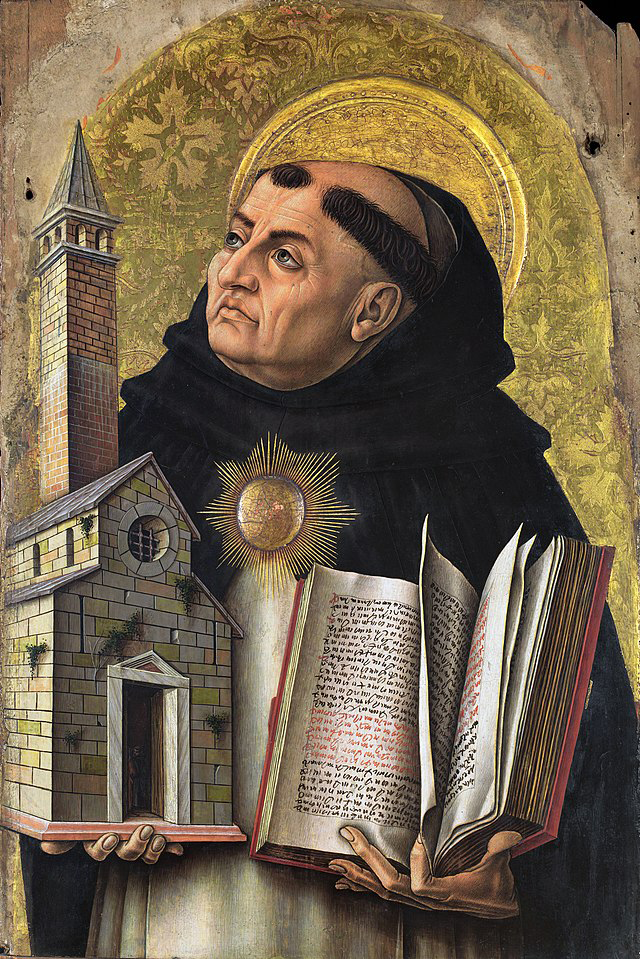
Thomas Aquinas, Wikimedia Commons

12th century theologian Thomas Aquinas didn’t think much of women.  He’d known less than a handful during his lifetime – his mother, who sent him off to a Benedictine monastery when he was five, as was the custom at the time, and later abducted and imprisoned him, with the help of her other sons, seeking to “rescue” him from his choice of becoming a Dominican priest; his two sisters who were sent to him while imprisoned to dissuade him from his choice; and the prostitute his brothers sent into his prison cell to try to tempt him to sin and break his vows – unsuccessfully. So perhaps it is no wonder that Question 92 of his Summa Theologica asks, “Should woman have been made in the original creation?” Though more likely his question was prompted by the milieu of misogyny in which he was raised and lived, having been educated in the theological tradition of Augustine who believed women to be the “lesser” sex and necessarily subject to men, and highly schooled in and known for reviving the thought of Aristotle, who said of women, “a woman is a misbegotten man.”[i]

Continue reading “The Purpose of Women by Beth Bartlett”

From the Archives: Is Baptism a Male Birthing Ritual? By Michele Stopera Freyhauf

This was originally posted on March 22, 2012

Quite a number of years ago I had a conversation with one of my professors, a feminist theologian, who posed the question “Why do I need a man to purify my baby with the waters of baptism?  Is there something wrong or impure about the blood and water from a mother’s womb – my womb?”  Before you jump and shout the words Sacrament or removal of original sin, this question bears merit in exploring, especially in today’s world where women are taking a serious beating religiously, politically, and socially.  In today’s world, violations and rants are causing women to stand up and say STOP!  This is MY Body.  This outcry was provoked by chants of ethical slurs against women– Slut! Prostitute! Whore!  The cry got even louder when the issue of religion and government was raised in the fight of healthcare coverage of contraception. The cry got even louder with the enactment of the laws in Virginia and Texas (and many other states to follow suit) that forces women to undergo transvaginal ultrasounds in early stage abortions.  The mandatory insertion of a wand into a woman’s vagina (mandated by the government, mind you), is a violation and has women crying RAPE!

Continue reading “From the Archives: Is Baptism a Male Birthing Ritual? By Michele Stopera Freyhauf”

An Ambitious Task: A Queer, Feminist, Decolonial Listening to the Gospel According to Mark by Xochitl Alvizo

Photo by Chris Pinkham. (I recently shaved by head again – I’ll get an updated photo soon!)

I was recently invited to give the Castañeda-Jennings lecture via Zoom at the Chicago Theological Seminary. The lecture was yesterday and it was founded to celebrate the the awarding of the Castañeda-Jennings Scholarships, which go to students whose work helps transform Christian congregations from places of hostility to places of support and empowerment for the LGBTQ community. It really was an honor to get to participate and share through a lecture. And, it was an opportunity to do what I don’t often get to do, which is to be fully theological – to present my critical reflection on Christian praxis in light of the scripture, which is considered the word of God by Christians, and in this case, I was specifically reflecting on the gospel according to Mark.

This lecture is a snapshot of the larger book project on ecclesiology that I am working on – a feminist, queer, anti-racist, decolonial theology of church. So here I’ll share some of the highlights of the talk…

Continue reading “An Ambitious Task: A Queer, Feminist, Decolonial Listening to the Gospel According to Mark by Xochitl Alvizo”

Processing my experiences of patriarchy has changed my faith for the better by Liz Cooledge Jenkins

As my first book, Nice Churchy Patriarchy, approaches six months of being out there in the world, I find myself reflecting on the journey. The process of unpacking all the ways patriarchy shows up in faith communities—and, in particular, the ways patriarchy has impacted my experience of church—has been a long one, and a winding one. It is no easy path.

How could a person travel this road and have their faith remain unscathed? Or perhaps a better question is this: How could one’s faith remain unchanged? And is this even a desirable goal?

After spending eleven years in “complementarian” (that is, explicitly patriarchal) evangelical church spaces and then two years in evangelical spaces that were egalitarian in theory but still had a long way to go to reach full gender equity—and, especially, after spending four years intentionally reflecting on these experiences and writing about them—I certainly see questions about gender roles and women in leadership differently. But it’s not only that. I see everything differently.

Continue reading “Processing my experiences of patriarchy has changed my faith for the better by Liz Cooledge Jenkins”

The Pain and Struggle of Gender by Michele Bodle

In the April 2024 issue of Christianity Today, Fellipe Do Vale wrote, “Gender on Earth as in Heaven: Will Our Gender be Removed or Renewed in the Resurrection?”

            The entire issue was dedicated to a conversation between egalitarian and complementarian beliefs regarding gender, which I am not here to argue. However, I will wholeheartedly and fully engage with a quote in the article where Do Vale states the following.

                        There is a long and impressive lineage in Christian history and
contemporary theology that says the best way to envision the
redemption of our gender is to picture its removal….
They say that gender was an attribute given to us only
because God knew humanity would sin. It was meant
to sustain us only until the restoration of creation. Therefore, 
attributes like gender, race, and disability, which they believe
cause the most pain and struggle in this life, will not remain
in the resurrection. 
(Do Vale, “Gender on Earth as in Heaven,” Christianity Today (Aril 2024), p. 24-25.)

Continue reading “The Pain and Struggle of Gender by Michele Bodle”

I Don’t Want Jesus by Katherine Rose Wort

Pietá – Anónimo

Well, you may ask, who said I should?

My grandparents, mother, father, sisters, aunts, uncles, cousins, nieces, nephews, godparents, a good many teachers, childhood friends, a former therapist, myriad internet strangers who felt compelled to try to divert the flames approaching my immortal soul, an astrologer I met once, innumerable people encountered on public transportation and sidewalks, all of my exes’ parents, and, of course, the Roman Catholic Church — an institution of such enormous weight as to have crushed frames far sturdier than my own.

Continue reading “I Don’t Want Jesus by Katherine Rose Wort”

Life-Giving Blood by Michelle Bodle

“What did you think?” This question was posed to me by a young woman I am mentoring in ministry. After receiving The Book of Womanhood by Amy Davis Abdallah as a gift, she asked me to walk through the book and discuss it with her, as suggested in the introduction. 

            I inhaled deeply before replying that I thought Davis Abdallah was writing from a posture of privilege that she was completely unaware of – and that deeply troubled me.

            Davis Abdallah’s premise is that Christian women need a rite of passage accompanying the journey of getting to know themselves. Piloted at the former Nyack College where Davis Abdallah taught, Woman was a program that sought to develop a Christian right of passage for women focused on relationships with God, self, others, and creation. 

Continue reading “Life-Giving Blood by Michelle Bodle”

TRUMP AS MESSIAH by Esther Nelson

Once upon a time long, long ago, I identified as an evangelical Christian. The term “evangelical” has evolved over time, however, evangelicals can probably be found in every branch of Protestant Christianity. Wherever you find them, they emphasize the authority/ inerrancy of the Bible, a “born-again” experience into the Kingdom of God, and a personal relationship with Jesus Christ. Generally, evangelicals are socially conservative and rarely does their thinking go beyond the borders of their insulated theology.

It comes as no surprise to me that many (most?) evangelicals embrace Trump with a fervor akin to their enthusiasm for Jesus. Trump supporters, especially those who identify with the Religious Right may love Jesus, but Jesus is not the Messiah they yearn for.

Continue reading “TRUMP AS MESSIAH by Esther Nelson”

Legacy of Carol P. Christ: LET’S ASK MITT IF MORMON PATRIARCHAL BELIEFS AFFECT HIS VIEWS ON WOMEN’S EQUALITY

This was originally posted on September 10, 2012. Moderator’s Note: While Mitt Romney is not running for office at this time, there are many politicians, of varying religions, who are and who deserve to be questioned in this manner.

Why has Mitt Romney’s Mormon faith mostly been a non-question in his political life?  John Kennedy was asked if he would obey the Pope or make his own decisions, Jimmy Carter was asked how his Baptist faith would affect his Presidency, and Barack Obama was asked if he agreed with the sermons of his preacher.  Why is the press afraid to ask Mitt Romney if he agrees with the patriarchal teachings of his church and if so, if this affects his views on the rights of women?

Like other patriarchal institutions, the Mormon Church believes that women’s place is in the home.  Every Mormon man is a priest and a patriarch in his own home.  Mormon belief teaches that men are to make the final decisions in the family, that only they can be leaders in the church, and that they are the members of the Mormon community who should speak and act in the public (non-home) dimensions of life.  Traditional Mormons believe that “ [The] LDS [woman is] always [to] accept counsel from her husband, and not as just his opinion, but as God-inspired revelation.” 

Continue reading “Legacy of Carol P. Christ: LET’S ASK MITT IF MORMON PATRIARCHAL BELIEFS AFFECT HIS VIEWS ON WOMEN’S EQUALITY”

Archives from the FAR Founders: We Are Responsible for Asking the Questions by Caroline Kline

This was originally posted on FAR July 3, 2102 (a version of this was originally posted at Patheos) This is part of a project to highlight the work of the four women who founded FAR: Xochitl Alivizo, Caroline Kline, Gina Messina, and Cynthia Garrity-Bond

Twelve years ago, a conversation with my then-boyfriend turned to the Mormon ideal of husbands presiding over wives. I couldn’t understand why such language was necessary in a relationship of equals. My boyfriend speculated, among other things, that it might simply mean that the man was ultimately more responsible for the family’s success than the woman.

We explored that idea for a bit, but the more we talked about it the sicker I felt. As this dark feeling came over me, I first articulated to myself a truth I would later often return to: that I am fully human, fully responsible before God, an agent in my own right, and an equal partner in the truest sense of the word. My future husband would need to see me as such for any marriage to survive. And God must see me as such as well.

Continue reading “Archives from the FAR Founders: We Are Responsible for Asking the Questions by Caroline Kline”