Over the Rainbow or…“Over” the Rainbow? by Marie Cartier

What are the dreams that we dare to dream today?

I was sitting with a young queer student from my Gender Women’s Studies class at the gay coffee shop in Long Beach, California. I offer this option to my students—meet in

Long Beach on Friday of finals week if it helps — realize that I teach in Northridge, so on a Friday afternoon this means perhaps a 2 hour drive to do this. But many students do it—this one student included. It happened that he made this trek on the first day of Gay Pride activities in Long Beach—the Dyke March was that night.

of Gay Pride activities in Long Beach—the Dyke March, marie Cartier, feminism and religion, stonewall
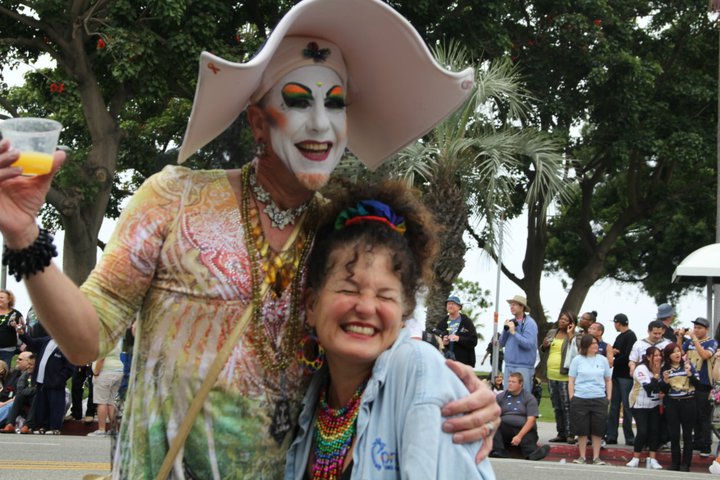
Marie with sister of perpetual indulgence—tippy tappy toes

I asked if he was going to any Gay Pride events while he was in Long Beach—perhaps even attending the Dyke March. He said, “I’m over Pride.” It felt like a game changing statement for a young queer activist.  I asked, “Why?” He said, “Why do I want to go somewhere and have someone try to sell me sheets or …a condo ….or buy pillows…it’s just about money, Professor. It’s got nothing to do with… what it was supposed to be about…?

I said, “Stonewall.” Continue reading “Over the Rainbow or…“Over” the Rainbow? by Marie Cartier”

Thanks for Coming (Out): Sexuality, Sports, and Spirituality by John Erickson

I have to be honest, Jason Collins’ admission that he was a homosexual, albeit brave, upset me. While coming out is an completely unique experience to every individual that does it, Jason Collins’ story was just another example of the rampant sexist and heteropatriarachal world that privileges male bodies and sexualities over women’s similar experiences. While I applaud Jason’s story and it’s timing, the first thing I asked to my colleagues was: Where was the hubbub over Sheryl Swoopes or Martina Navratilova?

John Erickson, sports, coming out. Like marking off items on a proverbial checklist, closeted LGBTQ individuals who exist within and outside of the world of professional sports, can recount the numerous things they struggle with in terms of their sexuality.  From fearing of the actual coming out process, dressing in their car or at home to avoid the subtle glances and whispers of individuals in the locker room, to wondering what coming out would mean not only for their game but also for their social and, if they choose, spiritual lives, closeted and out LGBTQ individuals within the multi-billion dollar professional sports industry must grapple with that age old question: what does it mean to be gay and open about it?

The Locker Room

I have to be honest, Jason Collins’ admission that he is a homosexual, albeit brave, upset me.  While I understand that coming out is an completely unique experience to every individual who does it, for me Jason Collins’ story was also an example of the rampant sexist and heteropatriarachal world that privileges male bodies and sexualities over those of women.  While I applaud Jason’s story and the timing, the first thing I asked to my colleagues was: where was the same hubbub over Sheryl Swoopes or Martina Navratilova? Continue reading “Thanks for Coming (Out): Sexuality, Sports, and Spirituality by John Erickson”

(Femen)ism? by Kile Jones

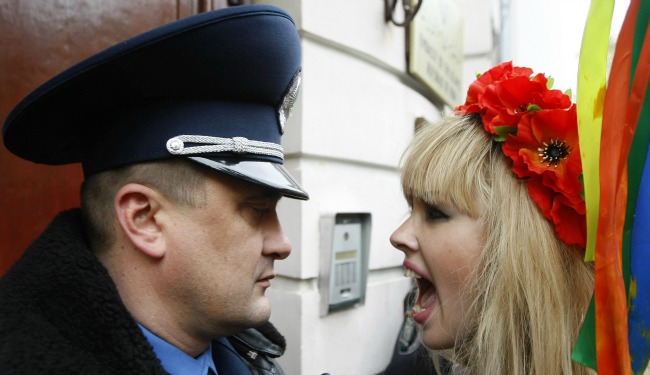
Kile Jones, atheistAs most of us are aware by now, there is a “feminist-sextremist” group from Ukraine called “Femen.”  This group has been very controversial by their public demonstrations of nudity, the words they paint on their bodies, and their explicit condemnations of political structures and organized religions.  They were started by Anna Hutsol in 2008 and have now spread throughout Europe and the Middle East.  The question I pose for this post is: Does Femen harness or hinder the power of the feminist critique?

Image from Konstantin Chernichkin/Reuters

Femen is precisely the kind of movement that pushes us in our understanding of feminism, the means by which it is best expressed, and the issues surrounding moral condemnation and religious sensitivity. Continue reading “(Femen)ism? by Kile Jones”

Grief Beyond Belief and Rebecca Hensler by Kile Jones

Kile Jones, atheistIn my last post, “A Pro-Science, Skeptical Woman Speaks” I interviewed a woman with whom I share many views in common.  One of my goals here at Feminism and Religion is to introduce different secular, atheistic, liberal feminists who share many of the same ethical views as regular contributors and readers, but not the same “religious” or “spiritual” ideas.  In this post I examine an online support network for unbelievers, Grief Beyond Belief, and ask a few questions to its founder, Rebecca Hensler.

I met Rebecca in February in San Francisco while on a visit I made to meet with the Unitarian Universalist Association in regards to my ordination.  My girlfriend and I met Rebecca in North Beach, San Francisco for dinner and drinks.  I experienced her as a compassionate, friendly, and genuine person.  Her experiences and insights inspired me to think more about the role of grief and pain among unbelievers.  I mean, atheists cry, agnostics experience loss, skeptics lose family members, and we do it all without a “God” or “spirit” to help us.  And if we were to meet C.S. Lewis, we would make

sure to exclaim, “No…pain is not some megaphone for God to rouse a deaf world.”

R Hensler

Why did you start Grief Beyond Belief?

The original idea was born of my own grief.  After my son died, I found a group in which to share comfort and compassion with other grieving parents: The Compassionate Friends, a mainstream parental grief support organization with a strong online presence.  It was so close to exactly what I needed, but I frequently felt alienated by the religious and spiritual content — not just the offers of comfort that depended on beliefs I do not hold, but the assumption that everyone there held some sort of belief in life after death. And the assumption, so common in mainstream grief support, that even if I am not the same religion as you are, I have a religion, and I believe in some sort of afterlife was equally alienating and hurtful. Continue reading “Grief Beyond Belief and Rebecca Hensler by Kile Jones”

Knowledge is Power by Kelly Brown Douglas

If knowledge is power, not knowing is privilege.

It has long since been understood that knowledge is power. Women and other subjugated voices have recognized that those who control the world are those who define the world— and define not simply what counts as knowledge—that is the content of knowledge, but they also define the production of knowledge—that is what sources and means are considered resources for knowing. Just as Michael Foucault has made this clear in his deconstruction of discursive power, so have womanists and black feminists like Patricia Hill Collins who have called for an “epistemology of knowledge, where the meaning of knowledge itself, in terms of content and production, is re-examined and re-defined. For it is undeniable that the what and ways of knowing peculiar to marginalized groups and classes of people are rarely considered knowledge—perhaps “wisdom,” “folkways,” “customs,” “superstitions,” or “women’s intuition,” but not knowledge, not something worth knowing and thus not something worth teaching. Why am I talking about all of this today? Continue reading “Knowledge is Power by Kelly Brown Douglas”

Second Class Rape Victims: Rape Hierarchy and Gender Conflict

Deconstructing masculinity isn’t the key to solving social, sexual, and domestic violence across the world but it is a step worth taking when attempting to engage men in affecting change to stop these violent actions since men, statistically are the perpetrators of such crimes that both cause such outcry as well as perpetual silence.

johnThe most disturbing part of the 2006 documentary Deliver Us from Evil isn’t the fact that Father Oliver O’Grady is rewarded by the Catholic Church with a new congregation in Ireland after his short stint in prison for the rape of dozens of children in the 1970s, but rather the hierarchy of gendered victimization which is often created throughout the various rape cases that are both reported and unreported throughout history.

I am often troubled by the ways in which rape cases are discussed and deconstructed via mediums such as blogs, online communities, social media networks, the news, and popular culture.  No series of events troubled me more than the Jerry Sandusky trial, but more importantly, the ways in which the young boys and adult men who were subjected to Sandusky’s abuse quickly overshadowed the other rape cases that are reported on a daily basis, specifically those involving young girls and women. Continue reading “Second Class Rape Victims: Rape Hierarchy and Gender Conflict”

The Next Liberal Prophet: What Will She Look Like? By Amy Levin

Amy2

This past Martin Luther King, Jr. day, I was privileged enough to attend the 57th presidential inauguration at the U.S. Capitol.  Spirits were high and it seemed as if we were breathing recycled air infused with the hope of four years past.  As the President approached the stage, he appeared with the confidence of a second term sage, and yet there was a newer, fresher quality about him – purified and politically born-again. As he began to speak, the religious undertones leaped out into the pews.  Beautifully crafted in diction, rhetoric, and reference, Obama pleased and inspired his dedicated supporters. Guiding us historically through Seneca, Selma, and Stonewall, we understood the meaningful tributes toward women, African Americans, and the LGBT communities. But there was an excess – another constituent represented – God had entered the stage.

Continue reading “The Next Liberal Prophet: What Will She Look Like? By Amy Levin”

Don’t Worry, I Won’t Marry Your Girlfriend: Sexuality, Identity, and the Easy Laugh

No longer having to deconstruct the larger cultural and sexual narratives, heterosexuals who do not support marriage equality or feel threatened by homosexuals return to their one source of power that reinforces the ideology that they are on the right path: the Bible. “Marriage is between a man a woman,” or “A man shall not lie with another man as he would a woman,” becomes the newly reinforced heterosexual rallying cry and the progressive progress that occurred in the past becomes nothing more than a joke.

johnI must say, I will be the first to admit that the recent outbreak of videos promulgating the idea that gay men will marry a straight guy’s girlfriend or lesbians will marry a straight girl’s boyfriend all for the sake of marriage equality left me stifling my laughter as I attempted to pay attention in class.

However, after the calamity died down I took a moment to reflect upon the intrinsically embedded aspects of misdirected norms of sexuality, gender, and misogyny latent within the laugh lines and the guffaws throughout each video. Continue reading “Don’t Worry, I Won’t Marry Your Girlfriend: Sexuality, Identity, and the Easy Laugh”

Out of the Bars and Into the Streets and ….by Marie Cartier

I remember the election season of 1984. At the 1984 Democratic National Convention on July 18 in San Francisco, California, Jesse Jackson delivered the Keynote address, entitled “The Rainbow Coalition.” The speech called for Arab Americans, Native Americans, Asian Americans, youth, disabled veterans, small farmers, lesbians and gays to join with African Americans and Jewish Americans for a political purpose. My lover at the time woke me up very early in the morning to tell me that Jesse Jackson had said the words “lesbians and gays” as part of his speech at the Democratic Convention. I started to cry and called my mother and she cried, too. We both cried. It was a moment I will never forget…because in that moment I as a lesbian existed on national television and in the imagination and spoken word of the country’s political system where I live and pay taxes—in a way I never had before—I was spoken out loud. Continue reading “Out of the Bars and Into the Streets and ….by Marie Cartier”

Blessed Are The Organized, by Amy Levin

It was a humid yet windy day in Broward County, South Florida. My long pants and sleeves were becoming hostile towards me as I proceeded to slip off my shoes, don my borrowed headscarf, and set up shop just outside the modest mosque in Pembroke Pines.  I waited patiently for prayers to end, hoping that my “Register to Vote” sign was placed in optimal eyesight of the female worshippers as they exited the prayer hall. All of my hope to expand the Florida electorate to help re-elect President Barack Obama was bundled in my mix of clipboards, voter registration forms, pens, and volunteer sign-up sheets.  Just moments after the Imam wrapped up the Friday afternoon prayers, two young women wearing full hijab sauntered out. “Oh, I’ve been meaning to register to vote,” one of them said. “Perfect.” Continue reading “Blessed Are The Organized, by Amy Levin”