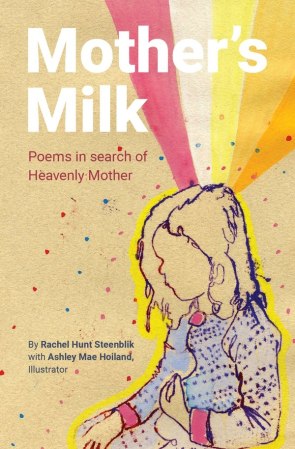
Finding Heavenly Mother with Rachel Hunt Steenblik by Caryn D. Riswold

Feminist theologies are filled with queries and questions about the divine feminine. Whether women need the Goddess. If She really is. Where herchurch might flourish. I have my own complicated views about the subject, and continue to be enriched by those who seek and find. Rachel Hunt Steenblik is the newest voice calling to and from the divine feminine, singing in a distinctively Mormon key.

If you read Mother’s Milk: Poems in Search of Heavenly Mother from front to back, you encounter what seem like scratches of verse and fragments of wisdom from a young mother catching time to write in the midst of her graced obligation to feed and sustain tiny bodies. If you read it back to front, you encounter a wealth and depth of engagement with Christian sacraments, feminist theology, sacred texts, Mormon history, modern philosophy, and children’s books and movies. This cacophony of source material and influence is distilled into sparse poems whose brevity bely decades of the author’s feminist engagement with vast religious history, philosophy, and theology.

In my review of Mormon Feminism: Essential Writings, edited by Steenblik along with Joanna Brooks and Hannah Wheelwright, I noted that feminists in many religious traditions “have had to document their history, make their theological case, and engage their scriptures as robustly as any conservative traditionalist would.” In Mother’s Milk, Steenblik offers us her contribution to the reconstruction of religious tradition. The words of her introduction state plainly: “These are the poems that I could write with my questions, my hurt, my hope, and my reading. Others could write other poems with theirs. I hope they will. We need them all.”

Continue reading “Finding Heavenly Mother with Rachel Hunt Steenblik by Caryn D. Riswold”

Brigid from The Goddess Project: Made in Her Image by Colette Numajiri

She is the reason BRIDES wear white, swan-like wedding gowns. Brides veil themselves like the Goddess herself, Whom all Bridegrooms honor, until revealing Herself to Her chosen groom. Tiny flowers and shamrocks are said to bloom in Her wake, She brings new life.

BRIDGET BRIGHT by Hedgewytch

She is known as Brigid Bright,
Goddess who shines against the night.
At Cille Dara, at the setting sun,
Her sacred flame is kept by one.
Nineteen times the earth turns round,
As sacred springs come forth the ground.
Twenty times the sun has burned,
And now the Goddess has returned.
Alone she tends her thrice-bright flame,
Born of her heart that bears her name.
The Dagda knows Brigid as Daughter,
Triple Blessed by fire and water.
Poets call her name to inspire.
And healers oft gain from her fire.
Wayland too would know her well
As hammer and anvil ring like a bell.
A sorrowful cry did she give meaning,
When first she brought to Eire keening.
Oh Sacred Fire against darkest night,
Burn for Brigid, for Brigid Bright!
Fire in the head…to quicken us.
Fire in the cauldron…to heal us.
Fire in the forge of the heart…to temper us.

Continue reading “Brigid from The Goddess Project: Made in Her Image by Colette Numajiri”

Inner Garbage (Fear) vs. Inner Goddess (Love) by Vanessa Soriano

I’m sitting on my meditation pillow for the thousandth time searching for clarity.  Initially, going within feels like traversing a jungle; swinging from one thought branch to another.  I’m itching for some peace and I’m almost certain this isn’t the way to it.  But, I’ve been here before and I won’t quit breathing through the discomfort.  I know I will greet the inner goddess soon enough.  Getting past the noise is part of accessing her wisdom.  The noise teaches me discernment (if I allow it to).

Eventually, the monkey mind gathers up all the branches and turns them into a prodigious figure that blocks the sun inside.  Hello darkness my old friend.  Inner garbage (fear) makes her entrance.  I’m still breathing.  Eyes closed.  Determined through slow, rhythmic breaths, to move past her.  I know I cannot run from her.  She’s faster and outwits me every time.  Continue reading “Inner Garbage (Fear) vs. Inner Goddess (Love) by Vanessa Soriano”

“The Burning Lava of a Song” by Joyce Zonana

Aurora’s autobiographical narrative is a passionate paean to poets as the “only truth-tellers, now left to God”; she celebrates them as agents for personal and social transformation. As we come to the end of this National Poetry Month in the U.S., where truth is under siege, it’s worth recalling Aurora Leigh and its daring exploration of poetry, gender, divinity, and social justice.

jz-headshotI was in graduate school when I first read Aurora Leigh, Elizabeth Barrett Browning’s fiery 1856 epic about a young woman claiming her vocation as a poet despite Victorian society’s patriarchal strictures. The poem was not on any assigned reading-list; I’d simply stumbled across it while doing research for my dissertation. The opening lines brazenly assert the speaker’s authority and ambition:

OF writing many books there is no end;
And I who have written much in prose and verse
For others’ uses, will write now for mine,–
Will write my story for my better self . . .

Encountering those words, I was immediately possessed by Aurora’s voice and vision, a welcome change from all the male poets and critics I’d been reading. I devoured the verse novel’s nine books in one night. The poem became the centerpiece of my dissertation, and I studied and enthusiastically taught it for years.

Continue reading ““The Burning Lava of a Song” by Joyce Zonana”

Sophia from The Goddess Project: Made in Her Image by Colette Numajiri

“Happy are those who find wisdom. . . . She is more precious than jewels, and nothing you desire can compare with her. . . Her ways are ways of pleasantness, and all her paths are peace. She is a tree of life to those who lay hold of her; those who hold her fast are called happy” (Proverbs 3: 13, 15, 17-18).

Sophia is DIVINE WISDOM, Her name comes from the feminine Greek word meaning Holy Wisdom. She is found all over the Bible (Proverbs, Sirach and the Wisdom of Solomon..) and in the Gnostic Gospels (unearthed at Nag Hammadi in 1947.) She has been called the MOTHER OF THE UNIVERSE, Mother of Yahweh and HOLY SPIRIT. The words: “Philosophy, theosophy and sophiology” all come from Sophia. The Bible links her to Christ: “Christ is the Wisdom (Sophia)” (1 Corinthians 1:24, 30). There is some evidence that Mary Magdalene was also called “Mary Sophia.”

Because She did not help advance the patriarchal scheme, Sophia was all but deleted from history. Hidden throughout the Bible and the Dead Sea Scrolls, knowledge of the DIVINE FEMININE all but went up in flames. Even a great cathedral build in Her honor in Constantinopole, Hagia Sophia (Holy Wisdom), was burned to the ground twice. It’s newest rebuild was a mosque and is now a museum. NOTRE DAME (Our Lady) has survived but they eventually claimed it was named after the Virgin Mary. (The famous Notre Dame rose windows are a common symbol of the Divine Feminine!). Some say there are secret societies that still exist to keep knowledge of Her alive.

Continue reading “Sophia from The Goddess Project: Made in Her Image by Colette Numajiri”

Death is a Gift, and Christ is a Hag by Trelawney Grenfell-Muir

My father is dying, and I am haggard with grief and exhaustion. Over a month of frantically arranging child care, driving to the ICU in the middle of the night, fighting to protect my Dad from neglect and malpractice, chasing case managers, begging doctors, negotiating with nurses, sensitive, depleting, agonizing family debates about hospice and DNR, and hour after hour sitting and holding my Dad’s hand, singing, comforting, soothing, reassuring. Washing his face. Massaging salve into his feet and legs. Continually checking to see if he is too cold, too warm, in pain, breathing ok. Weeping as I drive home through snow and rain and dark, watching car accidents happen just one lane over, trying to soothe my frazzled and anxious little children, support my husband in his degree program, and not lose my own career entirely.

So when my daughter asked me, “Mummy, why does Grampy have to die?” I felt dizzy for a moment with my exhausted, overwhelmed, haggard inability to have an instant, perfectly formulated response to provide comfort and meaning for my child. Finally, I said, “Because, darling, if no one died, no one could live. All of us, our bodies are made from the food we eat, which is made from plants, which is made from dirt, which is made from everything that has died. Death is the only way for life to exist. Death allows life, births life, IS life. Death is our only path and connection to eternity.”  Continue reading “Death is a Gift, and Christ is a Hag by Trelawney Grenfell-Muir”

Where Did She Go?  A Slothful Seeking of the Divine by Cynthia Garrity-Bond

 A week ago today was my birthday.  I’m the same age as my mother when she died of a stroke some twenty-eight years ago.  This past year has been marked by the deaths of close friends and family; most recently my Uncle Jack who almost made it to his 93rd birthday. This latest passing, coupled with being the same age as my mother when she passed, has left me more than a bit reflective of life and vulnerability.   This internal examination has lead me to acknowledge another loss I have been ignoring for a few years—my love affair with the divine.
It didn’t happen all at once; instead it’s been a slow brew of indifference to the spiritual domain.  Like many who read or contribute to FAR, my spiritual compass was fined tuned to point north in all matters of my life, even at a very early age.  The Virgin Mary, Mass, the Sacraments of the Catholic Church and its rituals are what Andrew Greeley defines as The Catholic Imagination.  Taken together, these insist on a spirituality that sees the divine saturated in all of creation.  Grace, abundant grace, is never outside the reach of those who wish to experience it.    Continue reading “Where Did She Go?  A Slothful Seeking of the Divine by Cynthia Garrity-Bond”

Goddess Spirituality and Women’s Leadership by Jessica Bowman

As a public school administrator, and a human, I feel tremendous grief for the tragedy generated in the latest school shooting. The impact is devastating and disastrous. Immediately after such a calamity is the public outcry for change and the immediate backlash from others who don’t want to lose their perceived rights under the constitution. Blaming federal agencies isn’t the answer either.

I find it critical to recognize that school shootings are not isolated events. Despite the outcry and current tug-of-war, stricter gun laws will only serve as a Band-Aid to one aspect of a major debilitating world problem. In just over 15 years of serving children and communities as a school administrator, I have witnessed extreme violence, rape, racism, walkouts orchestrated by teachers, administrators engaged in illegal behavior, parents abusing children, bullying, decay, outrageous political power struggles, and more.

Public schools are a microcosm of society; they are not stand-alone programs independent of the larger world. Truthfully, I am sometimes quite taken with how successful school programs are across the nation in spite of these immense pressures and misguided criticisms. Increasing student achievement in math and the English language arts is our charge; sometimes the realities and tragedies of life make this very difficult. But, that isn’t the point of this conversation.

Continue reading “Goddess Spirituality and Women’s Leadership by Jessica Bowman”

Queen Esther from The Goddess Project: Made in Her Image by Colette Numajiri

Queen Esther
An orphan child,
who became
a well respected queen,
Esther, the Queen of Persia,
was a woman of integrity,
Wisdom and courage,
a beautiful woman, truly supreme,
favored by God,
She had a awareness of dependability,
steady strong, long-suffering faithfulness, with vision foreseen
in courage to stand in times of trouble
with true self esteem,
wise above measure,
Esther, Queen of Persia.
Like many Goddess tales, Esther (from the Old Testament “Book of Esther” or the “Megillah”) took full control of a dangerous situation and against all odds created a miracle, saving the lives of ALL OF HER PEOPLE.
There is a yearly Jewish celebration because of Her called PURIM (today, March 1st this year) where people wear costumes, re-read the Megillah, feast and give gifts of food and money to the needy.

Continue reading “Queen Esther from The Goddess Project: Made in Her Image by Colette Numajiri”

Esther’s Choice — And Ours by Joyce Zonana

The Book of Esther tells a story in which women’s power is not so much repressed as asserted. The king who banishes one queen finds himself submitting to the will of another. Numerous women writers of various ethnic, religious, and racial backgrounds in the nineteenth, twentieth, and twenty-first centuries have found inspiration in the stories of both Esther and Vashti’s disobedience to an autocratic king.

jz-headshotThis year, February 28th, the 14th of Adar on the Jewish calendar, is the first night of Purim, a holiday the orthodox Chabad organization blithely calls the “most fun-filled, action-packed day of the Jewish year.” Purim is celebrated with two full readings of the Megillah–the Book of Esther–in synagogues; whenever the tale’s villain Haman is mentioned, congregants drown out his name with noisemakers and foot-stomping. Children and adults masquerade and often cross-dress. Plays are performed; Haman is burned in effigy. After a daylong fast, everyone shares a festive meal, where drinking is encouraged, even mandated:

A person should drink on Purim until the point where he can’t tell the difference between “Blessed is Mordechai” and “Cursed is Haman. (Talmud – Megillah 7b; Code of Jewish Law 695:2)

It all sounds like great fun. But what exactly are we celebrating when we celebrate Purim?

Continue reading “Esther’s Choice — And Ours by Joyce Zonana”