

In these United States and across the world we are in quarantine. Lockdown.
Shelter in place. We’re alone together.
And I miss it all: restaurants, coffee shops, movies, hanging out with friends in real time,
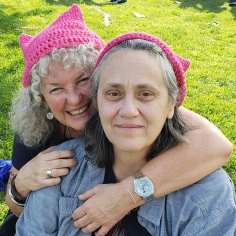
But mostly I miss hugs—and I live with my wife and we hug a lot
…but I miss hugs from friends and even sometimes strangers.
I’m a hugger.
I miss handshakes and whispers and rubbing shoulders and close smiles.
Are we embodied beings? Does the body need other bodies?
What is a “crowd of something called” is always my favorite thing to look up:
a pandemonium of parrots, a swarm of eels, a fever of sting rays,
a cauldron of bats, a gaggle of women,
a herd of sea horses, a clutch of vampires, a clowder of cats,
an army of frogs, a crash of rhinos, a business of ferrets,
a passel of possums….
It’s all mythical now, for humans anyway, groups and crowds.
We might as well be mermaids.
And if mermaids were fish, a group of us would be called a school.
If we were human mermaids, we would be a tribe.
And if we were sea mammals, like dolphins, we would be a pod.
I’m missing my pod,
my school, my tribe.
Like whales or manatees, or dolphins—we need a pod.
We are social creatures. We zoom our pod on social media.
And I worry for the elderly in my pod that they do not use this technology that keeps us whizzing
into each other’s homes.
Zooming in– in Brady Bunch boxes.
Here we are! Open your mic!

Toasting the edges of my Brady Bunch box with my glass of wine—Cheers!
Did God mean for us to need each other in bodies? As bodies.
In the same space?
What does it mean that we are here spinning on the planet in embodied forms?
Our experience and our consciousness of being in bodies—
the phenomenology of what it means to be in a body with other bodies.
We are bodies first I think; we are bodies.
Human bodies. A crowd of them, a group… a family, a band, a community,
a nation, a city, a town…a party.
So– I miss hugs, and handshakes and close spaces and smiles and whispers.
I miss sitting tight next to strangers at a sold-out play, a concert, a movie….
I miss crowded events, parades…a club where I am jostling my drink
across the floor to meet my friends.
I miss waiting for a table and making small talk with the other patrons
and chatting up the maître de.
I miss laughing with clerks at the convenience store and talking
to everyone. In person.
And I miss hugging. I’m a hugger.
And I miss, oh I miss
my pod.
–Marie Cartier
April 2020


Photos by the author: from the “sheltering at home” collection
Marie Cartier has a Ph.D. in Religion with an emphasis on Women and Religion from Claremont Graduate University. She is the author of the critically acclaimed book Baby, You Are My Religion: Women, Gay Bars, and Theology Before Stonewall (Routledge 2013). She is a senior lecturer in Gender and Women’s Studies and Queer Studies at California State University Northridge, and in Film Studies at Univ. of CA Irvine.
 I have been writing and celebrating ritual for half of my life. The equinoxes and solstices and the cross quarter days (May 1, August 1, All Hallows, and February 2) comprise the eight spokes of the year. What I have learned from my research is that virtually every Indigenous culture follows this calendar in a general way – What I have gleaned from personal experience is that during these ritual periods my body is opened to the Powers of Nature in very specific ways that can be positive or/and negative.
 Every morning I walk to the river in the velveteen hour between the vanishing blue night and the coming of the first scarlet, pink, lavender, purple or golden ribbons that stretch across the horizon. Sometimes clouds with heavy gray eyelids mute first light. Either way all my senses except that of sight are on high alert; a deep peace embraces me in the dark. My body knows the way. I murmur to the willows as I pass through the veil and under their bowed bridge. Their response is muted, a song beneath words.
 The term “panpsychism” is made up of two Greek words: pan, meaning all, and psyche, often translated mind or soul. Panpsychism is the view that (forms of) soul or mind or consciousness are found throughout the web of life. This view is in contrast to the traditional western philosophical and theological consensus that having a soul or a mind is what sets human beings apart from other forms of life. In contrast, mystics, children, and many indigenous people assume that human beings are not the only form of life with consciousness.
 Who knows when each of us first learns that sensation—the sensation of being misunderstood. My hunch is that it comes early on in our lives, maybe even before our brains are making narrative memory, maybe even before we have begun to understand much of anything about ourselves or the world. But it doesn’t take much for the seed to be planted in us that the world won’t always understand us.
 For almost 35 years nature has been my sacred place. As an 8-year old, I started to pray to Mother Earth even though the protestant tradition in which I grew up only recognised ‘God the Father’. I went outside in my inflatable rowing boat to seek solitude (as an only child in a quiet family!) on a small island in the lake of our local park. I practised rowing and walking quietly to not break the sacred silence. I collected herbs to brew infusions in my little thermos flask with boiled water brought from home. I sung to the moon, and danced my love for all creation back through my moving body. Over the last 15 or so years, I spent many days and nights at Neolithic monuments, dreaming in ancestral burial mounds, time traveling in stone circles in Cornwall, Wales, Scotland, England, Ireland and Brittany. This nature-based practice evolved naturally, and later incorporated my training with the Scandinavian Centre for Shamanic Studies and the School of Movement Medicine. Nature is where I reconnect most easily with the Sacred, and listen to the whispers on the great web of life in which all of nature is a great teacher. Nature, for me, is a strong place of prayer, solace, awe, reverence, gratitude, joy, guidance, reconnection, healing and transformation.

 From the Latin word limen meaning threshold.
 According to Marija Gimbutas, the religion of Old Europe celebrated the Goddess as the power of birth, death, and regeneration in all of life. Agricultural peoples understand that seeds must be kept in a cold dark place during the winter if they are to sprout when planted in the spring. People who work hard during the long days that begin in spring, peak at midsummer, and continue through the fall, are grateful for the dark times of the year when they can rest their weary bones on long winters’ nights. Long winters’ nights are a time for dreams, a time when people gather around the hearth fire to share songs and stories that express their understanding of the meaning of the cycles of life.

