“The Burning Lava of a Song” by Joyce Zonana

Aurora’s autobiographical narrative is a passionate paean to poets as the “only truth-tellers, now left to God”; she celebrates them as agents for personal and social transformation. As we come to the end of this National Poetry Month in the U.S., where truth is under siege, it’s worth recalling Aurora Leigh and its daring exploration of poetry, gender, divinity, and social justice.

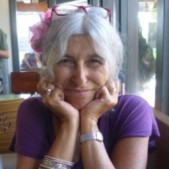
jz-headshotI was in graduate school when I first read Aurora Leigh, Elizabeth Barrett Browning’s fiery 1856 epic about a young woman claiming her vocation as a poet despite Victorian society’s patriarchal strictures. The poem was not on any assigned reading-list; I’d simply stumbled across it while doing research for my dissertation. The opening lines brazenly assert the speaker’s authority and ambition:

OF writing many books there is no end;
And I who have written much in prose and verse
For others’ uses, will write now for mine,–
Will write my story for my better self . . .

Encountering those words, I was immediately possessed by Aurora’s voice and vision, a welcome change from all the male poets and critics I’d been reading. I devoured the verse novel’s nine books in one night. The poem became the centerpiece of my dissertation, and I studied and enthusiastically taught it for years.

Continue reading ““The Burning Lava of a Song” by Joyce Zonana”

The Practices of Forgiveness and Yoga by Vanessa Soriano

Forgiveness and yoga require consistent practice.  As we engage in each, healing unfolds in the body, mind, and soul.  Forgiveness and yoga exist in a symbiotic relationship: forgiveness allows us to release emotional blockages that affect the body/mind, and yoga delivers us to more empowered and peaceful states within the body/mind that encourage the release.  Yoga and forgiveness illuminate the body-mind connection.

All world religions and spiritual traditions emphasize the practice of forgiveness.  Sages, prophets, rishis, shamans, medicine women—figures who have helped shape religion and spirituality—understood that resentment and anger depress the body and mind, which hinders our connection to the soul and Divine.

Being angry diminishes the quality of life and can incite violence against our self and others.  Forgiveness helps us function at fuller capacity from a healthy internal state.

Just as forgiveness promotes healing in the body/mind, yoga accomplishes the same effect.  Scientific studies from Harvard show that yoga increases body awareness, relieves stress, improves mood and behavior, and calms and centers the nervous system.  Since yoga decreases the stress response in the body, it creates space in the psyche to journey into the practice of forgiveness.

Continue reading “The Practices of Forgiveness and Yoga by Vanessa Soriano”

Time Traveling Letter to Kids of the 70s (especially you, Natalie) by Natalie Weaver

Hmmm…. Time Travel?  Maybe, I suppose.  I recall a strange video clip in which Steven Hawking throws a Time Travelers’ Party.  He sends an invitation for a fancy soiree, holds the event, and sets the scene where future folk will find a welcome reception at specific coordinates in the past, should they find the means to get there.

Then, there’s the Baby and Bird pub in Oxford, England, where the famed Inklings writers convened to share manuscripts.  There was a curious tile in the wall of one of the more private rooms, wherein, while drinking my Pimm’s Cup, I was told by some cat playing cards that Tolkien, Lewis, and company made a pact to use that tile as a sort of gathering horcrux, if they discovered they could get meet up again after crossing into the world beyond.  I can imagine that conversation among pipe-smoking guys in tweed, very seriously stacking their hands together, imbuing their spirits into a piece of decorative ceramic.  I hope it is a true story.  I’ve heard enough Brian Greene to appreciate theoretically how perhaps skipping ahead to the future is possible.

My greatest sympathy, though, for the time theorists goes to my old professor, who used to pray for things to be different in his past.  He said he believed God could change anything.  I thought it was eccentric, and I sort of think he was praying for particular events and things to actually have been different.  I admit, his level of specificity is hard for me to brook, but the concept makes a measure of sense when I consider that a person’s past is still actively present in her or his personhood insofar as we are constantly remembering, revaluing, and reintegrating ourselves in one way or another.

From a transcendental personal perspective, things that are decades old condition certain meanings, values, and tolerances in the present self. I have lunch with a friend every couple of months, and there is a never a visit that goes by in which she does not recount and somehow integrate the experience of having a gun pointed at her head.  Our stories, especially how we re-member them, great and small, live on in us.  It occurs to me even as I write that our conditioning is not even our own exclusively; we carry legacies of the human and cultural past in our embodied presents.  And, we presume the future every time we make a promise.

I am reminded of St. Augustine here and largely persuaded to appreciate the value of recognizing something like a perpetual NOW: Continue reading “Time Traveling Letter to Kids of the 70s (especially you, Natalie) by Natalie Weaver”

Children of German Immigrant Farmers in Cherry Ridge: American Stories by Carol P. Christ

In my genealogy research, I traced my father’s grandmother, Catherine, to her roots on the Iloff farm in Cherry Ridge, Honesdale, Pennsylvania, about two hours north of New York City. Catherine’s parents were Henry Iloff, who emigrated in 1841 from St. Nicholas, Saarland, and Catherina Lattauer who emigrated in 1845 or 1846 from Ober-Floerscheim, Hesse-Darmstadt. They were married February 2, 1846 at St. Matthew’s Church in “Little Germany” on the Lower East Side of Manhattan.
Iloff farmhouse

In 1850, Henry and Catherina purchased land in Cherry Ridge, Honesdale, where they built the farm that remained in the family for a hundred years. In 1851 Catherina’s sister Agnes Lattauer Schweizer emigrated with her family from Ober-Floerscheim to Cherry Ridge. The Schweizer farm also remained in the family for a hundred years.

I had been told about the family Henry Iloff had with two wives who were somehow related: nine children with his first wife and nine with his second over a forty year period–fourteen of whom were living at the time of his death in 1889. I was shocked to learn that when his first wife died in 1869, Henry married his wife’s sister’s daughter Johanna Schweizer–who was half his age and his children’s cousin. I suspect that the marriage was considered scandalous in a conservative farming community, and that it did not sit well with the children of the first marriage, four of whom left the local area. Nonetheless, Henry Iloff was elected to the prestigious position of Wayne County Commissioner a decade later. Continue reading “Children of German Immigrant Farmers in Cherry Ridge: American Stories by Carol P. Christ”

Opening Our Hearts Through Armenian Dance by Laura Shannon

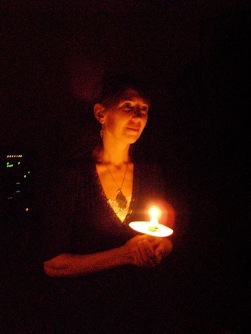
The candle represents the light of love, compassion and connection kindled in our hearts as we dance.
In these challenging times, one of the hardest things to do is to keep our hearts open. Grief and despair tend to shut them down. And even among close friends, colleagues, family members, and people with whom we share worship, when we clash over differing political opinions, trust can swiftly erode. These kinds of losses and sorrows can make us just want to close the doors to our hearts.
Yet hardened hearts and minds are not going to help us overcome conflicts and affirm connections. Only if we can open our hearts to one another, holding the fullness of our (and others’) feelings in a compassionate way, can we weather the storms which threaten to divide us further. And only if we are united can we find our way together through those storms.
One of the best ways I know to connect with others and to open my heart is through the joyful experience of traditional circle dance, particularly Armenian dances. I have written previously on this blog (The Dance of MemoryThe Wishing Tree) about Armenian dances and their ancient roots, their links to the pre-Christian Goddess, and how they affirm survival throughout the traumas of history. I have also written about my friend and colleague Shakeh Major Tchilingirian and her inspiring Circle of Life project, which brings Armenians, Turks, Kurds, Assyrians, and other survivors of atrocities and genocide to dance together for reconciliation.

Continue reading “Opening Our Hearts Through Armenian Dance by Laura Shannon”

Human Elements in Plants: Wisdom and Botanical Lore by Nazia Islam

My paternal side of the family comes from an extensive line of farmers. They were notable for growing eggplants, but they held all sorts of agricultural knowledge. My maternal side of the family has a hushed history of female kobiraj/ natural medicine practitioners. General folk knowledge was passed through mothers and mothers-in-law.

Much of this “folk knowledge” would peek into my life as I was growing up in New Jersey–especially through our garden. It didn’t matter where we lived, we would always grow something somewhere even if it was just germinating seeds for other people. My parents would go to great measures to bring back seeds of vegetables they could not find in the US–specifically gourds and beans– from Bangladesh whenever they visited.

Continue reading “Human Elements in Plants: Wisdom and Botanical Lore by Nazia Islam”

Reclaiming My Body by Carol P. Christ

Shortly after writing “Asking for Help,” a blog in which I described losing my physical strength following a series injuries, I finally took a friend’s advice—mainly to stop her from badgering me—and went to the doctor. This is something I don’t usually do, as not only have I almost always had excellent health, but also, I believe that, for the most part, the body can heal itself.  The first doctor sent me to an orthopedist who told me that the persistent bursa on my knee was nearly healed and to go ahead and exercise in order to regain my strength.

A few days later, I found myself walking to the end of my cobblestone street with my little dog and continuing on to the harbor, a walk of about fifty minutes that included a good deal of up and down, as my house is situated above the sea. As I had only planned to walk a short distance, I was amazed that I found the strength to go farther. Soon I found the perfect walk. Leaving home at 4:30 in the afternoon, I follow the road past houses and open fields down to the sea and around the harbor quay out to the lighthouse. The sun sets while I am on the quay and on most days the clear winter sky lights up and the sea turns rose-gold. The return around the harbor takes me past the little church of Agios Nikolaos where I stop to light a candle and say a prayer. Then back up the hill to my house, where I arrive just before dark. Continue reading “Reclaiming My Body by Carol P. Christ”

The Trouble  with “Wellness” by Katey Zeh

katie-smith-104748

During the holiday season we’re bombarded constantly with contradictory messages about how we ought to take care of our bodies this time of year. Over the early winter months there is a collective expectation and even glorification of indulging in all kinds of ways–eating, drinking, spending money, etc. But if we dare enjoy ourselves a bit, we’re then on the receiving end of the diet and fitness culture propaganda that capitalizes on our time of indulging by telling us we need to clean up our eating and get (back) to the gym–assuring us that 2018 will be the year when we finally achieve our “dream bodies.”

Oftentimes the coded language of “wellness,“ “clean eating,” and even “health” is rooted in the same problematic framework that toxic diet and fitness culture espouses: your best self is your thinnest self. Strict binary language used to describe food–processed foods high in fat or sugar are “bad” while fruits, vegetables, and whole grains are “good”–attributes moral weight to what we eat. Beneath this is the myth that our health outcomes and the way that our bodies look are completely within our control. If we simply commit to “healthy” habits, we can become “good” (thin). Continue reading “The Trouble  with “Wellness” by Katey Zeh”

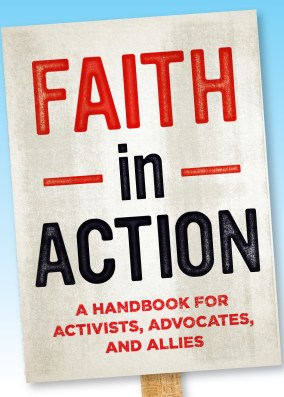
Faith in Action by Lisa Kloskin

Nearly a month ago, American voters showed up at the polls and delivered some big wins: the first openly transgender person was elected to a statehouse—Danica Roem in Virginia. Roem defeated an incumbent candidate who authored an anti-trans bathroom bill. Also in Virginia: the boyfriend of a reporter shot and killed on live TV, Chris Hurst, won a seat to the statehouse on a gun-control platform, defeating the three-term NRA-backed incumbent. And Hoboken, New Jersey, got its first Sikh mayor: Ravi Bhalla. These and others are encouraging signs that love and tolerance are gaining ground in the public sphere. But there’s still so much work to do. White Supremacists and Nazis still walk boldly in the streets, LGBTQIA teens still face bullying and higher rates of self-harm, women are still paid less for equal work and harassed in every arena, sea levels are rising at faster rates than we previously thought, people of color are still being killed by police, mass shootings are still a regular part of our news cycle, refugees are still waiting in camps around the world for a chance at a better, safer life.

Activists and advocates have been working for justice in these and other areas for decades. In the last year, spurred on by events like the Women’s March, a growing group of would-be activists has emerged. These allies are a welcome addition to the justice movement, but many worry they won’t do or say the right things, and want to have their perspectives deepened on important issues. They need guides and resources to give them the knowledge, tools, and confidence to make a real impact.

Continue reading “Faith in Action by Lisa Kloskin”

Asking for Help by Carol P. Christ

I climbed trees and rode my bike and roller skated on sidewalks for hours on end when I was a child. As an adult, I have always been physically strong without having to work at it. Nor have I had to think much about my health. I have been able to trust my body to do pretty much everything I wanted it to do. I am also fiercely independent. And I don’t always like to be touched because my body is extremely sensitive to other people’s energies.

On the Goddess Pilgrimage to Crete I was always the first one in and out of the caves and usually the first or one of the first up and down the mountains too. This changed when I injured my knee a few years ago in one of the caves and then six months later re-injured it in a fall on my front steps. I was told not to stress my knee by the pharmacist, and as a consequence stopped walking and doing yoga. I began to lose my physical strength. Continue reading “Asking for Help by Carol P. Christ”