Monarch Magic, by Molly Remer

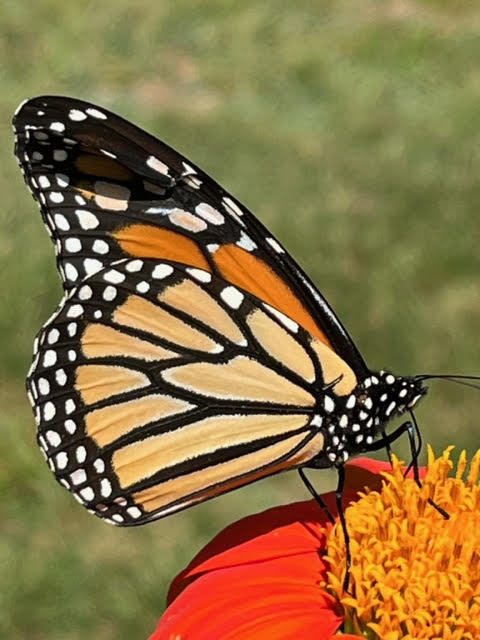
When my father was a boy in the 1950’s, he had a butterfly collection. His friends would bring him dead butterflies to add his collection and ask him what they were called. He got so many monarchs that his reply would be, “Thanks! That’s a ‘common sicker,’” secretly meaning they were so common he was sick of them. Now, my father is 70 and his grandchildren rarely see a monarch butterfly, the population of them having declined by 85% or even more in just two short decades. This rapid change is one of the most clear and alarming, observable indications of the massive changes wrought by both climate change and industrialized farming in our very own lifetimes.

Each year, I watch for monarchs from my Missouri home, during their migration season that carries them over our heads and on their way to Mexico. Each one I spot feels like a brush with magic on the wing, a testament to endurance and to hope. I watch them careen along in their delicate and determined way across highways and rooftops, across cars and parking lots, across my own house, and across open fields. I watch them alight on thistles, on goldenrod and oak trees, vine and bush. I see one above the Atlantic Ocean at Daytona Beach. I see two above the weeds in the Dollar General parking lot in Alabama. I see one above the sunflowers by the overpass in Kansas City. I see two coming over the Walmart roof and into the Staples parking lot in central Missouri.

Continue reading “Monarch Magic, by Molly Remer”

The Monarch That Didn’t Get Away –Butterfly Tagging, part 2 by Sara Wright

Part 1 was posted last week. You can read it here.

Today I learned that everyone is invited to witness butterfly tagging twice a week during the month of September. Efforts to publicize the value and ‘rightness’ of tagging are being stepped up.

Several people agreed with my assessment, namely that tagging creates trauma for the insect – and the idea that this practice may interfere with the butterfly’s ability to survive the 2000-mile journey, winter over successfully and then fly north to reproduce in the spring.

To my knowledge no one else had openly expressed their personal views to those in charge of the organization. However, some folks have come to talk with me. Most of us know that trauma weakens any organism’s immune system making it more vulnerable.

Continue reading “The Monarch That Didn’t Get Away –Butterfly Tagging, part 2 by Sara Wright”

Earth Stories by Sara Wright

Every day I send a FB post into what feels like a Great Void including nature photos that I took around the house or in the woods that morning or the day before. There is always Something. Coalescing early morning thoughts with recent images helps me orient myself to the day to come, reminding me to be Present to Now.

Now is my only Refuge.

 In these posts I also hope to capture an audience through image if not through words, introducing or reinforcing people’s positive relationship to nature before it’s too late. My intention is twofold. Help others to see nature in all her wonder, and to encourage folks who read the text to think creatively, to question, to challenge what has been normalized.

Continue reading “Earth Stories by Sara Wright”

Round and Round: The Circle Game by Sara Wright

 It’s raining again. In five days, the moon will be full as s/he turns her pearl -like face towards September while her rabbit prepares his treachery, and oh I am so ready to leave this season behind. This is the first year where we have viscerally experienced the reality of what a Changing Climate really means to people in Maine. A summer of floods, months of rain, gray clouds, massive humidity, the worst bugs I ever remember, and poor air quality may force even the most skeptical to pause. Extremes. Of course, what has happened here is nothing like what is going on elsewhere. Tornados, fires, drought, and intense heat have ripped through the rest of the continent tearing both human and non-human lives to shreds. Most of the earth is on fire. I would like to think that we are finally learning that our country is not immune to the unpredictability that comes with climate warming. “You are hopelessly naïve” a Voice states sternly. I bow my head. We are living the Unknown and most are denying it.

Continue reading “Round and Round: The Circle Game by Sara Wright”

Legacy of Carol P. Christ: Essentialism Reconsidered

This was originally posted on September 15, 2014

In my Ecofeminism class we have been discussing essentialism because some feminists have alleged that other feminists, particularly ecofeminists and Goddess feminists, are “essentialists.” They argue that essentialist views reinforce traditional stereotypes including those that designate men as rational and women as emotional. I too find essentialism problematic, but I do not agree that Goddess feminism and ecofeminism are intrinsically essentialist.

Goddess feminists and ecofeminists criticize classical dualism: the traditions of thinking that value reason over emotion and feeling, male over female, man over nature. We argued that the western rational tradition sowed the seeds of the environmental crisis when it separated “man” from “nature.”

Goddess feminists and ecofeminists affirm the connections between women and nature in an environmental worldview that acknowledges the interconnection of all beings in the web of life.

Continue reading “Legacy of Carol P. Christ: Essentialism Reconsidered”

August: A Summer to Reflect, and a Time to Start Letting Go by Sara Wright

This has been an unusual summer. I can still listen to a roaring brook as I fall asleep at night. The flooding has been intense. The humidity is hardest to bare; I am grateful my cellar is finally free of water if not drying out. Our overall weather pattern remains the same; thundershowers almost every day; many clouds and thick morning fog. And tropical hurricane season is underway.

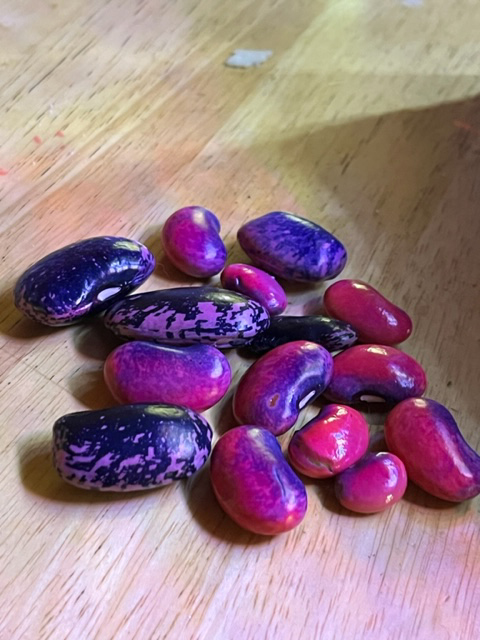
I am grateful for the moss and tall grasses that still glow lemony- lime emerald and sage green. My frog pond is empty except for snails; all the tadpoles have matured into tiny froglets that have disappeared into the dense foliage I have provided for them; ferns and anemones tower over others. A large toad only shows himself/herself  mostly at night when he hunts from the water dish I leave for him. Wild bee balm spikes are in bloom providing bees and hummingbirds with enough food for now. Some bee balm are ragged around the edges but the rain has brought in a second blooming cycle. My magic bean, the one I planted in March (in the house) has masses of deep orange flowers just outside my window. Grape leaves are climbing over the ground and visiting with the bean vine.

Continue reading “August: A Summer to Reflect, and a Time to Start Letting Go by Sara Wright”

Legacy of Carol P. Christ: Transcendence, Immanence, and the Sixth Great Extinction

This was originally posted August 4, 2014

In my recent blog “The Flourishing of Life and Feminist Theology” I discussed Grace Jantzen’s view that theology should focus on “natality” or birth and life, rather than life after death or life apart from this world. This week Tikkun magazine published its summer issue with a feature called “Thinking Anew about God.” In it two male thinkers, one Buddhist and one Christian, argue for a similar turn toward the world in their traditions. Their calls for religions to focus on this world were published the same week scientists warned that the world stands on the brink of the sixth great extinction.

I have come to believe that any religion espousing cosmological dualism (devaluing this world in favor of a superior reality such as heaven) and individual salvation (the idea that what ultimately happens to me is disconnected from what ultimately happens to you) is contributing to our world’s problems rather than offering a solution. … [Religions should] stop emphasizing the hereafter and focus instead on how to overcome the illusion that we are separate from this precious, endangered earth. –David Loy, Buddhist, writing in Tikkun Summer 2014

Continue reading “Legacy of Carol P. Christ: Transcendence, Immanence, and the Sixth Great Extinction”

The Flood by Sara Wright

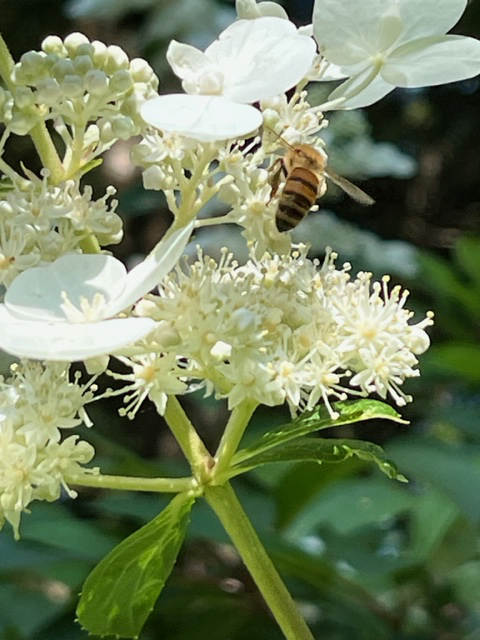
Bee on butterfly weed

It is just four days from the Turning. The season of abundance is supposed to be upon us as the goddess turns the wheel towards the dark of the year. We have already lost a half an hour of light. The leaves of fruit trees are yellow, many drifting like butterflies to the ground, prematurely. The ground is sodden, like walking on sponge. Cicadas coax down the sun on the few days we have seen it since the beginning of June. A few crickets have joined the chorus. In the fields the goldenrod is painting a golden haze over emerald and lime. The quality of that green belies the changing season. No wheat- colored grasses. Flowers bloom on with a determination that reveals nature’s intention to survive. Torrential rains pour down silver sheets from the sky obliterating the possibility of peering out to see the hummingbirds dip and soar, sip bee balm nectar. Fog is a constant companion on my  pre-dawn walks – the only time I can listen to birds when the air quality is clean. That three – mile walk is my sanity and sometimes my only exercise. By 8 AM some mornings the air is already reaching the poisoning stage. Most days the windows stay shut. ‘Moderate’ is wishful thinking. If a morning sun burns through the clouds the invisible killer starts burning my eyes if I step out the door to sit on the porch. Inside, the humidity is so high that I am chilled; never below 75.

Continue reading “The Flood by Sara Wright”

Fire by Beth Bartlett

The nature and meaning of fire have been appearing in several disparate aspects of my life lately – in the fire of Celtic spring rituals; in books I’ve been reading[i]; in the fireflies of summer nights and the fireworks of the 4th of July; even as a clue in a game; and most ubiquitous of all – the smoke from Canadian wildfires. So persistent a theme begs pondering.  It first appeared in a Rewilding course as the sacred element of spring in the Celtic wheel of the year. Spring is the time of new beginnings, of the sunrise – the element of fire in the sacred direction of east, of the fires of passion and creativity, and the celebration of Beltane.

Continue reading “Fire by Beth Bartlett”

Legacy of Carol P. Christ: TWO TORTOISES IN THE WEB OF LIFE

This was originally posted on March 14, 2014

The Gods made only one creature like them—man.  Greek TV documentary

The sight of a reptile or an amphibian usually provokes, at the very least, a feeling of repulsion in most people. Natural History of Lesbos

testudo marginata face

In the past days and weeks thetwo tortoises with whom I share my garden have woken up from a long winter’s sleep.  Henry, testudo marginata, has been up for a while now.  More than a month ago when I was cutting back and weeding in the area of the garden where he had been sleeping, Henry roused himself to sit in the sun near me for a few hours each day before creeping back under a shrub.  At first I thought I had disturbed him, but when he came back out day after day while I worked, I began to wonder if he was coming out to say hello.

Continue reading “Legacy of Carol P. Christ: TWO TORTOISES IN THE WEB OF LIFE”