Saying Yes to Saying No by Katey Zeh

andy-tootell-59614

I was sitting in my then-therapist’s office one day, feeling exhausted and hopeless. Between mourning a break-up and constantly traveling for work, I felt like I’d been digging myself out of an ever-deepening hole of despair for months.

“When someone asks you to do something, how do you decide when to say ‘yes’?” she asked.

“If I’m not committed to something else at the same time, then I usually agree to do it,” I responded.

That was my only criterion: was I physically able to do it? If I was, I did it. 

I was living in Washington, D.C. at the time where I was surrounded by other ambitious, overachieving twenty-somethings who seemingly never turned down an opportunity that might help them succeed professionally.

Continue reading “Saying Yes to Saying No by Katey Zeh”

Questions that Matter: What is Feminism? by Elise M. Edwards

elise-edwardsIt certainly is a busy time of year for me, but I’m fortunate that many of the events I am participating in offer a chance to share what is important to me.  Next week, I’ll be speaking to a group of students in one of my campus’ residence halls about feminism and Christianity.  For this informal setting, I was allowed to choose my own topic under the broad heading of “Questions That Matter.” I’ve decided to take on the f-word in religion and attempt to explain why it’s important to me and how it relates to my religious identity.  Although I’m still trying to figure out what to say, I’d like to share my thoughts so far and get some insight from you. Continue reading “Questions that Matter: What is Feminism? by Elise M. Edwards”

In Light of Women by Mary Jane Miller

Why are so few women mentioned in the great feast days like Pentecost, the Last Supper, the Baptism of Christ, etc.? God made no commandment that they not be included.
Inquisitive women like myself have always been around Christ listening to His message. There they were, cooking and cleaning at the Last Supper, at the wedding at Canon and when He fed the five thousand. When Christ invited the children to come to him, you can be sure the mothers were there, too.
Beginning as early as the fourth century the dominant Christian leaders, all men, twisted and distorted Holy Scriptures to thwart the ascendant positions for women within the religious hierarchy and in christian societies in general. Yet, the underlying teachings of Jesus Christ, the Apostle Paul, Moses and the prophets, – all call for the proper and equitable treatment of God’s children. Without a doubt, God and Christ love all of humankind with no gender bias. When women listen to scripture we naturally fill in the gap, or adjust the gap knowing in our hearts and souls, we are not inferior to men.

Continue reading “In Light of Women by Mary Jane Miller”

Exploring Muslimness in the Aftermath of September 11, 2001 by Stephanie Arel

In my last post, I addressed the deeply personal accounts of Haroon Moghul’s self- and religious exploration in his memoir How to be a Muslim: An American Story. This post will broaden that reading to consider an October 2017 interview with Moghul at the 9/11 Memorial & Museum in New York City.

The interview echoes themes relevant to current global crises which implicate religion including how religious rhetoric circulates to support extremist violence and Islamophobia. Exploring how the events of 9/11 intertwine with such crises adds depth to understanding Moghul’s individual experience.

Continue reading “Exploring Muslimness in the Aftermath of September 11, 2001 by Stephanie Arel”

Hope for the New Year by Katie M. Deaver

I have never been one to set major resolutions at the beginning of the new year, but this year feels different somehow.  I can’t say that I am sad to see the end of 2017.  This year has felt like an unpredictable roller coaster both on a national and personal level.  The highs of finishing a doctoral program and building a relationship with my boyfriend’s six year-old daughter were met with the complications of job searching, concern over losing access to affordable health care, and my feeble attempts to balance appropriate and timely responses to the constant onslaught of ridiculous, or often downright appalling, headlines with my need to remain at least somewhat sane.  All in all I am ready for 2018 to begin and I feel a new drive to find ways to make this a better year for myself and for those around me.

How do I go about accomplishing this? I don’t want my new goals to go the way of so many resolutions… given up on or discarded by mid-January or perhaps February if I’m lucky.  Rather I want to find ways to dedicate myself to small changes that I can sustain long-term, small changes that help me feel as though I am having an impact.  In addition, I want to find ways to rejuvenate and reinvigorate myself and my actions on a regular basis… to make 2018 feel more like an enjoyable walk in lightly falling snow and less like slogging through five feet of that snow while carrying a heavy burden on my back.

Continue reading “Hope for the New Year by Katie M. Deaver”

Another Season of Reflection and Review by Elise M. Edwards

elise-edwardsI turn inward and become reflective at this time of year.  It’s the Advent season in the Christian liturgical year, which encourages practices of piety focused on preparation, examination, and hopeful longing.  It’s the end of a semester and a calendar year, which provokes review of the months before.  In the northern hemisphere, it’s a time of darker days and longer nights, which suggest a retreat indoors, in silence or in stillness.

During this time of year, I’m typically exhausted, and so I seem to enact annual rituals with a recurring sense of ambivalence.   I really love the celebration of Christmas, but preparing for it takes a lot of energy.  So I do some decorating, but not as much as I planned.  I attend some parties and celebrations, but end up missing or cancelling others.  I start a new devotional book, only to set it aside within a week or so.  I want this time of year to be both reflective and celebratory.  I want it to be spiritual and religious.  I want to be sociable with friends and family and also find time to rest and recover in solitude.  At some point, those goals seem too contradictory to be realizable and then I start practical negotiations:  How much decorating will I do? What kind of time will I set aside for solitude and self-care?  Will I have enough energy to be joyful and present with my family and friends?

“Some, but not enough” is the answer I seem to come to every year.

Some decorating, but not enough.  Some time for solitude and self-care, but not enough.  Some energy for social occasions, but not enough.  This year, I want to let go of that voice that says it’s not enough.  That voice that says I am not enough.

To help myself let go of the guilt and self-deprecation, while retaining the reflective focus of the season that may be life-affirming, I reviewed my previous years’ December writings on this blog.  What might I discern from this pattern of yearly reflection?

In 2012, I wrote about why women might be tempted to cancel Christmas.  I was in my final year of the Ph.D. program when I wrote that, and was prompted to do so when I heard that friends and colleagues were planning to skip Christmas preparations or scale them back dramatically.  That year, I sought to maintain “religious and social rituals associated with Christmas” so that I could be “spiritually grounded, emotionally provoked, mentally rested, and physically fed.” I don’t have a vivid memory of that year’s holidays, but as I read it again, I wonder if I was carrying a sense of religious obligation rather than release.  Did I feel free or beholden to social custom? I’ve learned that I will only be able to let that “not enough” voice go when I let go of the expectation that Advent and Christmas should look a certain way or I should be present to it in a certain way.  I’m more willing this year to let peace and joy ebb and flow  in celebrations and moments of sadness and mourning that accompany the season, too.

In 2014 and 2016, my Advent reflections were more focused on justice and peace at the societal level than in the household.  They were mournful.  In December 2014, I was trying to stave off despair after Michael Brown’s killer was not indicted by a grand jury.  The police officer would not stand trial for killing the black teen.  That year, I was mourning Michael Brown and Trayvon Martin and the loss of my own naivete as I became more conscientized about racial violence. I had a similar wake-up call last year when Hillary Rodham Clinton lost the US presidential election and I working through the anger and dread I felt at 45’s approaching presidency.  This year, the struggle continues as we anticipate changes to the tax code and DACA.  But at least Roy Moore lost.  We do continue to work for progress and systemic change, and sometimes, it works.

Feminists have long asserted that the personal is political and that the political is personal.  I’m acknowledging this holiday season that my perpetual weariness during Advent and Christmas is legitimate, as it emerges from personal and political struggle.  I am frustrated with the injustices and hardships I encounter at home, work, and the broader community.  I would not be weary if I was not awakened to the suffering.  This year, I accept that the exhaustion is part of the cost of my work and my calling.  The weariness will ebb and flow, as will joy and peace. Being able to teach and write is a blessing that allows me to help others become more aware of injustice and more involved in addressing it.  This year, I’m acknowledging that I’ve done what I can do.  I’m resisting the impulse to assess whether it was enough.  In previous years, I’ve been trying to hold on to hope; this year I’m resting in God’s grace.

As Christmas approaches, I’m embracing the Christian teaching that the divine meets humanity where we are.  The beauty of the Incarnation is that the eternal meets the temporal and that God unites with human to bring light to a suffering world.  That’s a gift for me this year, a comfort to be able to shift the focus from my own action and being to divine action and being.

I can see the sacred work and presence in this online community and other communities of faith.  Holiday blessings to you all.

Elise M. Edwards, PhD is a Lecturer in Christian Ethics at Baylor University and a graduate of Claremont Graduate University. She is also a registered architect in the State of Florida. Her interdisciplinary work examines issues of civic engagement and how beliefs and commitments are expressed publicly. As a black feminist, she primarily focuses on cultural expressions by, for, and about women and marginalized communities. Follow her on twitter, google+ or academia.edu.

Grieving through the Holidays: Painting Holy Women Icons of Grief by Angela Yarber

The holiday season is a particularly difficult time for grief. Whether it is grieving someone who died earlier in the year as you celebrate your first holiday season without them, or the lasting memories of loved ones who are no longer present at family gatherings, this time of year makes grief bubble to the surface. Since this is my first holiday season without my little brother, who died in March, I’ve planned ahead with coping strategies that I’d like to share with other feminists struggling to grieve through the holidays.

Upon the death of a loved one, most people in the West are offered commodified grief, costly funerals, and stifled feelings pre-packaged as dignified tradition. When deathcare became a commercial enterprise at the turn of the twentieth century, there was what mortician and author Caitlin Doughty calls a seismic shift in who was responsible for the dead. “Caring for the corpse went from visceral, primeval work performed by women to a ‘profession,’ an ‘art,’ and even a ‘science,’ performed by well-paid men. The corpse, with all its physical and emotional messiness, was taken from women. It was made neat and clean, and placed in its casket on a pedestal, always just out of our grasp (Caitlin Doughty, From Here to Eternity: Traveling the World to Find the Good Death, 136).”

Continue reading “Grieving through the Holidays: Painting Holy Women Icons of Grief by Angela Yarber”

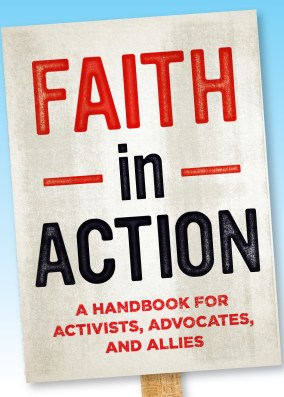
Faith in Action by Lisa Kloskin

Nearly a month ago, American voters showed up at the polls and delivered some big wins: the first openly transgender person was elected to a statehouse—Danica Roem in Virginia. Roem defeated an incumbent candidate who authored an anti-trans bathroom bill. Also in Virginia: the boyfriend of a reporter shot and killed on live TV, Chris Hurst, won a seat to the statehouse on a gun-control platform, defeating the three-term NRA-backed incumbent. And Hoboken, New Jersey, got its first Sikh mayor: Ravi Bhalla. These and others are encouraging signs that love and tolerance are gaining ground in the public sphere. But there’s still so much work to do. White Supremacists and Nazis still walk boldly in the streets, LGBTQIA teens still face bullying and higher rates of self-harm, women are still paid less for equal work and harassed in every arena, sea levels are rising at faster rates than we previously thought, people of color are still being killed by police, mass shootings are still a regular part of our news cycle, refugees are still waiting in camps around the world for a chance at a better, safer life.

Activists and advocates have been working for justice in these and other areas for decades. In the last year, spurred on by events like the Women’s March, a growing group of would-be activists has emerged. These allies are a welcome addition to the justice movement, but many worry they won’t do or say the right things, and want to have their perspectives deepened on important issues. They need guides and resources to give them the knowledge, tools, and confidence to make a real impact.

Continue reading “Faith in Action by Lisa Kloskin”

What I Believe (Post-2016) by John Erickson

Ever since the election of You-Know-Who, I have been doing a lot of creative writing.

Ever since the election of You-Know-Who, I have been doing a lot of creative writing. Unlike academic publications, policy reports, or my dissertation, creative writing, much like my mentor Dr. Marie Cartier has written about, provided me with a needed escape from a world that seems to grow darker with each passing day.  In college, I served as Poetry Editor for the Wisconsin Review, the oldest literary journal in Wisconsin. Continue reading “What I Believe (Post-2016) by John Erickson”

Moving Toward an End: The Role of the Faith Community in the Struggle to End Domestic Violence by Katie M. Deaver

I have used my last few posts here on Feminism and Religion to begin unpacking the three primary understandings of atonement theology, the feminist critiques of these understandings, and how the relationship between power and violence influences how Christian women view the atonement.  This post will consider the role that faith communities are called to play in situations of domestic violence.

Personal faith often has a huge impact on the lives of survivors of violence.  This impact, unfortunately, as can be seen in the other posts as well as in the comments on those posts, is not always a positive one.  In her book, Redeeming Memories: A Theology of Healing and Transformation, Flora A. Keshgegian envisions communities of faith as communities of remembrance.  A community of remembrance does not ignore or suppress the negative experiences of its members but strives to  enable us to embrace personal identity, form our faith, and to nurture hope in order to heal and transform after such experiences.

One question that my dissertation set out to answer was how we might begin the difficult work of moving our communities of faith in this direction.  Sadly, the biggest difficulty seems to be the lack of awareness, or the downright denial, that domestic violence is an issue for the average faith community.  So many congregation members assume that if their pastor is not talking about an issue then it must not be a problem in their particular community.

Continue reading “Moving Toward an End: The Role of the Faith Community in the Struggle to End Domestic Violence by Katie M. Deaver”