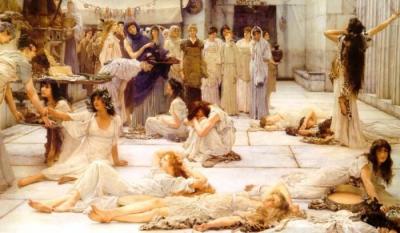
 A few nights ago, on the way to dinner, two friends and I passed by a small church near the old fortress in Ierapetra, Crete. The liturgy was broadcast via microphone and a crowd of people gathered outside the church. “Must be some kind of name day,” one of my friends commented, but I could not think of a saint celebrated on August 1.
We decided to light candles and make our prayers. I asked one of the Greek women the reason for the ceremony. “This is the first night of our celebrations for the Panagia,” she responded, referring to the Assumption of Mary that would occur on August 15. I looked around and saw that indeed many of the women were wearing black. “Of course,” I thought to myself. Continue reading “We Are Not Alone: Embodying and Re-enacting Ancient Wisdom by Carol P. Christ”
 I dream that all of us who are suffering burn-out because of national and world politics come together to plant and nurture trees. Scientists say that planting



 Last week I wrote about the grief I feel for the state of my nation (the United States) and of the world. A few days later one of my favorite writers,