
Sawbonna: Godde and Another Route to Forgiveness by Margot Van Sluytman

From the day my Father, Theodore, was brutally and callously murdered in Toronto, on Easter Monday, March 27, 1978, I wanted to meet his killer. I wanted to know how it was possible to do such a horrific thing. I wanted to know how he felt about destroying the lives of so many; my family’s, and his own.

We did meet. The meeting occurred in July of 2007. Because of reading about an award I received for my Therapeutic Writing Workshops and the publication of my books about healing, voice, and agency, he emailed me. Our meeting, our reconciliation, even those many years after that dark, dark day, was a rich blessing in my life, and proved helpful for him too.

The word forgiveness, is one that can lead to great suffering for victims and offenders alike. Victims are told that if they do not forgive, they cannot heal. Offenders are told that if they are not forgiven, they cannot move on from the crime they have committed. Forgiveness is a loaded word, with as many understandings, expectations, and definitions as there are experiences of savage loss, savage grief, savage pain.

Continue reading “Sawbonna: Godde and Another Route to Forgiveness by Margot Van Sluytman”

Windigo by Sara Wright

Windigo,

the Potawami Nations call him.

Malignant,

this spirit thrives

in the Northern Woods,

within the human soul.

Hatred for self or other

hidden

under Lies.


Windigo, the

Potawami Nations call him

He thrives

on greed.

Empty

He can never

Be filled.

Continue reading “Windigo by Sara Wright”

A Matter of Life and Death: The Military or the Green New Deal? by Carol P. Christ

“I have set before you life and death . . .  Choose life.” (Deut. 30:19)
Scientists tell us that an environmental catastrophe which has already begun threatens every aspect of life as we know it on planet earth. The choice could not be clearer. Will we choose life? Or will we choose death?

On March 6, 2019, William Barber and Phyllis Bennis published an opinion piece titled: “If America can find $716 bn for the military, it can fund the Green New Deal.” In it, they note that politicians in both parties are rushing to dismiss the Green New Deal as an unrealistic pipe dream, stating that there simply is no money to fund it. Senator Dianne Feinstein’s response is characteristic of the Democratic Party’s so-called moderate and pro-military wing. As Barber and Bennis report:

When young organizers from the Sunrise Movement recently challenged Senator Dianne Feinstein to support a Green New Deal, she told them “there’s no money to pay for it”. She probably didn’t expect those eight- and 10- and 11-year-old kids to respond immediately: “Yes, there is, there’s tons of money going to the military.”

Feinstein responded condescendingly that the military does “important things” with that money.

Continue reading “A Matter of Life and Death: The Military or the Green New Deal? by Carol P. Christ”

Exercising Women’s Religious Voice and Authority – Why is this Still an Issue? by Elise M. Edwards

elise-edwardsOver the past few days, I’ve been spending time at a church in Alexandria, Virginia conducting oral history interviews.  I’m doing research for a project about the arts and the church that has me diving deep into the church’s congregants’ and leaders’ experiences. Yesterday’s conversations offered insight about many theological topics that interest me, but what was particularly encouraging was what I witnessed concerning women in ministry.  That’s not what I was looking for, but it is what I needed to see.

Before beginning these interviews, I had already been thinking about the ways women’s authority and voice are often challenged.  This past weekend, I attended a regional religion conference where I assumed a leadership position and my voice was sought out for advice and insight.  I had great conversations with other women in academia about wellness and success while I was there.  Attending the conference provoked fond memories of a similar conference many years ago, when I connected with many colleagues in this FAR community and we discussed the theme of “Women and Authority.” Those were positive experiences.  But I had an unpleasant encounter, too, when I was on the receiving end of a male colleague’s condescending remarks.  I was also made aware of a disturbing incident in which a woman of color was publicly disrespected while speaking at a university event and subsequently trolled.  Those experiences triggered anger and deep sadness. To be honest, I also felt a sense of resignation and defeat.  Patriarchy is just so persistent.

Continue reading “Exercising Women’s Religious Voice and Authority – Why is this Still an Issue? by Elise M. Edwards”

Tree-Hugging Is About Trees and So Much More Than Trees by Carol P. Christ

Not too long ago I heard someone deride members of a seminar who were building labyrinths in the olive groves of Greece as “a bunch of tree-huggers.”  I bristled! I probably first heard of the Chipko tree-hugging movement which is led by women in the 1970s and 1980s. Because I love nature, I naturally assumed hugging trees is a good thing. Originally, I had no idea that the tree-hugging movement was about much more than saving trees from being felled in the interests of short-term profit.

I did not know that the deeper purpose of the movement is to save a way of life based on forest-culture that is being threatened by the imposition of western ideas and practices promoted by colonialism and its successor, the green revolution. Nor did I know that the traditional forest-culture of India is the provenance of women: more than 4000 years of observing and experimenting created a “women’s knowledge” passed down from mother to daughter. Continue reading “Tree-Hugging Is About Trees and So Much More Than Trees by Carol P. Christ”

Recognizing Abuse by Karen Tate

I’ve been thinking a lot about abuse.  Of course, most of us know about the domination, exploitation and  need for control meted out by patriarchy, but I wonder if we have actually normalized many abuses?  Abuse in the home, in the workplace, in our culture.   Perhaps  we accepted it unconsciously because so many of us are conditioned by religions that tell us to make noble sacrifice and tolerate suffering silently. I wonder if we’re calling it out when we see it – often and loudly – or if we’ve become conditioned to quietly accept the abuse with little push back.

My intent is not to offend anyone with this.  I want to find common ground and defeat the polarization we find around us, but our President is the poster child for abusive behavior.  Do we recognize his lies and fear-mongering and so many of the ideas he gives credence and license to as abuse?  Not only is he eroding our democratic institutions but he poisons the political, social and cultural arena with negativity, fear and hate, rather than uplifting us and encouraging us to evolve and be the best version of ourselves.  I equate him to poison in a well from which we must all drink. Continue reading “Recognizing Abuse by Karen Tate”

Gendered Only In Expression by Chris Ash

“I want you to see this new piece I wrote for our newsletter,” said Sister Ann.
We were safe inside the dining room of the Episcopal convent where she lived and I was an extended guest, and yet she spoke in hushed tones that suggested she realized the controversial nature of what she was about to say.

“This whole piece – it’s about the idea that being ‘born again’ clearly indicates the concept of God as mother.” She laid out her argument about wombs and motherhood and the feminine divine. It was a fairly essentialist argument (being the mid-nineties), but it was the first time I’d heard any modern Christian reference God as anything other than father, son, male. Before finding the Episcopal cathedral where I regularly attended services, I’d had two general experiences of the divine: the evangelical, conservative, patriarchal God of my father’s church, and the gender-creative spirit found in practices that were fairly alternative for my small, South Carolina town. Continue reading “Gendered Only In Expression by Chris Ash”

I am in Peace: The Ministry of Margaret Fell by Mary Sharratt

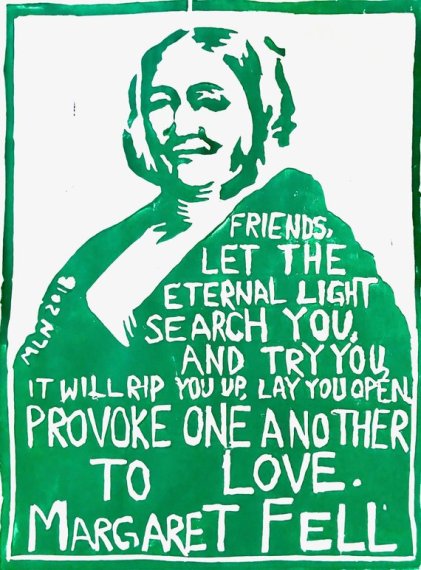
margaret fell

This linoprint of Margaret Fell can be ordered here.

Pendle Hill will forever be associated to the Pendle Witches of 1612 who live on in the undying soul of the landscape and its folklore and who inspired my 2010 novel, Daughters of the Witching Hill. Pendle Hill also gave birth to the Quaker movement.

In 1652, George Fox, a simple weaver’s son and cobbler’s apprentice turned dissenting preacher, wandered across England on a spiritual quest. When he climbed Pendle Hill, his revelation came to him—an event that would change both Fox and the world forever. He envisioned a “great multitude waiting to be gathered.”

As we travelled, we came near a very great hill, called Pendle Hill, and I was moved of the Lord to go up to the top of it; which I did with difficulty, it was so very steep and high. When I was come to the top, I saw the sea bordering upon Lancashire. From the top of this hill the Lord let me see in what places he had a great people to be gathered.

George Fox: An Autobiography, Chapter 6 Continue reading “I am in Peace: The Ministry of Margaret Fell by Mary Sharratt”

Eve by Any Other Name… by Janet Maika’i Rudolph

This title isn’t entirely true. Eve would need an exceptionally well thought out replacement for Her name to be as sweet as it already it. That is because Eve’s name is unique, multi-dimensional and integral to the Bible’s mysteries. The Hebrew word for Eve translated to English means “life.”

And Adam called his wife’s name Eve;
because she was the mother of all living.
Genesis 3:20

Barbara Walker wrote about variations of Eve’s name as they appeared in neighboring cultures. Eve in Hebrew is pronounced variously as hawah or chavah. Walker wrote that in many middle-eastern cultures, Her name was the hallmark of “superior feminine power. To the Hittites, she was Hawwah, Life.’ To the Persians, she was Hvov, ‘the Earth.’ Aramaeans called her Hawah ‘Mother of All Living.” (The Women’s Encyclopedia of Myths and Secrets, p 289.) In other words, She was a Great Goddess in Her own right. Her name was and is still is reminiscent of the awesome power that She has held in our lives. Continue reading “Eve by Any Other Name… by Janet Maika’i Rudolph”

Meeting the Windigo by Carol P. Christ

Towards the end of Braiding Sweetgrass, mother, biologist, and member of the Citizen Potawami Nation Robin Wall Kimmerer sets out at the end of winter to visit a forest area near her home that she considers hers not in name but in virtue of her love and care for it. On arriving, she discovers that the forest is no more, having been clear-cut by the owner. The wildflowers and the plants she has harvested over the years have sprouted up, but Kimmerer knows that without the forest cover they will be burned by the sun and their places taken by brambles. Continue reading “Meeting the Windigo by Carol P. Christ”