A Decision To Exist: One Feminist’s Musings on the Transformation of a Catholic Women’s College by Cathleen F.

Last week the oldest Catholic liberal arts college for women in the United States announced it would admit men into its campus-based undergraduate programs for the first time since the institution was founded 175 years ago. As an alumna, I have lived the value and reaped the benefits of all-women’s liberal arts education at a Catholic institution. But throughout the past year, my work of recruiting young women to attend the College revealed in new ways the dissonance between Catholic higher education and women in this time and place. As is the case in most sacred struggles I have more questions than answers, but I will speak to what I have felt and observed.

In the 21st century it has become increasingly difficult for institutions and individuals to identity as both Catholic and pro-woman. As a constituent at a women’s institution, I celebrate the empowerment of women in leadership roles within their careers and families. But as a constituent of a Roman Catholic institution, I am aware of the Church’s patriarchal governance and inconsistent appropriation of power to lay and religious women. As a constituent of a women’s institution, I see women’s diverse expressions of sexuality and gender. But as a constituent of a Catholic institution, I am immersed in binary, sexist language and assumptions at every formal liturgy.  Continue reading “A Decision To Exist: One Feminist’s Musings on the Transformation of a Catholic Women’s College by Cathleen F.”

The Religiosity of Silence by John Erickson

In a repetitive culture of abuse and silence, is it really shocking to find out that an individual who preached such hate and discontent for others actually perpetuated other forms of heinous abuse against others?

John Erickson, sports, coming out.In 2013, I wrote an article about the then latest reality TV scandal featuring A&E’s Duck Dynasty’s Phil Robertson and his rampant foot-in-mouth disease that caused him to express, in the pages of GQ, his true distaste for the LGBT community and specifically for the sexual proclivities of gay men.

Now, two years later in another reality TV show, TLC’s ’19 Kids and Counting’, it isn’t star Josh Duggar’s anti-LGBT statements getting him into trouble but rather his sexual assault and molestation of 5 girls, including two of his sisters. However, while the Internet explodes with attacks against Josh Duggar and his Quiverfull background, it is vital to remember that the silence that he and his family inflicted upon his victims since 2006 has not only been ongoing since then but is also being reemphasized today with each keystroke focusing on the assailant rather than the victims. Continue reading “The Religiosity of Silence by John Erickson”

All-Male Nonsense by Kecia Ali

Kecia Ali Bio pic officeA brilliant site has been making the rounds of social media: allmalepanels.tumblr.com. I became aware of it just in time to suggest a post: an all-male symposium at Cambridge Muslim College on the future of the madrasa. The original article, since removed, touted its diverse participants, but as someone observed, clearly they only meant diverse styles of facial hair. The organizer apparently chose “to exclude women despite having had the matter brought to his attention” in the planning stages by male participants. (As of this writing, the college still has an all-male homepage.)

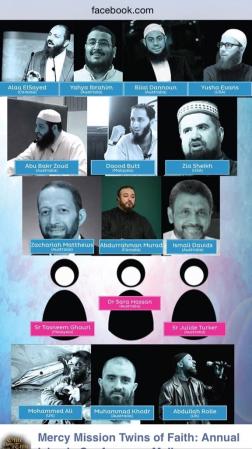
Right around the same time, I learned of an Australian Muslim conference taking a slightly different route, advertising an event with thirteen male speakers and three female ones. Not an ideal ratio, but certainly better than many events. What is troubling is the way men and women appear on the poster. Each man has a picture along with his name. The women are literally faceless, represented by identical balloon figures. While the men appear in color or grayscale photographs, the women are stark black and white, clearly inhuman caricatures. (Other similar events give slightly different lists with only one woman;  she appears with different line drawings, one in profile and one “full face” – except, still, faceless.)

Mercy Missions Twins of Faith poster blue for boys pink for girls Continue reading “All-Male Nonsense by Kecia Ali”

What if Divine Feminine and Divine Masculine Are Not Oppositional Categories? by Carol P. Christ

Carol in Crete croppedA friend who is a spiritual teacher speaks often “bringing back the values associated with the Divine Feminine.” For her this has to do with helping women to understand the beauty of our bodies and the importance of ways of being such as giving and caring for others that have been associated with the undervalued so-called “feminine” side of the masculine-feminine polarity. Though she also speaks about the Goddess, I think she prefers the term “the Divine Feminine” because of the implication that men too have their “Divine Masculine.”

This friend has a wonderful husband who is a teacher in his own right and who often ends up spending a lot of his time among powerful women who enjoy talking about the Goddess. In these conversations he sometimes speaks of the need for men to “recover the Divine Masculine” if they are to become whole.

I was reminded of these conversations when a two other friends, in different contexts, recently voiced their concern that Goddess imagery is problematic if it repeats sex role stereotypes. My response to them was that in the West, the feminist association of femaleness with power and value in Goddess symbolism automatically shatters the most important sex role stereotype: the notion that women are less powerful and less valuable than men. But, I said, after that, problems may arise.

I added that (for me) the categories of Divine Feminine and Divine Masculine are problematic because (it seems to me) that at their core these concepts are rooted in the notion that males and females are fundamentally different, and that the so-called “feminine” is relational, loving, giving, while the so-called “masculine” is independent, rational, aggressive, and sometimes violent and warlike. Those who speak of the Divine Feminine and Divine Masculine as oppositional categories usually try to avoid categorizing men and women by stating that “we all have our masculine and feminine sides.” Still it is hard to avoid the implication that men are more masculine and women are more feminine.

Though I agree that men need new images of what it means to be men as much as women need new images of what it means to be women, I hesitate to speak of these as new images of the Divine Feminine and Divine Masculine for two reasons. Although I recognize that others are inspired by images of the Sacred Marriage, for me it has been more important–and more possible–to find power within myself and in a wide variety of relationships, than to find it in a male-female heterosexual couple relationship in which the opposites are “joined.”

More importantly, I find that images of Divine Feminine and Divine Masculine often do justify patriarchal sex-role stereotypes. An internet search for “Divine Masculine” validated this fear. The first (and therefore most popular) website defined the Divine Masculine through six archetypes: God, King, Priest, Warrior, Lover, Sage.

The site’s author seems to want to help men learn new ways to interact with powerful women—as neither dominant over them nor submissive to them. The author writes: “The Divine Masculine represents an archetypal ideal, the best and most inspiring, elevating, and restorative aspects of masculine expression and manifestation in the universe. For those seeking an expanded understanding of the Self, the Divine Masculine is not a distant, detached, jealous and vengeful male deity. The Divine Masculine (along with the Divine Feminine) acts as a shining mirror of the Self, revealing aspects that need compassionate attention and support to become one’s highest potential.”

Following this insight, he redefines the God archetype as “unconditionally loving, inclusive, open, welcoming, heart-centered, spiritually focused, supportive and inspirational.” For him, the King archetype is “benevolent, evenhanded, calm, caring and thoughtfully present.” And the Warrior “finds his place in collaborative projects, being fulfilled and contented with the collaboration and not by ambition or competition.”

While I appreciate the ways in which this man redefines masculinity and male strength in terms that in the past have been associated with “the feminine,” I am concerned that he continues to view the six “archetypes” that include the King and Warrior as universal. He does not explicitly name patriarchy as a system of male dominance enforced through violence as the reason for redefining the meaning of the “archetypes.” I also worry that a good king is still a king, and that a warrior who fights for the good of others is still a warrior. From a feminist perspective, these archetypes are not universal, but rather are the product of patriarchy. Perhaps instead of redefining them, we should discard them.

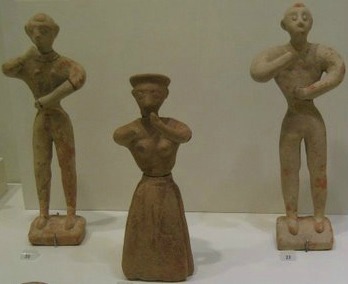
peak shrine figurines 3
Male and female figures from ancient Crete are not strongly differentiated.

New research suggests that in matriarchies, there is no divine masculine per se, because though men have their own important roles, both males and females are encouraged to embody the values associated with mothers and mothering—in other words to be loving, giving, caring, and generous. In this context there is no opposition or sharp contrast between the divine masculine, the divine feminine, and any other divine gender or transgender.

I believe that that we need a multiplicity of images for divine power that express the diversity and differences of our bodies and all bodies in the web of life. We also need new images of how to be strong and powerful, yet loving and caring above all, in male, female, and other bodies.

However, if the “highest” values are the same for both—and all–genders, then perhaps it is time to retire the oppositional binary of Divine Feminine and Divine Masculine and to speak instead of images of divinity in male, female, and other bodies.

Carol leads the life-transforming Goddess Pilgrimage to Crete (facebook and twitter).  Carol’s books include She Who Changes and and Rebirth of the Goddess; with Judith Plaskow, the widely-used anthologies Womanspirit Rising and Weaving the Visions and forthcoming next year, Goddess and God in the World: Conversations in Embodied Theology. Explore Carol’s writing. Photo of Carol by Maureen Murdock.

The Importance of Rituals (Part 2) by Elise M. Edwards

elise-edwards

In my previous post, I wrote about the importance of rituals. The rituals of the Easter season helped me process some difficult emotions. The way that rituals mark time and demonstrate consistency has been a comfort for me when facing new challenges and settings. But I am quite aware that rituals can become empty.   In one of the comments to that post, a woman named Barbara responded, “There came a time for me when familiar and meaningful ritual no longer made sense. I had changed in understanding of what the ritual symbolized and celebrated. And haven’t found new rituals that make sense for me now…or at least I’m not aware of any.” Barbara’s remarks capture not only the loss from no longer being able to relate to existing rituals after life changes, but also the difficulty in finding or creating new rituals to take their place. I thanked Barbara for her honesty and decided that this post would continue the discussion, focusing more on discovery and creation of new rituals.

As I was preparing that post, I watched an episode of Call the Midwife that prompted me to reflect on the need to create rituals when existing ones just don’t work. Call the Midwife is a BBC-PBS show about nurses and midwives living in a convent in London’s East End at the end of the 1950s and early 1960s. The show is based on the memoirs of Jennifer Worth, and it does a better job than most primetime dramas of showing female characters’ experiences the joys and challenges of their professional lives and personal lives. As it is set in a convent with several characters who are both nuns and midwives, the show also explores the theme of vocation. What does it mean to be called to the religious life? Called to nursing? What does motherhood demand? Continue reading “The Importance of Rituals (Part 2) by Elise M. Edwards”

Do You Eat Animals? Ecofeminism and Our Food System by Ivy Helman

10953174_10152933322533089_8073456879508513260_oCarol Adams in her article “Ecofeminism and the Eating of Animals,” argues that ecofeminists should be vegetarians, since ecofeminism is, among other things, action-based and “one’s actions reveal one’s beliefs,” (129). According to ecofeminism, the patriarchal domination of animals and nature is linked to the oppression of women. For her and many ecofeminists, the survival of our planet rests on two foundations: first, fixing the conditions of women and other oppressed groups and, second, envisioning differently our relationship to the natural world. In other words, a better arrangement of human relationships requires better human relationships with the environment. Vegetarianism and veganism are two ways in which ecofeminists opt out of the patriarchal system of domination and exploitation and help create a better world.

But, does one really? Does adopting a vegetarian or vegan lifestyle really have such an impact on the world? Yes and no. Yes, because it has been shown that raising animals to eat uses exorbitant amounts of fuel, water and land, not to mention, the larger environmental impact of farm run-off in the forms of disease-carrying manure, valuable topsoil and harmful pesticides. Yes, because animals are often inhumanely treated, housed in horrible conditions, genetically and/or hormonally-modified and cruelly killed. Continue reading “Do You Eat Animals? Ecofeminism and Our Food System by Ivy Helman”

Experiencing Divinity in the World by Carol P. Christ

carol mitzi sarahAs I work on revisions of the new book, Goddess and God in the Worldthat Judith Plaskow and I are writing, I am thinking again about John Cobb’s notion of the “two ultimates” as two different ways of thinking about divinity. Cobb suggested that religions have defined the nature of ultimate reality as personal and as impersonal, as God and as the ground of being. The ground of being is the impersonal ultimate: the metaphysical principles that structure all of life, principles that he described as creativity or the creative process.

Judith describes God as the impersonal creative process and views personal language for divinity as metaphoric or symbolic. I define Goddess as personal, yet also view the impersonal ultimate, the creative process, as sacred. For me, this raises the question of the relationship between Goddess and the creative process.

In Cobb’s view, the two ultimates are co-eternal: the personal God did not “create” the creative process, nor was the personal God “created” by the creative process. Rather, for Cobb, God as the personal ultimate, like all other individuals, participates in the creative process. What then is the creative process? Although the term “creativity” has multiple meanings, in process philosophy it has a specific one.

Whitehead’s description of the creative process is rooted in the insight of modern science that the most basic components of our universe are particles of atoms that defy being categorized as either matter or energy, but seem to move and change, depending on their relationships. It is from the relationships of these tiny individuals that the evolutionary process of our universe began. This insight led Whitehead to recognize that the nature of reality (or being) is not fixed and static (as Western philosophers before him had concluded) but is always moving, changing, or “in process.” Whitehead’s understanding of the creative process is summed up in his much-quoted phrase, “the many become one, and are increased by one.”

The creative moment in the creative process (which is in fact every moment in the life of an individual) is the moment when the individual (whether particle of an atom, cell, animal, human, or divinity) in an act of creative freedom unifies the world (the many) into a new synthesis (the one): this new synthesis adds a new fact to the world (the many is increased by one). This is an abstract description of the creative process in its most basic form. In fact, however, we do not experience the world in the abstract, but in the concrete.

In this moment I (Carol) remember my past (many different Carols situated in many different worlds and some of the books I have read) as I shape this sentence (with my hands on my computer acting in concert with the feelings of my body and the thoughts that are flowing in my mind) and unite myself and my world in a new synthesis (which is this sentence). As I do so, I add a new fact to the world (the many are increased by one), a sentence that may be read by others in the future, therefore influencing their lives.

The reader who reads my words (you) reflects on them in relation to her or his memory (your memories of your past selves in your past) and asks if what I am saying makes sense: in the moment that she or he (you) decides if it does or it doesn’t, a new fact is added to the world (the many are increased by one), an opinion that in turn may be expressed to someone else (the many is again increased by one) who in turn responds to it (the many is increased by one more).

Though this description of the creative process focuses on mental actions, our mental processes are not divorced from our bodies and feelings, and the relations of mind, body and feeling are complex. In some creative moments, feelings are primary, while in others the body leads. This second richer description of the creative process is still an abstraction. We do not generally experience life as a series of moments but as a flow in which one moment is indistinguishable from the others; nonetheless, we can recognize that our lives are made up of a series of moments in which we along with others create the world anew.

Sometimes we take a longer and broader view of the creative process, recognizing patterns and cycles within the world that we share with other than human life. Traditional peoples, for example, often speak of or invoke the creative processes of birth, death, and regeneration that are the basis of life on this earth. This is also an important way of describing the ground of being because it situates human creativity within the creativity of the web of life. In our time we might also speak about the evolution of life. Taking a long view, we experience the sacrality of the web of life.

I experience—feel and sense—the personal ultimate, the presence of Goddess as intelligent love in my body, mind, and spirit and in all bodies, minds, and spirits, as I go about my everyday life. She is always there: feeling the love and joy I feel; supporting and understanding me when things are difficult; inspiring me to share the grace of life with everyone and everything. I also feel the power of the impersonal ultimate, the creative process that supports the creativity or freedom of all individuals who interact with each other in the web of life. For me the two ultimates—Goddess and the web of life—are both real.

Though the two ultimates are separate in the abstract, in the concrete experience of those of us who affirm a personal divinity, they are intertwined because the personal divinity is experienced through the creative process that is the basis of life. Thus, at one and the same time, I experience myself and divinity within me, other individuals and the divinity with in them, the creative process and the divinity within it.

I celebrate the creative process and its fruits, the powers of birth, death, and regeneration and the evolutionary process as a whole, as the ground of all being as well as the Goddess I experience as a personal, intelligent, loving, compassionate presence who cares about me, all other individuals in the world.

Carol leads the life-transforming Goddess Pilgrimage to Crete (facebook and twitter).  Carol’s books include She Who Changes and and Rebirth of the Goddess; with Judith Plaskow, the widely-used anthologies Womanspirit Rising and Weaving the Visions; and forthcoming in 2016, Goddess and God in the World: Conversations in Embodied Theology.

It is a Matter of Focus by Deanne Quarrie

deanne_2011_B_smMany of the young women I meet tell me that they think feminism is not what they are about, that they prefer to work for the good of all. I understand that and certainly we can all choose where we wish to place our focus. However, it does make me wonder how effective we can be with our focus placed on so broad a scope. Certainly, we want equal rights for all and some call that “feminism” these days but is it?

In my 73 years, I have lived through quite a few years of women working for equal rights. I have seen many successes as well as the failures. I am incredibly proud of those successes. When I was in the early stages of my career and had just entered management, I was able to implement leadership methods, which now have become models for employers such as team building and servant leadership. Then however, there were no names for them. I led my teams based simply on how I wished my employers to treat me. Continue reading “It is a Matter of Focus by Deanne Quarrie”

Feminism, Friends, and Faith by Michele Buscher

Michele BuscherAlmost a year ago, I contributed my first post to this blog.  I wrote about the struggles I had encountered mostly during my time pursuing my PhD in Religious Studies.  Reflecting on my experiences helped me realize the impact women have had on my successes and how their support during my failures meant everything.

Now, I’m reflecting on a similar theme but with particular attention to my friendships with women.  Certain events that have taken place over the past few days have helped shed light on these friendships and how the dynamic I have with two women, in particular, has shaped my personhood, helped my continued pursuit to define what feminism means to me, resulting in a spiritual, faithful experience.   Continue reading “Feminism, Friends, and Faith by Michele Buscher”

Gender, Friendship, Collaboration, and Unacknowledged Authorship by Carol P. Christ

Carol in Crete croppedIn recent weeks Judith Plaskow and I have been revising the manuscript of our new book Goddess and God in the World in preparation for sending it to the publisher. Yes, we have a publisher. We signed a contract with Fortress Press a short time ago. The book should be out in 2016.

We have been hard—and I mean very hard—at work revising the four chapters in the book that are jointly written. The versions have been going back and forth and forth and back as we revision what we want to say and revise each other’s revisions of the drafts we have. We both want the final manuscript to say things just right and it is very hard not to make one more set of (alleged) improvements.

In the process we have realized that while we often disagree on words and wording, we have come to think alike on a wide variety of issues to the point that it becomes hard to say who had the ideas first. In addition we have both become so familiar with each other’s positions that we can each easily articulate both sides of our dialogue on the issues on which we disagree.

All of this has gotten me to thinking again about authorship and co-authorship and original and shared ideas. This train of thought led me back to the subject of Judith’s and my first essay together originally titled “Against My Wife” but published as “For the Advancement of My Career: A Form Critical Study in the Art of Acknowledgement.”  We discussed 5 formulaic tropes used in acknowledgements to wives in academic books, ending with “the wife as unacknowledged co-author.” Continue reading “Gender, Friendship, Collaboration, and Unacknowledged Authorship by Carol P. Christ”